
A 35% missed-call rate in law firms is not a customer-service quirk, it's a revenue leak with a headset on BiggerLawFirm's national study. If your phones send people to voicemail and you call that “coverage,” you're mostly paying for the privilege of finding out who wanted to hire you after they've already gone elsewhere.
Telephone answering services are supposed to fix that. In practice, the good ones do more than answer the phone. They own the first few seconds of an inbound call, separate the matters from the noise, route the important ones to the right person, and leave the firm with a structured intake record instead of a half-remembered message and a prayer.
Table of Contents
- What Telephone Answering Services Actually Do for Law Firms
- Core Features That Matter and Which Ones Are Noise
- How Telephone Answering Services Are Priced
- A Realistic Week at a Law Firm With and Without Coverage
- Benefits and Real Risks Law Firms Should Weigh
- Checklist for Choosing the Right Answering Partner
- Integrating an Answering Service With Your Intake Workflow
- Coverage Is the Start, Not the Solution
What Telephone Answering Services Actually Do for Law Firms
The brochure version is simple. A telephone answering service answers calls when your staff can't, shouldn't, or won't. The law-firm version is less polite and far more useful, because the job is to stop good leads from evaporating while everyone is “in a meeting,” “in court,” or mysteriously unavailable at 4:45 p.m.
For law firms, the operational definition matters more than the label. A real service owns the first 90 seconds of the call, asks the right questions, decides whether the caller is a new matter, an existing client, a vendor, or a wrong number, and then sends that information into your workflow. That is different from a voicemail box with a nicer accent. It is also different from a generic auto-attendant that turns urgent human problems into menu navigation.
What the service is actually doing
A competent answering layer should do four things well. It should capture intent, qualify the matter, route the call, and document the outcome. If it can't do those four things, you don't have intake. You have a live message pad.
Practical rule: if the caller reaches a person but the firm still has to rebuild the story later, the process is still broken.
The distinction between live agents, IVR, and solo “virtual receptionists” matters. Live agents can hear urgency, ask follow-up questions, and warm-transfer when the matter is worth it. IVR can route simple traffic, but it cannot judge grief, confusion, or the difference between “I need a lawyer now” and “I pressed the wrong button.” Solo operators can be personable, but they're not a scalable operating system.
If you want a useful example of how software vendors frame the same problem, automated call handling from Nutmeg shows the direction the market is moving, but law firms should still judge any tool by whether it helps a caller reach a real next step. Coverage is table stakes. Conversion is the actual job.
Core Features That Matter and Which Ones Are Noise
The best answering service features are boring in the right way. They reduce friction, shorten the time between caller and action, and make your intake team look more competent than it may currently be at 7:12 p.m. on a Friday. The flashy extras usually matter less than the basics done correctly.
The features that change outcomes
24/7 live coverage is the starting point, not the finish line. If a provider can't answer at night and on weekends, it's an overflow helper, not a law-firm intake partner. Skill-based routing matters too, because a workers' comp intake and a criminal defense emergency should not travel through the same script like they're ordering lunch.
Warm transfers are worth pushing hard for on high-value matters. The caller stays engaged, the lead feels heard, and your team gets a live handoff instead of an email summary that sits until morning. Bilingual support is useful, but only if the provider can tell you exactly which languages are covered, on which shifts, and by whom. “We speak Spanish” is not a plan.
What is mostly marketing fog
Message-only tiers are fine for office-hour overflow on billing questions. They are weak for plaintiff intake, where empathy and clarification matter. “Dedicated account manager” is just decoration if nobody reviews calls, and “HIPAA compliant” looks impressive until you realize the service never touches protected health information in the first place.
| Feature | What vendors advertise | What it actually does for a law firm | Verdict |
|---|---|---|---|
| 24/7 live coverage | Always-on availability | Captures after-hours matters before the caller cools off | Essential |
| Skill-based routing | Smart call distribution | Sends the right matter to the right intake path | Essential |
| Warm transfers | Live handoff to your team | Preserves momentum on serious cases | High value |
| Bilingual support | Serve more callers | Helps if coverage is real, not just on paper | Useful when verified |
| Message-only tier | Fast, affordable backup | Leaves the firm to do the actual intake work later | Limited use |
| Dashboards nobody reads | Reporting and analytics | Produces data that often dies in a tab | Noise unless acted on |
The test is simple. If a feature doesn't improve the next step in your intake script, it's probably there to make the sales deck feel expensive.
How Telephone Answering Services Are Priced
Pricing is not a finance issue. It is a behavior design issue. The way a service bills you changes how the agent works when the clock is running and the caller is impatient, which is usually when law firms need the best performance.
The four common models
Per-minute billing rewards speed in the wrong places and punishes long, legitimate intakes. Per-call billing feels easy to understand, but it encourages shallow handling because a qualified premises-liability lead and a 45-second wrong number cost the same to the vendor. Subscription pricing is predictable until the minute cap shows up like an unpaid intern with a calculator. Action-based billing ties cost to completed outcomes, which is why it aligns better with legal intake.
| Pricing Model | How It Bills | Incentive Created | Watch Out For |
|---|---|---|---|
| Per-minute | By talk time | Keep calls short | Long intakes become expensive |
| Per-call | By answered call | Minimize time spent | Qualified leads get priced like junk calls |
| Subscription | Monthly bundle | Predictable budgeting | Hidden overages and cap limits |
| Action-based | By completed outcome | Finish the task properly | Definitions must be very clear |
The hidden costs are where vendors make their margin look cleaner than your contract. Setup fees, CRM integration charges, after-hours multipliers, overflow surcharges, and termination fees all deserve a hard stare before you sign anything. If the agreement is written so the vendor wins when your call volume spikes and you lose when it drops, that's not a partnership. It's a trap with a welcome packet.
If you want a deeper breakdown of how reception pricing gets structured in legal workflows, review virtual receptionist pricing. Pricing model choice is really workflow choice wearing a tie.
A Realistic Week at a Law Firm With and Without Coverage
Monday starts the same way at both firms. Intake meeting, review of open leads, reminders about returning calls, and one manager saying “we're on top of it” in the tone people use right before a problem becomes calendar history. By Wednesday evening, the difference shows up.
Without coverage
At 6:18 p.m., a slip-and-fall caller lands in voicemail. At 7:04 p.m., another caller hangs up after hearing the recording a second time. The next morning, the intake coordinator has three messages, one partial name, and one number that is either a lead or a pizza place.
By Friday, the CRM tells a familiar story. Notes are incomplete, the callback list is stale, and nobody is sure who was supposed to call the commercial client back. The operations manager spends more time reconstructing events than managing them, which is a strange way to run a law firm but a common one.
With structured coverage
The same firm with live coverage gets a different week. The evening caller is qualified, tagged, and transferred to the on-call attorney. The Saturday morning caller is logged with the right matter type, jurisdiction, and contact window. The next-day team already knows what happened, because the intake record exists before memory has a chance to get creative.
The useful part isn't that someone answered. It's that the answering layer produced usable work. The operations manager opens the CRM on Monday and sees clean dispositions, timely follow-up tasks, and calls that turned into consults instead of folklore.
Taking a message is not intake. It's just a message with ambition.
Coverage quality matters more than coverage itself. A firm can answer every ring and still lose the lead if the process is slow, vague, or built around polite incompletion.
Benefits and Real Risks Law Firms Should Weigh
The upside of a telephone answering service is obvious if you've ever watched good leads disappear after hours. You get better after-hours capture, less pressure on the front desk, faster response times, and a way to handle spikes without throwing more bodies at the problem. For firms with bilingual callers or uneven call volume, that flexibility matters.
The risks are less glamorous, which is why sales decks tend to skate past them. Message-only services can look like coverage while stripping out context. Poor scripting can create confidentiality problems. A cheerful agent who can't tell a criminal defense emergency from a premises claim is not helping your brand, even if the hold music is tasteful.
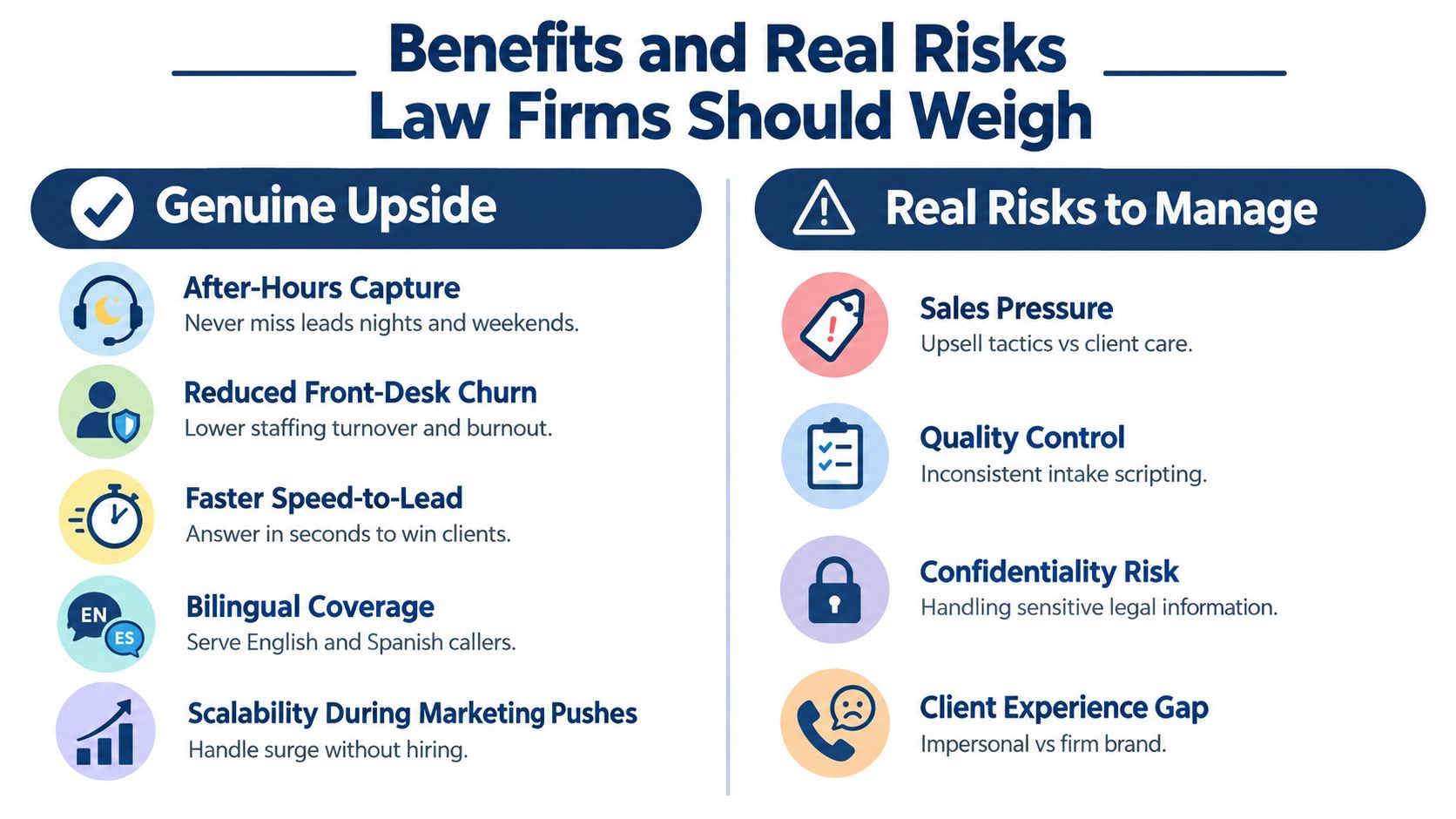
The trade-offs that actually matter
Confidentiality handling should be reviewed before any live scripts go live. If the service records calls, stores notes, or touches sensitive client details, you need clarity on security controls and consent by jurisdiction. After-hours liability is another quiet issue. If the script drifts into advice instead of intake, you've created a risk where you thought you were buying coverage.
Contract lock-in can be its own special comedy. Volume tiers sound efficient until your call pattern changes and the billing model starts punishing growth or punishing the wrong kind of growth. If the vendor can't distinguish a high-value case from routine office chatter, then your intake process is being judged by software that never had a bad Tuesday.
For firms still missing calls regularly, not answering the phone is usually the problem, not the absence of another logo in the vendor stack. The decision should come down to this, can the service reduce leakage without adding compliance drag or a second layer of chaos.
Checklist for Choosing the Right Answering Partner
A vendor demo is not a decision process. It's a sales event with a calendar invite. If you want a service that fits a law firm, score it against the way your intake team works, not the way the vendor wishes your firm worked.
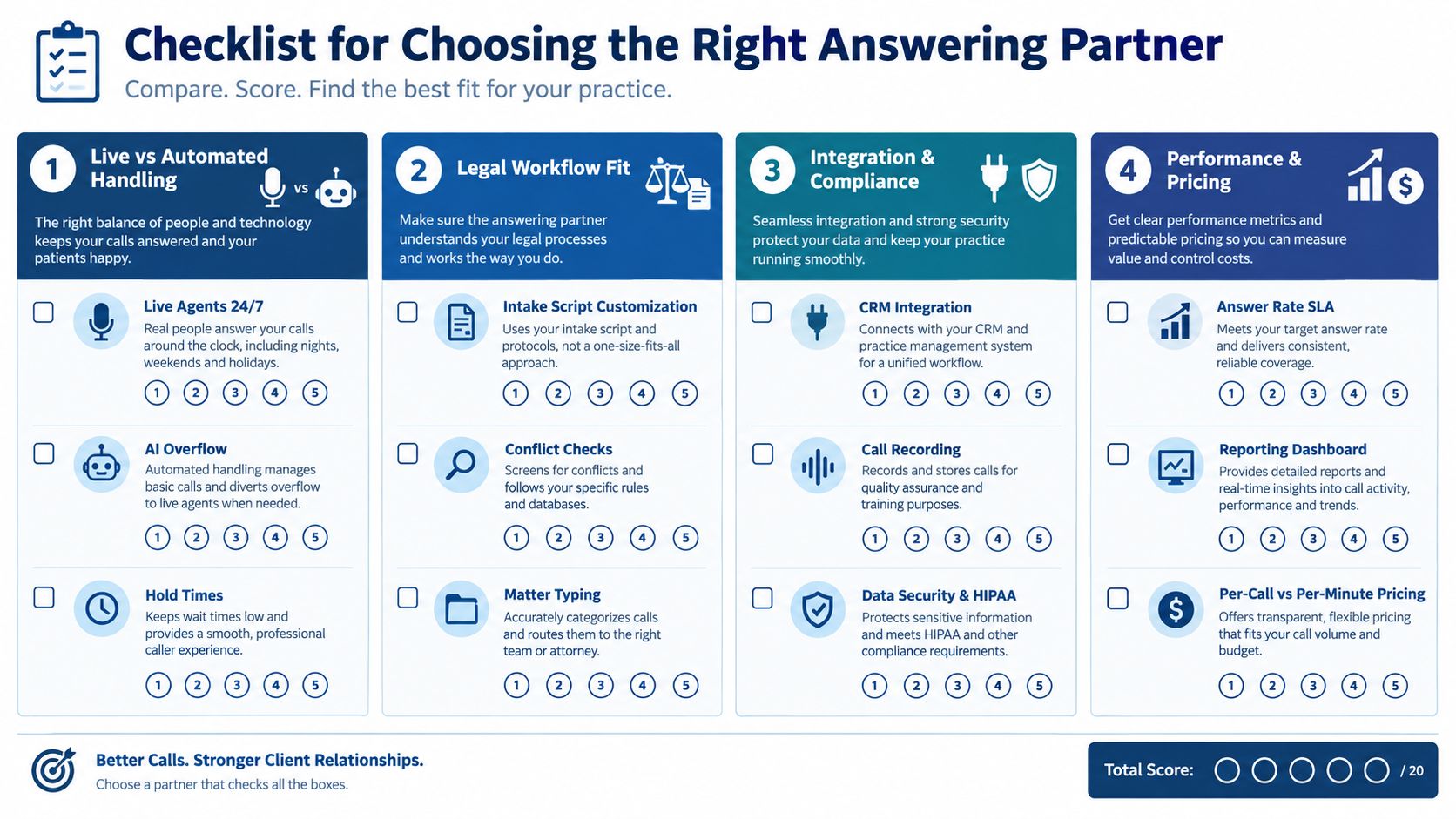
What to score before you sign
- Live vs automated handling: Ask who answers first, what happens if the caller needs a human, and whether the service ever dumps the caller into voicemail after a warm transfer fails.
- Legal workflow fit: Confirm the script can handle conflict flags, matter types, disqualifiers, and the questions your intake staff would ask.
- Integration fit: Make sure it can connect with the systems you already use, whether that's Clio, MyCase, Salesforce, or HubSpot.
- QA and accountability: Ask whether you can hear recordings, review call notes, and see how performance is checked over time.
- Contract terms: Read the termination language, data ownership terms, and any limits on after-hours liability before you let anyone near your phones.
The questions that expose weak vendors
Who answers first, and where are they located? What happens when the warm line rings out? Can you listen to live calls? How quickly can scripts change when your practice area changes? Pricing matters, but it sits behind operational fit, not ahead of it.
If a vendor can't answer those questions cleanly, you already know enough. Score at least three providers against the same checklist, because comparing one polished demo to your own frustration is how firms end up overpaying for underperformance.
Integrating an Answering Service With Your Intake Workflow
An answering service should sit inside your intake stack, not hover beside it like a polite stranger. Before go-live, map each call outcome to a CRM stage, then define the fields the operator has to capture before disconnecting. If the service cannot capture jurisdiction, a key date, conflict-check status, and preferred contact window, the handoff is still too thin.
Set the script before the phone rings
The script should mirror the way your intake paralegal qualifies matters. That means the service needs to know what you do not handle, not just what you do. It also means escalation rules should be time-based, so emergencies go to the on-call attorney and routine matters go to a follow-up path that does not depend on someone remembering to check an inbox.
For firms that want a structured follow-up cadence, lead follow-up system is the kind of operational discipline that turns a call record into a next step instead of a dead note. One more useful example is Attorney Assistant, which provides law-firm intake and staffing support with 24/7 live intake and co-managed workflows.
Measure the first month like you mean it
Sample recordings in week one. Review at least a slice of them against a simple rubric. Then track whether the service is improving speed-to-lead, consultation booking, and message resolution time, because transcripts alone don't pay rent.
- Map every outcome: New matter, existing client, vendor, wrong number.
- Load the CRM fields: Capture what your team needs, not what the vendor finds convenient.
- Test the escalation paths: After-hours emergency, routine intake, callback queue.
- Audit live calls: Correct bad habits early, before they become policy.
- Watch the first-month numbers: If response quality is flat, the “coverage” is just expensive noise.
A phone system that produces clean data and reliable handoffs can help. A system that sends chaos into a prettier inbox just preserves the problem in better lighting.
Coverage Is the Start, Not the Solution
Answering every ring only matters if the firm can do something useful with what comes in. Coverage creates raw intake, but conversion happens through follow-up speed, qualification quality, and consultation discipline. If those parts are weak, you haven't solved the revenue leak. You've given it a receptionist.
The firms that actually benefit
The firms that get value from answering services connect them to CRM-triggered texts, a clear consultation booking path, and conflict checks that happen in hours, not whenever someone gets around to it. They review recordings quarterly, refresh scripts when practice areas shift, and renegotiate billing if their call pattern no longer matches the plan they bought months ago.
That's the boring part of growth, and it works. The flashy part is buying a phone service because the demo sounded organized.
Telephone answering services are useful when they support a broader operations strategy. They are weak when they're treated as a silver bullet, because no one has ever grown a law firm by hoping a nice voice would fix poor follow-up.
Attorney Assistant helps law firms build the intake and staffing capacity that broken phone coverage is usually trying to fake. If your team is losing leads, missing callbacks, or turning attorneys into human voicemail, visit Attorney Assistant and look at how 24/7 intake and dedicated legal support can fit into the rest of your workflow.
Related Articles

Keep the Conversation Going: 8 Intake Follow-Up Tactics
Learn how to keep the conversation going with law prospects using eight practical intake and follow-up tactics, from speed-to-lead to attorney handoffs.
Preferred Method of Contact for Law Firm Intake
Discover how to capture and use the preferred method of contact in legal intake to improve conversions, ensure compliance, and streamline law firm operations.

1st Dollar Coverage in Law Firm Retainers: A Practical Guide
Understand 1st dollar coverage in legal and insurance contexts. Learn how it shapes intake, retainer strategy, firm revenue, and risk.