The Role of Communication in Client Conversion for Law Firms

TL;DR:
- Effective communication increases law firm client conversion by building trust and responsiveness. Firms that respond quickly and maintain consistent updates retain prospects, converting inquiries into signed cases more successfully.
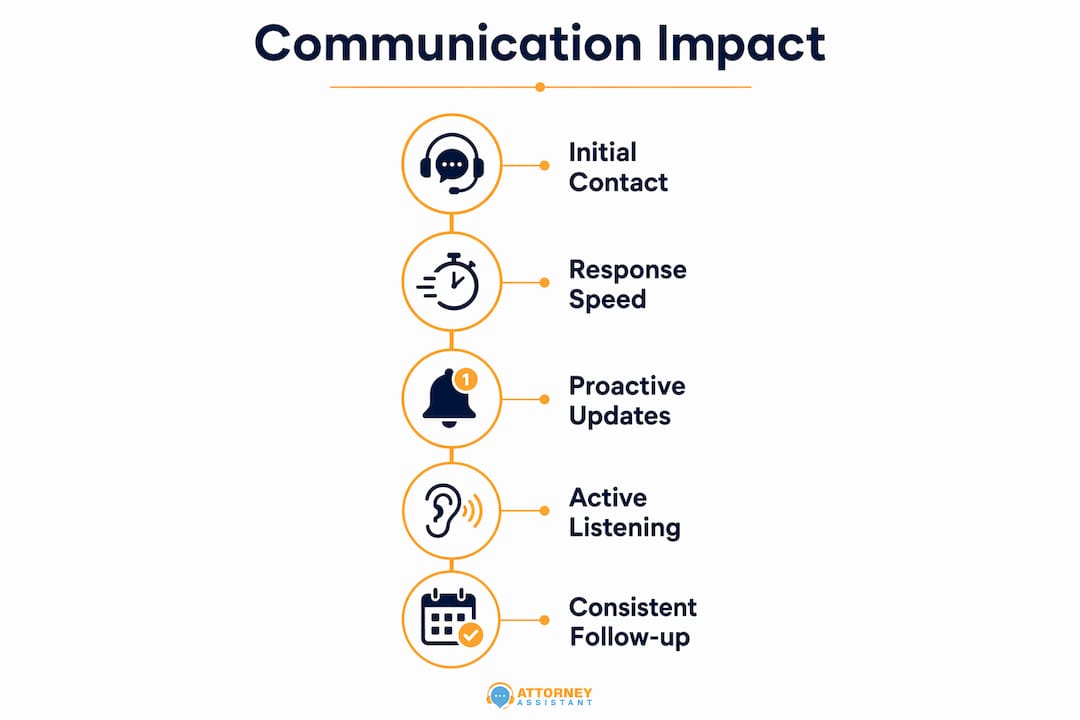
Effective communication is the single most controllable factor in law firm client conversion. Firms that respond quickly, listen carefully, and follow up consistently convert more inquiries into signed cases. Those that don’t lose revenue to firms that do. The American Bar Association identifies trust built through honesty, empathy, and respect as a precondition for clients sharing sensitive information, which is the exact information needed to close a case. Communication is not a soft skill. It is a revenue function.
How does communication directly drive client conversion rates?
Communication shapes every decision a potential client makes before signing a retainer. The prospect who calls your firm is evaluating you in real time. Your tone, your response speed, and your ability to make them feel heard all determine whether they move forward or call the next firm on their list.
Intake deficiencies most often stem from a lack of formal training, not from poor case quality. That distinction matters. A firm can have strong attorneys and still lose cases at the intake stage because the person answering the phone was never taught how to listen, qualify, or follow up. Conversion problems are frequently communication problems in disguise.
The role of communication in client conversion extends beyond the first call. Every touchpoint, from the initial inquiry to the signed retainer, either builds confidence or erodes it. Firms that treat communication as a core operational function, not an afterthought, consistently outperform those that don’t.
Why do response time and scheduled updates build trust?
Speed signals respect. Industry best practices for 2026 set the standard at same-day responses for urgent matters and no more than 48 hours for all other inquiries. Delays of 3–7 days are widely associated with client dissatisfaction and lost cases. A prospect who waits three days for a callback has likely already retained another firm.
Scheduled proactive updates serve a different but equally important function. They remove uncertainty. A client who knows they will hear from you every Tuesday does not need to call and ask for a status update. That predictability reduces anxiety, which is especially critical in family law, criminal defense, and personal injury cases where clients are already under stress.
| Communication Standard | Recommended Practice | Impact on Conversion |
|---|---|---|
| Urgent inquiry response | Same day | Prevents immediate drop-off |
| General inquiry response | Within 48 hours | Maintains prospect confidence |
| Case status updates | Scheduled, proactive | Reduces client anxiety and churn |
| Follow-up after no response | Within 24–48 hours | Recovers unconverted leads |
Pro Tip: Set a firm-wide communication calendar. Assign specific days for proactive client updates and build that cadence into your intake workflow from day one, not after a client complains.
Consistent communication tone and processes across your team also reduce refunds and make referrals natural. When every team member communicates with the same professional warmth and frequency, clients experience the firm as reliable rather than chaotic. That reliability is what generates word-of-mouth growth.
How does active listening during intake affect conversion outcomes?
First contact shapes client perception within seconds. Tone, listening, and professionalism at the initial touchpoint determine whether a prospect commits to a retainer or walks away. A rushed, transactional intake call communicates that the firm views the client as a file number, not a person with a problem that needs solving.

Intake specialists trained in active listening and empathy build rapport faster and qualify cases more effectively. The practical difference shows up in conversion rates. Trained staff outperform untrained staff in moving inquiries to signed retainers because they ask better questions, respond to emotional cues, and make the prospect feel understood before any legal discussion begins.
Key behaviors that define high-converting intake communication:
- Ask open questions. “Tell me what happened” generates more useful information than “When did the accident occur?”
- Reflect back what you hear. Restating a client’s concern in your own words confirms you were listening and builds immediate trust.
- Acknowledge emotion before moving to facts. In sensitive cases, a brief empathetic statement before the intake questions signals that the firm understands the human stakes.
- Avoid interrupting. Letting the prospect finish their thought, even when you already know the answer, demonstrates respect and patience.
- Follow up with unconverted leads. A prospect who didn’t sign on the first call is not a lost case. A structured follow-up sequence keeps the firm present while the prospect decides.
Pro Tip: Record intake calls with client consent and review them monthly. Patterns in where calls stall or where prospects disengage reveal exactly where your intake communication needs work.
Building client trust requires honesty, empathy, and respect at every touchpoint. This is especially true in practice areas where clients share sensitive personal information. The intake call is the first test of whether your firm can be trusted with that information.
What techniques build rapport and deepen client engagement?
Rapport is not charm. It is a set of repeatable behaviors that create alignment between your firm and the client. The most effective techniques are practical and trainable.
-
Mirror the client’s tone and language. A client who speaks slowly and carefully wants a measured, thoughtful response. A client who is direct and fast-paced wants efficiency. Mirroring tone lowers client effort and increases the sense that the firm understands them.
-
Balance automation with personal contact. Automated reminders and follow-up emails are efficient, but they do not replace human interaction. Over-reliance on automation disengages clients. A personal call at a critical case milestone communicates commitment in a way no automated message can.
-
Use the “looping to understand” technique. This method involves asking open questions, probing client concerns at least twice, and restating them before presenting any solution. Looping to understand shifts the conversation from a sales pitch to a shared plan. Clients who feel fully heard are far less defensive and far more likely to commit.
-
Present ideas before clients ask. Proactive account management that anticipates client needs differentiates firms in competitive markets. When you surface a relevant update or option before the client thinks to ask, you signal that you are genuinely invested in their outcome.
-
Invest in face-to-face contact where possible. A video call or in-person meeting at a key decision point communicates a level of commitment that email cannot replicate. It is especially effective for high-value cases where the client is weighing multiple firms.
These techniques are not personality traits. They are communication skills for intake staff that can be taught, practiced, and measured.
Why should law firms treat communication as a core service feature?
Communication that fails damages a firm’s reputation faster than a poor legal outcome. Delayed or sugarcoated bad news erodes credibility and reduces the likelihood that a client refers others or returns for future matters. The way a firm communicates difficult information is itself a signal of competence and integrity.
Firms that treat communication as a support function, something that happens around the legal work, consistently underperform on conversion and retention. The firms that convert at the highest rates treat every communication touchpoint as part of the service itself.
Practical behaviors that reflect this standard:
- Deliver bad news with a solution attached. Never present a problem without a path forward. Clients can handle difficult information. What they cannot handle is feeling abandoned by it.
- Use “looping to understand” before presenting options. Probe client concerns twice, restate them clearly, then present the solution. This sequence builds client ownership of the plan and reduces resistance.
- Maintain consistent tone across the team. A client who speaks to three different staff members should experience the same level of professionalism and warmth each time. Inconsistency reads as disorganization.
- Track communication gaps as operational metrics. Missed calls, delayed responses, and skipped follow-ups are revenue leaks. Measure them the same way you measure case outcomes.
The impact of communication on sales in legal services is direct and measurable. Firms that fix their communication processes convert more of the leads they already have, without spending more on marketing.
Key Takeaways
Effective communication is the primary operational lever law firms can use to increase client conversion without increasing marketing spend.
| Point | Details |
|---|---|
| Response time sets the baseline | Respond to urgent matters same day and all others within 48 hours to prevent lead drop-off. |
| Intake training drives conversion | Staff trained in active listening and empathy convert more inquiries into signed retainers. |
| Rapport is a repeatable skill | Techniques like mirroring tone and looping to understand build trust faster than personality alone. |
| Proactive updates reduce churn | Scheduled communication removes client uncertainty and signals that the firm is in control. |
| Communication is a revenue function | Treating every touchpoint as part of the service converts prospects and generates referrals. |
What I’ve learned from watching firms lose cases they should have won
Law firms spend real money on advertising and SEO, then lose the lead at the phone call. I’ve seen it repeatedly. The attorney is excellent. The case is strong. But the intake call was rushed, the follow-up never happened, and the prospect signed with a competitor two days later.
The uncomfortable truth is that most firms don’t have a lead problem. They have a communication discipline problem. And discipline is harder to fix than a marketing budget because it requires changing how people behave under pressure, not just what tools they use.
Skills training alone doesn’t solve it either. You can run an active listening workshop and see zero change in conversion if the underlying workflow still allows calls to go unanswered or follow-ups to fall through the cracks. Operational structure has to support the communication skills you’re trying to build.
The firms I’ve seen improve their conversion rates most consistently did two things. They set measurable communication standards, response times, update frequency, follow-up sequences, and they held people accountable to those standards the same way they track billable hours. Communication became a metric, not a mood.
The client psychology piece matters too. Prospects in legal trouble are scared. They are not shopping for a service the way they’d buy a car. They are looking for someone they can trust with something that could change their life. The firm that makes them feel heard in the first five minutes wins the case before the legal work even begins.
— Nicole
Attorney Assistant helps firms convert the leads they’re already getting
Most firms don’t need more leads. They need to stop losing the ones they have to slow responses, missed calls, and inconsistent follow-up.
Attorney Assistant handles intake, follow-up, and administrative workflows so your firm responds faster and converts more inquiries into signed cases. From lead follow-up services that keep prospects engaged to lead recovery that brings back contacts your firm missed, the focus is on the revenue already in your pipeline. Join a virtual webinar to see how firms are fixing their intake and communication workflows, or book a call to talk through what’s costing your firm cases right now.
FAQ
What is the role of communication in client conversion?
Communication determines whether a prospect trusts your firm enough to sign a retainer. Every touchpoint, from the first call to the follow-up, either builds or erodes that trust.
How quickly should a law firm respond to new inquiries?
Industry best practices for 2026 set the standard at same-day responses for urgent matters and within 48 hours for all other inquiries. Delays beyond that range are directly associated with lost cases.
Why does active listening improve law firm conversion rates?
Trained intake staff who use active listening build rapport faster and qualify cases more effectively, which moves more inquiries to signed retainers compared to untrained staff.
What is the “looping to understand” technique?
Looping to understand involves asking open questions, probing client concerns at least twice, and restating them before presenting any solution. It shifts the conversation from a sales pitch to a shared plan and reduces client resistance.
How does proactive communication reduce client churn?
Proactive updates and account management remove uncertainty for clients and signal that the firm is in control. Clients who receive scheduled updates are less likely to disengage or seek representation elsewhere.
Recommended
- Benefits of Responsive Client Communication for Law Firms | Attorney Assistant
- Client Communication Guide: Boost Law Firm Intake | Attorney Assistant
- Boost client intake: top communication strategies for law firms | Attorney Assistant
- Conversion optimization for lawyers: Win more clients | Attorney Assistant
Related Articles

Client retention step by step for PI law firms
Master client retention step by step for your PI law firm. Learn to convert clients into advocates and boost referrals with proven strategies.

Boost client intake: top communication strategies for law firms
Learn how PI law firms can boost client intake conversions with faster response times, multi-channel follow-up, and empathy-driven intake scripts.

10 Business Finance Course Options for Law Firms
Compare 10 business finance course options by level, format, workload, and law-firm relevance, then choose the right fit for your role and goals.