Lead Response Time for Law Firms: The 5-Minute Standard

TL;DR:
- Law firms must respond to leads within five minutes to maximize case conversion chances.
- Automated acknowledgment and instant human contact are crucial, especially after hours.
Lead response time is the elapsed time between a prospect’s first inbound action — a form submission, phone call, or chat message — and your firm’s first meaningful contact attempt. For law firms, the target is clear: instant automated acknowledgement plus first meaningful human contact within 5 minutes during business hours, and a guaranteed acknowledgement within 60–120 seconds after hours.
- Inbound received: the exact timestamp the form was submitted, the call came in, or the chat opened
- First automated acknowledgement: the SMS, email, or voicemail confirmation sent without human delay
- First meaningful contact attempt: a human call, qualifying message, or scheduled appointment
- Appointment booked or qualified: the outcome that converts a lead into a case
Pro Tip: Measure from the inbound timestamp, not from when a receptionist noticed the message. Assign ownership at the moment of capture — if no one owns the lead in the first 60 seconds, it already has a problem.
Table of Contents
- Why lead response time determines which firm gets the case
- How do you measure lead response time accurately?
- What are realistic benchmarks, and where does speed create risk?
- Why are law firms slow to respond in the first place?
- What should you do this week to cut response time?
- How should your intake architecture be designed?
- Which KPIs belong on your intake dashboard?
- What tools and roles actually move the number?
- Ready-to-use templates for first contact
- Key Takeaways
- The intake failure pattern most firms don’t see until it’s too late
- How Attorney Assistant reduces lead response time for law firms
- FAQ
Why lead response time determines which firm gets the case
Speed is not a courtesy. It is the primary variable in whether a prospect signs with you or someone else. Responding within 5 minutes increases the probability of qualifying a lead significantly compared to responding at 30 minutes. After an hour, many of those leads are effectively gone.
For personal injury and criminal defense firms, the stakes are higher than in most industries. A prospect searching for an attorney after an accident or arrest is making a fast, high-emotion decision. The first firm that reaches them — not the best-reviewed, not the cheapest — wins the case most of the time.
The math is direct: if your firm spends $20,000 per month on marketing and generates 80 leads, a response time of 5 minutes versus 60 minutes can be the difference between 24 consultations and 12 from the same spend.
Attorney Assistant’s analysis shows that many firms lose roughly 20% of incoming leads at intake — not because the marketing failed, but because the follow-up did. That is a revenue problem, not a lead-volume problem. Slow intake costs more than most firms realize until they measure it.
How do you measure lead response time accurately?
Accurate measurement requires four timestamps captured for every inbound lead:
- Inbound received — logged automatically by your web form, telephony system, or chat platform
- First automated acknowledgement — the timestamp your CRM or SMS tool records when it fires the auto-reply
- First human contact attempt — logged when a staff member dials, texts, or messages the lead
- Appointment booked or qualified — the outcome timestamp that closes the intake loop
With those four points, you can calculate the metrics that belong on your dashboard:
| Metric | What it measures | Example calculation |
|---|---|---|
| Time-to-first-contact | Gap between inbound received and first human attempt | Form at 10:00 AM, call at 10:05 AM = 5 minutes |
| Median response time | Middle value across all leads in a period | 50 leads: median = 13 minutes |
| % within 5 minutes | Share of leads reached in under 5 minutes | 25% |
| Response distribution | 50th, 75th, 90th percentile spread | P50: 13 min, P75: —, P90: 4 hrs |
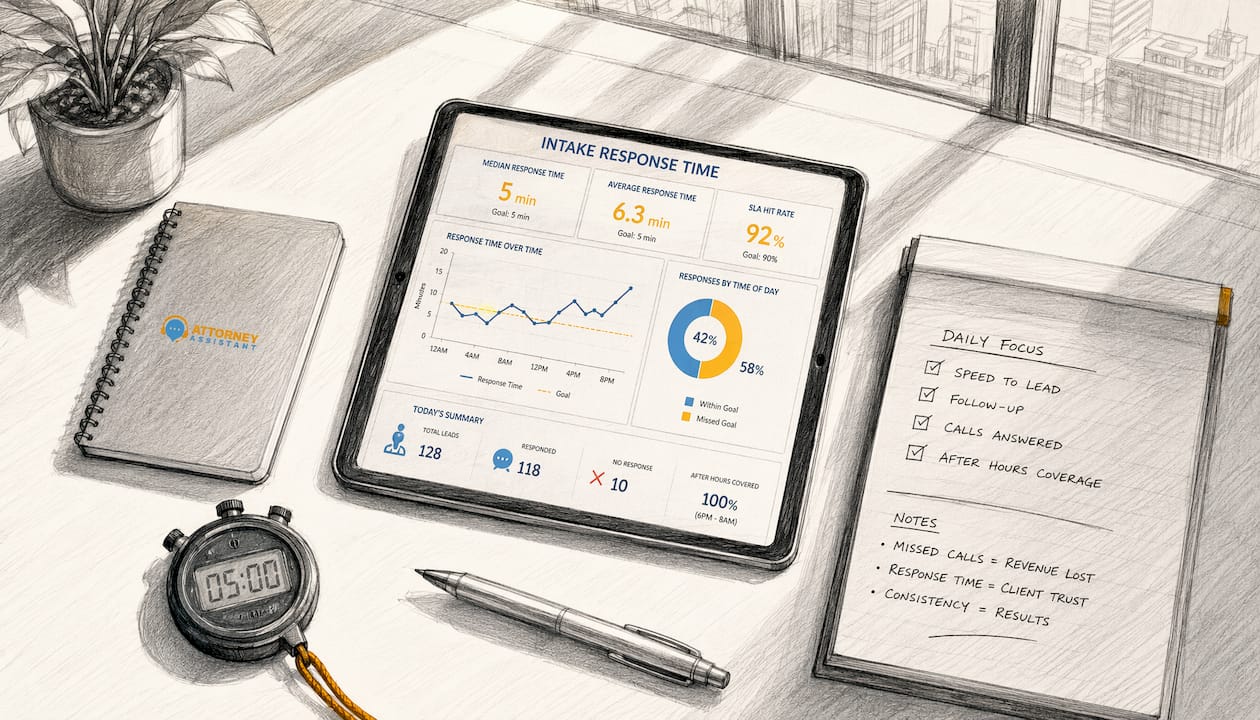
For a phone call answered live, time-to-first-contact is near zero. For a form fill, the clock runs until a human dials or a qualifying message is sent.
Pro Tip: Instrument measurement at the source — web form, telephony system, chat widget — and write timestamps directly to the CRM. Human-reported times carry bias and gaps that make your data unreliable for decisions. Intake optimization starts with clean timestamps.
What are realistic benchmarks, and where does speed create risk?
Studies have found that a minority of law firms respond to online leads in under 5 minutes, with median response times exceeding this target. Some progress is evident over recent years. Progress, but most firms still miss the window.
CallSetter’s benchmarks indicate the legal industry median response time is several hours, with top performers responding within tens of minutes. Top performers are not faster because they hired more people. They built different systems.
| Lead type | Suggested SLA target | Notes |
|---|---|---|
| Emergency / criminal defense | Under 5 minutes, live call | Prospect decision cycle is hours, not days |
| Personal injury (hot lead) | Under 13 minutes, live call | High competition; first contact wins |
| General inquiry / family law | Under 60 minutes, same day | Urgency lower but same-day minimum |
| Estate planning / low urgency | Within 24 hours | Relationship-driven; speed less critical |
Speed without qualification is a different problem. Experts recommend pairing instant acknowledgement with immediate triage so leads are reached quickly and evaluated. A 90-second call that books nothing is faster than a 5-minute call that qualifies and schedules — but it converts less. The goal is speed plus qualification, not speed alone. For context on how quick, competent first contact shapes attorney selection, disability attorney evaluations offer a useful parallel from a related practice area.
Sub-5-minute human-only response is rarely sustainable without automation or routing changes. Hybrid solutions — AI acknowledgement plus human follow-up — are how top performers hit those numbers consistently.
Why are law firms slow to respond in the first place?
The failure modes are operational, not motivational. Most firms know speed matters. The breakdown happens in the systems.
- Missed calls routing to voicemail that captures a message but books nothing — the lead sits until someone checks the queue
- No defined intake owner — leads land in a shared inbox and fall between shifts
- After-hours and weekend gaps — a lead submitted Friday at 6 PM may not get a human response until Monday morning
- CRM hygiene failures — timestamps not logged, leads not assigned, no visibility into how long each lead waited
- Answering-service hand-off delays — the service takes a message, but the hand-off to internal staff creates a second delay before anyone actually calls back
The answering-service scenario is the most common and most expensive. Capturing a message is not the same as making contact. If the service does not book directly into your calendar, the effective response time is measured from when your staff eventually calls back — not when the service picked up.
What should you do this week to cut response time?
Immediate (1 week)
- Enforce timestamp logging on every inbound channel — form, phone, chat
- Add an auto-acknowledgement SMS or email for all web form submissions
- Define a single intake owner for each shift and document the SLA in writing
Short term (1 month)
- Deploy a routing rule that sends high-intent forms to a prioritized queue
- Add SMS callback attempts as a parallel channel to phone calls
- Train intake staff on a 60-second qualification script (see templates below)
Medium term (3 months)
- Implement hybrid automation: AI-first acknowledgement plus human follow-up for all after-hours leads
- Integrate telephony with your CRM so timestamps write automatically at capture
- Run A/B tests on acknowledgement message copy to improve response rates
Priority order: SLA definition and ownership first. Automated acknowledgements second. Staffing and integration changes third. Firms that skip the first two and jump to hiring rarely fix the underlying problem.
Pro Tip: Before adding any tool, audit your current median response time for one week. You cannot improve what you have not measured. Improving response time starts with a baseline, not a software purchase.
How should your intake architecture be designed?
A reliable intake flow has four stages: capture, instant acknowledgement, triage, and booking.
- Capture: web form, phone, or chat triggers an immediate CRM entry with a timestamp
- Instant acknowledgement: automated SMS or email fires within 60 seconds, confirming receipt and offering options
- AI or human triage: the lead is evaluated for urgency and practice-area fit before routing
- Calendar booking or specialist handoff: high-priority leads go to live intake and appointment booking; general inquiries get a self-schedule link or scheduled callback
Routing matters. A personal injury lead with a recent accident date goes to live intake immediately. A general estate planning inquiry gets a same-day scheduled callback. Treating every lead identically wastes your fastest resources on low-urgency contacts and leaves hot leads waiting.
Required integrations: telephony plus CRM plus calendar. Calendar visibility at triage is what allows the intake specialist to book the appointment during the first call rather than promising a callback. That single change eliminates one full hand-off from the process.
Pro Tip: Book the first appointment during the first contact whenever possible. Every hand-off is a drop risk. Intake-to-onboarding conversion improves when the prospect leaves the first interaction with a confirmed time on the calendar.
Which KPIs belong on your intake dashboard?
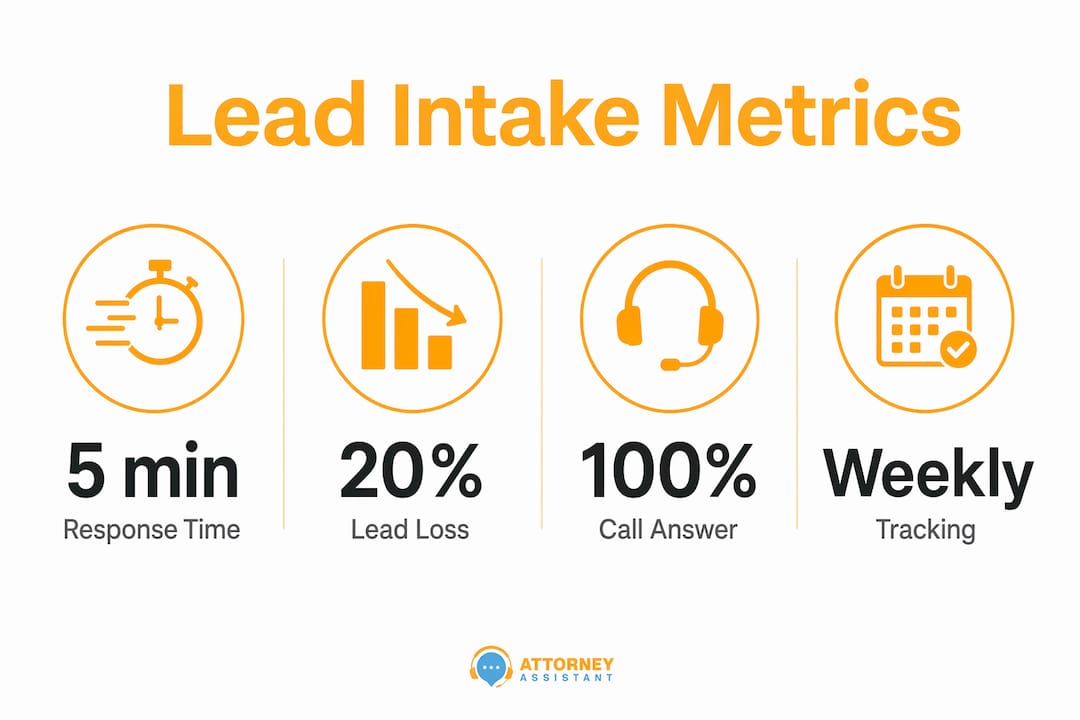
Core KPIs to track:
- Median time-to-first-contact (target: under 13 minutes; top performers under 18 minutes)
- % of leads contacted within 5 minutes (industry top quartile: 25%)
- % of leads acknowledged instantly (automated; target: 100%)
- Conversion rate from first contact to signed case
- Response distribution at P50, P75, and P90
Reporting cadence:
- Daily: % acknowledged instantly — flags same-day coverage gaps
- Weekly: median time-to-first-contact — catches drift before it becomes a trend
- Monthly: full distribution plus revenue-at-risk analysis based on leads that missed the SLA
Action triggers: if % within 5 minutes drops below your target, escalate to the intake manager the same day. If median response time increases by more than 20% month-over-month, run a root-cause analysis before adding headcount.
What tools and roles actually move the number?
Tool categories that matter:
- Telephony with instant-answer routing and automatic CRM logging
- CRM with timestamping, lead assignment workflows, and SLA alerts
- Live chat or AI chat for instant qualification on the website
- Appointment-scheduling integrations with two-way calendar sync
- SMS outreach tools for parallel contact attempts
Role definitions:
- Intake specialist: first human contact, qualification, and appointment booking
- Intake manager: owns the SLA, reviews daily metrics, escalates misses
- After-hours coordinator: covers nights and weekends, either live or via AI-plus-human hybrid
- Operations lead: owns integrations, CRM hygiene, and timestamp accuracy
Prioritize tools that write timestamps to the CRM at the moment of capture. A tool that requires manual logging will produce incomplete data within weeks. The intake specialist role is the human anchor of the system — the tools support it, not the other way around. For additional context on how first-contact quality shapes client decisions, qualities of effective legal representation are worth reviewing alongside your qualification scripts.
Ready-to-use templates for first contact
SMS auto-acknowledgement (fires within 60 seconds of form submission): Email auto-acknowledgement (form submission): 30–60 second first-call qualification script: Voicemail for missed live calls:
Key Takeaways
Law firms that respond within 5 minutes, pair speed with immediate qualification, and track median response time weekly convert significantly more leads into signed cases from the same marketing spend.
| Point | Details |
|---|---|
| Define lead response time correctly | Measure from the inbound timestamp to first meaningful human contact, not from when staff noticed the message. |
| The 5-minute target is the standard | 25% of law firms hit sub-5-minute response; the industry median is 13 minutes — the gap is an operational systems difference. |
| Speed requires qualification | Instant acknowledgement plus triage converts better than raw speed with no qualification step. |
| Track three core metrics | Median time-to-first-contact, % within 5 minutes, and % acknowledged instantly belong on every intake dashboard. |
| Attorney Assistant closes the gap | Attorney Assistant handles 24/7 intake coverage, SLA enforcement, and hybrid AI-plus-human follow-up so firms stop losing leads they already paid for. |
The intake failure pattern most firms don’t see until it’s too late
Most firms that come to Attorney Assistant are not short on leads. They are short on captured leads. The pattern is almost always the same: a call goes to voicemail, a form sits in an inbox, a weekend passes with no coverage. By Monday, the prospect has already signed somewhere else.
The fix is not hiring more people. It is building the system before the leads arrive. That means defined ownership, automated acknowledgements, CRM timestamps at capture, and a qualification step that happens in the first contact, not the third. Firms that build this architecture stop competing on speed and start winning on it.
If you are not sure where your firm stands, the first step is measuring your current median response time for one week. The number is usually worse than expected, and it points directly to where the fix needs to start.
How Attorney Assistant reduces lead response time for law firms
Attorney Assistant handles the intake work that most firms know they need but never get around to fixing. That includes 24/7 phone and reception coverage, hybrid AI-plus-human acknowledgement for after-hours leads, SLA enforcement, calendar-based appointment booking during the first contact, and CRM hygiene so your timestamps are accurate and your reporting is real.
Firms working with Attorney Assistant stop losing cases to slow follow-up and missed calls. The lead follow-up service is built specifically for law firms that want faster response without rebuilding their internal team from scratch. If you want to see how it works for your practice, book a call or join the next virtual webinar to walk through the intake audit process with the Attorney Assistant team.
FAQ
What is lead response time for a law firm?
Lead response time is the elapsed time between a prospect’s inbound action (form, call, or chat) and the firm’s first meaningful contact attempt. For law firms, the target is instant automated acknowledgement plus human contact within 5 minutes during business hours.
How does slow response time affect case conversion?
Responding within 5 minutes increases lead qualification probability by approximately 21 times compared to a 30-minute response. For personal injury and criminal defense firms, a delay of even one hour can mean the prospect has already signed with a competitor.
What is a realistic lead response time benchmark for law firms?
Hennessey Digital’s 2025 study found a median response time of 13 minutes among sampled firms, with 25% responding in under 5 minutes. The legal industry overall lags most verticals significantly.
What metrics should law firms track for intake response?
Track median time-to-first-contact, percentage of leads contacted within 5 minutes, percentage acknowledged instantly, and conversion rate from first contact to signed case. Review median weekly and run a full distribution analysis monthly.
Can Attorney Assistant help a firm hit the 5-minute standard?
Attorney Assistant provides 24/7 intake coverage, automated acknowledgements, and SLA-enforced follow-up so firms can hit sub-5-minute response without relying on internal staff to be available around the clock.
Recommended
Related Articles

Fear of Talking on Phone: 7 Practical Confidence Tips
Overcome fear of talking on phone with practical scripts, role-play, exposure exercises, and intake tools built for legal teams.

Appointment Setting Online: A Law Firm Guide
Master appointment setting online for law firms with proven strategies that turn leads into booked consultations and grow your practice.
Medical Records Request: A Practical Guide for Law Firms
Run a clean medical records request with HIPAA-compliant steps, sample language, timelines, fees, and follow-up tactics built for law firm operations.