What Is Legal Operations Efficiency for Law Firms

TL;DR:
- Legal operations efficiency involves systematically optimizing workflows, technology, and resources to reduce cycle times and improve output.
- It relies on standardized processes, consistent matter management, integrated platforms, data-driven reporting, and clear ownership to prevent bottlenecks.
Legal operations efficiency is defined as the systematic optimization of workflows, resources, and technology within a legal team to reduce cycle times, eliminate waste, and increase the volume of quality work delivered per attorney hour. Legal teams spend about 41% of their time on non-strategic, administrative tasks. That figure represents a direct drag on case throughput and client satisfaction. For practice managers and legal professionals, understanding what is legal operations efficiency means recognizing that the problem is rarely a shortage of talent. It is a shortage of operational discipline. Tools like Lawcadia, ClearContract, and AI-powered contract platforms are redefining what a well-run legal department looks like in 2026.
What is legal operations efficiency and its core components?
Legal operations efficiency rests on six interconnected components. Each one builds on the last, and weakness in any single area creates bottlenecks that ripple across the entire department.
- Standardized intake processes. Every matter request should follow a defined path with clear triage criteria and an assigned owner. Without this, attorneys spend time clarifying requests that should have been structured at the point of submission.
- Matter management. Ownership, status tracking, and audit trails must be consistent across all active matters. Inconsistent categorization makes reporting unreliable and accountability impossible.
- Financial and spend management. Matter-level budgeting and outside counsel billing guidelines prevent cost overruns before they occur. Preferred counsel panels reduce rate variance and improve predictability.
- Integrated technology platforms. Document management, workflow automation, and spend tracking work best when they live in a single environment. Fragmented tools create data silos and reduce adoption.
- Data-driven reporting. Metrics like contract turnaround time, self-service rates, and matter cycle time give leadership a factual basis for resource decisions.
- Governance and clear ownership. Every legal ops function needs a named owner. Without assigned accountability, adoption stalls and benefits are lost.
Pro Tip: Before investing in any new technology, map your current intake and matter tracking processes on paper. If you cannot describe the current state clearly, no software will fix it.
These components define legal process efficiency in practice. They are not aspirational. They are the minimum operating standard for a department that wants to perform at a high level.

How does AI and technology enhance legal operations efficiency?
Technology is the multiplier. It does not replace operational discipline. It amplifies whatever discipline already exists.
The most cited example of AI impact in legal work is research time. AI reduces legal research from 17 to 28 hours down to 3 to 5.5 hours per task. That is an 80% reduction in one of the most time-intensive activities in legal practice. The time recovered can be redirected to client-facing work, complex analysis, or case strategy.
Beyond research, AI supports legal workflow optimization in four specific areas:
- Contract intake and metadata extraction. AI agents read incoming contracts, extract key terms, flag deviations from standard positions, and route documents to the correct reviewer. This eliminates manual triage for high-volume contract queues.
- Invoice review. Automated billing guideline enforcement catches non-compliant line items before they reach approval. This reduces outside counsel spend without requiring manual line-by-line review.
- Low-risk contract drafting. AI-assisted drafting tools generate first drafts from approved templates, reducing turnaround time on NDAs, vendor agreements, and other routine documents.
- Unified contract lifecycle management (CLM). Platforms that centralize drafting, negotiation, redlining, and approval eliminate version control problems and reduce approval cycle times.
| Technology Area | Primary Benefit | Risk Without It |
|---|---|---|
| AI legal research | 80% time reduction per task | Attorneys tied to low-value research |
| Automated invoice review | Spend compliance at scale | Billing guideline violations go unchecked |
| CLM platforms | Single source of contract truth | Version conflicts and approval delays |
| AI intake agents | Faster triage and routing | Bottlenecks at the intake stage |
Effective AI implementations apply a governance-first strategy, prioritizing high-volume, repeatable tasks while keeping human judgment in place for legal decisions. This means AI handles the volume and humans handle the complexity. Matching technology to the maturity level of the team is the deciding factor between a tool that gets used and one that gets abandoned.
Pro Tip: Start AI adoption with one high-volume, low-risk task. Contract metadata extraction or invoice review are ideal starting points because the output is verifiable and the downside of an error is manageable.
You can also explore AI-driven admin automation examples that legal teams are deploying right now to reduce research time and improve throughput.
Common challenges in achieving legal operations efficiency
Most legal departments do not fail because of bad intentions. They fail because they skip steps.
Introducing automation before standardizing processes leads to scaled chaos. If intake is inconsistent before automation, it becomes inconsistently automated. The errors multiply faster, and they become harder to trace. This is the single most common reason legal ops initiatives stall after an initial technology investment.
Other recurring challenges include:
- Tool fatigue. Legal teams that adopt multiple point solutions end up managing software instead of managing legal work. Platform consolidation and embedding rules in playbooks outperform bespoke, complex workflows in both adoption and efficiency.
- Poor data hygiene. Inconsistent matter categorization corrupts reporting. When categories shift between matters or attorneys, trend data becomes meaningless and leadership loses confidence in the numbers.
- Scope definition failures. Without a clear policy on what goes through formal legal review versus self-service, attorneys become a bottleneck for requests that do not require their involvement.
- Governance gaps. Technology without ownership degrades. If no one is accountable for a platform’s data quality or adoption, both will decline within months of launch.
The fix for most of these challenges is the same: fix intake triage first, centralize policies in a searchable location, and assign a named owner to every operational function. Centralized, searchable policy storage directly increases compliance because people follow policies they can actually find.
Pro Tip: Run a quarterly data hygiene audit on your matter management system. Check for uncategorized matters, missing owners, and stale status fields. Thirty minutes of cleanup prevents months of bad reporting.
What does a legal operations maturity model look like?
The legal operations maturity model describes the stages a legal team moves through as it builds operational capability. Understanding where your team sits on this model prevents wasted investment in tools the organization is not ready to use.
The maturity model moves from ad hoc processes through connected operating models to fully integrated and automated platforms. Each stage has specific prerequisites.
| Maturity Stage | Characteristics | Priority Action |
|---|---|---|
| Ad hoc | Requests arrive informally, no tracking, no ownership | Standardize intake with a defined form and triage criteria |
| Developing | Basic matter tracking exists but is inconsistently used | Enforce categorization standards and assign matter owners |
| Consistent | Processes are documented and followed; data is reliable | Consolidate technology platforms and build reporting dashboards |
| Optimized | Live data drives decisions; automation handles routine tasks | Deploy AI agents for high-volume, repeatable work |
Most law firms operate between the ad hoc and developing stages. That is not a criticism. It is a starting point. The maturity model’s value is that it gives practice managers a clear sequence. You do not skip from ad hoc to optimized. You build each layer before adding the next.
The final stage features integrated platforms with live data and automated workflows. Legal operations leaders at this stage function as strategic partners to firm leadership, not administrative support. They shape resource allocation, technology investment, and process design across the entire organization. That shift from cost center to strategic partner is the measurable outcome of mature legal ops.
Honest self-assessment is the most important input to this model. Teams that overestimate their maturity invest in tools they cannot use. Teams that underestimate it delay improvements that would pay off quickly.
Practical steps to improve legal operations efficiency today
Improving legal department performance does not require a multi-year transformation program. Several high-impact changes can be made within weeks.
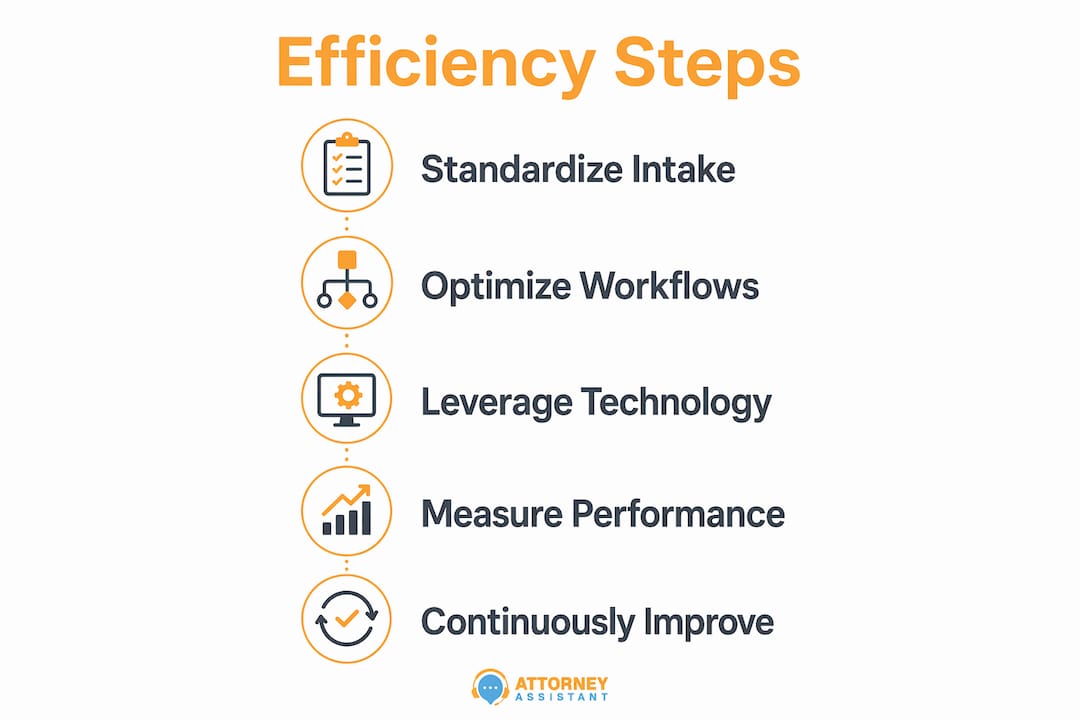
- Standardize intake immediately. Build a single intake form with required fields for matter type, requestor, deadline, and priority. Assign a triage owner who routes requests within 24 hours. This one change reduces attorney interruptions and clarification cycles.
- Implement matter-level tracking. Choose consistent categories and enforce them. Every matter needs an owner, a status, and a next action. If your current system cannot support this, a shared spreadsheet is better than no tracking at all while you evaluate platforms.
- Enforce billing guidelines with outside counsel. Send written billing guidelines to all outside counsel and require acknowledgment. Audit invoices quarterly against those guidelines. Firms that do this consistently reduce outside counsel spend without renegotiating rates.
- Consolidate your technology stack. Identify tools that duplicate functions and eliminate the lower-adoption option. One platform used well outperforms three platforms used poorly.
- Define two or three core metrics and report them monthly. Contract turnaround time, intake response time, and self-service rate are strong starting points. Metrics create accountability and surface problems before they become crises.
- Deploy AI for metadata extraction on incoming contracts. This is the lowest-risk, highest-return AI application for most legal teams. It reduces manual review time and improves data completeness without requiring human judgment to be replaced.
Pro Tip: Track intake response time as your first metric. The gap between when a request arrives and when it gets acknowledged is where most operational failures begin. Closing that gap improves both attorney efficiency and client experience simultaneously.
For a deeper look at how automating legal intake drives conversion and reduces rework, the practical applications are directly transferable to law firm practice management.
Key takeaways
Legal operations efficiency requires standardized intake, consistent matter tracking, and technology matched to team maturity before automation can deliver measurable results.
| Point | Details |
|---|---|
| Define efficiency before investing | Map current intake and matter tracking before selecting any technology platform. |
| AI multiplies existing discipline | AI reduces legal research time by roughly 80%, but only works when underlying processes are consistent. |
| Maturity model guides sequencing | Teams must standardize before automating; skipping stages leads to scaled operational failures. |
| Governance determines adoption | Every legal ops function needs a named owner or technology investment will stall. |
| Metrics create accountability | Track contract turnaround time and intake response time as the first two performance indicators. |
Why legal operations efficiency is the real competitive edge
I have spent years watching law firms invest in technology and get disappointing results. The pattern is almost always the same. The firm buys a platform, runs a training session, and then watches adoption drop to near zero within six months. The technology was not the problem. The sequence was.
What I have found is that legal operations efficiency is not a technology question. It is a discipline question. The firms that improve fastest are the ones that fix their intake process before they touch a single software setting. They assign ownership before they build dashboards. They define what “done” looks like for a matter before they automate the workflow.
The maturity model is not an abstract concept. It is a practical sequence. When I see a firm struggling with reporting credibility, the root cause is almost always inconsistent matter categorization, not a bad reporting tool. When I see attorneys overwhelmed by requests, the root cause is almost always missing triage criteria, not too many clients.
Legal ops has evolved from a back-office function to a strategic driver of firm performance. That evolution is real, but it does not happen automatically. It happens when practice managers treat operational discipline as a core competency, not an afterthought. The firms that do this well do not just run more efficiently. They convert more leads, retain more clients, and give their attorneys the space to do the work that actually requires a lawyer.
— Nicole
How Attorneyassistant helps fix the gaps that cost firms revenue
Most firms that struggle with legal operations efficiency are not losing ground on strategy. They are losing it on intake. Missed calls, slow follow-up, and inconsistent intake processes are where revenue leaks before a case ever gets opened. Attorneyassistant specializes in fixing exactly these gaps. The 24/7 intake service captures every lead regardless of when it arrives, and the lead recovery service re-engages prospects who fell through the cracks. If your firm is ready to close the gap between the leads you generate and the cases you sign, book a call with Attorneyassistant to talk through where the losses are happening.
FAQ
What is legal operations efficiency in simple terms?
Legal operations efficiency is the practice of organizing workflows, technology, and resources within a legal team so that work moves faster, costs less, and produces more consistent outcomes. It covers everything from intake triage to contract management to outside counsel spend control.
How does AI improve legal workflow optimization?
AI reduces legal research time by roughly 80%, from 17 to 28 hours down to 3 to 5.5 hours per task, and automates high-volume repeatable work like contract metadata extraction and invoice review. The key is applying AI to tasks where the output is verifiable and human oversight remains in place for legal judgments.
What is the biggest mistake in legal operations strategy?
Introducing automation before standardizing underlying processes is the most common and costly mistake. Automating a broken intake process does not fix it. It scales the dysfunction and makes the root cause harder to identify.
How do you measure legal department performance?
The most practical starting metrics are contract turnaround time, intake response time, and self-service rate. These three indicators surface bottlenecks, measure attorney workload distribution, and track whether operational changes are producing results.
What is a legal operations maturity model?
The legal operations maturity model describes four stages of operational development: ad hoc, developing, consistent, and optimized. It guides practice managers on which improvements to prioritize at each stage so that technology investments are made only when the underlying processes are ready to support them.
Recommended
Related Articles

10 Business Finance Course Options for Law Firms
Compare 10 business finance course options by level, format, workload, and law-firm relevance, then choose the right fit for your role and goals.

10 Good VoIP App Options for Law Firms in 2026
Compare 10 good VoIP app options for small and mid-sized law firms, including security, integrations, pricing, mobile use, and desk-phone readiness.
10 Insurance Software Companies Worth Comparing
Compare 10 insurance software companies by features, use cases, trade-offs, and implementation fit for carriers, MGAs, brokers, and agencies.