Why Administrative Support Is Critical for Law Firms

TL;DR:
- Proper administrative support boosts law firm profitability by freeing attorneys from non-billable tasks and recovering over 10 hours weekly of billable time. Structured admin systems improve operational efficiency, increase client conversion, and reduce attorney burnout. Investing in administrative processes and support roles is essential before expanding attorney headcount for sustainable growth.
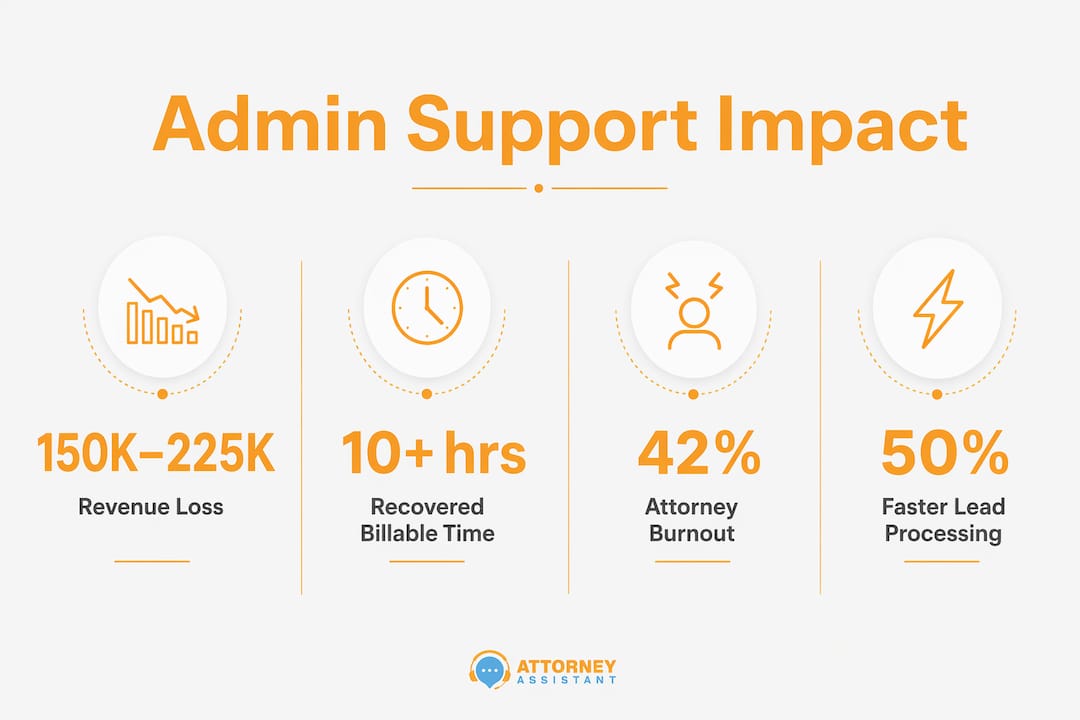
Administrative support is the operational foundation that determines whether a law firm captures or loses the revenue it has already earned. Attorneys spend 2–3 hours daily on non-billable administrative tasks. At a typical billing rate of $300 per hour, that translates to $150,000–$225,000 in annual revenue loss per attorney. Why administrative support is critical becomes clear the moment you calculate what those hours cost. Law firm owners who treat admin functions as overhead miss the real story: structured administrative support is a direct profitability lever, not a line item to minimize.
Why administrative support is critical for attorney productivity
Attorneys are the revenue engine of any law firm. When they spend their time scheduling, chasing documents, or following up on intake calls, the firm loses money on every one of those minutes. The role of administrative support is to absorb that work so attorneys can stay focused on billable legal tasks.
The numbers make the case plainly. Firms using remote case managers recover 10+ hours of billable time weekly that was previously lost to routine coordination and follow-up. At $300 per hour, ten recovered hours per week equals $156,000 in additional annual revenue per attorney. That is not a staffing expense. That is a return on investment.
Shifting administrative work to the right resources also increases billable output by 7%–12% without adding a single attorney to the payroll. This matters because the alternative, hiring more attorneys to handle more volume, does not fix the underlying problem. New attorneys face the same administrative drag as existing ones.
The benefits of admin assistance show up fastest when firms audit where attorney time actually goes. Common non-billable tasks that administrative support absorbs include:
- Scheduling consultations and court dates
- Drafting and routing routine correspondence
- Following up with leads and existing clients
- Managing document intake and file organization
- Coordinating with courts, vendors, and third parties
Pro Tip: Track attorney time in 15-minute blocks for two weeks before making any hiring decision. You will almost always find that 30%–40% of logged hours are tasks a trained admin professional could handle at a fraction of the cost.
How structured admin systems improve operational efficiency
Productivity gains at the attorney level only tell part of the story. The importance of administrative support extends to firm-wide operations: intake, billing, document management, and client communication. Each of these functions leaks revenue when left unstructured.

Centralized intake management is the clearest example. Firms that implemented dedicated intake support cut lead processing time from 45–60 minutes down to 25–30 minutes and saw a 7% increase in client conversion over six months. Understanding intake management fundamentals is the starting point for any firm that wants to convert more of the leads it already receives. Better intake tracking also drove a 46% increase in attorney fees through improved case management in the same period.
The table below shows the operational impact of structured administrative support across key firm functions.
| Function | Without structured support | With structured support |
|---|---|---|
| Lead processing time | 45–60 minutes per lead | 25–30 minutes per lead |
| Client conversion rate | Baseline | +7% over six months |
| Attorney billable output | Baseline | +7%–12% increase |
| Attorney fees collected | Baseline | +46% with case tracking |
| Weekly billable hours recovered | 0 | 10+ hours per attorney |
Billing and collections follow the same pattern. When attorneys handle their own billing follow-up, it happens inconsistently. A dedicated admin professional running a structured billing cycle produces faster collections and fewer write-offs. The same logic applies to calendar management: missed deadlines and double-booked hearings are almost always symptoms of an admin gap, not attorney error.
Pro Tip: Assign one administrative owner to each operational function, intake, billing, and scheduling, rather than splitting those tasks across multiple people with no clear accountability. Ownership drives consistency.
Document management is another area where admin support pays for itself quickly. Misplaced files, incomplete records, and version control failures all create attorney time waste and potential malpractice exposure. A structured document system with clear naming conventions and access controls eliminates most of these issues before they start.
What happens when law firms lack proper administrative support?
The consequences of poor administrative structure are predictable. Attorney burnout averages 42% across the profession, with mid-level associates showing even higher rates. Administrative overload and constant context switching between legal work and operational tasks are primary drivers of that burnout. A burned-out attorney produces less, makes more errors, and eventually leaves.
Hiring more attorneys without fixing administrative bottlenecks multiplies inefficiency. New attorneys also spend up to 63% of their time on non-billable tasks, compounding the problem rather than solving it.
The reactive client communication pattern is equally damaging. Firms without dedicated intake and follow-up staff respond to clients when they have time, not when clients need answers. Proactive case management through 24/7 intake support and digital communication portals raises client satisfaction and reduces the burnout that comes from constant interruption. Firms that make this shift stop losing clients to competitors who simply respond faster.
Cost structure is the third pressure point. Staffing costs for support personnel rose over 6% annually, and fully loaded paralegal costs now run $85,000–$92,000 per year. Firms that manage overhead at 40%–45% use scalable support models, including outsourcing and virtual assistants, rather than adding full-time headcount for every administrative need. The firms that struggle are the ones that add attorneys to solve volume problems without addressing the operational gaps underneath.
The common pitfalls that signal an administrative support failure include:
- Attorneys personally handling intake calls and follow-up emails
- No defined process for lead routing or response time standards
- Billing cycles that depend on attorney memory rather than system triggers
- Client complaints about slow responses or missed callbacks
- High staff turnover driven by unclear roles and overloaded workflows
Practical steps to build effective administrative support
Building an effective administrative support model starts with measurement. Many firms carry 30%–40% excess administrative capacity that is misallocated, meaning attorneys do work that should go to lower-cost staff, and lower-cost staff handle tasks that require no specialized skill at all. Fixing this requires a clear picture of who does what and at what cost.
A practical implementation sequence looks like this:
- Audit attorney time logs. Identify every recurring non-billable task and categorize it by skill level required.
- Map tasks to the right resource. Assign routine work to administrative staff, complex coordination to case managers, and legal analysis to attorneys.
- Hire or contract the right support. Virtual legal assistants handle scheduling, correspondence, and document management at a lower cost than in-house hires.
- Define response time standards. Set clear SLAs for lead follow-up, client callbacks, and document turnaround. Measure them weekly.
- Build accountability into the system. Assign one owner per function. Review performance metrics monthly, not annually.
Technology supports this model but does not replace it. Practice management platforms, intake software, and client portals all improve throughput when paired with trained administrative staff who follow consistent processes. Technology without process produces digital chaos instead of paper chaos.
Law firm efficiency gains from virtual assistants are well documented, but the firms that see the best results treat virtual support as a structured operational role, not a task dump. Clear job descriptions, defined workflows, and regular check-ins produce consistent output. Vague assignments produce inconsistent results.
Pro Tip: Before transitioning to a new administrative model, run a two-week parallel period where both the old and new processes operate simultaneously. This surfaces gaps before they affect clients and gives staff time to adapt without pressure.
Administrative support best practices also include building client communication into the admin function from day one. An intake specialist who owns the first 72 hours of every client relationship sets the tone for the entire case. Firms that delegate this role to whoever is available produce inconsistent first impressions and lose signed cases to competitors who respond within the hour.
Key Takeaways
Administrative support is the most direct lever law firms have for increasing billable revenue without adding attorney headcount.
| Point | Details |
|---|---|
| Revenue loss from admin overload | Attorneys lose $150,000–$225,000 annually per attorney to non-billable admin tasks. |
| Billable hours recovered | Remote case managers recover 10+ hours of billable time weekly per attorney. |
| Intake efficiency gains | Structured intake cuts lead processing time nearly in half and raises conversion by 7%. |
| Burnout risk without support | Attorney burnout averages 42%, driven largely by administrative overload and context switching. |
| Scalable support models | Firms managing overhead at 40%–45% use outsourcing and virtual assistants instead of full-time hires. |
The operational truth most firm owners learn too late
Law firm owners tend to frame administrative support as a cost they manage rather than a system they build. I have seen this pattern consistently: a firm invests in marketing, generates more leads, and then watches conversion rates stay flat because the intake process cannot handle the volume. The problem was never lead generation. It was operations.
The cultural shift required here is real. Attorneys are trained to believe that doing the work themselves is the safest path. That instinct makes sense in legal analysis. It destroys profitability in operations. The firms that grow sustainably are the ones where attorneys trust their administrative systems enough to stay out of them.
The future of law firm operations points toward more specialization, not less. Intake specialists, remote case managers, and virtual assistants are not temporary fixes. They are the operational model that high-performing firms are building now. Firms that wait until they are overwhelmed to address administrative gaps will spend twice as much fixing the damage as they would have spent building the system correctly from the start.
Fix the operations before you expand the headcount. That sequence matters more than almost any other decision a firm owner makes.
— Nicole
How Attorney Assistant helps firms stop losing revenue
Law firms that struggle with missed calls, slow follow-up, and inconsistent intake are not facing a lead problem. They are facing an operations problem. Attorney Assistant handles the administrative workflows that cause revenue to leak: lead follow-up, client communication, and intake management.
The lead follow-up service from Attorney Assistant addresses the most common point of revenue loss: the gap between a lead arriving and an attorney engaging. Firms that close that gap convert more cases from the same marketing spend. Attorney Assistant also offers a free virtual webinar that walks firm owners through the operational changes that produce the fastest results. If you want to assess where your firm is leaking revenue, booking a call is the right next step.
FAQ
Why does administrative support directly affect law firm revenue?
Administrative support removes non-billable tasks from attorneys, recovering hours that can be billed at $300 or more per hour. Firms with structured admin systems increase billable output by 7%–12% without adding attorneys.
How many hours do attorneys lose to admin tasks each week?
Attorneys lose 2–3 hours daily to non-billable administrative work. Remote case managers recover 10+ hours of that time weekly, returning it to billable legal work.
What is the role of administrative support in client intake?
Dedicated intake support cuts lead processing time nearly in half and raises client conversion rates. A structured intake process also improves case tracking, which correlates with higher attorney fees collected.
How does admin support reduce attorney burnout?
Attorney burnout averages 42%, with administrative overload identified as a primary driver. Shifting routine tasks to trained administrative staff reduces context switching and lets attorneys focus on legal work.
Should law firms hire more attorneys or invest in administrative support first?
Firms should fix administrative bottlenecks before adding attorneys. New attorneys face the same non-billable task burden as existing ones, spending up to 63% of their time on admin work without a supporting operational structure.
Recommended
Related Articles

Fear of Talking on Phone: 7 Practical Confidence Tips
Overcome fear of talking on phone with practical scripts, role-play, exposure exercises, and intake tools built for legal teams.

Appointment Setting Online: A Law Firm Guide
Master appointment setting online for law firms with proven strategies that turn leads into booked consultations and grow your practice.

Medical Records Request: A Practical Guide for Law Firms
Run a clean medical records request with HIPAA-compliant steps, sample language, timelines, fees, and follow-up tactics built for law firm operations.