How admin assistants power personal injury law firms

TL;DR:
- Most personal injury law firms waste potential revenue due to undertrained or overwhelmed administrative assistants who manage intake and workflows poorly. Effective support from well-trained assistants significantly improves client contact, case routing, and conversion rates, impacting overall firm growth. Investing in admin talent and integrating automation tools unlocks higher efficiency, better client experiences, and substantial financial gains.
Most personal injury law firms are sitting on a gold mine of potential revenue they never collect. Not because they lack great attorneys or a compelling value proposition, but because the people answering the phones, routing calls, and managing intake workflows are either undertrained, overwhelmed, or missing entirely. Administrative assistants in personal injury practices are far more than clerks who sort mail and schedule meetings. They are the difference between a signed retainer and a caller who hangs up and dials your competitor.
Table of Contents
- Why administrative assistants are a law firm’s frontline advantage
- Key responsibilities: Intake triage, lead conversion, and beyond
- Workflow integration: How admin support supercharges case intake and routing
- Operational impact: Efficiency gains and more converted leads
- The hidden ROI of investing in admin talent: What most firms miss
- Unlock more leads and smoother intakes with Attorney Assistant
- Frequently asked questions
Key Takeaways
| Point | Details |
|---|---|
| Lead intake is critical | Administrative assistants optimize intake processes, ensuring no potential client gets overlooked. |
| Workflow integration boosts results | Systematic routing and escalation driven by admin support increase conversions and reduce bottlenecks. |
| Efficiency drives growth | Effective admin teams help law firms handle more cases successfully and grow their business. |
| Training matters | Continual training in intake and workflow for administrative staff brings compounding ROI to the firm. |
Why administrative assistants are a law firm’s frontline advantage
When a potential client calls your firm after a car accident, they are often scared, in pain, and unsure who to trust. The first human voice they hear shapes everything that follows. Administrative assistants are that first voice, and their ability to handle that moment with professionalism and warmth directly determines whether the call becomes a signed case or a missed opportunity.
Beyond first impressions, virtual assistant roles in law firms have expanded dramatically over the past several years. Today’s administrative assistants in personal injury practices manage high-volume call triage, route urgent inquiries to the right attorney, coordinate consultation scheduling, and process time-sensitive documents. They keep the machine running.
A personal injury workflow involves many moving parts from the moment a client first contacts the firm through investigation, negotiation, and resolution. Without someone organizing each handoff, cases stall, deadlines slip, and clients feel ignored. Administrative assistants prevent that from happening.
Here is what strong administrative support looks like on any given day in a personal injury firm:
- Answering and triaging high-volume incoming calls without letting anyone go to voicemail indefinitely
- Routing urgent calls to the correct attorney or paralegal immediately
- Logging every message and voicemail with time stamps and contact details
- Distributing intake forms to potential clients while they are still engaged
- Scanning, naming, and filing incoming documents so attorneys can access them instantly
- Scheduling consultations the same day a lead calls, not two days later
As intake triage support shows, the operational role of administrative staff in injury practices covers high-volume call handling, routing, scheduling consultations, logging voicemails and messages, distributing intake forms, and organizing incoming documents to keep cases moving.
“The administrative team is the connective tissue of any law firm. When that tissue tears, the whole operation slows down.”
Pro Tip: Train your administrative staff on intake procedures using the same scripts your intake specialists use. When everyone speaks the same language with potential clients, conversion rates rise and the client experience stays consistent from call one through case close.
Understanding the essential admin assistant skills required for this role helps you hire the right people, train them effectively, and set clear performance expectations from day one.
Key responsibilities: Intake triage, lead conversion, and beyond
Administrative assistants wear many hats in a personal injury firm. To get the most from your team, it helps to map out exactly what they handle and how those tasks connect to case outcomes.
The real-world admin assistant duties inside law firms differ significantly from what most people picture when they hear the title. This is not simple data entry or coffee runs. This is structured, high-stakes workflow management.
Here is a comparison that clarifies the differences across three common roles:
| Responsibility | Traditional receptionist | General admin assistant | Legal administrative assistant |
|---|---|---|---|
| Answer incoming calls | Yes | Sometimes | Yes, with intake protocol |
| Schedule consultations | Basic | Yes | Yes, with conflict checks |
| Initial client intake | Rarely | No | Yes, including brief intake notes |
| Document scanning and filing | Rarely | Sometimes | Yes, organized by case |
| Voicemail logging and tracking | Rarely | Sometimes | Yes, every message tracked |
| Attorney support and task routing | No | Sometimes | Yes, daily |
| Follow-up on warm leads | No | No | Yes, using defined workflows |
The distinction matters. A legal administrative assistant is not just answering the phone. They are supporting the case timeline stages from the very first contact.

For intake specifically, the process works best when it follows a consistent sequence. Documented admin duties from injury firm job descriptions confirm this: the intake role includes answering and routing high-volume calls, scheduling consultations, logging and tracking voicemails, opening and sorting mail, scanning and filing incoming documents, and performing a brief intake on potential clients.
Here is what a strong personal injury intake sequence looks like step by step:
- Call is answered within three rings by a trained administrative assistant
- Caller is greeted warmly and asked the nature of their inquiry
- If it is a potential new case, the assistant begins a brief intake using a scripted set of questions
- Key details are logged immediately: name, contact information, date of incident, type of injury
- The caller is told a specific next step, typically a scheduled consultation time
- The consultation is booked before the call ends, and a confirmation is sent
- All notes are added to the firm’s case management system within minutes of the call ending
Each step in that sequence is a handoff point. Miss one and you risk losing the lead entirely.
Pro Tip: Use your case management software to track every admin touchpoint with a timestamp. If a lead goes cold, you can trace exactly where the communication broke down and fix it fast.
Workflow integration: How admin support supercharges case intake and routing
Strong administrative support does not operate in isolation. It plugs into your firm’s broader intake and case management system. When it is done right, leads flow from first contact to scheduled consult without friction.
Integrating your administrative staff into intake automation for law firms creates an escalation and routing workflow that prevents any lead from falling into a gap. The goal is simple: every person who contacts your firm gets a response, gets logged, and gets a next step scheduled before they disengage.
Here is how a well-integrated workflow flows through the admin layer:
| Stage | Action | Who handles it | Handoff to |
|---|---|---|---|
| First contact | Call answered, brief intake begins | Admin assistant | Intake form sent |
| Lead logging | Contact info and inquiry details logged | Admin assistant | Case management system |
| Scheduling | Consultation booked and confirmed | Admin assistant | Attorney calendar |
| Document intake | Forms received, scanned, filed | Admin assistant | Attorney file |
| Follow-up | Warm lead called back if no consult scheduled | Admin assistant | Signed retainer or case closed |
Escalation and routing workflows integrated with reception and intake staff ensure that no leads stall after first contact. That is not a nice-to-have. It is the operational baseline for any firm serious about growth.
Key workflow improvements you can implement immediately include:
- Establish a 30-minute callback rule for any missed call or voicemail
- Create a shared voicemail log that is reviewed every two hours during business hours
- Use automated form distribution so intake paperwork goes out the moment a consult is scheduled
- Set calendar rules that prevent consultation slots from being double-booked or left unconfirmed
- Build a weekly lead audit so every inquiry from the previous week is accounted for
Organizing your intake team effectively starts with making sure each person knows exactly which part of the pipeline they own. Ambiguity is where leads disappear.
Automation and routing tools are powerful, but they do not replace the human judgment that a well-trained administrative assistant brings to every call. Technology handles repetition. Your admin staff handles nuance, emotion, and the moments that matter most to a frightened client.
Visit the intake process optimization resources to understand how to map your current workflow and find the gaps where leads are leaking out right now.
Operational impact: Efficiency gains and more converted leads
The downstream effects of strong administrative support are measurable and significant. When your admin team runs a clean intake process, every other part of your firm operates with less friction.
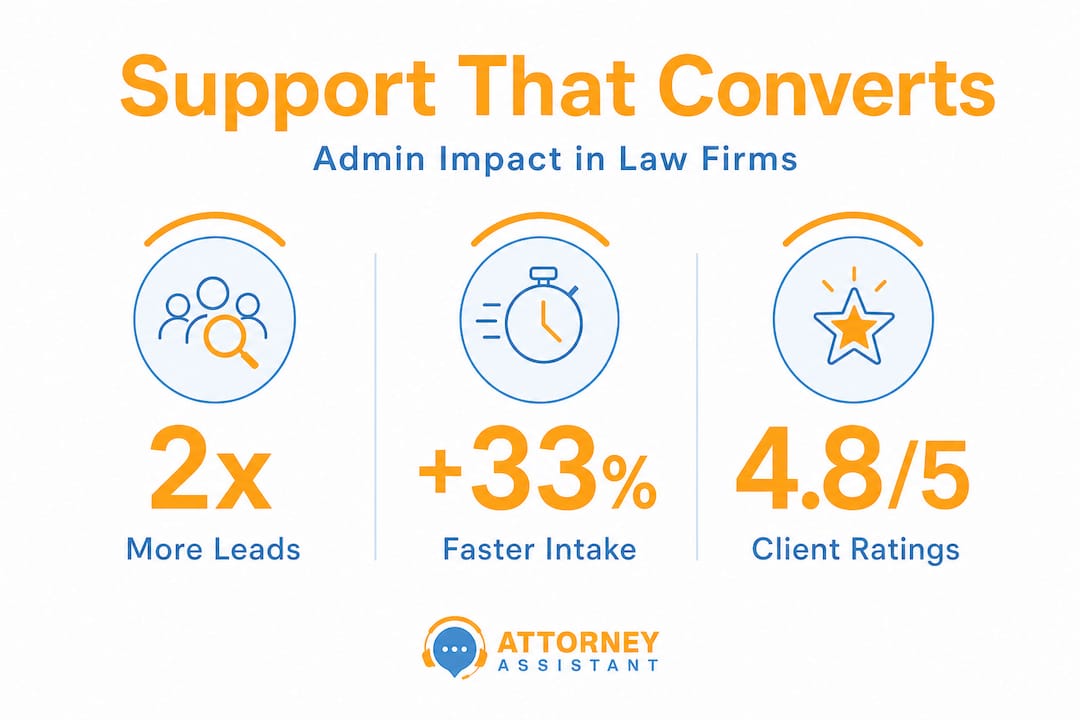
The administrative duties that enable routing and automation across injury practices are the foundation that makes higher-level work possible for your attorneys and paralegals. When documents are already scanned and organized, attorneys do not waste time hunting for paperwork. When consultations are already confirmed and calendared, no-shows drop and attorneys spend their time on billable work.
Efficiency gains from optimized admin support include:
- Faster intake response: Leads are contacted and logged within minutes instead of hours, dramatically improving conversion rates
- Organized call and message tracking: No inquiry is lost or left unanswered for longer than your defined response window
- On-time document processing: Incoming records, forms, and correspondence are processed the same day they arrive
- Fewer attorney interruptions: Administrative assistants filter and route requests so attorneys stay focused on casework
- Consistent client communication: Every client hears the same professionalism and follow-through regardless of who answers the phone
The link between operational efficiency and client satisfaction is direct. A potential client who gets a callback within 30 minutes, receives their intake forms that same day, and has a consultation confirmed before they hang up is far more likely to sign with your firm than one who waits two days for a callback.
Using an onboarding checklist for efficiency helps new administrative hires get up to speed quickly and start contributing to conversion and client satisfaction from week one.
The benefits of working with injury attorneys extend beyond legal expertise. Clients choose firms that feel organized, responsive, and trustworthy. Your administrative team is the engine behind that perception.
Most firms lose their best leads not because the lead was low quality, but because the follow-up was slow, inconsistent, or never happened at all. That is an admin workflow problem. And it is entirely fixable.
The hidden ROI of investing in admin talent: What most firms miss
Here is something most law firm consultants will not tell you: the biggest growth lever for a small to mid-sized personal injury firm is rarely marketing spend. It is the quality and training of the people managing your intake and administrative workflows.
Many firms treat administrative roles as entry-level positions with high turnover and minimal investment. They underestimate what a well-trained, well-compensated administrative assistant actually costs them when they are operating below potential. The math is not complicated. If your firm loses three potential clients per week because calls are not followed up on, and each retained case is worth an average of $8,000 in fees, that is $24,000 in weekly leakage. Every week.
Training your admin team on consultation scheduling and follow-up creates compounding gains. The first month, your team converts a few more leads. By month six, your conversion rate has climbed, your referral base has grown because clients feel well cared for, and your attorneys are handling more cases with less chaos. That is not a coincidence. That is what happens when administrative roles are taken seriously.
The costliest errors in personal injury intake are not attorney mistakes. They are intake drop-offs and missed touchpoints. A caller who goes to voicemail and never gets a callback. A lead who submits an online form and waits three days for a response. A warm prospect who books a consult and never gets a reminder. Every one of those failures happens at the administrative layer, and every one of them is preventable with the right support structure.
Audit your client intake communication strategies regularly. Look at where calls are being answered versus missed, where leads are being logged versus dropped, and where follow-up is consistent versus sporadic. The patterns will tell you exactly where to invest next.
Pro Tip: Schedule a monthly 30-minute workflow review with your administrative team. Ask them where they feel the process breaks down. They see the gaps in real time, and their input is the fastest path to fixing them.
Unlock more leads and smoother intakes with Attorney Assistant
If you are serious about converting more of the leads you are already generating, the answer starts with your intake and administrative infrastructure.
Attorney Assistant provides professional intake and administrative support services built specifically for personal injury law firms. We handle the calls you are missing, the leads you are not following up on fast enough, and the intake workflows that are creating invisible gaps in your pipeline. Our team integrates with your existing systems so nothing falls through the cracks. Whether you need full intake coverage or targeted support for your administrative workflows, we have solutions designed for firms at your exact stage of growth. Start with our intake services for law firms or explore our reception and intake support options to find the right fit for your practice.
Frequently asked questions
What are the top three daily tasks for an administrative assistant in a personal injury law firm?
The top daily tasks include answering and routing high-volume calls, scheduling client consultations, and scanning or organizing incoming documents so attorneys can access them immediately.
How do administrative assistants help improve lead conversion in law firms?
They capture lead details on the first contact, route inquiries immediately within a defined workflow, and follow up consistently so no potential client waits long enough to call a competitor.
What’s the difference between a legal receptionist and an administrative assistant?
A legal receptionist primarily handles calls and greets visitors, while an administrative assistant manages intake triage and workflow and provides broader support to attorneys across case management and documentation.
How can law firms make the most of their admin support staff?
By integrating admin staff into structured intake workflows, training them on escalation procedures, and pairing them with automation and routing tools, firms see measurable gains in lead conversion and operational efficiency.
Recommended
Related Articles

Lead qualification in law: boost case conversion and efficiency
Discover what lead qualification in law is and how it can boost your case conversion and efficiency. Optimize your firm's inquiries today!

Optimize your case intake workflow for more conversions
Boost your firm's success by optimizing your case intake workflow. Discover essential strategies to increase conversions and reduce leaks!

Convert more leads into signed cases for injury firms
Learn how to convert leads into clients for your injury firm. Boost your revenue by optimizing intake processes and following up effectively!