Lead qualification in law: boost case conversion and efficiency

TL;DR:
- Effective lead qualification filters out unsuitable inquiries, saving time and reducing ethical risk for law firms. It involves assessing practice area fit, jurisdiction, urgency, and client background before proceeding. A dedicated, structured process improves conversion rates and ensures cases align with the firm’s capabilities.
Not every call your firm receives is a case worth taking. That’s a hard truth many law firms avoid confronting, especially when inbound inquiries feel scarce or expensive to generate. But fielding every inquiry with the same level of effort is one of the fastest ways to burn out your staff, inflate your costs, and ultimately miss the clients who actually matter. Lead qualification is the structured process that separates promising cases from dead-end inquiries, and it’s the single most overlooked lever for improving your firm’s conversion rate and day-to-day efficiency.
Table of Contents
- What is lead qualification in law?
- Key factors for qualifying legal leads
- Best practices for law firm lead qualification
- Common challenges in legal lead qualification (and how to overcome them)
- Our perspective: why precision matters more than volume in legal lead qualification
- Connect lead qualification with actionable solutions
- Frequently asked questions
Key Takeaways
| Point | Details |
|---|---|
| Define lead qualification | Lead qualification in law filters potential cases, ensuring only viable inquiries advance to intake. |
| Use clear criteria | Consistently apply practice area fit, urgency, and client history to assess lead quality. |
| Implement best practices | Structured routines, scripts, and intake reviews improve qualification outcomes for law firms. |
| Overcome challenges | Address unclear criteria and inconsistent intake with training and technology for better conversion. |
| Precision over volume | Qualifying for fit, not quantity, leads to sustainable growth and satisfied clients. |
What is lead qualification in law?
In its simplest form, lead qualification means evaluating an incoming inquiry to determine whether the person’s situation fits your firm’s practice areas, resources, and ethical obligations before investing significant time in their case. It’s a filter, not a rejection machine. Done right, it helps you serve the right clients better.
Legal lead qualification is fundamentally different from how a software company or real estate agency qualifies prospects. In sales, qualification often comes down to budget, authority, need, and timeline. In law, you add layers that don’t exist elsewhere: jurisdiction, statute of limitations, conflict of interest checks, case complexity, and whether the matter is even legally actionable. A prospect might desperately want representation, but if their situation falls outside your practice area or violates ethical rules, taking that case creates more risk than revenue.
Consider lead qualification in defense practice as an example. A white collar defense attorney receives dozens of inquiries from individuals who believe they’re under investigation. Not all of them have actual exposure. Not all of them are within the attorney’s geographic jurisdiction. Without a structured qualification process, staff might spend hours on intake conversations that lead nowhere, while a genuinely viable client waits too long and chooses a competitor.
The comparison below illustrates how legal lead qualification differs from generic sales qualification:
| Dimension | Generic sales qualification | Legal lead qualification |
|---|---|---|
| Primary filter | Budget and purchase intent | Practice area fit and legal viability |
| Ethical screen | Not required | Conflict of interest and bar rules |
| Urgency driver | Sales cycle timing | Statutes of limitations and court deadlines |
| Complexity factor | Low to moderate | High: jurisdiction, facts, prior representation |
| Outcome if unqualified | Lost sale | Potential malpractice or wasted retainer |
Lead qualification in law ensures only suitable cases proceed for intake, which protects your firm from wasted hours and ethical risk alike. Think of it as your first line of defense against operational chaos.
“A strong qualification process isn’t about turning clients away. It’s about making sure every case you accept has a real chance of success and a real fit for your firm’s capabilities.”
Key factors for qualifying legal leads
Once you understand what lead qualification is, the next question is: what are you actually measuring? The answer varies by firm, but certain criteria appear consistently across high-performing practices. Understanding high-quality leads for law firms means knowing exactly which signals separate a viable prospect from a mismatched inquiry.
Here are the core factors your intake team should evaluate on every call:
- Practice area match. Does the inquiry fall within your firm’s active, competent areas of law? A personal injury firm receiving an immigration question should have a referral path ready, not a vague “we can look into it” response.
- Geographic and jurisdictional fit. Are you licensed to practice in the relevant state or jurisdiction? This is non-negotiable and often the first disqualifier.
- Urgency and deadlines. Is there a statute of limitations approaching? A case with 30 days left before a filing deadline requires a completely different response than one with two years of runway.
- Client background and history. Has the prospect worked with prior counsel? Do they have a history of firing attorneys or have unrealistic expectations? These signals matter for long-term case management.
- Financial readiness. Can the client meet your retainer requirement or fit a contingency model? Financial misalignment kills cases before they begin.
- Factual threshold. Does the initial story suggest a legally cognizable claim? Not every grievance is a lawsuit. Intake staff need basic training to spot the difference.
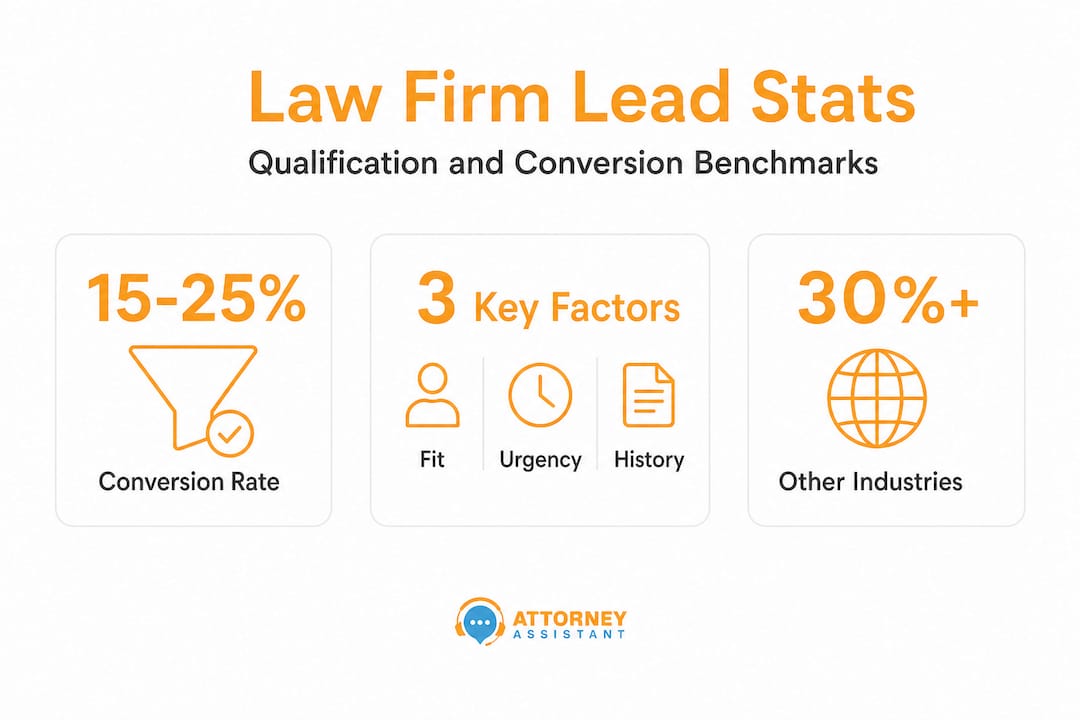
Law firms use practice area fit, urgency, and client background as key qualification signals, and research consistently confirms that firms applying these filters reduce unproductive intake time significantly.
Did you know? Law firms typically convert between 15% and 25% of their inbound leads into signed clients, compared to 30% or higher in other professional service industries. That gap exists largely because legal intake is reactive rather than structured.

| Qualification criterion | Impact on conversion | Risk if ignored |
|---|---|---|
| Practice area fit | High | Time waste and malpractice exposure |
| Urgency and deadlines | Critical | Missed filing windows |
| Client financial readiness | Moderate to high | Unpaid fees and case abandonment |
| Jurisdictional match | Critical | Ethics violations |
| Prior legal history | Moderate | Conflict of interest issues |
Pro Tip: Set minimum intake criteria in writing and review them with your intake team every quarter. Practice areas evolve, court rules change, and your team needs updated guidance to apply qualification consistently.
Best practices for law firm lead qualification
Knowing what to evaluate is one thing. Building a repeatable system that your entire team follows is another. Here’s a stepwise routine that takes a prospect from initial inquiry to case acceptance or referral:
- Capture basic information immediately. Name, contact details, nature of the inquiry, and how they found your firm. This takes under two minutes and opens the file.
- Screen for jurisdiction and practice area. Before anything else, confirm you can legally and competently handle the matter. If not, refer out immediately with a warm handoff.
- Assess urgency. Ask directly about any relevant deadlines. If a statute of limitations issue exists, flag it for an attorney review within the hour, not the next business day.
- Run a conflict check. Most practice management systems can automate this step, but it must happen before any substantive discussion of the case.
- Evaluate case strength. Your intake specialist doesn’t need to be a lawyer, but they should follow a structured checklist to determine whether the facts suggest a viable claim or defense.
- Discuss financial fit. Be transparent about your fee structure early. This prevents awkward conversations later and filters out prospects who aren’t aligned with your model.
- Document and route. Enter all findings into your intake system and assign the lead a qualification status: accept, refer, or follow up pending additional information.
Applying a defined qualification process can double your conversion rates, and the firms seeing those results aren’t doing anything magical. They’re simply being consistent where other firms are improvising.
“Process is what separates a high-converting intake from an expensive guessing game. Every step you leave undefined is a step where your team will make it up.”
The follow-up process for lead conversion is just as important as the initial screening. Many firms qualify a lead correctly but then lose the client during the gap between first contact and signed retainer. Follow-up protocols, including timing, channel, and message, need to be as structured as your intake script itself.
Best practice intake scripts should include open-ended questions that let the prospect describe their situation, followed by targeted clarifying questions that collect qualification data. Scripts aren’t about sounding robotic. They’re about making sure no critical information slips through the cracks because the intake call happened to be staffed by your newest team member.
Review actionable steps for hiring lawyers to understand what informed clients look for in the engagement process. That knowledge helps your intake team respond more effectively to high-value prospects who are also evaluating your firm while you’re evaluating them.
Pro Tip: Use a CRM or intake software to track each lead’s qualification status, last contact date, and outcome. Without visibility into these metrics, you can’t identify where your pipeline is leaking.
Common challenges in legal lead qualification (and how to overcome them)
Even firms with strong intentions run into consistent roadblocks. Recognizing these patterns is the first step toward eliminating them. Obstacles such as inconsistent intake and unclear criteria lower conversion rates, and most of these obstacles are structural, not personal.
Common challenges law firms face include:
- Unclear qualification criteria. When intake staff don’t have written standards, they improvise. One team member might pass a borderline lead through; another might reject it. Inconsistency destroys your pipeline reliability.
- Slow follow-up. Research suggests that responding to an inbound lead within five minutes makes a firm seven times more likely to connect with the prospect meaningfully. Most firms respond in hours, not minutes.
- Staff turnover. Intake is often the lowest-paid, highest-turnover role in a law firm. Every time someone new joins, qualification quality dips until they’re trained. Without documented processes, that dip lasts weeks.
- No technology support. Firms relying on sticky notes, spreadsheets, or memory to track leads are setting themselves up for losses. Leads fall through the gaps not because staff is careless but because the system has no safety net.
- Overreliance on attorneys for qualification. When an attorney has to weigh in before a lead is even screened, it creates a bottleneck. Most qualification decisions can and should happen before the attorney’s time is involved.
Solutions that work:
The fix for unclear criteria is documentation. Write your intake standards down. Make them specific. “Personal injury cases in our state with damages over $50,000” is a qualification standard. “Good cases” is not.
For slow follow-up, automate the first response. An immediate text or email acknowledging receipt of an inquiry and setting expectations for a call is infinitely better than silence.
For staff turnover, invest in a training document that new intake staff can absorb in a day. It won’t replace experience, but it prevents catastrophic misqualification in the first week.
Assigning an intake specialist for law firms to own the qualification process is one of the highest-leverage moves a growing firm can make. A dedicated specialist becomes expert at reading prospects, following the script, and escalating edge cases appropriately.
Pro Tip: Assign lead qualification to a dedicated intake specialist rather than distributing it across your support staff. Specialization drives consistency, and consistency drives conversion.
Our perspective: why precision matters more than volume in legal lead qualification
Most law firm marketing conversations orbit around the same idea: get more leads. Run more ads, post more content, rank higher on Google. And yes, visibility matters. But the firms we see growing sustainably are not the ones generating the most inquiries. They’re the ones converting the highest percentage of the inquiries they already have.
Precision in lead qualification is the competitive advantage that doesn’t show up in your ad spend. It shows up in your close rate, your average case value, and your staff’s ability to actually do meaningful work instead of fielding calls from people who were never a match to begin with.
There’s also a client experience dimension that rarely gets discussed. When a firm accepts a case that doesn’t truly fit its expertise, everyone suffers. The client gets substandard representation. The attorney is stretched thin on an unfamiliar matter. The relationship ends in disappointment or worse, a grievance. Precision qualification is an act of respect, for both the client and the firm.
“The most successful firms are relentless about qualifying for fit, not just quantity.”
Strong law firm engagement strategies are built on this foundation. Engagement only creates value when it’s directed at the right prospects. Volume without precision is just noise.
Connect lead qualification with actionable solutions
Strong qualification processes are only as good as the systems supporting them.
Attorney Assistant is built specifically for law firms that want to stop losing viable cases to missed calls, slow follow-up, and inconsistent intake. Our law firm intake tools are designed to capture, qualify, and track every inbound lead so nothing slips through the cracks. Whether you need free tools for law firms to get started or a full intake reception solution to handle your inbound volume professionally, we have options that fit firms at every stage. The leads you’re already generating deserve a system that converts them.
Frequently asked questions
What makes lead qualification different for law firms?
Law firm lead qualification requires assessing legal fit, urgency, and ethical considerations not found in typical sales qualification processes. Lead qualification in law ensures only suitable cases proceed for intake, making it a multi-layered filter rather than a simple budget or intent check.
How can a law firm optimize its lead qualification process?
By implementing structured intake routines, using technology to track lead status, and regularly updating qualification criteria. Applying a defined qualification process can double your conversion rates when applied consistently across all inbound inquiries.
What are the most common lead qualification criteria for law firms?
Practice area compatibility, urgent timelines, and the client’s financial and legal history are key criteria. Law firms use practice area fit, urgency, and client background as key qualification signals to determine which leads are worth pursuing.
Should lead qualification be handled by a dedicated intake specialist?
Yes, dedicated specialists improve consistency and conversion rates by focusing solely on lead vetting. Obstacles such as inconsistent intake and unclear criteria lower conversion rates, and specialization is the most direct solution to that problem.
Recommended
- Convert more leads into signed cases for injury firms | Attorney Assistant
- 10 Lead Conversion Strategies Attorneys Need for Higher Revenue | Attorney Assistant
- Legal intake tips to boost case conversion in 2026 | Attorney Assistant
- Law firm lead management: convert more clients in 2026 | Attorney Assistant
Related Articles

How admin assistants power personal injury law firms
Discover the crucial role of administrative assistants in personal injury law firms, shaping client experiences and driving revenue. Learn more!

Optimize your case intake workflow for more conversions
Boost your firm's success by optimizing your case intake workflow. Discover essential strategies to increase conversions and reduce leaks!

Convert more leads into signed cases for injury firms
Learn how to convert leads into clients for your injury firm. Boost your revenue by optimizing intake processes and following up effectively!