Streamline your law firm follow-up process: convert more leads

TL;DR:
- Most law firms lose clients due to poor follow-up, not lack of leads.
- Implementing prompt, automated follow-up systems significantly increases conversion rates.
- A strong follow-up culture and metrics tracking are essential for optimal results.
Most personal injury law firms are not losing cases because they lack leads. They are losing them because up to 80% of leads slip away before anyone follows up properly. That is not a marketing problem. That is a process problem. A well-designed follow-up system can be the difference between a thriving caseload and a calendar full of gaps. In this guide, you will find the tools, steps, and fixes that help small to mid-sized personal injury firms stop leaking revenue and start converting the leads they already have.
Table of Contents
- Why every lead deserves follow-up
- Key tools and requirements for an effective follow-up system
- Step-by-step guide: Building your law firm follow-up process
- Troubleshooting and optimizing your follow-up process
- Why most law firm follow-up efforts underperform
- Power your follow-up process with Attorney Assistant
- Frequently asked questions
Key Takeaways
| Point | Details |
|---|---|
| Follow-up drives conversions | Responding swiftly to every lead greatly boosts client conversion rates. |
| Automation is essential | Using the right tools can streamline your follow-up process and prevent leads from falling through. |
| Track and improve | Regularly measure and refine your process using simple metrics for best results. |
| Culture matters | Staff buy-in and a proactive mindset are key to sustained follow-up success. |
Why every lead deserves follow-up
Every missed call, every unanswered email, and every lead that goes cold represents real money walking out the door. Personal injury leads are not passive shoppers. They are people in pain, often scared, and actively comparing their options. If you do not reach them first, your competitor will.
The numbers are striking. Firms that follow up within the first hour increase conversion rates by over 50%. Wait 24 hours, and that window closes fast. Most firms wait much longer, or never follow up at all.
“The lead that goes unanswered does not just move on. It signs with someone else and funds their marketing budget.”
Here is what happens when follow-up breaks down:
- Lost cases: Potential clients sign with a competing firm that responded faster.
- Wasted marketing spend: Every dollar you spent generating that lead is gone with no return.
- Damaged reputation: Slow response signals disorganization, even to clients who eventually do hear back.
- Staff frustration: Without a clear process, your team wastes time chasing cold leads instead of converting warm ones.
Organizing your follow-up is just as important as the initial consultation. Think about it this way: you would never show up to a deposition unprepared. Your follow-up process deserves the same discipline.
Prompt, personalized contact builds trust before you even meet the client. A quick text or call that says “We received your inquiry and want to help” sets a tone of responsiveness that clients remember. Pairing that with strong client intake communication strategies and a focus on improving lead engagement creates a foundation that turns inquiries into signed retainers.
Now that we have clarified the stakes, let’s look at what you need to build a reliable follow-up system.
Key tools and requirements for an effective follow-up system
Building a follow-up process without the right tools is like trying a case without evidence. You need systems that capture leads, track interactions, and trigger the right actions at the right time.
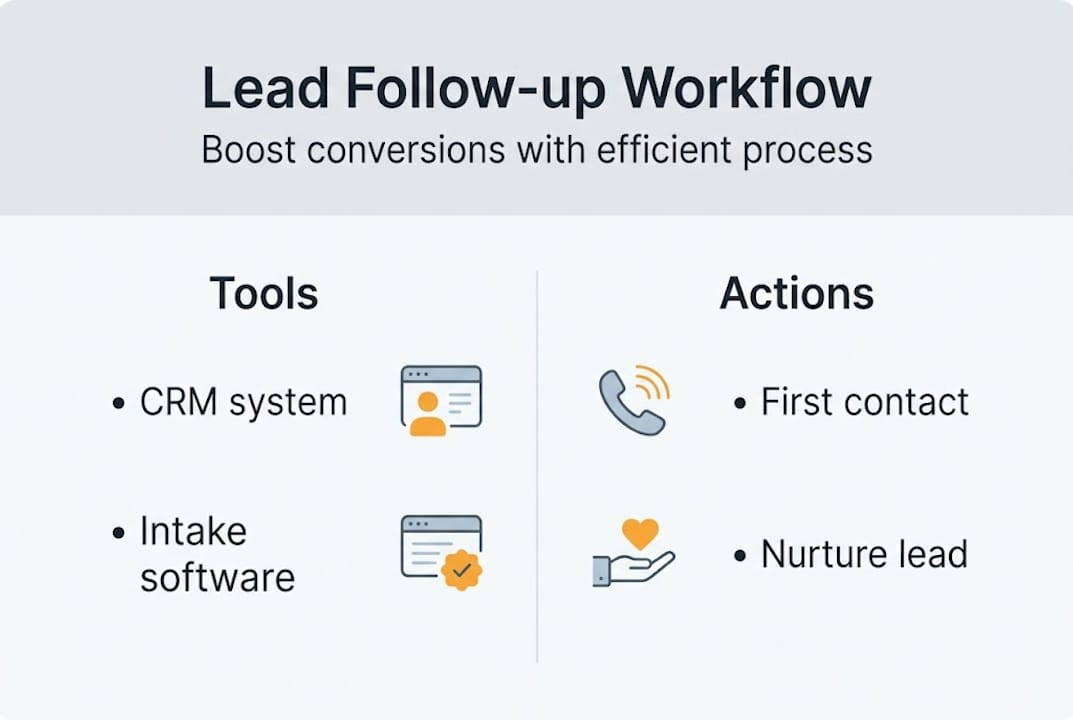
CRM and intake software are the backbone of any modern follow-up process. A good CRM logs every lead, tracks where they are in the pipeline, and alerts your team when action is needed. Intake software goes further by collecting key case details upfront, so your team is never starting from scratch.

| Tool type | Primary function | Best for |
|---|---|---|
| CRM system | Track leads and pipeline stages | Firms managing 20+ leads per month |
| Intake software | Collect case details at first contact | Streamlining qualification |
| Automated texting | Instant follow-up after inquiry | After-hours and weekend leads |
| Drip email sequences | Nurture leads over days or weeks | Leads not yet ready to sign |
| Virtual receptionist | Live call answering and intake | Capturing leads when staff is busy |
Automating intake and follow-up can increase conversions by up to 80%. That is not a marginal improvement. That is a transformation.
Here is what a complete toolkit looks like in practice:
- A CRM that assigns leads to specific team members with deadlines
- Automated text messages sent within minutes of a new inquiry
- Drip email sequences that keep your firm top of mind over several days
- A centralized communication log so anyone on your team can see the full history
- An intake specialist or virtual receptionist for live call handling
Exploring the right lead nurturing tools and understanding the value of hiring intake specialists can help you decide which combination fits your firm’s size and budget.
Pro Tip: Even a simple shared spreadsheet with follow-up dates is better than no system at all. Start where you are, then upgrade as your volume grows.
With your toolkit and team in place, you are ready for the step-by-step execution.
Step-by-step guide: Building your law firm follow-up process
Firms with defined follow-up workflows consistently convert more leads than those relying on memory and good intentions. Here is how to build yours from scratch.
-
Capture every lead at first contact. Use intake forms on your website, a live answering service, or both. Never let a call go to voicemail without a backup plan. Every inquiry should enter your system automatically.
-
Qualify and assign the lead immediately. Not every inquiry is a viable case. Use a short set of intake questions to determine fit, then assign the lead to a specific person with a clear deadline for first contact.
-
Initiate a timed follow-up sequence. Your first outreach should happen within five minutes of the inquiry if possible. Follow that with a text, then an email, then a second call. Space these out over 48 to 72 hours.
-
Automate reminders and touchpoints. Use your CRM or intake software to trigger automated messages so nothing falls through the cracks, even on weekends or holidays.
-
Document every interaction. Log every call, text, and email so your team always knows what has been said and what comes next.
Here is a quick comparison of manual versus automated follow-up workflows:
| Factor | Manual follow-up | Automated follow-up |
|---|---|---|
| Speed of first contact | Minutes to hours | Seconds to minutes |
| Consistency | Depends on staff | Always consistent |
| After-hours coverage | Limited | Full coverage |
| Cost | Staff time | Software subscription |
| Scalability | Low | High |
For firms looking to tighten their intake funnel, streamlined intake optimization and practical lead nurturing tips can help you refine each step.
Pro Tip: Set a firm rule that no lead waits more than five minutes for an automated acknowledgment and no more than one hour for a live human response during business hours.
Once your process is running, it is critical to measure, analyze, and fix what is not working.
Troubleshooting and optimizing your follow-up process
Even a well-designed process will develop weak spots over time. The key is knowing where to look and what to measure.
Failure to respond to leads quickly is the number one intake problem across law firms of every size. But slow response is usually a symptom, not the root cause. Here are the most common bottlenecks:
- Unclear ownership: Nobody knows who is responsible for following up on a specific lead.
- Missing notes: Intake details are scattered across email, voicemail, and sticky notes instead of one system.
- No escalation path: When a lead does not respond, there is no defined next step.
- Overloaded staff: Your team is too busy with active cases to prioritize new inquiries.
“If your follow-up process only works when everything goes right, it is not really a process. It is a hope.”
Here are the metrics every firm should track:
- Response time: How long does it take from inquiry to first human contact?
- Follow-up attempts: How many times does your team reach out before marking a lead inactive?
- Conversion rate: What percentage of inquiries become signed clients?
- Lead source performance: Which channels bring in the highest-quality leads?
Quick fixes for common problems include assigning a dedicated intake role, using phone answering benefits to cover gaps, and reviewing your lead management tips regularly as a team.
For continuous improvement, hold a monthly review of your intake metrics. Look at where leads drop off and test one change at a time so you can measure its impact clearly.
Pro Tip: Record your response time for every lead for 30 days. Most firms are shocked to discover their average is measured in hours, not minutes.
You now have the foundation for an optimized, efficient follow-up process. But let’s look at what most law firms miss.
Why most law firm follow-up efforts underperform
Here is the uncomfortable truth: most firms that struggle with follow-up do not have a technology problem. They have a culture problem.
Firms invest in CRMs and intake software, then watch conversion rates stay flat. Why? Because the tools only work if the team believes follow-up is a core part of the client experience, not an administrative chore. When leadership treats intake as a back-office function, the rest of the team follows that lead.
The mistaken belief is that follow-up is a checklist. Check the box, move on. But for a personal injury client, every touchpoint is part of how they evaluate your firm. A slow response does not just lose the lead. It tells them something about how you will treat them as a client.
Real results require ongoing accountability. That means tracking metrics in team meetings, recognizing staff who hit response time goals, and treating intake performance as seriously as billable hours. Reviewing your lead management perspective with your whole team, not just intake staff, changes the conversation.
A follow-up-first culture starts at the top. If you prioritize it, your team will too.
Power your follow-up process with Attorney Assistant
Building a follow-up process from scratch takes time, and maintaining it takes discipline. That is where we come in.
At Attorney Assistant, we offer custom solutions for lead follow-up services that automate and outsource the most time-sensitive parts of your intake workflow. Our 24/7 intake support means no lead goes unanswered, even at midnight on a Sunday. And if you want to sharpen your process before committing to a service, explore our free law firm tools to benchmark your current performance. We help personal injury firms respond faster, convert more leads into signed cases, and reduce the internal chaos that slows everything down.
Frequently asked questions
How quickly should my firm follow up with a new lead?
Responding within one hour of a new inquiry can increase conversion rates by over 50%, so the faster your team responds, the better your chances of signing the case.
What tools help automate law firm follow-up?
CRM systems and dedicated intake software can automate messages, scheduling, and reminders, and automating these workflows can lift conversions by up to 80%.
How do I know if my follow-up process is working?
Track response time, follow-up attempts, and conversion rate monthly. Firms with defined workflows consistently outperform those relying on informal habits.
What is the biggest mistake small law firms make with follow-up?
Failing to respond quickly and consistently is the top issue. Slow response to leads is the number one intake problem reported across law firms of every size.
Recommended
- Optimize law firm intake and convert 80% more leads | Attorney Assistant
- Law firm lead management: convert more clients in 2026 | Attorney Assistant
- Lead nurturing for lawyers: increase client conversion | Attorney Assistant
- Boost client intake: top communication strategies for law firms | Attorney Assistant
Related Articles

Your Firm Works. It Just Shouldn’t Be This Hard.
From the outside, your law firm looks exactly like it’s supposed to.

Law firm CRM: boost client intake and case conversion
Learn how law firm CRM systems automate client intake, accelerate follow-up, and boost case conversions with proven ROI benchmarks and implementation steps.

Intake specialists: the key to higher PI case conversion
Learn how intake specialists help PI law firms respond faster, qualify leads, and convert more cases without spending more on marketing.