How phone answering boosts client acquisition in law firms

Every personal injury law firm invests heavily in marketing to generate leads, yet many lose up to 40% of potential clients before the first conversation even happens. The culprit? Ineffective phone answering. When a potential client calls after an accident, they’re scared, in pain, and looking for immediate help. If your firm misses that call or handles it poorly, they’ll move on to the next attorney within minutes. This article reveals how optimizing your phone answering system transforms lead conversion, increases revenue, and creates a competitive advantage without requiring more marketing spend.
Table of Contents
- Key takeaways
- The crucial role of phone answering in law firm success
- Options for phone answering in law firms: in-house, virtual, and outsourced
- Best practices for phone answering to maximize lead conversion
- Measuring the impact of phone answering on law firm growth and revenue
- Elevate your law firm’s call handling with Attorney Assistant solutions
- Frequently asked questions
Key Takeaways
| Point | Details |
|---|---|
| Phone answering drives revenue | Effective phone answering at the first contact improves client intake and increases revenue. |
| Missed calls cost revenue | Missed or poorly handled calls translate into revenue loss and lower conversion for the firm. |
| Three handling options | Firms can choose in house, virtual, or outsourced receptionists to balance control, cost, and coverage. |
| Training and systems | Proper training and standardized intake processes reduce missed calls and improve lead qualification and conversion. |
The crucial role of phone answering in law firm success
Phone answering represents the critical first touchpoint between your firm and potential clients. When someone calls after a car accident or workplace injury, they’re experiencing one of the most stressful moments of their life. Your receptionist’s voice, tone, and ability to provide immediate reassurance determines whether that lead becomes a signed case or moves to a competitor. Responsive call handling significantly increases client conversion because it demonstrates your firm’s commitment to client care from the very first interaction.
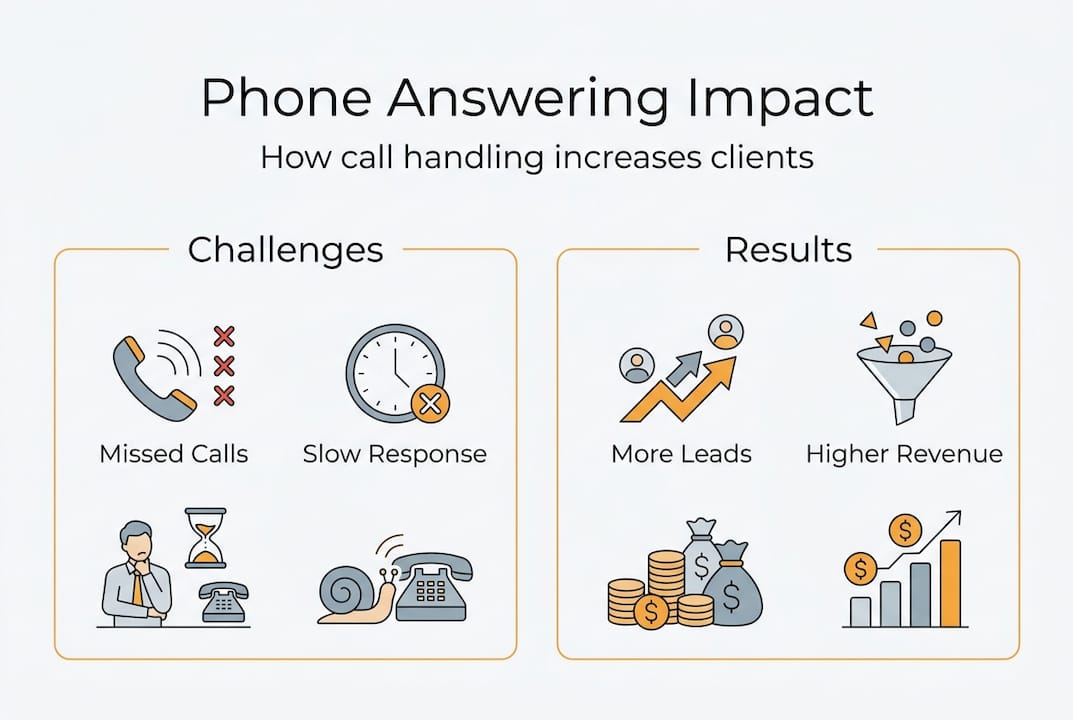
Missed calls represent pure revenue loss. Every unanswered phone call is a potential case walking out the door. Small to mid-sized personal injury firms face unique challenges in maintaining consistent phone coverage. Your team juggles court appearances, client meetings, case preparation, and administrative tasks. When calls go to voicemail during busy periods, potential clients rarely leave messages. They simply call the next firm on their list.
Research shows that 80% of callers who reach voicemail will not leave a message and will instead contact a competing firm.
Efficient phone systems create competitive advantages in saturated legal markets. While your competitors struggle with missed calls and inconsistent intake, your firm captures every opportunity. Consider the challenges law firms face:
- High call volume during peak hours overwhelms in-house staff
- After-hours and weekend calls go unanswered when offices close
- Staff turnover creates gaps in coverage and inconsistent quality
- Attorneys answering phones interrupts billable work and case preparation
- Untrained receptionists lack legal knowledge to properly qualify leads
- Multiple practice areas require different intake approaches and expertise
Addressing these challenges through improved phone answering systems directly impacts your ability to grow revenue from existing marketing investments. When you capture and convert more of the leads you’re already generating, your cost per signed case drops dramatically.
Options for phone answering in law firms: in-house, virtual, and outsourced
Law firms have three primary approaches to handling incoming calls, each with distinct advantages and limitations. Understanding these options helps you make informed decisions aligned with your firm’s size, budget, and growth goals.
In-house receptionists provide maximum control over your client experience. You train staff specifically for your firm’s culture, values, and intake processes. They understand your attorneys’ schedules, case types, and client management systems intimately. However, this approach carries the highest costs. You’re paying full-time salaries plus benefits for coverage that still has gaps during lunch breaks, sick days, vacations, and after-hours periods. Small firms often can’t justify the expense of multiple receptionists needed for comprehensive coverage.
Virtual legal receptionists offer flexibility and expertise with lower overhead compared to in-house staff. These professionals work remotely but function as extensions of your team. They’re trained in legal terminology, understand personal injury case intake, and follow your firm’s specific protocols. Virtual receptionists provide 24/7 coverage, handle overflow during busy periods, and scale with your firm’s growth. The cost savings are substantial because you’re not paying for benefits, office space, or equipment.
Outsourced answering services provide the most scalable solution for firms with high call volumes. These services employ large teams that handle calls for multiple businesses simultaneously. While they offer excellent availability and can manage significant call volume, they may lack the personalized touch and deep legal knowledge that builds client trust. Generic answering services often struggle with the emotional complexity of personal injury intake calls.
| Option | Cost Range | Coverage | Legal Expertise | Best For |
|---|---|---|---|---|
| In-house staff | $35,000-$50,000/year per person | Business hours only unless multiple staff | High after training | Large firms with consistent high volume |
| Virtual receptionist | $1,500-$4,000/month | 24/7 available | Specialized legal training | Small to mid-sized firms seeking growth |
| Outsourced service | $500-$2,000/month | 24/7 available | Limited unless specialized | Firms needing basic overflow coverage |
When choosing your phone answering method, evaluate these critical factors:
- Average daily and weekly call volume patterns
- Budget constraints and cost per signed case targets
- Required hours of coverage based on lead source timing
- Complexity of your intake process and qualification criteria
- Current staff capacity and administrative burden
- Growth projections and scalability needs
Pro Tip: Track your missed calls for two weeks before making any changes. Most firms are shocked to discover they’re missing 20 to 30% of incoming calls during business hours alone. This baseline data helps you calculate the revenue opportunity and justify investment in better phone answering solutions.
The right choice depends on your firm’s specific situation. A solo practitioner building their practice has different needs than a five-attorney firm handling 200 calls weekly. Start by understanding your current performance gaps, then select the solution that addresses those specific problems.
Best practices for phone answering to maximize lead conversion
Implementing effective phone answering requires more than just having someone pick up the phone. Well-trained receptionists using proper scripts increase client retention and satisfaction by creating consistent, professional experiences that build trust immediately. Follow these proven strategies to transform your intake process.
Develop call scripts tailored specifically to personal injury law:
- Open with empathy and immediate reassurance that validates their situation
- Gather essential case information without overwhelming the caller
- Qualify the lead by asking targeted questions about injury severity and liability
- Set clear expectations about next steps and timeline for attorney contact
- Obtain multiple contact methods to ensure successful follow-up
- Close by reinforcing your firm’s commitment to their case
- Document everything in your case management system immediately
Your scripts should feel conversational, not robotic. Train receptionists to listen actively and adapt their approach based on the caller’s emotional state. Someone calling from a hospital bed needs different handling than someone calling two weeks after an accident. The script provides structure while allowing flexibility for genuine human connection.
Pro Tip: Record and review actual intake calls monthly to identify improvement opportunities. Listen for moments where receptionists sound scripted or miss chances to build rapport. The best scripts evolve based on real conversations, not theoretical best practices. Update your scripts quarterly based on what actually works in practice.
Train your team to handle emotionally distressed callers with genuine empathy. Personal injury clients are often scared, angry, or overwhelmed. Your receptionist’s ability to remain calm, patient, and supportive directly impacts whether they trust your firm. Role-playing exercises help staff practice de-escalation techniques and develop confidence handling difficult conversations.
Leverage technology to improve call handling and identify missed opportunities. Call tracking systems reveal exactly which marketing channels generate calls, when calls come in, and how many go unanswered. This data exposes patterns like missed calls during lunch hours or high abandonment rates on Mondays. Analytics transform phone answering from a cost center into a measurable revenue driver.

Implement systematic follow-up processes for every lead. The firms that win cases aren’t always the ones who answer first but they’re always the ones who follow up consistently. Set automated reminders to contact leads who didn’t answer return calls. Send text messages confirming appointments. Use multiple communication channels to reach people where they’re most responsive. Persistence pays off because potential clients are juggling medical appointments, insurance calls, and daily responsibilities.
Measuring the impact of phone answering on law firm growth and revenue
Optimizing phone answering delivers measurable improvements across multiple business metrics. Firms that improved call responsiveness saw up to 30% increase in client acquisition by simply ensuring every call received professional, timely handling. Data proves the return on investment when you track the right metrics.
| Metric | Before Optimization | After Optimization | Improvement |
|---|---|---|---|
| Average call response time | 4+ rings or voicemail | 2 rings or less | 50% faster response |
| Calls answered during business hours | 70% | 98% | 40% more calls captured |
| Lead to consultation conversion rate | 35% | 52% | 49% increase |
| Consultation to signed case rate | 60% | 68% | 13% increase |
| Monthly revenue from phone leads | $45,000 | $67,500 | 50% revenue growth |
These improvements compound over time. A firm generating 100 qualified leads monthly that improves conversion by just 10% signs 10 additional cases. At an average case value of $15,000, that’s $150,000 in additional annual revenue from the same marketing spend.
Beyond direct conversion metrics, improved phone answering delivers additional benefits:
- Enhanced firm reputation through consistently professional client experiences
- Reduced attorney stress by eliminating interruptions from phone coverage gaps
- Lower marketing costs per signed case as conversion rates improve
- Competitive differentiation in markets where most firms handle calls poorly
- Increased referrals from clients who felt cared for from their first interaction
- Better staff morale when administrative chaos decreases
Track these key performance indicators monthly to justify continued investment in phone answering improvements. Calculate your cost per signed case by dividing total marketing and intake costs by cases signed. When this number decreases while case volume increases, you’ve proven ROI. Share these metrics with your team to maintain focus on phone answering as a revenue driver, not just an administrative function.
Establish baseline measurements before implementing changes, then monitor progress quarterly. Small improvements in answer rates and conversion percentages create massive revenue impacts over 12 months. The data will reveal exactly where your system still has gaps and where to focus next.
Elevate your law firm’s call handling with Attorney Assistant solutions
Your firm doesn’t need more leads. You need to stop losing the ones you already have. Attorney Assistant specializes in helping personal injury law firms capture every opportunity through professional intake services designed specifically for legal practices. Our virtual receptionists understand the emotional complexity of personal injury calls and follow proven scripts that convert leads into signed cases.
We handle intake, follow-up, and administrative workflows so your firm responds faster, converts more leads, and reduces internal chaos. Our intake and reception solutions integrate seamlessly with your existing systems, providing 24/7 coverage that ensures no call goes unanswered. Learn how firms like yours have increased revenue by 30 to 50% through improved call handling at our virtual webinar, where we share proven strategies and real results. Stop leaking revenue and start converting the leads your marketing is already generating.
Frequently asked questions
What is the key role of phone answering in law firms?
Phone answering serves as the critical first impression that determines whether potential clients trust your firm with their case. Professional, empathetic handling during this initial contact directly influences lead conversion rates because injured clients need immediate reassurance and guidance. When calls are missed or handled poorly, potential clients simply move to the next attorney on their list, resulting in permanent revenue loss.
Should my law firm hire in-house staff or use a virtual receptionist?
Virtual receptionists typically provide better value for small to mid-sized personal injury firms because they offer 24/7 coverage, specialized legal training, and significantly lower costs compared to full-time employees. In-house staff makes sense only when your call volume consistently exceeds 300 calls weekly and you need deep integration with complex internal systems. Most firms find virtual receptionists deliver superior results at a fraction of the cost while eliminating coverage gaps.
How can law firms improve their phone answering to increase leads?
Implement comprehensive training focused on empathy, active listening, and proven intake scripts that build trust immediately. Use call tracking technology to identify when calls are missed and why, then adjust staffing or systems to eliminate those gaps. Establish systematic follow-up processes that contact every lead multiple times through different channels, as persistence dramatically increases conversion rates even when initial contact is delayed.
How do I measure the success of my phone answering improvements?
Track four critical metrics monthly: percentage of calls answered, lead to consultation conversion rate, consultation to signed case rate, and cost per signed case. Compare these numbers before and after implementing changes to calculate exact ROI. Most firms see 20 to 40% improvement in conversion rates within 90 days of optimizing phone answering, which translates directly to measurable revenue growth that justifies the investment.
Recommended
Related Articles

Inbound Calls Management for Law Firms: 2026 Guide
Discover what is inbound calls management for law firms. Learn strategies to convert leads, improve client retention, and optimize operations.

Lead Management Best Practices for Law Firms in 2026
Discover effective lead management best practices for law firms in 2026. Improve client conversion and maximize your marketing spend.

How to Reduce Intake Errors at Your Law Firm
Learn how to reduce intake errors at your law firm. Discover steps and tools to enhance client data accuracy and streamline your processes.