Why Case Management Efficiency Matters for Law Firms

TL;DR:
- Effective case management consolidates workflows, automation, and transparency to enhance firm productivity and client outcomes. Firms leveraging automation and real-time metrics reduce administrative tasks, increase billable hours, and prevent costly errors. Success depends on process discipline, strategic workflow design, and ongoing review, not just technology adoption.
Case management efficiency is defined as the structured coordination of legal cases through optimized workflows, automation, and transparent processes that reduce delays, cut administrative overhead, and improve client outcomes. For law firms, it is the single most direct lever connecting operational performance to revenue. Firms that treat case management as a back-office function consistently lose leads, miss deadlines, and leave billable hours uncaptured. Those that treat it as a strategic priority convert more prospects, retain more clients, and run leaner operations. The difference is not the number of leads coming in. It is how well the firm handles every case from first contact to resolution.
Why case management efficiency matters for lead conversion and productivity
The connection between efficient case workflows and lead conversion is direct and measurable. When intake is slow, follow-up is inconsistent, or case data lives in disconnected systems, prospects move on. Speed and responsiveness are the deciding factors for most legal consumers, and inefficient case handling kills both.
Automation is the fastest way to recover lost capacity. Legal firms using case management software report up to 20% increases in billable hours by automating scheduling, document generation, and client follow-up. That is not a marginal gain. For a mid-size firm billing at $300 per hour, a 20% increase in captured billable time translates directly to six-figure annual revenue recovery.
The productivity gains extend beyond billing. Workflow automation can reduce manual administrative effort by 40 to 90% and deploy new case processes up to 50% faster. This means staff spend less time on coordination and more time on work that actually moves cases forward.
- Automated scheduling removes the back-and-forth that consumes paralegal time
- Document generation tools eliminate repetitive drafting for standard case types
- Automated follow-up sequences prevent leads from going cold between touchpoints
- Centralized task tracking reduces the need for status meetings and check-in calls
Pro Tip: Audit where your staff spends time for one week before buying any software. Most firms discover that 60% or more of administrative time goes to tasks that can be automated with tools already available in platforms like Clio, MyCase, or Filevine.
The role of a legal case manager shifts fundamentally when routine coordination is automated. Instead of chasing documents and scheduling calls, case managers focus on client relationships and case strategy. That shift alone improves both client satisfaction and attorney output.

What are the real costs of poor case management?
Poor case management does not just slow things down. It creates financial exposure that most firm owners do not see until it is too late.
The most visible cost is lost leads. When a prospect calls and no one follows up within the hour, that case is likely gone. But the hidden costs run deeper. Staff spend 30 to 40% of their time on non-billable administrative coordination. That is nearly half the workday consumed by tasks that generate no revenue and advance no cases.
The financial risk compounds when tracking failures occur at the case level. A recent settlement reached nearly $2 million attributable to a missed complaint tracking failure. That figure represents what happens when case oversight breaks down at the operational level. It is not an outlier. It is the predictable result of managing complex cases without adequate systems.
“Without monitoring, delays and process blockages remain hidden despite system upgrades.” This finding from America’s Essential Hospitals applies directly to law firms: technology alone does not fix inefficiency. Visibility does.
Common operational bottlenecks that drive these costs include:
- Siloed case data spread across email, spreadsheets, and disconnected platforms
- No standardized intake process, causing inconsistent client experiences
- Manual deadline tracking with no automated alerts or escalation protocols
- Lack of real-time reporting, leaving managers blind to case backlogs
Pro Tip: Set up a simple weekly dashboard that shows three numbers: cases opened, cases with no activity in seven days, and leads with no follow-up in 48 hours. Those three metrics will surface 80% of your firm’s operational problems.
The importance of case intake cannot be separated from case management efficiency. A broken intake process creates disorder that cascades through every subsequent stage of case handling.
What modern strategies drive case management efficiency?
The firms gaining the most ground on efficiency are not just buying software. They are redesigning how cases move through their operations.
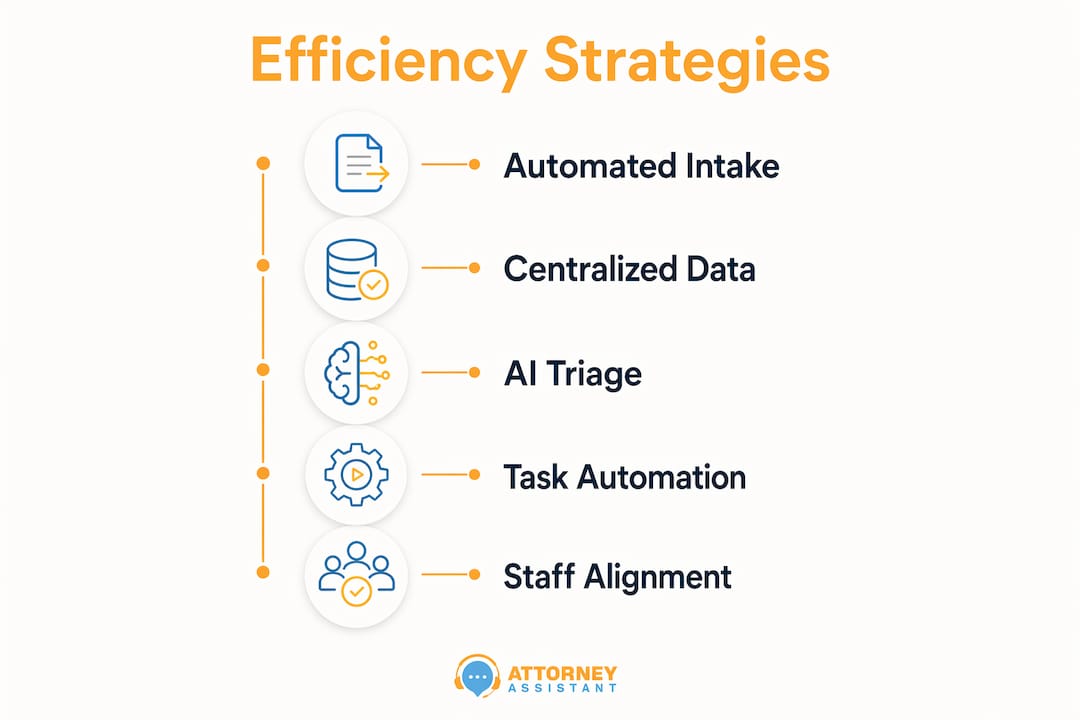
Four strategies consistently produce measurable results:
-
AI-driven case triage. AI and automation enable predictive resource allocation and multi-channel client engagement. Instead of assigning cases manually, AI tools route new matters based on attorney workload, case type, and complexity. This reduces assignment delays and improves case-attorney fit from day one.
-
Centralized case data. Digital records increase transparency and expedite reporting, enabling faster risk identification. When every document, communication, and deadline lives in one system, attorneys stop wasting time searching for information and start spending it on legal work.
-
Adaptive case processing. Not every case follows the same path. Effective case management systems allow firms to define standard workflows while building in flexibility for case-specific variations. Rigid systems fail on complex matters. Adaptive systems handle both routine and high-touch cases without breaking.
-
KPI dashboards for accountability. Transparent real-time metrics reveal hidden bottlenecks that would otherwise go undetected. Firms that track metrics like time-to-first-contact, case cycle time, and follow-up completion rates consistently outperform those that do not.
| Strategy | Primary Benefit | Key Metric to Track |
|---|---|---|
| AI-driven case triage | Faster assignment, better fit | Time from intake to attorney assignment |
| Centralized case data | Reduced search time, fewer errors | Cases with complete documentation at intake |
| Adaptive workflows | Handles case variability without delays | Workflow deviation rate by case type |
| KPI dashboards | Accountability and bottleneck detection | Cases with no activity over 7 days |
The legal admin automation examples available to firms in 2026 cover everything from intake forms to billing reminders. The barrier is no longer access to tools. It is the discipline to implement them with clear process design behind them.
How can law firms sustain long-term efficiency gains?
Technology implementations fail when firms treat them as one-time fixes rather than ongoing operational commitments. Sustained efficiency requires three organizational disciplines.
Align staffing to case complexity. Not every case needs a senior attorney’s attention at every stage. Firms that map case complexity to staff roles reduce both cost and bottlenecks. A well-structured team with clear handoff protocols handles higher volume without adding headcount.
Standardize workflows without removing flexibility. The most effective case management best practices combine standardized steps for predictable tasks with defined escalation paths for exceptions. Firms that over-standardize create rigidity that breaks on complex cases. Firms that under-standardize create chaos that breaks on volume.
Invest in training, not just tools. A longitudinal study of 174 participants found that relationship-based case management produced net savings of $248,121 alongside improved client satisfaction. The key variable was not the system used. It was the quality of the people operating it and their understanding of the client’s needs over time.
- Schedule quarterly workflow reviews to identify new bottlenecks as case volume grows
- Train staff on both the technical system and the reasoning behind each workflow step
- Create clear escalation protocols so exceptions do not stall in someone’s inbox
- Use performance data to recognize high performers and address gaps before they become problems
Pro Tip: When onboarding staff to a new case management system, run a parallel process for 30 days. Keep the old method running alongside the new one. This surfaces gaps in the new workflow before they affect real cases.
The impact of modern technology on client satisfaction is real, but it depends entirely on how well the firm integrates tools with human judgment. Software does not replace process discipline. It amplifies it.
Manual vs. automated case management: what the numbers show
The operational gap between manual and automated case management is not subtle.
| Factor | Manual case management | Automated case management |
|---|---|---|
| Administrative time | 30 to 40% of staff time on coordination | Reduced by 40 to 90% through automation |
| Billable hour capture | Significant leakage from scheduling and admin | Up to 20% increase in captured billable hours |
| Lead follow-up speed | Dependent on staff availability and memory | Triggered automatically within defined timeframes |
| Error and risk exposure | High, especially in deadline and complaint tracking | Reduced through automated alerts and audit trails |
| Data visibility | Siloed across email, spreadsheets, and files | Centralized with real-time reporting |
The AI-driven tools available to law firms in 2026 make the transition from manual to automated case handling more accessible than it has ever been. The firms still running on spreadsheets and shared inboxes are not saving money. They are deferring costs that will eventually show up as lost cases, missed deadlines, or staff turnover.
Key takeaways
Efficient case management is the operational foundation that determines whether a law firm converts leads, retains clients, and captures billable revenue at scale.
| Point | Details |
|---|---|
| Automation recovers billable time | Firms report up to 20% more billable hours by automating scheduling, documents, and follow-up. |
| Poor tracking creates financial liability | Missed complaint tracking has led to settlements approaching $2 million in documented cases. |
| Staff time is the hidden cost | Up to 40% of staff hours go to non-billable coordination without structured workflows. |
| Technology requires process discipline | Software amplifies good processes and exposes bad ones. Deployment without redesign fails. |
| Real-time metrics are non-negotiable | Without dashboards tracking case activity and follow-up, bottlenecks stay invisible. |
What I’ve learned about efficiency that most firms ignore
I have worked with enough law firms to know that the conversation about efficiency almost always starts in the wrong place. Firm owners want to know which software to buy. That is the last question they should be asking.
The firms that actually improve their operations start by mapping what is broken. They look at where cases stall, where leads go unanswered, and where staff time disappears. Only after that do they evaluate tools. Most of the time, the problem is not a missing feature. It is a missing protocol.
The other thing I see consistently is the assumption that all cases can be handled the same way. They cannot. A personal injury intake is not the same as an estate planning consultation. Treating them as identical sequences in a workflow system is how firms misconfigure their tools and then blame the software when results do not improve.
The firms that get this right build workflows that reflect how cases actually behave, not how they wish they would behave. They assign accountability at every stage. They measure what matters. And they revisit their processes quarterly instead of waiting for a crisis to force a review.
Efficiency in case management is not a technology problem. It is a management problem that technology can help solve, once the management side is addressed.
— Nicole
How Attorneyassistant helps firms stop losing cases
If your firm is losing leads to slow follow-up, inconsistent intake, or administrative overload, Attorneyassistant addresses those problems directly. We handle intake workflows, follow-up sequences, and administrative coordination so your attorneys focus on legal work instead of chasing paperwork.
Most firms do not need more leads. They need to stop leaking the ones they already have. Attorneyassistant’s lead follow-up service is built specifically to close that gap, with faster response times and structured follow-up that converts more prospects into signed cases. You can also join our virtual webinar to see how firms like yours are fixing intake and follow-up without adding headcount. If you want to talk through your firm’s specific situation, book a call with our team.
FAQ
Why does case management efficiency matter for law firms?
Case management efficiency directly determines how many leads convert to signed cases, how many billable hours get captured, and how much financial risk the firm carries. Firms with inefficient workflows lose revenue at every stage of the case lifecycle.
How much time do law firm staff waste on administrative tasks?
Staff spend 30 to 40% of their time on non-billable coordination tasks in firms without structured case management systems. Automation can reduce that administrative burden by 40 to 90%, freeing attorneys and paralegals for substantive legal work.
What is the financial risk of poor case management?
Tracking failures in case management have led to settlements approaching $2 million in documented cases. Beyond litigation risk, poor case handling drives client attrition, missed deadlines, and uncaptured billable hours that compound over time.
What are the most effective case management best practices for law firms?
The most effective practices combine automated workflows for routine tasks, centralized case data for transparency, real-time KPI dashboards for accountability, and regular process reviews to address new bottlenecks as case volume changes.
Does software alone fix case management inefficiency?
Software alone does not fix inefficiency. Transparent real-time metrics and clear process design are required before technology can produce sustained gains. Firms that deploy tools without redesigning their workflows typically see minimal improvement.
Recommended
Related Articles

9 Case Management Best Practices for Law Firms
Explore 9 case management best practices for law firms covering intake, documentation, deadlines, communication, QA, and scalable operations.

White Glove Support for Law Firms
Discover how white glove support transforms law firm intake and operations. Learn the metrics, staffing models, and workflows that actually sign cases.

10 Business Finance Course Options for Law Firms
Compare 10 business finance course options by level, format, workload, and law-firm relevance, then choose the right fit for your role and goals.