Why Client Response Time Matters for Law Firms

TL;DR:
- Fast response times build trust and increase the likelihood of converting inquiries into cases.
- Most firms respond too slowly, often taking days, which results in lost leads and damaged reputation.
Client response time is the speed at which a law firm acknowledges and replies to prospective and existing client inquiries, and it is the single most important operational factor affecting client satisfaction and case acquisition. 83% of legal clients expect a same-day response in 2026, and 88% want direct contact details for their assigned lawyer. Those numbers are not aspirational. They are the baseline your clients already expect before they decide whether to stay or call the next firm on their list. Understanding why client response time matters is the first step toward fixing the intake gaps that cost firms signed cases every week.
How does client response time impact client satisfaction and trust?
Fast responses build trust faster than any other signal a firm sends. When a prospective client reaches out during a stressful moment, a quick reply tells them the firm is present, organized, and takes their situation seriously. A slow reply tells them the opposite, regardless of how good the firm’s case results are.
Research confirms that client experience and case outcomes carry equal weight in client satisfaction. This is what the 2026 Legal CX Report calls the “Outcome Illusion.” Firms that focus only on winning cases miss the larger opportunity to earn loyalty through how they communicate. Clients who feel ignored during intake rarely become loyal clients, even when their case resolves well.
“Responsiveness is no longer a differentiator in legal services. It is a baseline requirement. Firms that treat it as optional are not just losing leads. They are losing reputation.”
2026 Legal CX Report
The practical consequence is clear. Firms perceived as accessible retain more clients and generate more referrals. Clients who rate their experience with a Net Promoter Score methodology are 4.9 times more likely to leave positive reviews. Positive reviews drive referrals. Referrals drive growth. The chain starts with a returned call or a timely email.
- Clients equate response speed with competence and care.
- Firms that respond quickly reduce client anxiety before the first consultation.
- Accessible firms outperform competitors in client retention, not just acquisition.
- Client loyalty and referrals depend on communication quality throughout the case, not just at intake.
Pro Tip: Set a firm-wide standard that every new inquiry receives an acknowledgment within 15 minutes during staffed hours. Even a brief “We received your message and will call you within the hour” reduces client anxiety and signals professionalism.
What operational benchmarks define excellent client response times?
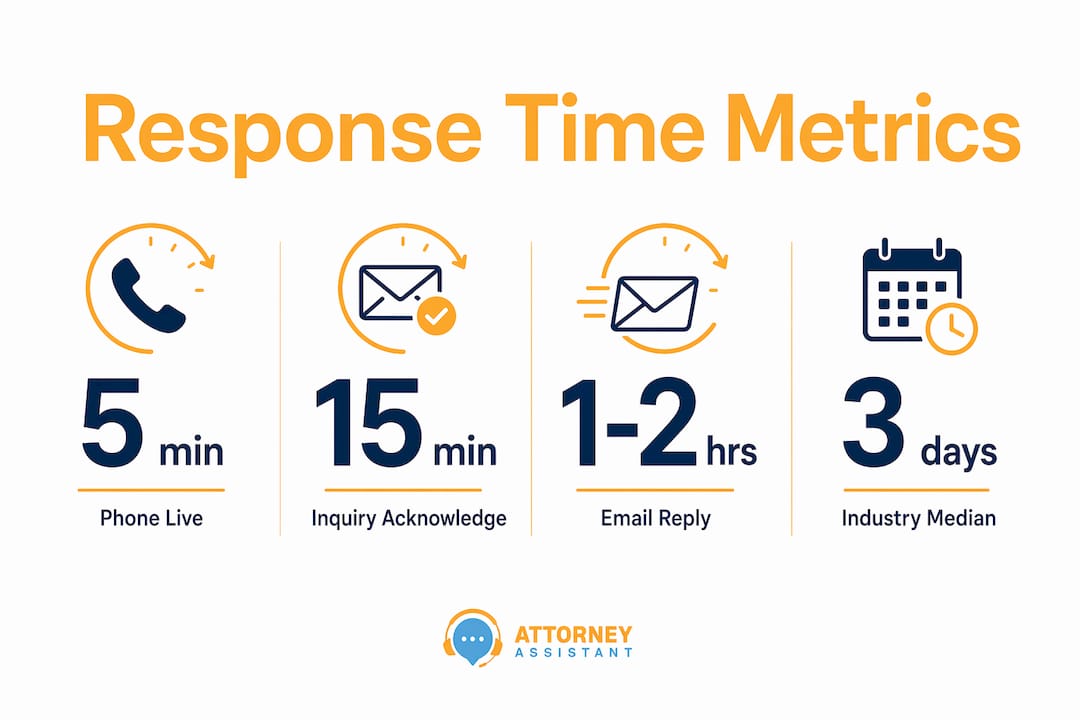
The industry target for live response is within 5 minutes of a new inquiry. That number is not arbitrary. Firms responding within 5 minutes are 21 times more likely to qualify a lead than those responding within 30 minutes. Responding within 1 hour yields 7 times higher qualification rates than waiting 24 hours. The drop-off is steep and fast.
The median law firm response time is 3 days. That gap between what clients expect and what most firms deliver is where cases are lost.
Different communication channels carry different expectations. Phone calls demand the fastest response. Text messages and live chat follow closely. Email allows slightly more time, but “slightly” means hours, not days.
| Channel | Recommended response time | Notes |
|---|---|---|
| Phone (inbound) | Immediate or callback within 5 minutes | Missed calls need same-day return |
| Text message | Within 15 minutes | Clients expect near-real-time replies |
| Live chat | Under 2 minutes | 61% of clients now expect live chat on firm websites |
| Email / web form | Within 1–2 hours during business hours | Same-day response is the minimum standard |
| After-hours inquiry | Automated acknowledgment immediately, follow-up next morning | Automation must comply with ABA Model Rule 5.5 and TCPA |
After-hours inquiries present a specific challenge. 39% of clients feel reassured by support between 9 AM and 5 PM, but 26% prefer early evening availability. That means roughly one in four prospective clients contacts firms outside standard hours. Firms without an after-hours response system lose those leads by default.
Pro Tip: Automated acknowledgment messages sent after hours keep leads warm until staff returns. Keep the message brief, confirm receipt, and give a specific callback window. Vague promises (“we’ll be in touch soon”) reduce trust rather than build it.
Why do slow client responses lead to lost cases and damaged reputations?
Slow responses do not just frustrate clients. They hand cases to competitors. A prospective client contacting multiple firms selects the first to respond about 68% of the time. Speed is the deciding factor, not price, not reputation, not location.
The client perception gap makes this worse. Firm managers often assume that prospective clients will keep trying if they do not hear back. The data says otherwise. Only 23% of legal consumers will continue trying to contact a firm that does not respond to the first inquiry. Nearly 80% hire the first professional who replies with a helpful, professional response. Most firms overestimate client patience by a wide margin.
The downstream effects compound quickly:
- Lost leads generate no revenue, but they still consumed marketing spend to acquire.
- Clients who feel ignored post negative reviews, which reduce future inquiry volume.
- Reduced referrals follow poor communication experiences, cutting organic growth.
- Staff time spent on late follow-up is less productive than timely first contact.
The impact of response time on firm reputation is often invisible to leadership until it shows up in review scores or declining intake numbers. By then, the pattern is established and harder to reverse. Monitoring response time as a weekly operational metric, not an annual review item, is what separates firms that grow from firms that plateau.
Stat to know: Two-thirds of clients want 24/7 contact availability. That expectation is not fully achievable for most firms, but it signals how high the bar has moved.
What strategies can law firms use to improve response times safely?
Improving response time requires both process changes and the right tools. The goal is to compress the time between inquiry and meaningful contact without creating legal risk or overwhelming staff.
-
Implement automated acknowledgment workflows. Every inbound inquiry should trigger an immediate automated reply confirming receipt and setting a callback expectation. Automated responses must comply with ABA Model Rule 5.5 and TCPA regulations. Automation handles acknowledgment and basic qualification. Licensed attorneys handle substantive advice.
-
Integrate conflict checks into intake. Running conflict checks manually after a consultation wastes time and delays follow-up. Firms that integrate conflict screening into the intake workflow reduce the gap between first contact and case acceptance.
-
Assign dedicated intake staff or coverage. Attorneys are not the right people to answer every first inquiry. Dedicated intake staff or a trained coverage system keeps response times consistent without pulling attorneys from billable work.
-
Set escalation protocols for delayed responses. If an inquiry has not received a live response within 30 minutes during staffed hours, a supervisor should be notified automatically. Escalation protocols prevent individual oversights from becoming systemic failures.
-
Monitor response time as a KPI. Track average response time by channel, by day of week, and by staff member. Data reveals patterns. Patterns reveal where the process breaks down.
Building client communication efficiency into daily operations requires leadership commitment. Firms that treat response time as a metric, not a suggestion, consistently outperform those that leave it to individual judgment.
- Use text and email for after-hours acknowledgment, not phone callbacks.
- Calibrate staffing levels to peak inquiry times, which are often Monday mornings and Friday afternoons.
- Review intake scripts quarterly to remove friction from the first client interaction.
- Partner with law firm SEO services that understand how digital accessibility and response speed connect to client acquisition.
Pro Tip: Run a monthly “mystery shopper” test. Have someone outside the firm submit a web form inquiry and record how long it takes to receive a response, what the response says, and whether a follow-up call comes. The results are almost always surprising.
Key Takeaways
Fast, consistent client response time is the single most controllable factor determining whether a law firm converts inquiries into signed cases.
| Point | Details |
|---|---|
| Response time is a baseline expectation | 83% of legal clients expect same-day responses; slow replies signal disorganization, not just inconvenience. |
| Speed determines who wins the case | Firms responding within 5 minutes are 21 times more likely to qualify a lead than those waiting 30 minutes. |
| Most lost leads never call back | Only 23% of prospective clients try again after an unanswered first inquiry; the rest hire someone else. |
| Client experience equals case outcome | The 2026 Legal CX Report confirms clients weigh communication quality as heavily as legal results when rating satisfaction. |
| Automation must stay compliant | Automated responses must respect ABA Model Rule 5.5 and TCPA; they handle acknowledgment, not legal advice. |
Response time is a revenue decision, not a service detail
Law firm managers often frame response time as a customer service issue. I think that framing costs firms money. Response time is a revenue decision. Every inquiry that goes unanswered for more than an hour during business hours is a case that has a meaningful chance of going to a competitor. That is not a service failure. It is a financial one.
What I have observed in firms that get this right is not complicated. They treat intake like a sales function, not an administrative one. They measure response time the same way they measure billable hours. They assign ownership. They review the numbers. When response time slips, they investigate why, not who to blame.
The firms that struggle share a common pattern. They assume their reputation does the work. They believe clients will wait because the firm is good. The data does not support that belief. Nearly 80% of clients hire the first firm that responds well, not the most reputable firm that responds slowly. Reputation earns you the inquiry. Speed earns you the case.
The other misconception I see regularly is that improving response time requires hiring more people. It rarely does. Most firms have enough staff. They have unclear ownership, inconsistent processes, and no monitoring. Fix those three things and response time improves without adding headcount. The benefits of responsive communication compound over time through better reviews, more referrals, and higher conversion from existing marketing spend.
Treat responsiveness as an operational pillar. Build it into your intake process, measure it weekly, and hold someone accountable for it. That is the mindset shift that separates growing firms from stagnant ones.
— Nicole
How Attorney Assistant helps firms close the response gap
Attorney Assistant works with law firms that are losing cases not because of bad lawyers, but because of slow follow-up, missed calls, and intake processes that break under volume.
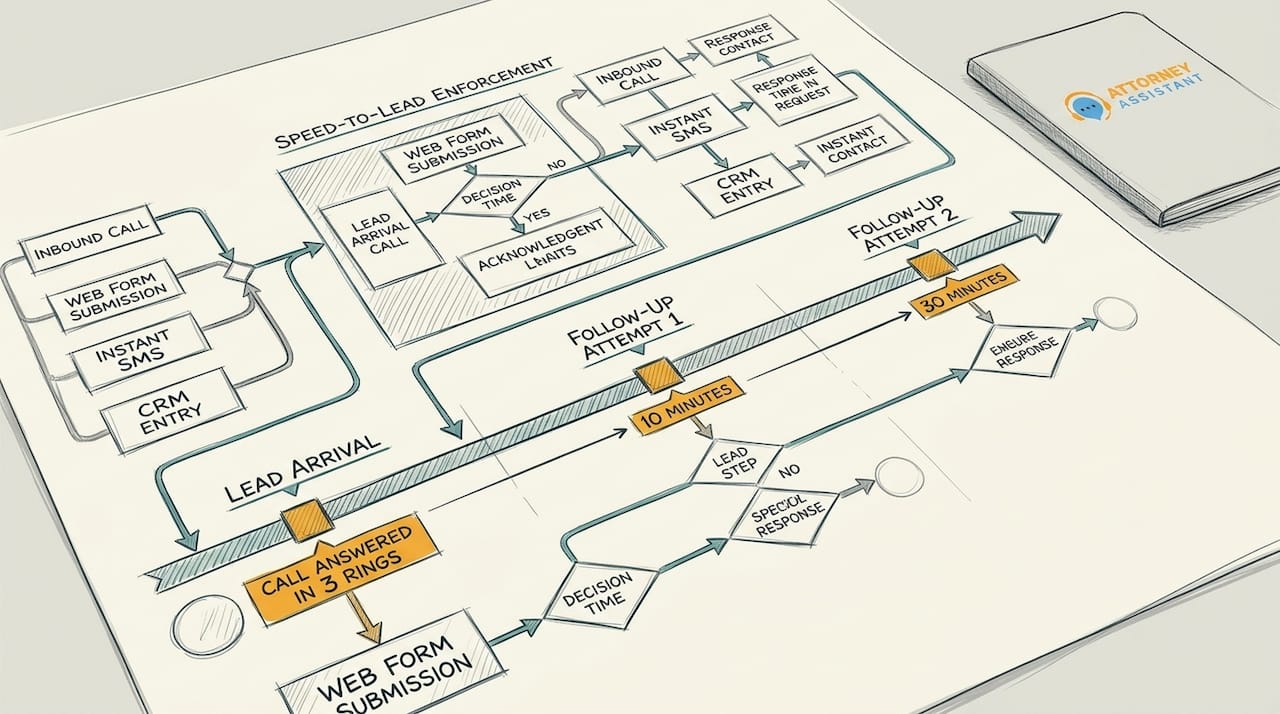
The lead follow-up service from Attorney Assistant handles the gap between inquiry and first meaningful contact, so firms stop losing leads to competitors who simply picked up the phone first. The intake and follow-up workflows are built around the benchmarks that matter: sub-5-minute acknowledgment, consistent follow-up sequences, and escalation protocols that keep leadership informed. If your firm is ready to see what a structured intake process looks like in practice, the Attorney Assistant virtual webinar is a practical starting point. Book a call and get a direct look at where your current process is leaking revenue.
FAQ
What is a good response time for a law firm?
The industry benchmark is a live response within 5 minutes for phone and text inquiries, and within 1–2 hours for email and web forms during business hours. Firms meeting this standard are significantly more likely to qualify and convert leads.
Why do clients hire the first firm to respond?
Prospective clients are often in a stressful situation and contact multiple firms simultaneously. The first firm to reply with a helpful, professional response earns the most trust at the most critical moment, which is why about 68% of clients select that firm.
How does slow response time affect law firm reviews?
Clients who feel ignored or underserved during intake post negative reviews at higher rates. Firms with fast communication and regular updates earn substantially more positive feedback, which directly influences referral volume and new inquiry rates.
Can law firms automate responses without violating ethics rules?
Automated acknowledgment and qualification messages are permitted, but they must comply with ABA Model Rule 5.5 and TCPA regulations. Automation handles initial contact and information gathering. Licensed attorneys must handle all substantive legal advice.
What is the biggest mistake firms make with client response time?
The most common mistake is assuming prospective clients will keep trying if they do not hear back. Only 23% of legal consumers will contact a firm a second time after an unanswered first inquiry. Most firms overestimate client patience and underestimate how quickly leads go cold.
Recommended
- Why Intake Response Time Matters for Law Firms | Attorney Assistant
- How to enhance law firm response time for client conversion | Attorney Assistant
- Why responsiveness drives law firm client conversion | Attorney Assistant
- Benefits of Responsive Client Communication for Law Firms | Attorney Assistant
Related Articles

Why Response Time Affects Cases: A 2026 Guide
Discover why response time affects cases and how it impacts outcomes across law enforcement, legal intake, and customer service. Learn more!

Appointment Setting Online: A Law Firm Guide
Master appointment setting online for law firms with proven strategies that turn leads into booked consultations and grow your practice.
Medical Records Request: A Practical Guide for Law Firms
Run a clean medical records request with HIPAA-compliant steps, sample language, timelines, fees, and follow-up tactics built for law firm operations.