Why Client Retention Is Important for Law Firm Growth

TL;DR:
- Client retention is a key driver of law firm profitability because it reduces costs and increases client value. Strong retention relies on effective communication and systems that foster loyalty, such as regular follow-ups and feedback collection. Tracking retention metrics helps firms identify and address revenue leaks and silent client churn.
Client retention is the practice of maintaining ongoing relationships with existing clients to maximize their lifetime value and firm profitability. For law firm owners and managers, understanding why client retention is important is not a soft business concept. It is a direct financial lever. Acquiring a new client costs 5–25 times more than keeping an existing one, and a 5% increase in retention can boost profits by 25–95%. Most firms chase new leads while quietly losing revenue from clients they already earned.
How does client retention enhance law firm profitability?
Retention is the most direct path to predictable revenue in a law firm. When clients return for additional matters, the firm earns revenue without paying the full cost of acquisition again. That compounding effect is what separates firms with stable margins from those that feel perpetually busy but never profitable.
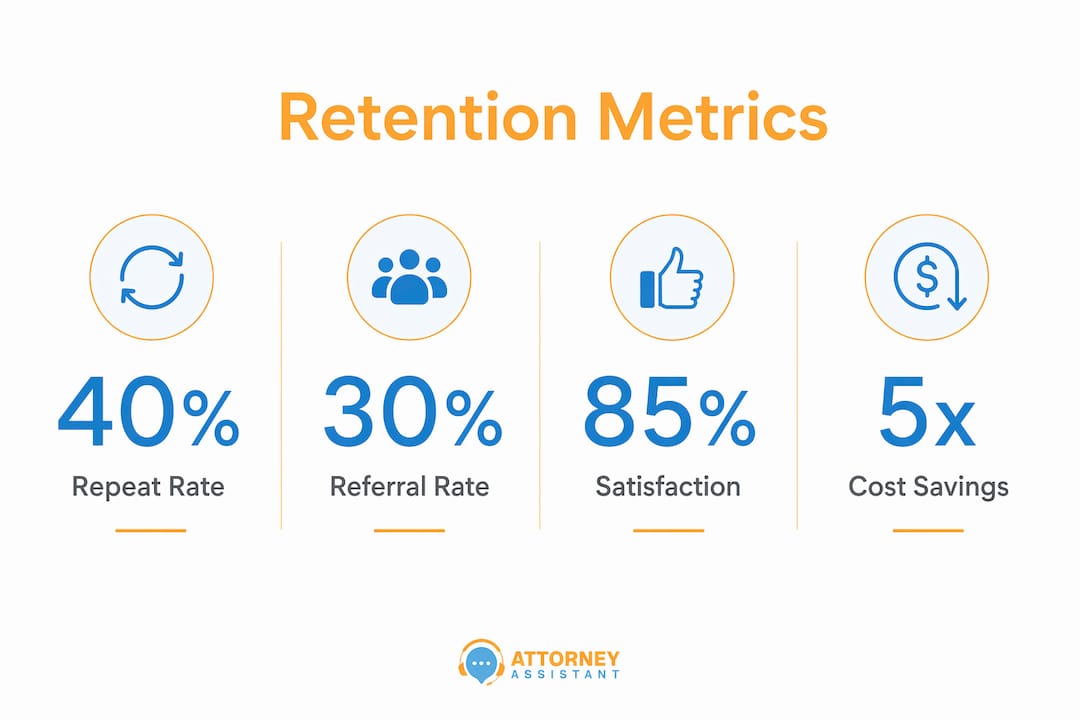
Strong retention reduces replacement costs and makes cash flow planning far more reliable. A firm that knows 40% of its revenue will come from returning clients can staff and budget with confidence. A firm that depends entirely on new intake lives month to month.
Retained clients also spend more over time. They return for related matters, refer family members and colleagues, and require less onboarding effort per engagement. Loyal clients generate more referrals and are more forgiving when minor issues arise. That combination of repeat revenue and inbound referrals creates a growth engine that no advertising budget can replicate.
The financial case for retention in legal services breaks down clearly:
- Lower cost per matter: Returning clients need no marketing spend to convert.
- Higher lifetime value: A client who returns three times is worth three to five times more than a single-matter client.
- Referral multiplier: Satisfied retained clients refer at higher rates than one-time clients.
- Reduced onboarding friction: Existing clients already understand your process, reducing administrative time per matter.
- Margin protection: Retention prevents the revenue erosion that happens when high-value clients leave quietly.
Firms that track revenue stability through retention consistently outperform those focused only on new lead volume.
What client experience factors drive retention in law firms?
Communication failures are the primary reason clients leave law firms, not poor legal outcomes. Clients who feel ignored, uninformed, or undervalued do not complain loudly. They simply do not return. That silent churn is the most dangerous form of client loss because it never triggers an internal alarm.
The factors that drive retention in legal practice are operational, not just relational:
- Response time: Clients who wait more than 24 hours for a callback form a negative impression that persists through the entire matter.
- Proactive updates: Clients should never have to call to ask what is happening with their case.
- Billing clarity: Unexpected invoices are a top driver of dissatisfaction and non-return.
- Post-matter contact: Most firms go silent after a matter closes. That silence reads as indifference.
- Feeling valued: Clients who feel listened to retain better, and value perception after the initial engagement drives loyalty more than competence during the matter alone.
Qualtrics frames retention as a customer experience KPI, not just a sales metric. That framing matters for law firms. Every touchpoint, from the first intake call to the final invoice, shapes whether a client returns.
Pro Tip: Send a brief satisfaction check-in within 10 days of matter closure. Ask one question: “Was there anything we could have done better?” That single message signals that you care, and it catches dissatisfaction before it becomes a lost client.
Improving the legal client experience at each stage of the matter lifecycle is the most reliable way to improve retention rates.
How can law firms measure and track client retention effectively?
Retention without measurement is guesswork. Law firms need specific metrics to know whether their retention efforts are working and where clients are falling off.
The three core metrics for law firm retention are the repeat matter rate, the referral rate, and the client satisfaction score. Each measures a different dimension of loyalty.
| Metric | What it measures | Benchmark |
|---|---|---|
| Repeat matter rate | Percentage of clients who return for a second matter | Below 25% signals a problem; strong firms reach 35–50% |
| Referral rate | Percentage of new matters sourced from existing clients | Higher rates indicate strong loyalty and satisfaction |
| Client satisfaction score | Post-matter rating of overall experience | Tracked via surveys or NPS; declining scores predict churn |
| Revenue retention | Percentage of prior-year revenue retained from existing clients | Tracks value, not just headcount |
A repeat matter rate below 25% signals retention problems. Strong firms achieve 35–50%. That gap represents real revenue sitting on the table.
Tracking both client count and revenue value is critical. A firm can appear to grow in client volume while losing its highest-value relationships. Losing one $50,000 client while onboarding five $5,000 clients is not growth. It is a net loss disguised by activity.
Operational KPIs like response time and proactive outreach must be tied directly to retention outcomes. If your average response time increases, your retention rate will follow it down. These inputs are leading indicators. Retention rate is the lagging result.
What are the best strategies to improve client retention?
The firms with the strongest retention rates treat it as a system, not an afterthought. They build structured processes around post-matter communication, client feedback, and relationship maintenance. Retention does not happen by accident.
1. Build a post-matter communication cadence

A 30-day check-in, 90-day newsletter, and 6-month call form the foundation of a retention cadence. Clients who hear from their attorney quarterly are significantly more likely to return and refer. The content does not need to be complex. A brief legal update relevant to their situation, or a simple check-in call, is enough to stay top of mind.
2. Use a CRM to automate follow-up
Manual follow-up fails at scale. A CRM system with automated reminders removes the dependency on individual staff memory. Set triggers for post-matter check-ins, anniversary outreach, and relevant legal updates. The goal is consistency, not volume.
3. Collect and act on client feedback
Firms that ask for feedback and visibly act on it retain clients at higher rates. A short post-matter survey with two or three questions gives you data and signals to the client that their opinion matters. Do not collect feedback and ignore it. Clients notice.
4. Treat retention as a leading indicator
Retention reflects whether post-value delivery is effective. If your acquisition engine is running faster than your retention rate can support, you are filling a leaking bucket. Measure retention monthly, not annually.
5. Assign ownership of retention
Someone in the firm must own client retention as a defined responsibility. Without ownership, it defaults to no one. That person tracks the metrics, manages the follow-up cadence, and flags at-risk relationships before they go cold.
Pro Tip: Review your client list from 18 months ago. Identify every client who has not returned or referred. That list is your retention gap. A single outreach call to 10 of those clients will tell you more about your retention problem than any survey.
Structured post-matter engagement increases repeat business and referral likelihood. Firms that implement these systems see measurable improvement within two to three quarters.
Key takeaways
Client retention is the single most cost-effective revenue strategy available to law firms, because retained clients cost less, spend more, and refer consistently.
| Point | Details |
|---|---|
| Retention beats acquisition on cost | Acquiring a new client costs 5–25 times more than keeping an existing one. |
| Profit impact is significant | A 5% retention increase can raise profits by 25–95%, compounding over time. |
| Communication drives churn | Clients leave due to poor follow-up and silence, not bad legal outcomes. |
| Measure both count and revenue | Track client volume and revenue retention separately to avoid misleading growth signals. |
| Systems prevent silent churn | Post-matter cadences and CRM automation are the operational foundation of strong retention. |
The retention gap most firms refuse to see
Most law firms I work with have the same blind spot. They can tell you exactly how many new leads came in last month. They cannot tell you what percentage of clients from two years ago have returned. That asymmetry is not a data problem. It is a priority problem.
Retention gets treated as a downstream outcome, something that happens naturally if the legal work is good. But retention is a revenue-growth lever, not a byproduct of good service. The firms that grow sustainably are the ones that build systems around it, not the ones that assume satisfied clients will find their way back.
The uncomfortable truth is that most client churn is invisible. Clients do not call to say they are leaving. They simply do not call again. By the time a firm notices the drop in repeat matters, months of revenue have already walked out the door quietly.
Retention also requires a mindset shift about where growth comes from. Firms that over-invest in acquisition while under-investing in retention systems are running a treadmill. More leads, more churn, same margin. The firms that win are the ones that slow down, measure what they already have, and build the operational infrastructure to keep it.
— Nicole
How Attorneyassistant helps law firms retain more clients
Retention problems in law firms almost always trace back to the same operational failures: slow follow-up, missed calls, and no system for post-matter communication. Those are not relationship problems. They are process problems, and they are fixable.
Attorneyassistant handles lead follow-up and intake workflows so firms respond faster, follow up consistently, and stop losing clients to silence. When a firm’s intake and follow-up processes run without gaps, retention improves as a direct result. Clients who feel attended to from the first call through matter closure are the clients who come back. If you want to see where your firm is losing revenue before it becomes a pattern, join a free webinar to walk through the operational gaps that drive client churn and what to do about them.
FAQ
What is client retention in a law firm?
Client retention in a law firm is the rate at which existing clients return for additional legal matters or refer new clients. It measures the ongoing value of client relationships beyond the initial engagement.
Why does client retention matter more than acquisition?
Acquiring a new client costs 5–25 times more than retaining an existing one, and a 5% retention increase can raise profits by 25–95%. Retention produces higher margins and more predictable revenue than acquisition alone.
What is a good repeat matter rate for a law firm?
A repeat matter rate below 25% signals a retention problem. Strong law firms achieve a repeat matter rate of 35–50%, meaning a significant share of revenue comes from returning clients.
Why do law firm clients leave without complaining?
Clients leave because of communication failures, delayed responses, and feeling undervalued, not because of poor legal outcomes. Silent churn is the most common form of client loss in legal practice.
How should law firms track client retention?
Firms should track repeat matter rate, referral rate, client satisfaction scores, and revenue retention separately. Tracking only client count can mask the loss of high-value relationships behind new client volume.
Recommended
Related Articles

How to Increase Client Conversion for Law Firms
Discover how to increase client conversion for your law firm. Learn key strategies like faster lead response and structured follow-up systems.

Client retention for law firms: Boost loyalty and profits
Learn how personal injury law firms can boost client retention, increase profits by up to 95%, and build lasting loyalty with proven strategies for 2026.

Macs for Lawyers: The Hardware and Compatibility Guide
A practical guide to Macs for lawyers covering hardware choices, software compatibility, security tradeoffs, and recommendations by firm size and workflow.