Why Intake Training Matters for Law Firm Growth

TL;DR:
- Intake training equips law firm staff with essential skills that significantly increase client conversion rates by handling prospects effectively.
- Failure to train leads to missed opportunities, trust gaps, and revenue loss, despite marketing efforts.
- Investing in ongoing coaching, clear processes, and skilled communication transforms intake into a strategic revenue driver.
Intake training is the structured process of equipping law firm staff with the skills, scripts, and judgment needed to convert inquiries into signed clients. Firms that invest in this training convert 15 to 20 clients from every 50 inquiries, more than double the rate of untrained teams. That gap is not a marketing problem. It is a training problem. Law firm partners and administrators who understand why intake training matters stop chasing more leads and start converting the ones they already have. Tools like Lead Docket and Filevine support the process, but the human skill layer is what closes cases.
Why intake training matters for lead conversion
Intake training, also called intake process training or intake specialist development, is the discipline of preparing front-line staff to handle the full conversion cycle from first contact to signed retainer. The importance of intake training becomes clear when you look at what untrained staff actually do: they answer questions instead of qualifying prospects, they miss follow-up windows, and they fail to build the trust a distressed caller needs before committing to a firm.
Responding within 5 minutes of a lead’s first contact dramatically increases the probability of qualifying and converting that lead. Most firms do not train staff on this threshold, so calls go to voicemail, emails sit unanswered for hours, and the prospect signs with the firm that picked up first. Speed-to-lead is a trainable behavior, not a technology feature.
Structured qualification is the second pillar. Trained intake staff recognize which cases fit the firm’s criteria within the first two minutes of a call. This protects attorney time, aligns firm resources with high-value cases, and gives callers a clear, confident experience. Untrained staff either accept every caller or awkwardly deflect cases they cannot handle, both of which damage the firm’s reputation.
Tools that support a trained intake team
Technology amplifies trained behavior. It does not replace it. Lead Docket CRM tracks lead status, follow-up cadence, and conversion rates so managers can identify where prospects drop off. Filevine supports case handoffs from intake to legal teams, reducing the friction that causes signed clients to feel abandoned after the first call. Both platforms work best when staff know how to use them as part of a defined intake workflow, not as standalone software.
Pro Tip: Implement a double-dial protocol: if a caller does not answer a return call within 60 seconds, hang up and call again immediately. Research on live-answer best practices shows this single behavior significantly reduces missed connections and signals urgency to the prospect.
| Intake behavior | Trained team | Untrained team |
|---|---|---|
| Response time | Under 5 minutes | 30 minutes to several hours |
| Lead qualification | Structured, case-fit focused | Inconsistent, reactive |
| Follow-up cadence | 6 to 10 touches across 3 channels | 1 to 2 attempts, then abandoned |
| CRM usage | Logged and tracked | Sporadic or absent |
How empathy and communication skills affect client trust
Intake calls are high-stress interactions. A person calling a personal injury firm just left a hospital. Someone calling a family law firm may be in crisis. The role of training in intake is to prepare staff for the emotional reality of these conversations, not just the logistical ones.

Behavioral strategies like mirroring caller pace, practicing active listening, and allowing silence during decision-making moments are proven techniques that improve engagement and conversion during intake calls. These are not soft skills. They are conversion skills. A caller who feels heard is far more likely to schedule a consultation than one who feels processed.
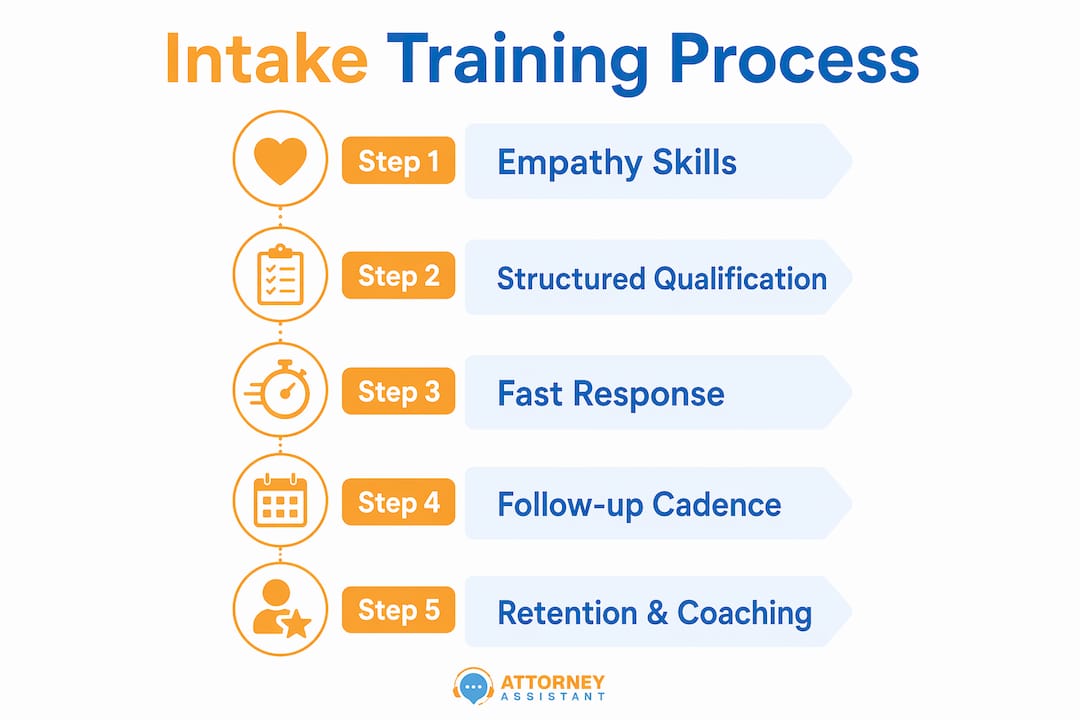
Effective intake training covers three communication behaviors that most firms never teach:
- Mirroring: Matching the caller’s speaking pace and tone to reduce anxiety and build subconscious rapport.
- Silence etiquette: Resisting the urge to fill pauses after asking a qualifying question. Silence gives the caller space to commit.
- Objection handling: Using scripted frameworks, not rigid scripts, to address concerns like cost, timing, or uncertainty about case strength without losing the lead.
The difference between a good and a bad intake call is often one sentence. A bad intake call sounds like this: “I’ll have someone call you back.” A good intake call sounds like this: “I want to make sure you speak with the right person today. Can I ask you a few quick questions so we can help you right away?” The second version signals urgency, care, and competence in under 20 words.
“Intake specialists are not receptionists. They are the first responders to a client’s crisis and the face of your firm’s brand. How they speak in that first call determines whether your firm gets the case or your competitor does.”
What happens when intake training is missing
The financial impact of poor intake training is direct and measurable. Intake turnover causes revenue leaks through lost trust, extended training periods, and repeated hiring costs. Each time a trained intake specialist leaves, the firm loses months of institutional knowledge and restarts a cycle that takes an average of four months to complete before a new hire reaches full proficiency.
Here is how the failure chain typically unfolds:
- A firm invests in paid search or social advertising to generate leads.
- Leads call in and reach an undertrained or overwhelmed intake person.
- The intake person fails to qualify the lead, misses the follow-up window, or gives a cold, scripted response.
- The prospect calls a competitor and signs there.
- The firm concludes its marketing is underperforming and increases ad spend.
Marketing spend is wasted when intake staff fail to have fast, human, and intentional conversion conversations with leads. The problem is not the campaign. The problem is the conversion layer beneath it. Firms that diagnose this correctly stop spending more on acquisition and start fixing the process that handles what they already have.
Automation compounds the problem when firms treat it as a replacement for human contact. Forms capture data but fail to build the trust that converts a prospect into a client. A chatbot cannot hear the fear in a caller’s voice. A contact form cannot reassure a parent who just learned their child was injured. Automation belongs in the logistics layer of intake, not the conversion layer.
Practical strategies to build and sustain intake training
Building a strong intake training program requires more than a one-day orientation. The benefits of training intake staff compound over time when the program includes ongoing coaching, real-time feedback, and clear accountability measures.
Start with a documented call guide. A call guide is not a rigid script. It is a framework that gives intake staff the structure to handle common scenarios while leaving room for genuine conversation. The guide should cover opening statements, qualifying questions, objection responses, and handoff language to the legal team. Kerri James and resources like those at Hiring and Empowering both emphasize that the exact language staff use in critical moments determines whether a lead converts or walks.
Use CRM data to identify training gaps. Lead Docket and similar platforms generate reports on call volume, response time, follow-up attempts, and conversion rates by staff member. These reports tell you exactly where the process breaks down. If one intake specialist converts 40% of qualified leads and another converts 15%, the gap is a training opportunity, not a performance management issue.
Build a follow-up cadence into the training program. Firms that contact leads via three channels over 72 hours with 6 to 10 total touches convert significantly more prospects than firms relying on a single call or email. Train staff on this cadence explicitly. Role-play the second and third contact attempts, which are where most untrained staff give up.
Pro Tip: Align intake training with your legal team’s handoff expectations. When attorneys receive a new client file, it should include a summary of the intake conversation, the client’s stated concerns, and any objections raised. This continuity signals professionalism and reduces the client’s need to repeat themselves.
Retention is the final piece. Training new intake staff to full proficiency takes three to six months on average. Firms that treat intake roles as entry-level, low-investment positions cycle through staff constantly and never build the institutional knowledge that drives consistent conversion. Competitive compensation, clear career paths, and regular recognition reduce turnover and protect the training investment.
Key takeaways
Intake training is the single highest-leverage operational investment a law firm can make to increase client conversion without increasing marketing spend.
| Point | Details |
|---|---|
| Training doubles conversion rates | Trained intake teams convert 15 to 20 clients per 50 inquiries, versus 6 to 8 for untrained teams. |
| Speed-to-lead is trainable | Responding within 5 minutes is a behavior that must be explicitly taught and reinforced. |
| Empathy drives decisions | Mirroring, active listening, and silence etiquette are conversion skills, not personality traits. |
| Automation supports, not replaces | Forms and CRMs handle logistics; human contact closes the trust gap that converts leads. |
| Retention protects ROI | With proficiency taking up to 4 months, reducing intake turnover directly protects training investment. |
The intake team is your revenue team
Most managing partners I speak with classify intake as an administrative function. That classification is the root cause of most conversion failures I see. Intake is the frontline of both brand and revenue. Every call that goes unanswered, every follow-up that never happens, and every objection that goes unaddressed is a direct financial loss. It is not a clerical oversight.
What I have found after working with law firms across practice areas is that conversion failures stem from leadership and system gaps, not from team incompetence alone. Intake staff cannot perform at a high level without documented processes, regular coaching, and leadership that treats their role as strategic. When a firm invests in intake training the way it invests in attorney development, the conversion numbers shift within 60 to 90 days.
The firms that grow consistently are not the ones with the biggest advertising budgets. They are the ones where every person who answers a call knows exactly what to say, why they are saying it, and what to do next. That is not a talent problem. It is a training and systems problem. And it is entirely solvable.
— Nicole
How Attorneyassistant helps firms fix intake gaps
If your firm is generating leads but not converting them at the rate your marketing spend deserves, the gap is almost always in the intake process.
Attorneyassistant works with law firms to fix the operational failures that cause leads to go cold: missed calls, slow follow-up, and inconsistent intake conversations. Our intake and reception support services give your firm a trained front line that responds fast, qualifies accurately, and keeps prospects engaged through the signing stage. We also offer lead follow-up services to maintain pipeline momentum when your internal team is stretched. If you want to see how your current intake process compares to best practices, start with our free tools for law firms or book a call to talk through your specific situation.
FAQ
Why does intake training matter more than getting more leads?
Most law firms already receive enough leads to grow. Intake training matters because it determines how many of those leads actually convert into signed clients, making it a higher-leverage investment than additional advertising spend.
How long does it take to train an intake specialist?
Full proficiency takes three to six months on average, with four months being the typical benchmark for consistent, confident performance. This timeline makes reducing turnover as important as the training program itself.
What are the core components of effective intake training?
Effective intake training covers empathy and communication skills, structured qualification, follow-up cadence, objection handling, CRM usage, and clean handoffs to the legal team.
Does automation replace the need for trained intake staff?
No. Automation handles logistics like data capture and scheduling, but human contact is required at the conversion moment. Prospects in legal distress need to feel heard before they commit to a firm.
What is the 5-minute response rule in intake?
The 5-minute response rule holds that contacting a lead within five minutes of their first inquiry significantly increases the probability of qualifying and converting that lead. This behavior must be trained and reinforced, not assumed.
Recommended
Related Articles

10 Business Finance Course Options for Law Firms
Compare 10 business finance course options by level, format, workload, and law-firm relevance, then choose the right fit for your role and goals.

10 Good VoIP App Options for Law Firms in 2026
Compare 10 good VoIP app options for small and mid-sized law firms, including security, integrations, pricing, mobile use, and desk-phone readiness.

10 Insurance Software Companies Worth Comparing
Compare 10 insurance software companies by features, use cases, trade-offs, and implementation fit for carriers, MGAs, brokers, and agencies.