Why Intake Workflows Fail — and How to Fix Them
TL;DR:
- Law firm intake workflows often fail due to unowned leads, slow response times, and lack of follow-up triggers. Fixing these operational leaks can significantly increase client conversion rates without additional advertising spending. Implementing automated acknowledgment, assigning clear ownership, and ensuring quick response times are essential short-term solutions.
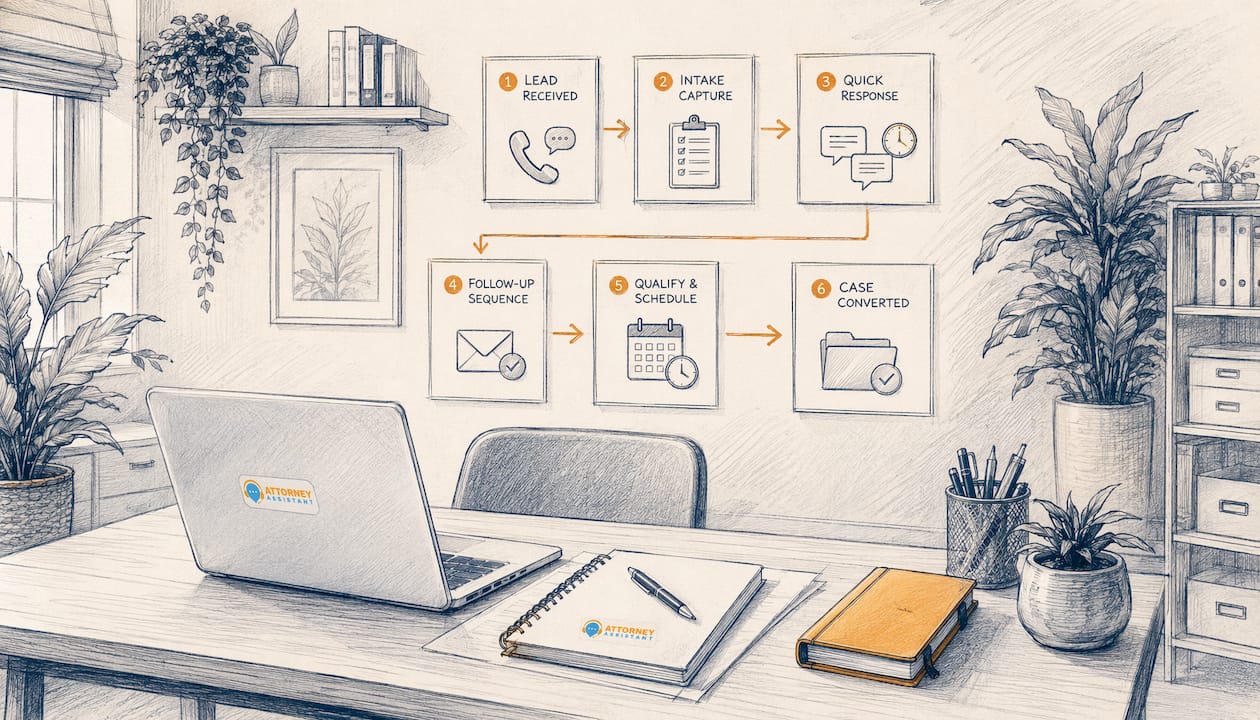
Intake workflows fail because inbound leads are not owned, acknowledged quickly, or routed to a next step with a named owner and a deadline. A lead arrives, clears the first handoff, then sits in a shared inbox or voicemail queue until someone gets to it. No SLA. No owner. No follow-up trigger. The prospect moves on, and the firm never knows it happened. Legal operations experts confirm that fixing this operational leak is cheaper and faster than buying more traffic. Attorney Assistant sees it constantly: firms spending thousands on ads while losing cases at the front door.
Table of Contents
- Most firms misdiagnose this as a marketing problem
- Common root causes of intake failure
- How intake failure shows up in your metrics
- How to run a 7-step intake audit in one week
- Prioritized fixes, short-term and medium-term
- Staffing, technology, or outsourcing: how to choose
- 30/60/90-day remediation plan
- How to measure success and avoid backsliding
- Key Takeaways
- Why operational fixes beat more marketing spend
- How Attorney Assistant fits into your remediation plan
- Useful sources and further reading
- FAQ
Most firms misdiagnose this as a marketing problem
Buying more leads feels productive. It is also the wrong move when your intake is leaking. A firm that converts 14% of inquiries to signed clients, while top performers hit 40% or more, does not have a lead-volume problem. It has a process problem.
Consider two firms with identical ad budgets. Firm A doubles its spend. Firm B fixes its response time, assigns ownership to every handoff, and adds after-hours coverage, resulting in signing more cases from the same lead pool at a lower cost. The math is straightforward: capturing a lead you already paid to generate costs nothing extra. Acquiring a replacement lead costs the same as the first one.
Common root causes of intake failure
Most intake problems trace back to a short list of operational failures:
- Missed calls and voicemail queues. Calls go unanswered during lunch, after 5 PM, or on weekends. Voicemails pile up and get returned the next business day, if at all.
- Slow speed-to-lead. Firms that respond quickly win a disproportionate share of clients. Many firms take much longer to respond.
- No ownership at handoffs. When no one owns the next step, leads stall between the receptionist, the intake coordinator, and the attorney.
- Over-qualification on first contact. Asking too many screening questions before booking a consultation creates friction and increases dropouts.
- CRM hygiene failures. Leads that never enter a matter management system are invisible. You cannot follow up on a record that does not exist.
- After-hours coverage gaps. Legal problems do not follow business hours. Inquiries that arrive at 9 PM on a Tuesday wait until morning, by which time the prospect has already called someone else.
- Inconsistent scripts. Without a defined script, every intake call is improvised. Quality depends entirely on who picks up the phone that day.
Pro Tip: Require a timestamped log entry at first contact and automate an immediate acknowledgment text or email. This single change makes your leak rate visible and gives prospects proof that someone received their inquiry.
How intake failure shows up in your metrics

Track these numbers. If you do not have them, that is itself a finding.
| Metric | What it measures | Benchmark |
|---|---|---|
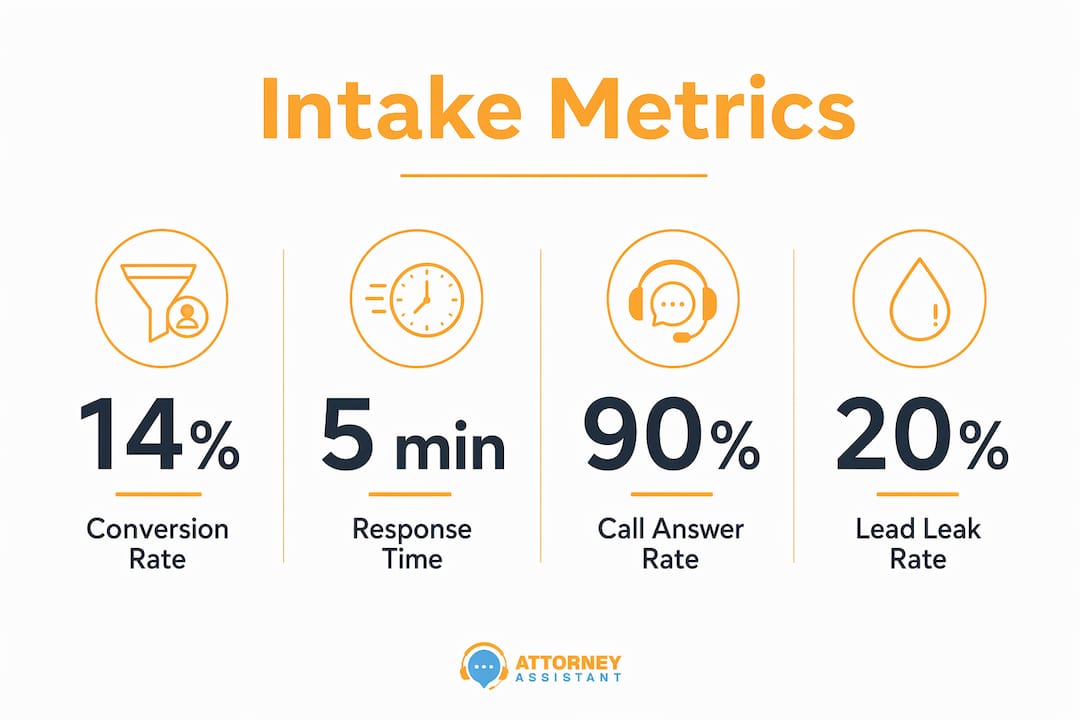
| Speed-to-lead | Time from inquiry to first human contact | Under 5 minutes during business hours |
| Call answer rate | Percentage of inbound calls answered live | 90%+ target |
| Form acknowledgment time | Time from web form submission to first response | Under 5 minutes automated; under 1 hour human |
| Lead-to-consultation rate | Inquiries that book a consultation | 60–80% is typical among high-performing firms |
| Consultation-to-signed rate | Consultations that convert to retained clients | 30–50% conversion is achievable |
| Overall inquiry-to-client rate | End-to-end conversion | Median firms convert about 14% of inquiries; top performers reach 40% or more |
| Follow-up attempts | Touches made before a lead is marked lost | Multiple attempts recommended to reduce lost leads |
| Lead leak rate | Inbound inquiries minus signed clients, as a percentage | Most firms leak 86% of inbound leads; closing the gap lifts revenue dramatically |
Your lead leak rate is the most useful single number. Divide signed clients by total inquiries, subtract from 100%. A firm receiving 100 inquiries per month and signing 14 clients has an 86% leak rate. Close that gap to 30% and you triple your caseload without a single new ad dollar.
How to run a 7-step intake audit in one week
Run this yourself or assign it to your office manager. Budget two to three hours total.
- Secret-shop your own firm. Call and submit a web form as a prospective client. Log the exact time. Note whether you get a live answer, a voicemail, or an automated response, and when a human follows up.
- Timestamp every form submission. Pull the last 30 web inquiries from your CRM or inbox. Record the submission time and the time of first human response. Compute the median.
- Test after-hours phone coverage. Call your main number at 7 PM on a weekday and on a Saturday morning. Document exactly what happens.
- Audit CRM records. Pull all inquiries from the past 60 days. Count how many have no follow-up logged, no consultation scheduled, and no disposition recorded.
- Map every handoff and name the owner. Draw the path from first contact to signed retainer. At each transition, write the name of the person responsible. If you write “whoever is available,” that is a gap.
- Spot-check your follow-up sequence. Pick five leads that did not convert. Count how many follow-up attempts were logged. If the answer is zero or one, your cadence is broken.
- Simulate an after-hours inquiry. Submit a contact form at 10 PM. Log whether you receive an automated acknowledgment and when a human contacts you the next day.
Outputs: median first response time, percentage of calls answered live, percentage of CRM records with no follow-up, and a list of handoffs with no named owner. These four numbers tell you where your leak is.
Prioritized fixes, short-term and medium-term
Do these first (within two weeks):
- Set up an automated text and email acknowledgment that fires within 60 seconds of any form submission.
- Assign a single named owner to every handoff in your intake path. No shared inboxes as a final destination.
- Stop screening on first contact. Book the consultation. Move qualification to that session.
- Add live or AI-assisted coverage for after-hours calls. AI intake agents can acknowledge inquiries within 60 seconds, collect scheduling data, and route to a human for anything requiring judgment.
- Create a required CRM record at the moment of first contact, before any qualification happens.
Build these over the next 12 weeks:
- Write a schedule-first script for your intake coordinator. The goal of every first call is one thing: book the consultation.
- Set SLAs in writing: first response within 5 minutes, first human call within 1 hour, follow-up cadence of at least 5 touches over 10 days.
- Build a follow-up sequence in your CRM with automated triggers at days 1, 3, 5, 7, and 10.
- Automate CRM logging and required fields so no record can be created without a timestamp and an owner.
Pro Tip: The highest-ROI staffing move is a dedicated intake coordinator who owns nothing else. Delegating intake off attorneys to trained staff standardizes the experience and frees attorneys for billable work. If you cannot hire full-time, a co-managed model with an external partner covers after-hours volume without the overhead.
Staffing, technology, or outsourcing: how to choose
The right remediation path depends on your volume and your current gaps.
- Low inquiry volume (under 50/month), business-hours only: A trained in-house intake coordinator with a basic CRM and an automated acknowledgment covers most of the leak. Technology investment is minimal.
- Mid-size firm with evening and weekend demand: You need after-hours coverage. An AI-plus-human hybrid handles first contact and acknowledgment; a human coordinator manages follow-up during business hours. This is where co-managed intake earns its cost.
- Firms scaling ad spend: Every dollar of new ad spend amplifies your existing leak rate. Fix intake first, then scale. Otherwise you are accelerating the leak.
Watch for these pitfalls regardless of path: over-automating without a human fallback for complex or distressed callers; outsourcing to a partner that does not own SLAs or report on metrics; and relying on attorneys to handle first calls, which creates a bottleneck tied to their availability.
Pro Tip: When evaluating an external intake partner, ask one question: “What is your SLA for first response, and how do you report on it?” If they cannot answer with a number and a reporting cadence, keep looking.
Digital notarization is one area where technology genuinely shortens the path to a signed retainer. Current digital notary trends show that firms integrating e-signature and remote notarization into intake cut document turnaround from days to hours.
30/60/90-day remediation plan
| Period | Priority actions | Owner | Checkpoint metric |
|---|---|---|---|
| Day 1–30 | Automated acknowledgment live; CRM required fields enforced; named owner for every handoff; after-hours coverage activated | Office manager | Median first response under 5 min; answer rate above 90% |
| Day 30–60 | Schedule-first script deployed; follow-up cadence built in CRM; SLA document signed by intake team; weekly intake review meeting started | Intake coordinator + office manager | Lead-to-consultation rate; follow-up attempts per lead |
| Day 60–90 | Monthly ROI check: map conversion lift to revenue; decision gate on hiring vs. expanding external partner; intake health audit run | Attorney lead + office manager | Inquiry-to-signed rate; lead leak rate vs. baseline |
At the 30-day gate, if your answer rate is still below 90% or your median response time is above one hour, add coverage before moving to script and cadence work. Sequence matters.
How to measure success and avoid backsliding
Run a weekly intake review. It takes 20 minutes and covers five numbers: median first response time, call answer rate, lead-to-consultation rate, follow-up attempts per lead, and lead leak rate. If any number moves in the wrong direction two weeks in a row, that is a red flag requiring immediate attention, not a note for next month’s meeting.
Monthly, map your conversion lift to revenue. If your inquiry-to-signed rate moved from 14% to 20% on 100 monthly inquiries, that is six additional cases. Multiply by your average case value. That number is what your intake fix is worth.
Red flags that require immediate intervention:
- Call answer rate drops below 85%.
- Any lead goes more than 24 hours without a logged follow-up attempt.
- CRM records appear with no owner or no timestamp.
- A secret-shop test produces a voicemail and no callback within two hours.
The firms that backslide are the ones that treat intake as a project with an end date. It is an ongoing operational function that needs a weekly owner and a monthly audit.
Key Takeaways
Law firm intake workflows fail because leads arrive without an owner, an SLA, or a follow-up trigger, and fixing that operational gap recovers more revenue than buying additional leads.
| Point | Details |
|---|---|
| Fix ownership first | Every handoff needs a named owner and a deadline; shared inboxes are where leads die. |
| Speed-to-lead is the single biggest lever | Firms responding within five minutes win a disproportionate share of clients. |
| Measure lead leak rate | Median inquiry-to-client conversion is 14%; top performers reach 40% or higher. Most firms leak 86% of their inbound leads, but closing that gap delivers substantial growth. |
| Use a 30/60/90 plan | Sequence matters: coverage and acknowledgment first, then scripts and cadence, then ROI review. |
| Attorney Assistant | Provides co-managed intake, SLA enforcement, and 24/7 coverage to close the gaps firms cannot staff internally. |
Why operational fixes beat more marketing spend
The firms I see recover the most revenue are not the ones that doubled their ad budgets. They are the ones that stopped treating intake as a clerical task and started treating it as the revenue function it actually is. A personal injury firm with a moderate inquiry volume and conversion rate may be leaving numerous signed cases on the table compared to a top-performing firm with much higher conversion rates. That gap does not close with more traffic. It closes with ownership, speed, and follow-up discipline.
Attorney Assistant’s entire model is built around this premise: co-managed intake, enforced SLAs, and 24/7 coverage embedded in your daily operations. The firms that engage us typically discover their leak within the first week of the audit. The fix is rarely glamorous. It is almost always operational.
How Attorney Assistant fits into your remediation plan
If the audit surfaces gaps you cannot close internally, Attorney Assistant handles the operational work directly: intake coverage and follow-up with enforced SLAs, 24/7 AI-plus-human response, CRM hygiene, and retainer signing support. Firms that bring their audit outputs to the first call move faster because the gaps are already mapped.
Run the seven-step audit first. Then book a call with Attorney Assistant to walk through what you found and where co-managed intake fits your remediation timeline.
Useful sources and further reading
- Law Firm Lead Conversion Benchmarks (LEXGRO) — inquiry-to-client conversion data and stage benchmarks
- Speed-to-Lead Benchmarks for Law Firm Attorneys (YMM Digital) — response-time research and operations-first framing
- Your Intake Process Is Costing You More Than You Think (Miami-Dade Bar) — practitioner-level breakdown of intake failure patterns
- Why Client Intake Stalls When No One Owns the Next Step (Legalboards) — ownership and handoff mapping
- Four Client Intake Mistakes to Avoid (Attorney at Work) — staffing and delegation guidance
- Workflow for Follow-Up Strategies at Law Firms (Attorney Assistant) — follow-up cadence and process documentation
- 9 Signs of Ineffective Client Intake at Your Law Firm (Attorney Assistant) — diagnostic red flags aligned with the audit steps above
- Webinar to watch next: Attorney Assistant’s intake workflow webinar covers the co-managed model, SLA templates, and live audit walkthroughs. Check the Attorney Assistant resources page for the current schedule.
FAQ
Why do intake workflows fail in most law firms?
Intake workflows fail because leads arrive without a named owner, a response deadline, or a follow-up trigger. The result is a chain of informal handoffs where leads stall and leak before anyone notices.
What is a good inquiry-to-client conversion rate for a law firm?
Median firms convert about 14% of inquiries to signed clients, while top performers reach 40% or more. The gap is largely determined by intake speed, ownership, and follow-up discipline.
How fast should a law firm respond to a new inquiry?
Firms aiming for top performance respond to new inquiries within five minutes during business hours. After-hours inquiries should receive an automated acknowledgment in under 60 seconds, with a human follow-up as soon as possible the next working day.
What is the fastest way to fix intake workflow problems?
Assign a named owner to every handoff, activate automated acknowledgment for all web inquiries, and stop screening on first contact. These three changes can be live within two weeks and produce measurable results within 30 days.
How does Attorney Assistant help with intake workflow failures?
Attorney Assistant provides co-managed intake with enforced SLAs, 24/7 AI-plus-human coverage, CRM hygiene support, and lead follow-up so firms close the gaps they cannot staff internally.
Recommended
- Intake Problems at Your Law Firm? Our Elite Staffing + AI Solutions Fix That | Attorney Assistant
- How to organize your law firm intake team for peak efficiency | Attorney Assistant
- Workflow for Follow Up Strategies at Law Firms | Attorney Assistant
- Optimize your case intake workflow for more conversions | Attorney Assistant
Related Articles

Intake Process Best Practices for Personal Injury Firms
Discover essential intake process best practices for personal injury firms. Boost your case wins by optimizing every step from call to closure!

Appointment Setting Online: A Law Firm Guide
Master appointment setting online for law firms with proven strategies that turn leads into booked consultations and grow your practice.

Medical Records Request: A Practical Guide for Law Firms
Run a clean medical records request with HIPAA-compliant steps, sample language, timelines, fees, and follow-up tactics built for law firm operations.