Intake Process Best Practices for Personal Injury Firms

TL;DR:
- Most personal injury firms fail to lose cases due to a lack of leads but because of inconsistent or absent intake best practices. Speed, standardized stages, automation, and continuous measurement are essential for converting inquiries into signed cases effectively. Fixing human processes first, then automating, is key to improving overall intake performance and revenue.
Most personal injury firms don’t lose cases because they lack leads. They lose cases because their intake process best practices are either nonexistent or inconsistently applied. A prospect calls your firm after an accident. You’re the third firm they’ve tried. If you don’t respond fast, qualify accurately, and follow through without gaps, they sign with someone else. The damage is invisible on your revenue reports, but it’s real. This article covers what a high-performing PI intake workflow actually looks like, from first contact through signed retainer.

Key takeaways
| Point | Details |
|---|---|
| Speed determines first contact | Respond to every new inquiry within 5 minutes to win the case before a competitor does. |
| Standardize every intake stage | Use defined ownership, required-field forms, and SLAs at each stage to prevent dropped leads. |
| Conflict checks take real time | Budget 24 to 48 hours for conflict clearance and communicate that timeline upfront to prospects. |
| Automate the right steps | Use automation for questionnaire delivery, e-signature reminders, and engagement letters to cut delay. |
| Measure drop-off weekly | Track where prospects exit the funnel each week so you can fix the actual problem, not a symptom. |
1. Intake process best practices start with speed-to-lead
The first benchmark every PI firm must meet is response time. Respond within 5 minutes of any new inquiry. That is the threshold that separates firms who win the first call from firms who leave a voicemail nobody returns.
Personal injury prospects are not loyal shoppers. They call multiple firms at once. The one that answers, or calls back immediately, earns the conversation. Every minute past that first five makes your odds worse.
Speed applies across every channel. Phone, web form, text, and referral email all count. If a lead comes in at 8 p.m. and nobody responds until 9 a.m., that lead is likely gone. Build after-hours coverage into your intake system or accept that you will lose a predictable share of your after-hours volume.
Pro Tip: Set up automatic text acknowledgment for every web form submission. Even a short message confirming receipt and promising a call within minutes keeps the prospect engaged and signals professionalism before your intake specialist dials.
2. Define clear stage ownership and SLAs
Intake without defined ownership is the operational equivalent of nobody owning it. A five-stage sequence with clear ownership, speed rules, and exit criteria at each stage is the foundation of a workflow that converts at a predictable rate.
Every stage needs a named role, a time limit, and a clear definition of what moves a prospect forward or out. When nobody owns a stage, leads stall. When there are no time limits, follow-up becomes optional.
A basic PI intake sequence might look like this:
- First contact: Intake specialist answers or returns call within 5 minutes
- Qualification: Specialist uses a scoring rubric, not gut instinct, to assess case viability
- Conflict check: Documented search completed within 24 to 48 hours
- Engagement letter: Sent within one business day of conflict clearance
- Signed retainer: E-signature collected with automated reminders if unsigned after 24 hours
Write this down. Train to it. Hold people accountable to it.
3. Use standardized intake forms with required fields
One of the most overlooked intake process improvement ideas is fixing the data collection step itself. Structured forms with required fields improve first-pass completeness and reduce the back-and-forth that slows every downstream step.
An intake form missing the incident date, insurance carrier, or treating provider forces someone to call back, wait for an answer, and re-enter data manually. That friction adds days and creates opportunities for the prospect to lose confidence.
Design your form around what your case managers actually need to open a file. Nothing more, nothing less. Required fields prevent blank submissions. Clear field labels prevent misinterpretation. A well-designed law firm intake form is not a legal document. It is a practical tool for fast, clean data capture.
4. Qualify with a scorecard, not a gut feeling
Intake qualification based on instinct is inconsistent by definition. Different staff members make different calls on the same case facts. That creates erratic acceptance rates, frustrated attorneys, and prospects who slip through when they should not.
Build a qualification scorecard. Include variables like liability clarity, severity of injury, insurance coverage, and statute of limitations proximity. Score each case against the same criteria every time. Train your intake staff to use it without deviation.
Consistent qualification does two things. It improves the quality of cases that reach your attorneys. It also gives you real data on why cases are being declined, which helps you refine your intake criteria over time.
Pro Tip: Review declined cases monthly. If your team is consistently declining cases that share the same one or two factors, that pattern tells you something either about how the scoring criteria are set or about a qualification error worth correcting.
5. Handle conflict checks with process discipline
Conflict checks are where many PI firms bleed credibility. The mistake is treating them as a quick formality. A documented six-point search with a realistic 24 to 48 hour clearance window is the standard. Rushing it creates ethical risk. Staying silent about the timeline damages client trust.
Tell every prospect upfront that conflict clearance typically takes one to two business days. Set that expectation on the first call. Then follow through on time.
The firms that do this well treat the conflict check as a communication opportunity. A brief update message at the 24-hour mark, even just to confirm the check is in progress, signals professionalism and keeps the prospect engaged during the wait.
6. Automate questionnaire delivery and follow-up reminders
Manual delivery of intake questionnaires is slow and unreliable. Automation for questionnaire delivery and timed reminders saves significant intake time and removes the dependency on staff memory.
The sequence is simple. A prospect qualifies on the first call. The system immediately sends a questionnaire link by email and text. If the questionnaire is incomplete after 24 hours, an automated reminder goes out. After 48 hours, a second reminder fires. If it is still unsigned after 72 hours, the case flags for a live follow-up call.
This approach also applies to engagement letters. Once generated, the letter goes out via e-signature platform with built-in reminders. No unsigned retainer sits idle because nobody remembered to check.
Pro Tip: Start automation with a single conditional form plus CRM integration before layering in document collection. Building workflows in layers prevents brittle systems that break when one step fails.
7. Execute clean handoffs from intake to case management
Poor handoffs from intake to case management damage client trust and waste time for everyone involved. A client who has to repeat their story to a case manager three days after signing a retainer starts their relationship with your firm on the wrong foot.
A clean handoff means the case manager receives a complete file before the first client call. That file should include intake notes, the signed retainer, the completed questionnaire, and any initial documents collected. Nothing verbal, nothing assumed.
Document the handoff protocol in writing. Make it a checklist your intake team completes before marking a case as transferred. Review compliance on it weekly, not quarterly.
8. Manual versus automated intake: understanding the tradeoffs
Before you replace your manual process, understand what you are trading. Manual intake gives staff flexibility to handle unusual situations and build rapport. Automation gives you consistency, speed, and coverage at scale. The right answer for most PI firms is a hybrid.
Here is a direct comparison of where each approach performs:
| Intake step | Manual process | Automated workflow |
|---|---|---|
| First response to inquiry | Depends on staff availability | Instant acknowledgment via text or email |
| Questionnaire delivery | Staff sends manually, may be delayed | Triggered immediately after qualification |
| Engagement letter generation | Attorney or paralegal drafts each one | Template auto-populates from intake data |
| E-signature reminders | Staff tracks and follows up manually | Timed reminders sent automatically |
| Conflict check alerts | Checked ad hoc, easy to forget | System flags and tracks clearance status |
| Handoff documentation | Varies by staff member | Standardized checklist auto-generated |
One caution worth noting: document your manual process first before configuring any automation. Automating a broken process makes the problem faster, not better.
Also, be deliberate about which data fields carry forward from intake to case management. Defining which intake data persists into the client matter avoids duplication and reduces the rework that frustrates case teams.
9. Build and train a dedicated intake team
Ad hoc intake handling, where whoever is available picks up the call, produces ad hoc results. Dedicated intake specialist roles outperform generalist coverage on speed, consistency, and conversion. This is one of the most direct intake performance improvement tips available to growing firms.
A dedicated specialist knows the qualification criteria cold. They run the same script on every call. They know how to handle objections, set expectations on timelines, and close for the next step without pushing too hard.
Training is not a one-time event. Weekly call reviews keep skills sharp and catch compliance drift before it becomes a pattern. Focus reviews on two things:
- Qualification consistency: Did the specialist apply the scorecard accurately?
- Client communication quality: Did they set the right expectations at each stage?
Pair call reviews with funnel metrics. Weekly tracking of stage-by-stage drop-off tells you where the process is failing before a month of lost conversions makes it obvious. Measuring conversion rates by lead source also helps you understand which channels bring in prospects most likely to sign. Firms tracking personal injury leads ROI at the source level can allocate follow-up resources more precisely.
My take on what most PI firms get wrong
I’ve worked alongside enough personal injury firms to see the same mistakes repeat. The most common one is conflating speed with urgency. Firms focus obsessively on answering the phone fast, then send a disorganized intake questionnaire, take four days to clear a conflict, and let the engagement letter sit unsigned for a week. The first impression was excellent. Everything after it fell apart.
The second mistake I see consistently is automating too early and too broadly. A firm decides to overhaul intake, buys a platform, and builds twenty automated steps before the team has any consistency in how they handle the first call. The automation runs around a fundamentally broken conversation process.
What I’ve found actually works is this: fix the human behavior first. Get your intake team running a consistent, scripted qualification call. Track your drop-off manually for two weeks. Then automate the steps where delay is costing you the most, usually questionnaire delivery and e-signature follow-up.
The relationship-building piece belongs to humans. Fact-gathering and follow-up belong to systems. Separating those two functions is what lets your intake team focus on the conversation instead of the clipboard. That is where conversion actually happens.
— Nicole
How Attorneyassistant helps PI firms convert more of their existing leads
If your firm is already generating leads but not converting them at the rate you expect, the problem is almost always operational, not marketing. Attorneyassistant works with personal injury firms to fix exactly that.
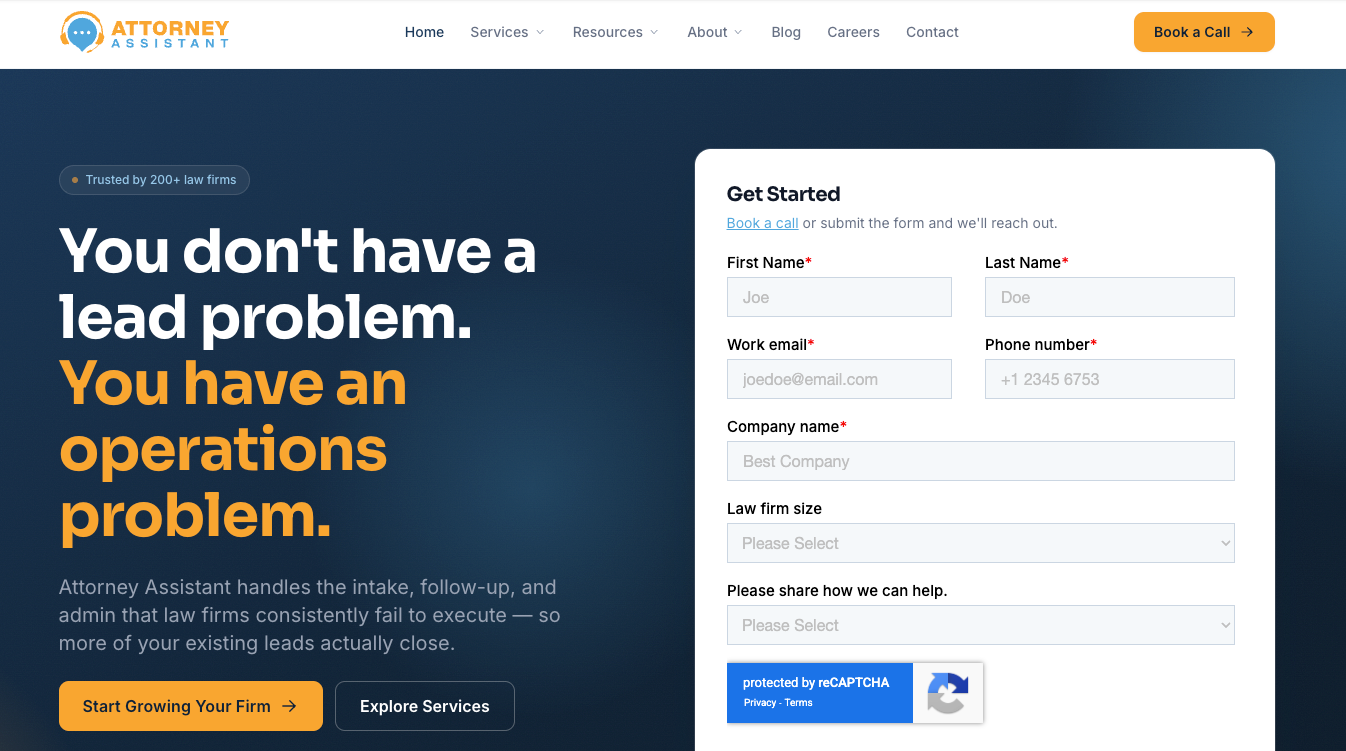
Attorneyassistant handles intake follow-up, engagement letter workflows, and administrative coordination so your team responds faster and signs more cases from the leads already coming in. Whether you want to see how your current intake stacks up or are ready to fix specific gaps, the lead follow-up service is built for firms that are done leaving signed cases on the table. You can also join an intake training webinar to work through your workflow with operational experts, or explore free tools for law firms built specifically for intake improvement. Book a call to get a straightforward assessment of where your intake is leaking revenue.
FAQ
How fast should a PI firm respond to a new inquiry?
Within 5 minutes is the standard benchmark. Personal injury prospects typically contact multiple firms, so speed determines who gets the first real conversation.
How long does a conflict check realistically take?
A properly documented conflict check requires 24 to 48 hours for clearance at most small firms. Communicating this timeline upfront prevents prospects from losing confidence during the wait.
What is the biggest intake process improvement to make first?
Fix response speed and qualification consistency before adding automation. Stage-by-stage discipline improves conversion more reliably than any single script change or technology addition.
Should intake be handled by dedicated staff or whoever is available?
Dedicated intake specialists consistently outperform ad hoc coverage on both conversion rate and client communication quality. Generalist handling introduces variation that compounds across hundreds of calls each month.
How often should firms measure intake performance?
Weekly review of drop-off rates at each intake stage is the minimum standard. Monthly reviews are too slow to catch and correct the patterns that quietly drain your conversion rate.
Recommended
- Effective law firm intake process: boost client conversion | Attorney Assistant
- Law firm client intake best practices: boost conversions | Attorney Assistant
- Master legal intake to boost PI case conversions by 40% | Attorney Assistant
- How intake technology boosts PI firm conversions | Attorney Assistant
Related Articles

What Is Intake Optimization for Law Firms in 2026
Discover what is intake optimization and how it can enhance your law firm's lead conversion. Boost revenue with effective strategies!

What Is Intake Chaos and How It Hurts Your Firm
Learn what intake chaos is and how it impacts your law firm's revenue. Discover solutions for better lead management and workflow integration.

Client Follow-Up Workflow for Law Firms: 2026 Guide
Discover how to create an effective client follow-up workflow for your law firm. Boost engagement and convert leads effortlessly!