What Is Intake Chaos and How It Hurts Your Firm

TL;DR:
- Intake chaos in law firms results from fragmented channels, unclear ownership, and disconnected workflows, leading to lost leads and revenue. Addressing it requires standardized processes, clear ownership, rapid follow-up, and seamless integration across systems, not just new forms or software. Improving intake management enhances client experience, increases conversion rates, and provides valuable data for strategic decision-making.
Most law firms believe their intake problem is a staffing issue or a missing form field. It isn’t. What is intake chaos, really? It’s the breakdown that happens when leads arrive through multiple channels, no one owns the follow-up, and prospects disappear before a single consultation is booked. This is not a back-office inconvenience. It’s a revenue problem that compounds with every unanswered call, every slow response, and every lead that quietly signs with a competitor while your team catches up on voicemail.
Table of Contents
- Key takeaways
- What intake chaos actually means for law firms
- How intake chaos costs firms clients and money
- Why better forms don’t fix the real problem
- Practical steps to reduce intake chaos in your firm
- Intake chaos vs. effective intake management
- My honest take on why intake chaos persists
- How Attorneyassistant helps firms stop losing leads
- FAQ
Key takeaways
| Point | Details |
|---|---|
| Intake chaos is operational | Fragmented workflows and unclear ownership cause lead loss, not just missing form fields. |
| Revenue leaks are hidden | Missed after-hours calls and slow follow-up are the most common sources of lost business. |
| Workflow connection matters | Fixing intake requires end-to-end workflow integration, not just better software or more fields. |
| Speed determines conversion | Responding within minutes versus hours changes whether a prospect signs with your firm or a competitor. |
| Measurement drives improvement | Tracking intake performance metrics exposes where leads drop off and which fixes have the most impact. |
What intake chaos actually means for law firms
The formal term for this problem in legal operations is intake failure or intake process breakdown, though the phrase “intake chaos” accurately describes what firms experience day to day. At its core, the intake chaos definition points to a state where new client requests arrive through disconnected channels, get handled inconsistently, and fall through the gaps before they convert.
Intake in a law firm is not just a form on your website. It’s every phone call, web inquiry, referral, social message, and walk-in that represents a potential client. When those contacts land in different places with no unified process, the result is fragmented legal workflow management that causes data re-entry, lost context, and chaotic handoffs.
What causes intake chaos in most firms comes down to four consistent problems:
- Multiple unmanaged channels. Calls go to a receptionist, emails go to a generic inbox, web forms go to a partner, and referrals are handled verbally. No single system captures all of them.
- No clear ownership. When a lead comes in, who is responsible for following up? If the answer is “whoever gets to it,” leads will wait too long or get missed entirely.
- No triage logic. Not every inquiry is equal. Without a process to prioritize time-sensitive matters, urgent leads sit alongside low-priority requests and nothing moves efficiently.
- Disconnected post-intake workflows. Even when a lead is captured, the handoff to a case manager, attorney, or scheduler breaks down. Context is lost, and the prospect has to repeat themselves.
Intake chaos reflects deeper workflow fragmentation, not a surface-level data collection problem. That distinction matters, because it changes what solutions actually work.
How intake chaos costs firms clients and money
The financial impact of poor intake is real and measurable. Leads frequently cancel after reaching voicemail during after-hours calls or receiving slow follow-up responses, and they don’t wait around. They call the next firm on their list.
“Intake is not just information capture. It’s the first moment a prospect decides whether to trust a firm.” — Lawyerist
That trust moment is fragile. A missed call at 7 p.m. on a Tuesday, or a two-day lag before anyone responds to a web form, is enough to lose a case that a competitor will sign that same week.
The operational damage goes beyond lost leads. Chaotic intake drives excessive labor waste, duplicate work, and poor reporting, all of which inflate operating costs and reduce leadership visibility into what is actually happening with new business. When your intake data is a mess, your marketing decisions are based on bad numbers.
There are four key leak points that consistently drain law firm revenue: after-hours calls that reach voicemail, website visitors who leave without any engagement, slow follow-up on submitted inquiries, and undecided prospects who never get a second contact. Each one is a gap where money exits the firm silently.
The client experience damage compounds the financial loss. A prospect who waits 48 hours for a callback, then has to explain their situation twice to different people, does not feel confident about hiring your firm. Poor intake harms client experience directly, and that perception affects referrals, reviews, and retention long after the initial contact.

Why better forms don’t fix the real problem
A common response to intake process issues is to add fields, build a new intake form, or switch intake software. These steps feel productive. They rarely solve the underlying problem.
Adding more forms without connecting them to downstream workflows creates the illusion of control without the reality of it. A lead can fill out a perfectly designed form and still fall through the cracks if no one receives a notification, no one is assigned to follow up, and no system tracks whether contact was made.
Pro Tip: Before buying new intake software, map your current lead path from first contact to signed retainer. Identify every handoff point and ask who owns each one. Most firms discover two or three disconnects that software alone will not fix.
The real issue is that intake is the first trust moment in a client relationship, not a data collection exercise. When the process is built around capturing information rather than responding to a human being, that priority mismatch shows in the outcome.
Connected legal workflow management means that when a lead comes in, the right person is notified immediately, the context travels with the lead through each handoff, and nothing requires manual re-entry. That kind of end-to-end intake management is what separates firms that convert consistently from firms that wonder where their leads went.
The connection between intake and downstream systems, including scheduling, conflict checks, case management, and billing, is where chaos either gets contained or spreads. Firms that treat intake as a standalone task rather than the first step in a connected workflow will keep rebuilding their intake process and keep getting the same results.
Practical steps to reduce intake chaos in your firm
Fixing intake process issues does not require a complete technology overhaul. It requires clarity, consistency, and a few well-placed improvements.
- Standardize how requests are captured. Pick one primary channel for each type of inquiry and build a clear process for each. Calls go to a dedicated intake line. Web forms notify a specific person within minutes. Referrals have a documented intake path.
- Assign ownership for every lead. Someone must be accountable for each incoming inquiry from first contact to either a signed retainer or a documented disqualification. Without assigned ownership, follow-up is optional by default.
- Build a triage process. Not every lead needs the same response time. A personal injury prospect calling 24 hours after an accident is not the same urgency as a business contract question. Classify and route accordingly.
- Cover after-hours contact points. This is one of the highest-impact fixes available. Automation reduces intake processing from days to minutes, but even a live answering service for after-hours calls prevents a significant share of lead loss.
- Follow up fast, and more than once. Speed matters more than polish. A quick call within five minutes of a web form submission converts at a significantly higher rate than a callback the next morning. If the first attempt doesn’t reach the prospect, a second contact within 24 hours is not aggressive. It is standard.
Here is a comparison of two intake approaches that firms commonly run, and what each produces:
| Factor | Unmanaged intake | Structured intake |
|---|---|---|
| Response time | Hours to days | Minutes |
| After-hours coverage | Voicemail only | Live or automated response |
| Lead ownership | Whoever gets to it | Assigned and tracked |
| Follow-up cadence | One attempt, if any | Defined multi-touch process |
| Reporting accuracy | Unreliable | Trackable and consistent |
Pro Tip: If you want to understand how to handle intake chaos at your firm, start with one week of tracking: log every incoming inquiry, who responded, how long it took, and what the outcome was. The data will show you exactly where you are losing business.
Balancing automation with human contact is where most firms get this wrong. Automating confirmation emails and routing is smart. Replacing the first human voice with a chatbot is not. Human contact at first response remains a critical factor in whether a prospect trusts the firm enough to move forward. The goal is to use automation to get a human to the lead faster, not to replace the human entirely. Firms that automate legal intake well use technology to handle routing and follow-up reminders while keeping the first real conversation personal.
Intake chaos vs. effective intake management
The difference between a chaotic intake process and an effective one is not the size of the firm or the sophistication of the technology. It’s whether the process is designed around the prospect’s experience or built around internal convenience.
| Metric | Intake chaos | Effective intake management |
|---|---|---|
| Lead conversion rate | Below 30% in most cases | 50% or higher with structured follow-up |
| Data quality | Incomplete, duplicated, unreliable | Clean, consistent, reportable |
| Client experience | Delays, confusion, repeated explanations | Fast response, clear next steps |
| Marketing ROI clarity | Unknown or misleading | Accurate attribution and cost-per-case data |
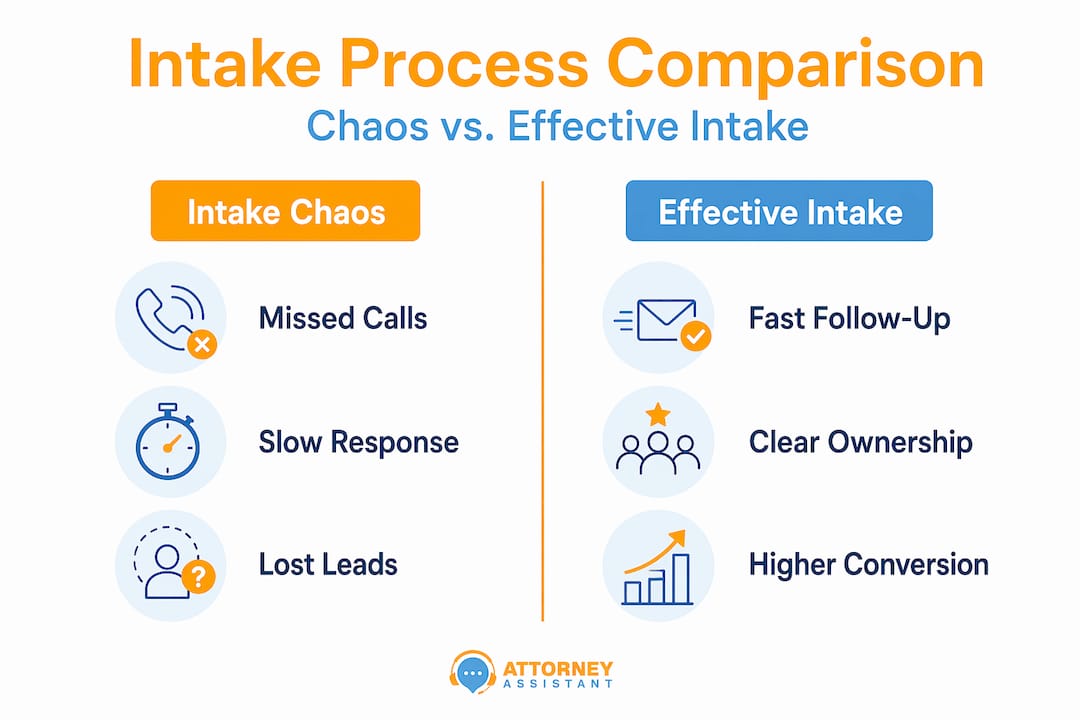
Firms with structured intake processes can directly measure law firm conversion rates and make informed decisions about where to invest in marketing. Firms running chaotic intake spend on advertising and cannot tell whether leads are converting or leaking out before anyone touches them.
Ignoring intake chaos while growing a firm accelerates the damage. More marketing spend brings more leads into a broken process, and the cost per signed case climbs while the conversion rate stays flat. The signs of intake chaos do not go away with volume. They get louder.
Firms that address intake as a growth priority rather than an administrative nuisance see the payoff across multiple areas: higher conversion rates, better client satisfaction scores, more accurate reporting, and a team that spends time on qualified matters rather than chasing down leads that should have been followed up days earlier.
My honest take on why intake chaos persists
I’ve spent years looking at how law firms handle new client contact, and the most consistent thing I’ve seen is this: intake chaos survives because no one owns it. It sits in the gap between marketing and operations, between the receptionist and the attorney, between the website and the case management system.
Most practice owners I’ve worked with didn’t realize how much business they were losing until someone ran a simple audit. Not a technology audit. A process audit. Who answered, when, what happened next. The results are almost always sobering.
The other thing I’ve noticed is that automation gets oversold as the fix. Technology is a multiplier. If your intake process is broken, automation makes it break faster and at scale. The firms that genuinely fix this problem start by clarifying ownership and expectations before they buy a single tool.
What I’ve found actually works is treating the first response as the most important moment in the client relationship, because for the prospect, it is. If your firm’s first impression is a voicemail box at 6 p.m., you’ve already lost ground. That’s not about resources. It’s about prioritization.
Intake improvement is not a one-time project. The firms that maintain clean intake processes build it into their operational rhythm. They review response time data regularly. They test what happens when a prospect calls after hours. They treat intake the way a serious firm treats billing: as something too important to assume is working.
— Nicole
How Attorneyassistant helps firms stop losing leads
If this article surfaced problems you recognize in your own firm, you’re not alone. Most firms don’t have an intake problem because they lack effort. They have one because the process was never built to handle the volume or the complexity of real lead flow.
Attorneyassistant handles intake, follow-up, and administrative workflows so firms respond faster and convert more leads into signed cases. From 24/7 intake coverage that catches after-hours calls to lead recovery services that re-engage prospects who went cold, the work is built around fixing the specific operational bottlenecks that cost firms the most revenue. If you want a clear picture of where your intake is leaking, the free intake audit is a practical starting point. Book a call and we’ll show you exactly what your firm’s intake process looks like from a prospect’s perspective.
FAQ
What is intake chaos in a law firm?
Intake chaos is the breakdown that occurs when new client requests arrive through fragmented channels, ownership is unclear, and follow-up is inconsistent. It results in missed leads, lost revenue, and a poor client experience.
What causes intake chaos?
The main causes are multiple unmanaged contact channels, no assigned ownership for incoming leads, missing triage logic, and disconnected handoffs between intake and downstream systems like scheduling and case management.
What are the signs of intake chaos?
Common signs include slow or missed responses to inquiries, leads who contacted the firm but never signed, staff uncertainty about who handles new contacts, and intake data too inconsistent to use for reporting.
How does intake chaos affect client conversion?
Slow follow-up and missed after-hours calls are the most direct causes of lost conversions. Prospects in legal matters often contact multiple firms at once, and the first firm to respond with a real human interaction typically wins the case.
How do you fix intake chaos in a law firm?
Start by mapping every contact channel and assigning clear ownership for each one. Then set response time standards, build a follow-up sequence, and cover after-hours contact points. Technology supports the process but does not replace the need for defined ownership and a human first response.
Recommended
- Free Intake Review for Law Firms Under $250K | Attorney Assistant | Attorney Assistant
- What is intake management? Streamline law firm client onboarding | Attorney Assistant
- What Is Intake Analytics for Law Firms | Attorney Assistant
- How intake shapes successful client onboarding | Attorney Assistant
Related Articles

Intake Process Best Practices for Personal Injury Firms
Discover essential intake process best practices for personal injury firms. Boost your case wins by optimizing every step from call to closure!

What Is Intake Optimization for Law Firms in 2026
Discover what is intake optimization and how it can enhance your law firm's lead conversion. Boost revenue with effective strategies!

Client Follow-Up Workflow for Law Firms: 2026 Guide
Discover how to create an effective client follow-up workflow for your law firm. Boost engagement and convert leads effortlessly!