Why Law Firms Miss Calls: Root Causes and Solutions

TL;DR:
- Missed calls cause significant revenue loss and lead to losing cases to competitors.
- Inadequate staffing, systems, and response times result in high missed call rates.
- Implementing 24/7 virtual receptionists and follow-up workflows can recover lost leads.
Every dollar you spend on marketing is wasted the moment a potential client calls and no one picks up. Studies show that missed calls cost firms significant revenue each year, yet most personal injury firm owners assume a few missed calls are harmless. They are not. Each unanswered call is a case that walks straight to a competitor. This guide breaks down exactly why calls go unanswered at small to mid-sized personal injury firms, what that silence actually costs you, and the concrete steps you can take right now to plug those intake leaks and convert more leads into signed cases.
Table of Contents
- Hidden impact: How missed calls harm intake and revenue
- Why law firms miss calls: Common pitfalls and process gaps
- Modern client expectations: Why responsiveness matters
- Practical solutions: Fixing intake and reducing missed calls
- The uncomfortable truth: Most firms underestimate intake leaks
- How Attorney Assistant helps law firms capture every lead
- Frequently asked questions
Key Takeaways
| Point | Details |
|---|---|
| Missed calls equal lost revenue | Every missed call can mean losing a valuable client and thousands in fees. |
| Common intake pitfalls matter | Reception gaps and poor systems are the main reasons law firms miss calls. |
| Client expectations have evolved | Modern clients demand fast, reliable communication and will leave for competitors quickly. |
| Solutions are actionable | Virtual receptionists, 24/7 answering, and follow-up workflows fix missed call problems. |
| Audit intake for hidden leaks | Law firms need to track every lead to identify and prevent lost revenue from missed calls. |
Hidden impact: How missed calls harm intake and revenue
Most firm owners think about missed calls as a minor inconvenience. The reality is closer to a slow financial bleed. When a personal injury prospect calls your firm and gets voicemail, they do not wait. They dial the next firm on their list. That single moment represents not just a lost call but a lost case, a lost contingency fee, and a lost referral from a satisfied client who never became your client.
Consider the math. If your firm averages a $25,000 case value and you miss just four calls per week, even a 25% conversion rate on those calls means you are leaving $6,500 on the table every single week. Over a year, that is more than $338,000 in potential revenue that evaporated before you even knew the opportunity existed.
“Missed calls often lead to lost clients and revenue” — a reality that compounds when firms continue to pour money into advertising without fixing intake first.
Here is a breakdown of how intake losses typically stack up for a mid-sized personal injury firm:
| Metric | Typical result |
|---|---|
| Calls missed per week | 4 to 8 |
| Estimated conversion rate | 20 to 30% |
| Average case value | $20,000 to $40,000 |
| Annual revenue at risk | $200,000 to $500,000+ |
The cruel irony is that most firms are simultaneously spending thousands on Google Ads and SEO to drive those very calls. You are paying to generate leads and then losing them at the first point of contact. Improving response time and conversion is almost always a faster path to revenue growth than increasing your ad budget.
Key consequences of missed calls include:
- Lost contingency fees on high-value personal injury cases
- Damaged reputation when prospects share negative experiences
- Inflated cost per acquired client because fewer leads convert
- Competitor firms capturing cases you paid to generate
Understanding legal call answering as a core business function, not just a receptionist task, is the mindset shift that separates growing firms from stagnant ones. Now that we have established the real business impact, let us explore why these calls go unanswered.
Why law firms miss calls: Common pitfalls and process gaps
Missed calls rarely happen by accident. They happen because of predictable, fixable gaps in people, process, and technology. Recognizing these patterns is the first step toward closing them.
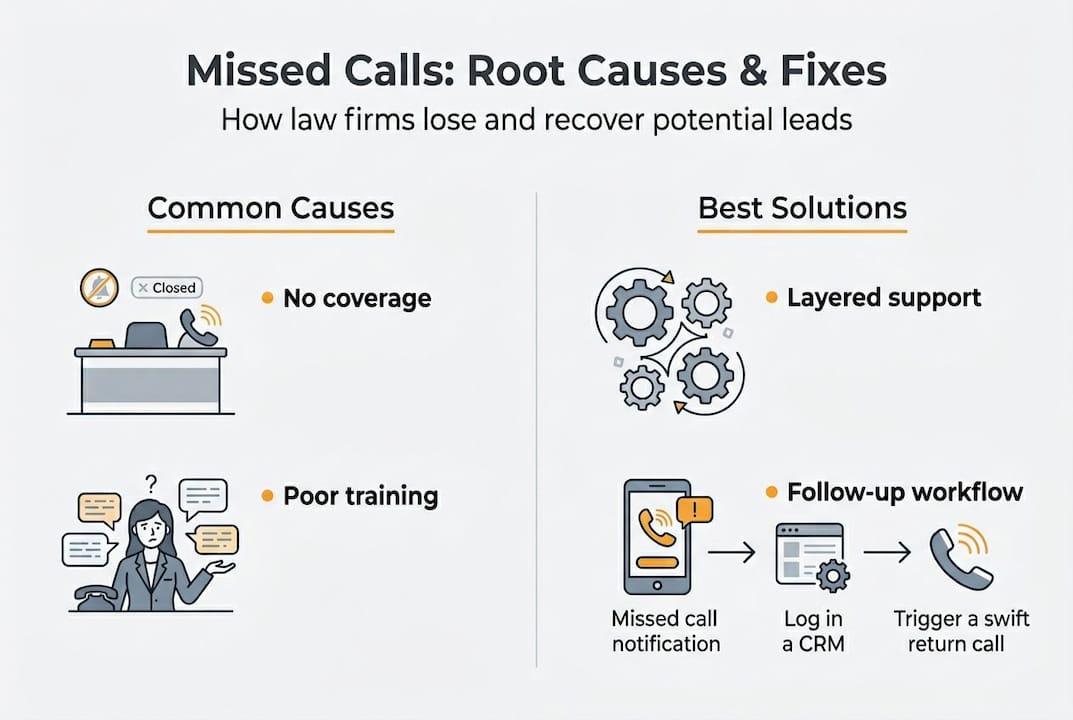
The most common culprit is staffing coverage. Receptionists take lunch breaks, call in sick, and go home at 5 p.m. Personal injury prospects do not follow business hours. Accidents happen at night, on weekends, and on holidays. If your phone coverage ends when your staff clocks out, you are structurally guaranteeing missed calls.

Training gaps are equally damaging. A receptionist who does not know how to qualify a personal injury lead, handle an emotional caller, or route an urgent case correctly can be just as costly as no receptionist at all. Poor intake handling causes prospects to disengage even when someone does answer.
Law firms often lack systems for tracking and responding to missed calls, which means opportunities disappear without anyone realizing they were ever there.
Here is a comparison of common intake setups and their weaknesses:
| Setup | Main weakness |
|---|---|
| In-house receptionist only | No after-hours or overflow coverage |
| Voicemail fallback | Clients rarely leave messages |
| Call forwarding to attorney | Attorneys are unavailable or untrained for intake |
| No tracking system | Missed calls go undetected and unfollowed |
Additional pitfalls that quietly drain your intake:
- Outdated phone systems with no call routing logic
- No callback protocol when calls are missed
- Multiple phone numbers with no unified tracking
- Staff treating intake as a secondary task rather than a priority
Exploring legal answering service benefits and reviewing phone answering service best practices can give you a clear picture of what a layered solution looks like in practice.
Pro Tip: Do not rely on a single point of failure for intake. Layer your coverage with a primary receptionist, an overflow answering service, and an automated follow-up sequence for any call that still slips through.
Understanding these pitfalls is the first step. Next, let us look at how client expectations have evolved.
Modern client expectations: Why responsiveness matters
The way people hire a lawyer has changed dramatically. A decade ago, a prospect might call a few firms, leave a message, and wait for a callback. Today, that behavior is almost extinct. Clients in 2026 expect an immediate response, and if they do not get one, they move on within minutes.
This shift is driven by how people interact with every other service in their lives. They get instant answers from Amazon, immediate confirmations from Uber, and real-time responses from customer service chatbots. When your firm sends them to voicemail, you are not just being slow. You are signaling that you do not prioritize them.
“Clients expect quick responses and will often move to another firm if ignored” — and in personal injury, where emotions run high after an accident, that window is even shorter.
Why clients refuse to leave voicemails:
- They assume no one will call back promptly
- They feel uncomfortable leaving sensitive case details on a recording
- They have already moved on to another firm by the time they would need to wait
- They view voicemail as a sign the firm is disorganized or understaffed
Enhancing response time is not just a customer service improvement. It is a direct revenue lever. Research consistently shows that leads contacted within the first five minutes are dramatically more likely to convert than those reached even 30 minutes later.
Here are the steps firms can take to meet modern client expectations:
- Answer every call live, 24 hours a day, 7 days a week
- Train intake staff to empathize and qualify on the first call
- Implement a callback system that triggers within 5 minutes of a missed call
- Use virtual receptionist options for overflow and after-hours coverage
- Measure response time weekly and set firm-wide benchmarks
Firms that treat responsiveness as a competitive advantage consistently outperform those that treat it as an afterthought. With client demands rising, addressing missed calls requires concrete improvements.
Practical solutions: Fixing intake and reducing missed calls
Knowing the problem is not enough. You need a system that catches every lead, follows up fast, and tracks what happens at every stage of intake. Here is how to build one.
Virtual reception and 24/7 answering are the foundation. Virtual legal receptionists and outsourced answering services greatly reduce missed calls by providing trained, live coverage around the clock without the overhead of a full-time employee. This is the single highest-impact change most firms can make.
Key solutions to implement immediately:
- Deploy a 24/7 answering service trained on personal injury intake scripts
- Create an automated follow-up workflow that triggers a text or email within 5 minutes of a missed call
- Audit your current phone system for routing failures and dead ends
- Set up a unified call tracking dashboard so every inbound contact is logged
- Review intake data weekly to identify patterns in when and why calls are missed
Pro Tip: Track every contact attempt, not just successful intakes. If you only measure signed cases, you will never see the leak. Log every call, every missed call, and every follow-up attempt so you can calculate your true conversion rate from first contact.
When choosing a legal receptionist service or building out your intake stack, look for providers who understand personal injury specifically. Generic answering services often fail to ask the right qualifying questions or handle emotional callers with the right tone.
Statistic to keep in mind: Firms that implement structured follow-up workflows report recovering 20 to 40% of leads that would otherwise have been lost to voicemail or delayed response. That is revenue sitting in your existing lead pool, waiting to be captured.
The virtual receptionist value goes beyond just answering phones. It extends to intake consistency, data capture, and the ability to scale coverage without scaling headcount. With these actionable steps, law firms can take charge of intake. But what is the deeper lesson industry experts overlook?
The uncomfortable truth: Most firms underestimate intake leaks
Here is what most advice on missed calls gets wrong: it treats the problem as a staffing issue when it is actually a systems issue. Hiring one more receptionist does not fix a broken intake process. It just adds one more person to a broken system.
The firms that truly solve this problem do three things differently. First, they audit every lead touchpoint, not just phone calls. Second, they measure outcomes at each stage of intake, so they know exactly where leads are dropping off. Third, they treat intake as a revenue function with the same rigor they apply to marketing spend.
Most firms operate on the assumption that if a case is meant to come in, it will. That assumption is costing you more than you realize. The firms winning in personal injury right now are the ones who have decided that “good enough” intake is not good enough. They have moved to a model where every lead is tracked, every missed call triggers a follow-up, and every intake interaction is measured.
Exploring legal call answering benefits is a practical starting point for firms ready to make that shift.
How Attorney Assistant helps law firms capture every lead
If you have read this far, you already know your intake process has gaps. The question is what you do about them.
Attorney Assistant was built specifically for personal injury firms that are tired of leaking revenue from leads they already paid to generate. Our lead follow-up services ensure no missed call goes uncontacted, and our intake 360 service gives your firm a full-coverage intake system that handles calls, follow-up, and administrative workflows around the clock. You do not need more leads. You need to stop losing the ones you have. Book a call with our team today and find out exactly how many cases your current process is leaving on the table.
Frequently asked questions
What is the average revenue lost by law firms due to missed calls?
Small to mid-sized law firms can lose tens of thousands of dollars annually from missed calls, especially in high-value practice areas like personal injury. Missed calls cost firms significant revenue each year, and the loss compounds when marketing budgets continue to grow without fixing intake.
Why don’t clients leave voicemails when their call goes unanswered?
Most clients expect an immediate response, and if no one answers, they usually call another firm rather than leaving a voicemail. Clients prefer immediate answers and will move on quickly if they feel ignored or deprioritized.
How can law firms reduce missed calls without hiring more staff?
Using virtual legal receptionists and outsourced answering services can reduce missed calls around the clock without expanding in-house staff. Virtual legal receptionists reduce missed calls efficiently while keeping overhead predictable and manageable.
What’s the fastest way a law firm can audit its intake process for missed calls?
Track every incoming call with intake logs and use technology to ensure follow-up on missed or unanswered calls. Intake logs and tech help you monitor missed calls and identify exactly where your intake process is breaking down.
Recommended
Related Articles

Inbound Calls Management for Law Firms: 2026 Guide
Discover what is inbound calls management for law firms. Learn strategies to convert leads, improve client retention, and optimize operations.

Lead Management Best Practices for Law Firms in 2026
Discover effective lead management best practices for law firms in 2026. Improve client conversion and maximize your marketing spend.

How to Reduce Intake Errors at Your Law Firm
Learn how to reduce intake errors at your law firm. Discover steps and tools to enhance client data accuracy and streamline your processes.