What is legal call answering? Improve intake and revenue

42% of high-value PI inquiries arrive after business hours, which means every unanswered call could be a six-figure case walking straight to your competitor. Most personal injury firms focus on generating more leads, but the real revenue leak is happening right now, on calls that ring out, go to voicemail, or get mishandled by an undertrained front desk. Legal call answering is not just a phone coverage solution. It is a structured intake strategy that captures, qualifies, and converts callers into signed clients. This guide breaks down exactly what legal call answering is, how it works, what compliance requirements you need to know, and how to measure its impact on your firm’s bottom line.
Table of Contents
- Defining legal call answering
- How legal call answering works in practice
- Human vs AI vs hybrid: Which model fits your PI firm?
- Compliance essentials: HIPAA, TCPA, and privilege for PI firms
- Maximizing lead capture, conversion, and ROI
- Legal call answering solutions for PI firms: Next steps
- Frequently asked questions
Key Takeaways
| Point | Details |
|---|---|
| Specialized intake process | Legal call answering goes beyond message-taking to qualify leads and collect case-critical information. |
| Compliance is crucial | HIPAA, TCPA, and attorney-client privilege must be built into every intake call. |
| Model choice affects results | Firms using hybrid (AI plus human) solutions see better intake growth and cost control. |
| Monitor intake metrics | Tracking answer and conversion rates helps small PI firms maximize case value and revenue. |
Defining legal call answering
Legal call answering is a specialized service where trained agents or AI-assisted systems handle inbound calls for law firms using custom scripts, legal intake protocols, and compliance safeguards. It is not the same as a generic answering service that takes a name and number and sends you a message.
A legal answering service is built around the specific needs of legal intake. That means agents understand legal terminology, know how to handle emotionally distressed callers, and follow structured workflows designed to capture the right information without crossing into legal advice territory. For PI firms, this distinction matters enormously.
Here is what a proper legal call answering workflow covers for a personal injury intake call:
- Professional greeting that sets the tone and builds immediate trust
- Empathy expression to acknowledge the caller’s situation before asking questions
- Case snapshot gathering including incident details, timeline, and injuries
- Qualification questions covering prior representation and case viability
- Conflict check to flag any existing firm relationships
- Next steps such as scheduling a consultation or routing to an attorney
These core mechanics are what separate legal call answering from basic message-taking. You can also see how attorney phone answering services apply these principles across different practice areas, including civil litigation call handling where intake complexity is equally high.
Common use cases for PI firms include after-hours coverage, overflow call handling during peak periods, bilingual intake support, and full-time virtual receptionist services.
How legal call answering works in practice
Knowing the definition is one thing. Seeing the step-by-step process in action is where it gets practical. Every call that comes into a PI firm should follow a consistent structure, because consistency is what drives conversion.
The intake call structure follows this sequence:
- Greeting: The agent answers with a warm, professional introduction that identifies the firm and the agent by name.
- Empathy: Before any questions, the agent acknowledges what the caller is going through. This is not optional for PI calls. Injured people need to feel heard first.
- Case details: The agent gathers the incident type, date, location, and a brief description of what happened.
- Qualification: Key questions determine whether the case fits the firm’s criteria, including injury severity and whether the caller has existing legal representation.
- Conflict and triage: The agent checks for conflicts of interest and flags urgent cases that need immediate attorney attention.
- Next steps: The call closes with a clear action item, whether that is a scheduled callback, a consultation booking, or a warm transfer.
Each stage serves a specific conversion purpose. Skipping empathy loses the caller emotionally. Skipping qualification wastes attorney time. Skipping next steps leaves the caller in limbo and dramatically increases the chance they call another firm.
Using custom call scripts built for PI intake ensures every agent follows this structure without deviation. If you are just getting started, implementing intake scripts is the fastest way to standardize your process.
Pro Tip: Always confirm the next step out loud before ending the call. Tell the caller exactly when they will hear from you and how. This single habit reduces no-shows and follow-up drop-off significantly.
Human vs AI vs hybrid: Which model fits your PI firm?
Firms today have three main options for handling legal call answering. Each has real trade-offs, and the right choice depends on your call volume, budget, and the complexity of your typical intake calls.
| Model | Cost | Answer rate | Empathy quality | Best for |
|---|---|---|---|---|
| Human agents | $1.25 to $3.50 per minute | High during staffed hours | Excellent | Complex, sensitive triage |
| AI only | From $29/month unlimited | 99.9% around the clock | Limited | Routine info gathering |
| Hybrid | Mid-range | Near 100% | High | Most PI firms |
According to ROI analysis for law firm intake, human agents excel at empathy and nuanced conversations but carry significant cost. AI delivers 24/7 coverage at a fraction of the price but needs human oversight when calls involve emotional distress or complex legal triage. The hybrid model combines both, using AI to handle routine questions and route calls, while human agents step in for sensitive or high-value conversations.

For PI firms specifically, hybrid is almost always the right answer. Your callers are often injured, scared, and making a fast decision about who to trust with their case. A purely automated experience can feel cold at exactly the wrong moment. But a fully human team is expensive and creates coverage gaps.
When choosing a virtual legal receptionist, ask vendors directly how they handle the handoff between AI and human agents, and what triggers that escalation.
Compliance essentials: HIPAA, TCPA, and privilege for PI firms
Call answering for PI firms is not just a customer service function. It is a compliance-sensitive operation. Three regulatory frameworks shape how every call must be handled.
Here is what each one requires:
- HIPAA: Personal injury cases often involve protected health information (PHI), meaning medical records, treatment details, and injury descriptions. Your call answering provider must use encrypted communication channels, sign a Business Associate Agreement (BAA), and train all staff on PHI handling protocols.
- TCPA: The Telephone Consumer Protection Act governs outbound calls and follow-up messages. Before calling or texting a lead back, you need documented consent. Your team must also scrub contact lists against the Do Not Call (DNC) registry.
- Attorney-client privilege: Intake agents must never provide legal advice. Every call should include a clear disclaimer that the conversation does not create an attorney-client relationship until formally established.
These key compliance requirements are not optional. A single TCPA violation can cost between $500 and $1,500 per call. HIPAA breaches carry penalties up to $1.9 million per violation category annually.
Pro Tip: Review your call scripts with a compliance checklist every quarter. Regulations change, and a script that was compliant last year may have gaps today. Your intake compliance solutions should include a built-in audit process.
Maximizing lead capture, conversion, and ROI
Legal call answering only becomes a revenue engine when you measure it. Most PI firms track leads and signed cases but ignore the conversion data sitting in their call logs.
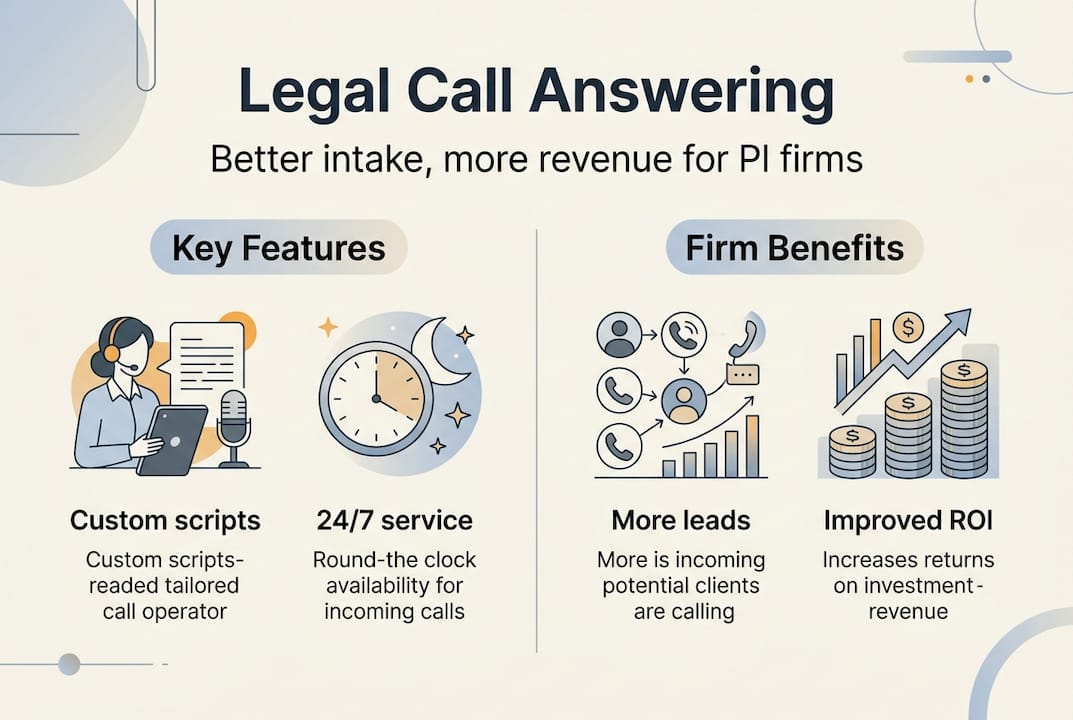
Here are the benchmarks that matter:
| Metric | Target benchmark | Why it matters |
|---|---|---|
| Answer rate | Above 80% | Missed calls are missed cases |
| Lead to intake conversion | 8% to 12% | Measures script and agent quality |
| Intake to signed case | 30% to 50% | Reflects attorney follow-up speed |
| ROI on call answering | 3x to 5x | Validates the investment |
PI firms targeting 40%+ intake growth and 3x to 5x ROI use optimized, compliant call answering as the foundation of their intake system. That kind of growth does not come from more ad spend. It comes from capturing and converting the leads already coming in.
Here are the top strategies to improve your numbers:
- Add bilingual coverage. A significant portion of PI callers are non-English speakers. Bilingual agents increase answer-to-intake conversion for this segment dramatically.
- Automate post-call follow-up. Send a confirmation text or email within five minutes of every intake call. Speed signals professionalism and keeps your firm top of mind.
- Track and review call recordings weekly. Identify where callers drop off and adjust scripts accordingly.
- Hire or designate an intake specialist. A dedicated intake specialist for your law firm owns the conversion process and keeps agents accountable.
- Connect intake to your SEO strategy. Strong intake performance impacts your Google ranking through engagement signals and review generation.
Setting clear intake department goals gives your team a target to work toward and makes performance reviews meaningful instead of subjective.
“PI firms that implement optimized, compliant call answering consistently target 40% or more intake growth and achieve 3x to 5x return on investment within the first year.”
Legal call answering solutions for PI firms: Next steps
Everything covered in this guide points to one conclusion: the firms winning in PI are not necessarily the ones with the biggest ad budgets. They are the ones who answer every call, qualify every lead, and follow up before the caller has time to dial someone else.
Attorney Assistant builds intake and call answering systems specifically for PI firms. From ready-to-use intake solutions with custom scripts and compliance frameworks, to AI and hybrid call answering options that keep your firm responsive around the clock, we handle the operational side so your attorneys can focus on cases. Join our webinar for PI firm owners to see how other firms are applying these strategies right now, or book a demo to walk through what a fully optimized intake system looks like for your specific firm size and practice focus.
Frequently asked questions
What makes legal call answering different from typical business answering services?
Legal call answering uses custom legal scripts to capture case details, qualify leads, and manage compliance requirements. Basic answering services only take messages without any intake structure or legal-specific protocols.
How does HIPAA impact personal injury law firm call answering?
HIPAA requires that any service handling PI intake calls use encrypted channels, sign a BAA, and train staff on PHI handling requirements to protect client health information during intake.
Is an AI or human answering service better for my law firm?
Hybrid models that combine AI for routine calls with human agents for complex or sensitive triage give PI firms the best balance of cost efficiency and client experience.
What metrics should I track to measure intake success?
Focus on answer rate (target above 80%) and lead conversion rates of 8% to 12% as your primary indicators of how well your call answering process is performing.
Recommended
Related Articles

Inbound Calls Management for Law Firms: 2026 Guide
Discover what is inbound calls management for law firms. Learn strategies to convert leads, improve client retention, and optimize operations.

Lead Management Best Practices for Law Firms in 2026
Discover effective lead management best practices for law firms in 2026. Improve client conversion and maximize your marketing spend.

How to Reduce Intake Errors at Your Law Firm
Learn how to reduce intake errors at your law firm. Discover steps and tools to enhance client data accuracy and streamline your processes.