At 9:14 p.m., a prospective client calls your firm. The receptionist has gone home, the attorney's phone is silenced, and voicemail answers with the confidence of a locked office door. The caller may leave a message. They may also call the next firm on the search results page.
That is the core purpose of a 24/7 phone answering service for a law firm. It isn't just about keeping the line open after business hours. It's about determining whether an inquiry becomes a qualified opportunity, a scheduled consultation, and eventually a signed matter, or becomes another message nobody owns.
A 2016 study of 85 small businesses across 58 industries found that only 37.8% of inbound calls were answered by a person. Another 37.8% went to voicemail, while 24.3% received no response, meaning 62.1% failed to produce a live conversation according to the study summary. The data is historical and broad, not a current universal benchmark for law firms. The operational lesson remains unpleasantly familiar: ordinary staffing leaves gaps, and legal inquiries don't wait politely for the office to reopen.
Table of Contents
- The After-Hours Call That Decides Your Quarter
- What a 24/7 Phone Answering Service Actually Does
- Why Seconds Matter More Than Coverage
- Features Worth Evaluating Before You Sign
- How Pricing Models Behave
- Plugging 24/7 Intake Into Your Existing Workflow
- Recording, Consent, and Privilege Before You Turn It On
- Choosing a Partner and Knowing What to Ask Next
The After-Hours Call That Decides Your Quarter
A serious call arrives after the office closes. It might involve an arrest, a collision, a custody emergency, a business dispute, or a prospective client who has finally decided to stop searching and speak with someone. The firm's marketing did its job. The phone rang. Then the process ended at voicemail.
That sequence is expensive because the call is not a customer-service ticket. It's an opportunity with a short attention span. The caller wants to know whether the firm handles the matter, whether someone can help, and what happens next. If the only answer is “leave a message,” the firm has transferred the most important part of intake to the caller.
Practical rule: If the firm can't explain who owns an after-hours inquiry, it doesn't have an after-hours process.
A 24/7 service is supposed to close that gap with live coverage during nights, weekends, holidays, attorney absences, court appearances, and overflow periods. But the buying decision isn't really about telephones. It's about revenue workflow.
A useful service should answer the call, capture the facts that determine fit, identify urgency, route the matter appropriately, book the next step, and create a record someone can act on. It should also follow up when the caller doesn't answer the first callback. Technically, calling someone four days later is follow-up. It isn't particularly useful follow-up.
The rest of this guide treats after-hours coverage as operational infrastructure. The question isn't whether an agent can say hello at midnight. The question is whether your firm can turn that conversation into a properly qualified, ethically usable intake without asking an attorney to reconstruct it from a vague voicemail over coffee.
What a 24/7 Phone Answering Service Actually Does
Many firms use “answering service” to describe two very different products. The first answers, takes a message, and sends the details somewhere. The second performs live legal intake, which means it gathers information, applies the firm's rules, and moves the inquiry toward a defined next action.
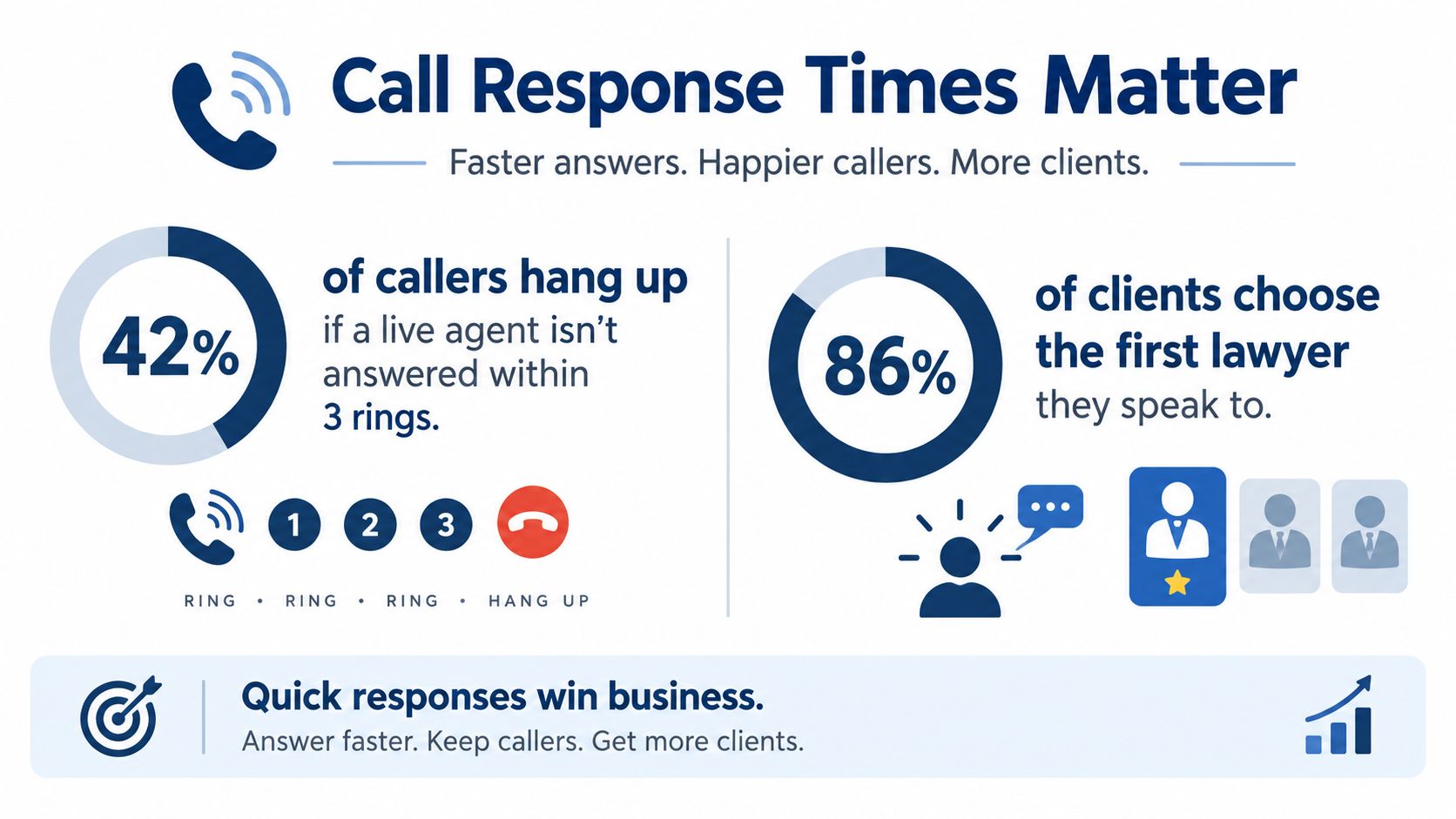
The distinction matters. In Clio's 2024 secret-shop study, only 40% of 500 law firms answered prospective-client calls, while 48% were effectively unreachable even after callbacks Clio reports. A firm can beat that baseline just by answering. It won't necessarily convert more matters unless the answer is connected to qualification and follow-up.
Message-taking versus intake
A message-taking service usually produces a voicemail substitute. The caller's name, number, and a short note arrive in an inbox. Someone at the firm must then determine the matter type, jurisdiction, urgency, conflicts, attorney assignment, consultation availability, and follow-up plan.
Real intake starts earlier. The agent should use structured questions and branching scripts to classify the matter, identify jurisdictional limits, flag potential statute-of-limitations concerns where appropriate, prompt for conflict-check information, and determine whether a warm transfer is justified. Coverage without qualification is not intake.
A proper process should produce one of several outcomes:
- Qualified consultation: The appointment is booked with the right person and the relevant information is recorded.
- Attorney escalation: An urgent or high-value inquiry is transferred according to a defined rule.
- Follow-up task: The caller needs additional contact, and the next attempt has an owner and a due time.
- Disqualification or referral: The reason is documented rather than left to guesswork.
The service should also know its boundaries. Intake staff can gather facts and explain firm process. They shouldn't give legal advice, promise an outcome, or improvise an answer because the script became inconvenient.
A live agent who records a complete, usable intake creates operational value. An agent who records “John called about an accident” has created administrative homework. Your attorneys went to law school to practice law. Ideally, they should occasionally get to do that.
The practical test is simple: ask to see the completed intake record, disposition codes, escalation workflow, and follow-up task created by a sample call. If the vendor can show only a call log, you're buying a nicer voicemail box.
Why Seconds Matter More Than Coverage
A prospective client calls at 8:47 p.m., gets a live person at 8:48, and hangs up at 8:51 still unsure what happens next. On paper, your firm had after-hours coverage. In revenue terms, you may have paid for a fast miss.
Speed matters because intent expires quickly. Research summarized from MIT Sloan found that across more than 1 million sales calls, the odds of converting a lead dropped by 100 times when the response came after 30 minutes instead of within 5 minutes as summarized in this missed-call research. Legal intake is not identical to general sales, but the operational lesson carries over cleanly. The window to connect is short, and it gets worse fast.
Consumer expectations do not give law firms much room to hide. 79% of consumers expected a response within 24 hours, and Clio also points to roughly five minutes as the strongest contact window for lead response Clio's legal trends reporting. Firms that treat an evening inquiry as tomorrow morning's admin task are not being patient. They are handing the next call to a competitor.
Still, the first answer is only the start of the workflow. If your answering service picks up quickly but fails to classify the matter, set a next action, or trigger follow-up, the clock keeps running, just under a nicer label.
Track the handoff like an intake pipeline, not a phone log.
- Inbound time: When the inquiry entered the firm's process.
- Live-answer time: When a person first spoke with the caller.
- Qualification completion: When the matter was classified and required facts were captured.
- Booking or escalation time: When the consultation was scheduled or the call was routed.
- Follow-up attempts: When the firm tried to reconnect.
- Retainer status: Whether the matter progressed to signing.
This is the difference between phone coverage and revenue coverage.
Clio's reporting also shows how often firms waste the moment after they answer. Only 41% of firms provided rate information, 12% offered cost estimates, and 36% explained the legal process or next steps during phone interactions. That gap matters because callers are not looking for a heartbeat on the line. They want to know what happens now. A trained agent does not need to give legal advice. The agent does need to capture the right facts, explain the process the firm has approved, and leave the caller with a concrete next step instead of uncertainty.
Judge vendors on outcomes that map to intake performance: speed to answer, qualified-lead rate, booked consultations, completed follow-up, and signed retainers. If the reporting stops at call counts, you are measuring motion, not progress.
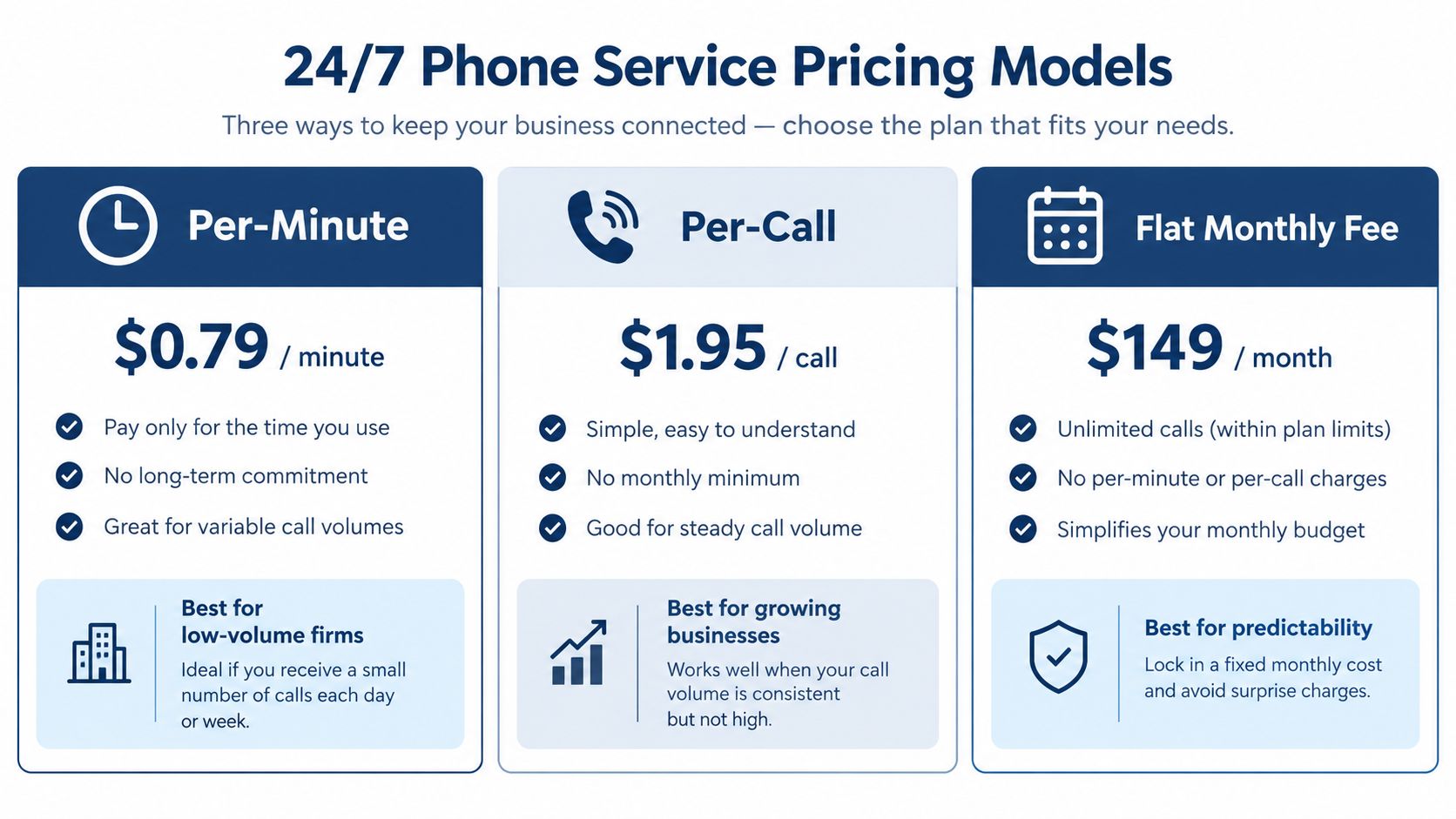
Pricing can also distort behavior. A per-minute model may reward shorter calls when your process needs better qualification. A per-call model may look tidy until repeat follow-ups pile up. A flat monthly fee may be sensible, or it may hide weak handling behind predictable billing.
If you need to estimate how long scripted calls and follow-up tasks may take, you can browse SemDash scripts as a practical planning resource. It will not tell you whether your intake converted, but it can help you model workload before you commit to a pricing structure.
Features Worth Evaluating Before You Sign
A vendor demonstration should feel less like a phone-system tour and more like an intake audit. Ask the vendor to walk through a realistic call from greeting to disposition, then inspect every handoff.
Start with the agent and the script
Ask whether coverage is provided by live humans, whether agents can handle English and Español, and how the team is trained on legal intake boundaries. Then request the actual script before signing. A polished demonstration script isn't enough. You need to see how it branches when the caller has the wrong jurisdiction, an urgent deadline, a potential conflict, or a matter the firm doesn't accept.
The script should include:
- Matter classification: What facts separate one practice area from another?
- Jurisdiction prompts: How does the agent identify where the issue occurred and where representation may be needed?
- Urgency rules: Which facts trigger immediate escalation?
- Conflict information: What names, entities, opposing parties, or related details must be collected?
- Expectation-setting: What can the agent explain about process, rates, consultation timing, and next steps without giving legal advice?
Then inspect the machinery
A good intake record should enter the firm's CRM or case-management system without a second round of transcription. Ask the vendor to demonstrate the integration using your actual fields, not a generic screen. Calendar booking should select the correct attorney, paralegal, consultation type, and availability rather than placing every caller into one large scheduling bucket.
Warm transfers also need rules. Who receives the call? During which hours? What happens if the attorney doesn't answer? Does the agent stay on the line, leave context, and create a fallback task?
Use this checklist during the demo:
| Capability | What to verify in the demo | Red flag to watch |
|---|---|---|
| Live human coverage | Ask for an after-hours test call and language options | The vendor describes availability but avoids explaining staffing |
| Structured intake | Request matter-specific branching and required fields | One generic script for every practice area |
| Conflict prompts | Show how names and opposing parties are captured | Conflicts are left to the attorney to discover later |
| CRM integration | Create a test record in the firm's actual system | The vendor sends an email for manual entry |
| Calendar booking | Book a consultation with defined routing rules | Every appointment goes to a shared calendar |
| Warm transfer | Test answered, missed, and urgent-call scenarios | “Someone will call back” is the entire escalation plan |
| Quality assurance | Review recorded or scored calls and coaching workflows | No call review process or ownership |
| Reporting | See qualified leads, appointment-set rate, and signed retainers | The main metric is total calls answered |
Call quality assurance matters because scripts drift. Agents skip questions, staff preferences change, and a workflow that worked during onboarding becomes folklore. The firm should receive enough reporting to identify whether failure comes from low answer rates, poor qualification, weak booking, or incomplete follow-up.
How Pricing Models Behave
A 24/7 answering service is not a phone expense. It is an intake cost structure. If the pricing model rewards time instead of progress, or counts dead-end calls the same as retained matters, the firm pays for activity and still loses revenue.
Start with what gets billed.
Per-minute pricing charges for conversation time. That works for low call volume and short, clean inquiries. It gets expensive fast when agents spend time calming a caller, chasing missing facts, or handling matters the firm should decline. Long calls can still produce nothing useful, and the invoice will not care.
Per-call pricing is easier to forecast. One inbound call, one charge. The problem is obvious. A wrong number, an existing-client status check, and a well-qualified new matter can all cost the same. That makes bookkeeping simple and intake analysis sloppy.
Flat monthly pricing gives the firm a steadier number to budget against, but only if the limits are real and readable. Check the cap, overage rules, transfer fees, setup costs, scheduling limits, and whether follow-up is included or billed separately. Many “predictable” plans stay predictable right up to the month your volume shifts.
Action-based credits move closer to how firms make money. The unit is completed work, not agent presence. That work may be a qualified intake, appointment set, warm transfer, or follow-up attempt. Attorney Assistant's Frontline model includes 75 credits per month, runs month to month, and charges overage by credit. The important question is simple. Does a credit represent work your firm would otherwise pay staff or attorneys to do?
Do not compare pricing pages in isolation. Compare them against your own intake path.
Pull a month of call records and sort them into categories: new matters, existing clients, vendors, wrong numbers, repeat callers, and anything that needed after-hours escalation. Then mark what happened next. Did the call need qualification, booking, a transfer, a callback, or nothing at all? That exercise tells you whether a cheap per-call plan is billing for noise, or whether a minute-based plan is charging premium rates for calls that never had a chance.
A short worksheet is enough:
- Count inquiries by type.
- Measure average talk time.
- List billable actions, including qualification, booking, transfer, and follow-up.
- Add internal labor costs, such as manual CRM entry, attorney callbacks, and cleanup work.
- Compare outcomes, not just answered-call totals.
Bad buying decisions show up here. A low per-minute rate can hide the cost of incomplete intake and attorney rework. A flat monthly fee can look safe until overages and exclusions start stacking. An action model can be cleaner to manage, but only when the vendor defines each action clearly and reports on it consistently.
For contract terms, IT support cost negotiation tips make the right point. Review scope, exclusions, escalation rules, and renewal terms instead of staring at the headline number. For a side-by-side look at service structures, use Attorney Assistant's virtual receptionist pricing guide. The fee matters. The handoff after the call matters more.
Plugging 24/7 Intake Into Your Existing Workflow
A night call should enter the same revenue path as a daytime inquiry. If after-hours intake ends in an inbox, a sticky note, or a callback someone remembers to make, you did not buy coverage. You bought delay.
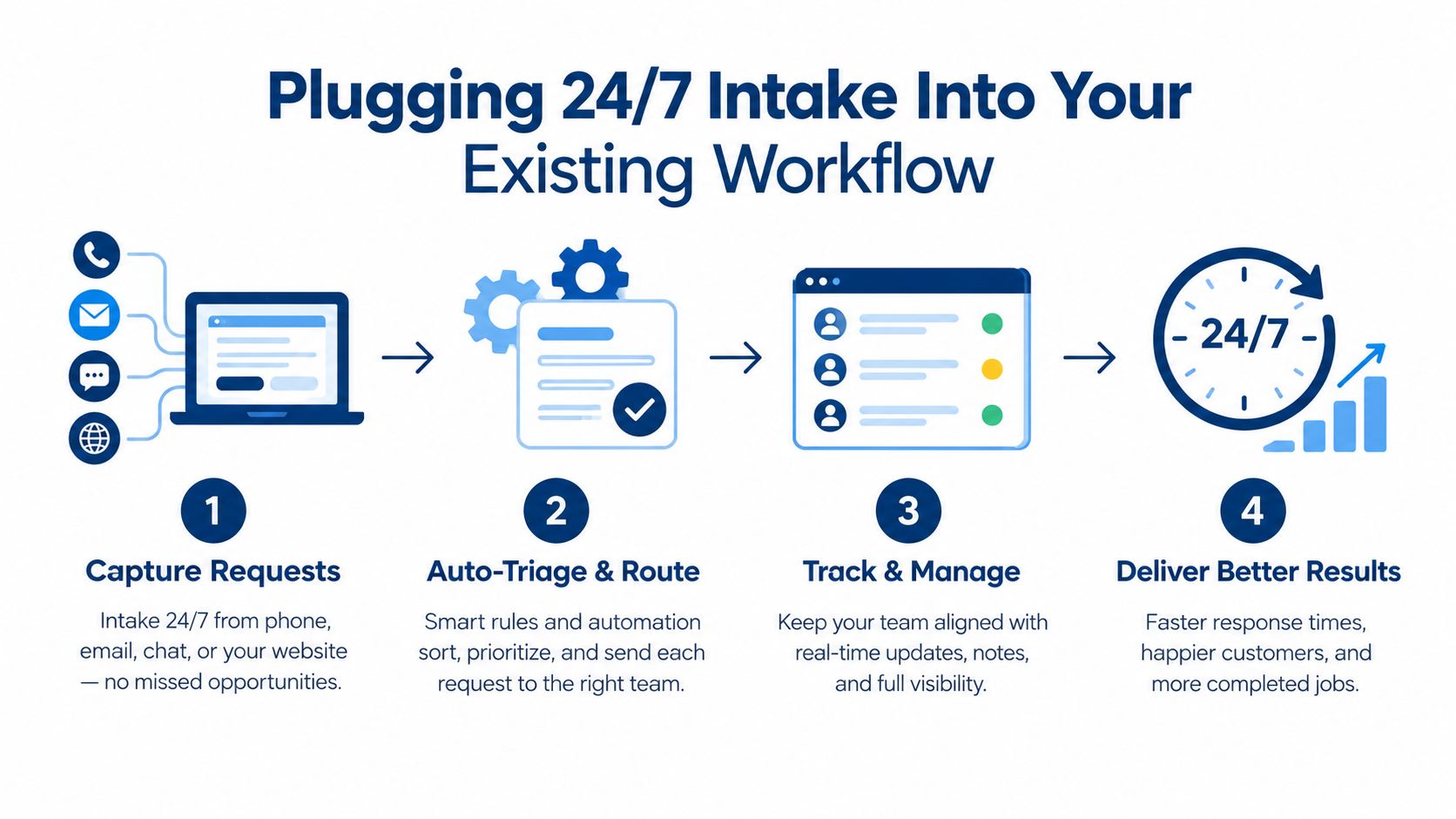
Start at the point where money is won or lost. The agent needs to create or update the CRM or case-management record while the call is happening, with the matter type, caller details, opposing-party information, jurisdiction, urgency flags, source, and disposition entered in the right fields. If a lawyer or intake manager has to retype the summary before anyone can run a conflict check, book a consultation, or decide on next steps, the workflow is broken.
Order matters here, because each bad handoff creates rework.
Create one record first. That sounds obvious until duplicate contacts, loose notes, and half-filled forms start colliding with conflict checks and follow-up tasks. One source of truth keeps intake from becoming an argument about which version of the caller is real.
Then route based on ownership, not convenience. Calendar rules should match practice area, attorney availability, and urgency. A personal-injury consult, a family-law emergency, and a business dispute do not belong in the same queue because that was the fastest setup.
Follow-up comes next, and firms often waste good leads. A missed callback needs a defined sequence across phone, text, and email, where legally and operationally permitted. Log the time, channel, outcome, opt-out status, and next action every time. Otherwise the report says “attempted,” and nobody can tell whether anyone worked the lead.
Close the loop with a real disposition. Consultation scheduled, attorney escalation, follow-up task, disqualified matter, referral, or no contact after defined attempts all mean something. “Handled” means nothing.
The technical work is usually plain and annoying. APIs, field mapping, user permissions, and error handling decide whether calls turn into usable matters or die in transit. Firms sorting through that setup can review business API integration services for the kinds of integration questions that matter behind the scenes.
Ownership still belongs to the firm. Attorney Assistant's co-managed model makes that point well. The service operates inside the firm's workflows, while the firm keeps control over procedures, permissions, and escalation rules. A dedicated Staffline professional can also handle CRM hygiene, calendar management, intake administration, and similar recurring support when daytime follow-up needs an owner instead of a vague promise.
After launch, track the leaks that affect conversion:
- Abandonment rate, callers who quit before reaching a person
- Speed to answer, how fast a live agent responds
- Qualified-lead rate, inquiries that meet acceptance criteria
- Appointment-set rate, qualified callers who get a scheduled next step
- Warm-transfer rate, priority calls routed successfully
- Signed-retainer rate, qualified opportunities that become signed matters
Use the numbers to find the broken step. A CRM cannot recover revenue from a lead that never entered the system correctly.
Recording, Consent, and Privilege Before You Turn It On
Recording and transcription can improve quality assurance, but they also create confidentiality, privilege, access, retention, and consent questions. A firm should answer those questions before the first call is recorded, not after a transcript appears in the wrong system.
A 2025 New York City Bar opinion advises attorneys to obtain client consent before recording calls, assess confidentiality and privilege risks, review AI-generated work product for accuracy, and account for states that require two-party consent the opinion explains these issues. The opinion concerns attorney obligations and ethical issues, not a universal vendor configuration. It makes one operational point clear: a recording feature isn't ethically self-managing.
Ask the vendor:
- Who is recorded? Does recording begin with every call, only after consent, or only for selected workflows?
- Where is data stored? Identify the location of recordings, transcripts, summaries, and backups.
- How long is it retained? Confirm retention periods and deletion controls.
- Who can access it? Review vendor staff access, firm permissions, audit logs, and export rights.
- Is AI involved? Determine whether a system transcribes, summarizes, classifies, or generates follow-up tasks.
- Can recording be disabled? The firm should be able to use live coverage without accepting one fixed data policy.
Two-party-consent requirements can make a generic greeting inadequate. The script may need jurisdiction-aware language, an escalation path when consent is declined, and a rule preventing sensitive information from being entered into an automated summary before attorney review.
Firms should also separate quality review from matter decision-making. A call recording can help coach an agent. An AI-generated summary should not become the factual basis for a legal decision without human verification.
Before implementation, map recording and deletion rules into the engagement terms, onboarding checklist, and vendor access controls. Attorney Assistant's guide to call recording consent can help frame that review, but the firm should obtain jurisdiction-specific advice where necessary.
Choosing a Partner and Knowing What to Ask Next
Take this checklist into the vendor call:
- Confirm live coverage. Ask who answers nights, weekends, holidays, and overflow calls.
- Request the script. Review matter branching, conflict prompts, jurisdiction questions, urgency rules, and expectation-setting.
- Inspect dispositions. Ask for the complete list of outcomes and the follow-up action attached to each one.
- Test integrations. Use the firm's CRM, case-management system, and calendar, not a generic demo account.
- Clarify consent handling. Ask how the vendor identifies two-party-consent situations and whether recording can be disabled.
- Demand outcome reporting. Require qualified leads, appointment-set rate, follow-up completion, and signed-retainer reporting, not only call volume.
- Define ownership. Identify who changes scripts, reviews quality, handles escalations, and corrects incomplete records.
The central question isn't whether the firm can afford 24/7 coverage. It's whether the firm can afford another quarter of missed matters, delayed callbacks, and attorneys reconstructing intake from scraps.
Attorney Assistant's Frontline provides 24/7 live intake with answering, qualification, follow-up, warm transfers, appointment setting, and case signing. Staffline provides dedicated full-time legal support professionals for ongoing work such as intake administration, CRM hygiene, records, calendars, case management, and other operational tasks. Use the first when the gap is live opportunity capture, and evaluate the second when the gap is the daytime capacity required to keep the workflow moving.
Attorney Assistant combines Frontline's 24/7 live intake with dedicated Staffline legal support so firms can capture inquiries, follow up consistently, and move administrative work away from attorneys. Visit Attorney Assistant to review the operating model and identify where your firm is losing opportunities or capacity.
Related Articles

How to Call Answer Phone for Your Law Firm
Learn how to call answer phone professionally at your law firm. A practical guide to building 24/7 intake, scripting, and follow-up that signs cases.

Live Virtual Receptionists for Law Firms: A Practical Guide
Learn how live virtual receptionists help law firms capture more leads, qualify intake, and operate 24/7 without adding attorney workload.

Telephone Answering Services for Law Firms Explained
Telephone answering services for law firms explained, including features, pricing models, risks, and how to choose and integrate the right partner.