Pull your phone system's call log for last month and filter for anything that arrived outside 9 to 5. Most firms find the same three things: a run of short calls that never connected, a couple of abandoned ones with a 40-second wait at the top, and a voicemail box functioning as a digital lost and found. Nobody owns those calls. They land in a shared inbox, get forwarded once, and die there while everyone assumes somebody else handled it.
The uncomfortable part isn't the volume. It's the timing. Calls that arrive when your office is dark tend to come from people in the middle of something: a crash, an arrest, a termination letter, a deadline that just got served. They aren't browsing. They're working down a list, and your firm is one line on it.
After hours service is the answer to that gap, assuming you know what you're buying. The phrase gets applied to four or five different arrangements, and most of the price confusion in this market comes from firms comparing one model against another without noticing they aren't the same product.
Table of Contents
- What After Hours Service Covers and What It Does Not
- Three Operating Models Compared Side by Side
- What Unanswered Calls Really Cost Your Firm
- Escalation Rules That Keep Intake Safe
- Metrics That Prove Your Coverage Works
- Audit Your Calls and Launch a Working System
- 1. Audit the last 30 days of call logs by window
- 2. Confirm the four service levels
- 3. Compare missed inquiries against the cost formula
- 4. Request written quotes with identical scopes
- 5. Build the script from the minimum data set
- 6. Set the KPIs and reporting cadence before launch
- 7. Pilot for two weeks, then adjust
- What to ask a provider before you sign
What After Hours Service Covers and What It Does Not
It is Friday at 6:40 PM. A caller has been rear-ended and is contacting the first firms that appear on their phone. A recording asks them to call back during business hours. They leave a hurried message, then sign with a firm that answers live. The recording may register a completed call on a dashboard. It does not capture the lead.

After-hours coverage handles calls at night, on weekends, and during business-hour overflow. At close of business, calls can roll over to the Attorney Assistant team. When call volume spikes during the day, overflow answering keeps callers from going to voicemail. The distinction is what happens after someone picks up.
A message-taking service records a name and number. Intake gathers information relevant to the firm's process, identifies urgency, and routes the inquiry for follow-up. That is lead capture, not legal advice or conflict clearance. Staffline carries the case once it is signed.
The four windows you have to plan for
- Evenings: Golden Hours are 5 to 9 PM, when answer and conversion rates are highest. Live answering runs every evening.
- Weekends: Coverage runs all weekend. A call at an inconvenient hour still needs a defined destination.
- Holidays: Holiday coverage matters because callers do not schedule legal problems around the office calendar.
- Overflow: A surge during business hours can leave calls unanswered if the receptionist is already helping someone else. Overflow coverage answers those calls instead of sending them to voicemail.
Every after-hours caller should reach a live person who knows the firm, its scripts, and its intake process. A live answer can capture the inquiry and send it into the firm's follow-up workflow. It does not, by itself, resolve conflicts or authorize legal advice.
Consumer support research cited in reporting on support agent availability found that many consumers expect access outside standard weekday business hours. That is a broad consumer expectation, not a legal-industry benchmark. For a firm, the practical question is whether an inquiry can be captured and acted on, not whether an automated system can report that a call was acknowledged.
The same distinction matters when reviewing call data. One analysis of 1,446,980 calls across 2,074 businesses reported that 28.5% arrived outside standard business hours in 2025, using a broader definition, and 14.1% under a stricter 2026 definition (Redial BPO's after-hours call analysis). Those figures use different definitions. Set yours before comparing periods: specify whether evenings begin at 5 PM, whether weekends count, and whether business-hours overflow is included. Otherwise, a change in reporting rules can look like a change in demand.
Where after-hours coverage stops
After-hours staff can capture and route an inquiry, but they do not give legal advice, clear conflicts, or decide whether the firm should accept a matter. If a caller asks whether they have a case, the appropriate next step is a consultation with the firm, not an opinion from the person answering.
At the start of each business day, the firm's team should receive a complete summary of after-hours interactions, with leads qualified and prioritized. That gives staff a queue to work, rather than a voicemail box to search.
Check three points in your own call flow:
- Who answers at 9 PM on a Tuesday? A live person, a recording, or nobody?
- What does the intake record contain? A name and number, or the details needed to route and follow up?
- Who receives the morning summary? Identify the team responsible for acting on each lead.
Three Operating Models Compared Side by Side
The models differ in who owns the intake process, how much a caller's information is developed, and what happens after the first contact. A live answer can capture a lead; it does not automatically mean the caller has been qualified, followed up, or routed safely.
| Model | Who answers | Coverage | Cost pattern | Best fit |
|---|---|---|---|---|
| In-house after-hours staff | Firm employees on rotation or on call | When staff are scheduled and available | Salary, benefits, and overtime, regardless of call volume | Firms with steady night volume and enough staff to rotate |
| Outsourced answering service | Shared operators working across clients | Often 24/7 for message capture | Per-call, per-minute, or flat monthly fee, with scope set in the quote | Firms that need basic message capture |
| Co-managed live intake | A live team integrated with the firm's scripts and intake process | Nights, weekends, and overflow, with calls answered live | Monthly plan; Frontline Pro is $997 per month and includes 75 credits | Firms that need live intake, qualification, follow-up, and handoff |
In-house staff. Your employees know the firm and can make judgment calls within their role. The trade-off is coverage reliability: rotations depend on people being available, and salaries continue whether calls arrive or not. PTO, illness, and holidays can leave gaps unless coverage is planned.
Outsourced answering service. A shared service can be a practical fit when the goal is to take a message. The limitation is what happens after that message: basic capture does not itself qualify a lead, arrange follow-up, or ensure the firm acts on the inquiry. Compare the actual intake steps included, not just the promise of a live answer. The Voicedial.ai legal call answering overview outlines the category.
Co-managed live intake. Every after-hours caller reaches a live person who knows the firm, its scripts, and its intake process. Calls roll over to the team at close of business; coverage also includes nights, weekends, holidays, and overflow. Each morning, the firm receives a summary of after-hours interactions, with leads qualified and prioritized. The trade-off is that the firm still needs clear intake rules and a process for reviewing and acting on those summaries.
Pairing 24/7 live intake with a dedicated full-time staff member can cover a firm from the first call through case resolution. The right division of work depends on the firm's needs and is scoped in a discovery call. A Staffline firm can add hours, roles, or coverage without recruiting, while its dedicated assistant handles ongoing operational work.
How to compare them without getting fooled
Compare the models against the same three criteria: when calls are answered, how far intake goes, and who owns the next action. Separate lead capture from conflict-safe triage: collecting a caller's details is not a conflict check or a decision about whether to accept the matter. An automated acknowledgment may confirm that a message arrived, but it does not qualify the lead or complete follow-up.
For pricing, distinguish a monthly plan from action-based credits. Frontline Pro costs $997 per month and includes 75 credits. The important comparison is what the service does with each call, not whether the fee is flat or usage-based.
What Unanswered Calls Really Cost Your Firm
At 6:45 PM, a prospective client calls with a deadline approaching. Voicemail records a number and a partial story; it does not capture a qualified lead or decide who should respond. The cost is not just the missed call. It is the lost intake opportunity, the follow-up work, and the risk that nobody sees the message in time.
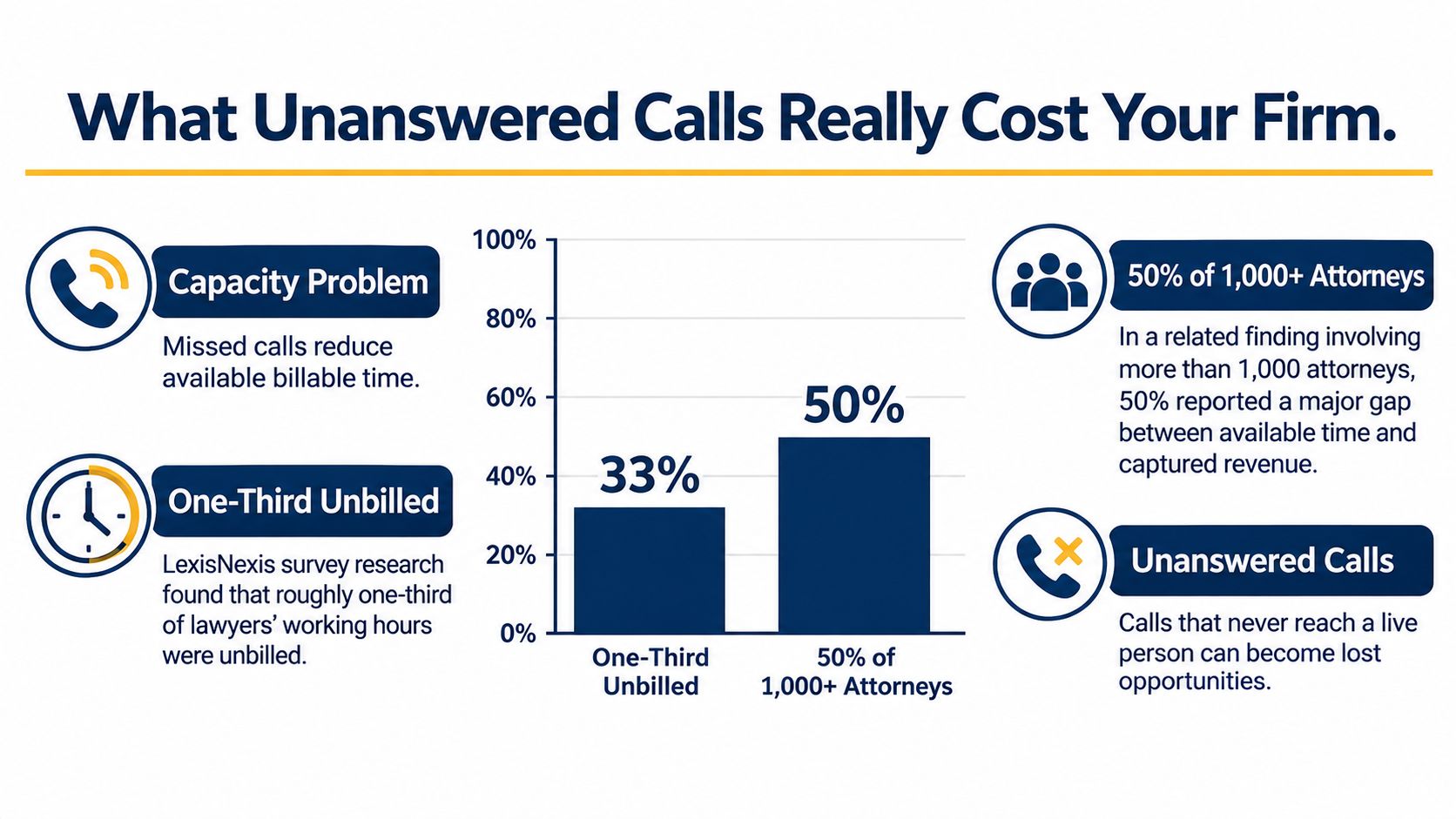
A national LexisNexis survey of nearly 500 attorneys found that roughly one-third of the hours lawyers worked were unbilled. In a related finding involving more than 1,000 attorneys, 50% ranked administrative or practice-management work among their top two sources of non-billable hours (Minnesota Lawyer's report on the LexisNexis survey). That points to an allocation problem. Each call an attorney answers personally takes time from billable work, and a callback can create another interruption before anyone has established whether the matter fits the firm.
The three cost layers
Matters lost before evaluation. A 2024 secret-shopper study commissioned for Clio's Legal Trends Report contacted 500 U.S. law firms by phone and email between June 20 and July 5, 2024. Only 40% of firms answered the phone when a prospective client called. After firms had an opportunity to return a message, 48% remained unreachable by phone (OnceHub's summary of the Clio legal answering study). The study measured business-hours calls. After hours, a caller may have no live person to answer.
Time spent reconstructing the inquiry. Staff must listen to the message, identify the caller, infer the practice area, and attempt a callback. The caller may no longer be available. Someone then has to establish the basics in a later conversation, rather than capturing the inquiry when the caller is ready to talk.
Overtime and coverage gaps. Firms may try to fill the gap with overtime, comp time, or an on-call rotation. Those approaches require staff availability and can become difficult to sustain. They also leave a practical question: who answers when the designated person is unavailable?
Response time affects how prospective clients judge a firm. Clio's 2017 Legal Trends research found that 67% of consumers considered a lawyer's speed in responding to calls and emails an important factor in choosing representation (Clio's Legal Trends press release). Scorpion's 2025 Legal Consumer Insights Report found that 72% of prospective clients may move on when a firm doesn't respond within 24 hours, and more than a third expect a same-day callback (Scorpion's 2025 Legal Consumer Insights Report). A quick automated acknowledgment may look like a fast response in a dashboard, but it does not capture the lead or establish what action the inquiry needs.
Walkthrough: How missed calls become lost intake opportunities
The arithmetic, using your numbers
Consider a firm that receives 40 after-hours inquiries in a month. Twenty reach voicemail. If 10% of those callers would have retained the firm after a timely callback, that leaves two potential matters to value against the cost of coverage.
- Missed inquiries: 20
- Assumed retention share: 10%
- Potentially recovered matters: 2
- Average value of a retained matter: use your firm's figure
- Estimated monthly recovered revenue: 2 × average value of a retained matter
This is a working estimate, not a guaranteed return. Compare it with the monthly coverage cost, then adjust the assumptions using your call logs and signed matters. A higher-value practice may justify live coverage where a lower-value practice may favor a prioritized callback queue. The right answer depends on what the firm signs, not on the number of calls alone.
A missed response can also weaken referrals: callers who feel ignored may share that experience with others, contributing to client service failures that cost firms referrals.
Escalation Rules That Keep Intake Safe
After-hours intake is triage, not an interview. Firms get into trouble by writing a script that tries to do everything at 11 PM: collect the full story, assess liability, quote a fee range and reassure the caller. That fails twice. It creates prospective-client obligations before anyone has run a conflict check, and it produces a half-told account the attorney has to redo from scratch anyway.
The four service levels
Every call outside business hours belongs to exactly one of these, and the script should say which:
- Immediate safety routing. Someone is in danger, badly injured or in custody. The answer is 911 or a local crisis line, then a short note about what was said.
- Live intake. An ordinary inquiry that needs qualification: name, callback number, practice area, opposing parties, any deadline.
- Prioritized callback. Time-sensitive but not an emergency. A filing deadline three days out, an eviction notice with a date printed on it.
- Routine acknowledgment. Low urgency, reviewed by a person the next business day.
The counterintuitive part is that the safest after-hours model often collects less, not more. Prospective-client information can create confidentiality and conflict obligations under ABA Model Rule 1.18 and Formal Opinion 510, which makes a detailed case narrative gathered before the conflict check a liability rather than a head start (guidance on building an after-hours intake script).
Collect the minimum that supports a conflict check and a next step. Everything past that is a conversation for a cleared matter and a licensed attorney.
| Situation | Response | Who decides |
|---|---|---|
| Imminent danger or medical emergency | Give the emergency disclaimer and direct the caller to 911 or local emergency services | Script only, no attorney decision needed |
| Arrest or detention | Take location, callback number and the caller's safe contact method, then escalate | Duty attorney |
| Filing deadline within days | Warm transfer or priority callback to the on-call attorney | On-call attorney |
| Eviction or time-limited notice | Priority callback and same-day escalation to the responsible attorney | On-call attorney or practice lead |
| Domestic violence | Offer crisis resources and arrange a safe callback time, without detailed narrative | Attorney following the firm's crisis protocol |
| Ordinary practice-area inquiry | Capture contact details, screen fit and sequence follow-up | Intake team, with next-business-day review |
The emergency disclaimer needs to be said out loud, early, and without hedging: we are not your lawyers yet, we cannot give you advice tonight, and if you are in danger you should hang up and call 911. For callers who may be in danger at home, the intake note should record a safe callback time and a safe number rather than defaulting to the standard workflow. Calling someone back at 9 AM while the person they're afraid of is in the room is worse than not calling at all.
Attorneys approve these rules. That isn't a formality. The rules have to reflect the jurisdictions and practice areas the firm handles, and every escalation decision gets written down with a timestamp and a name. For how the front end of this connects to screening and routing, see our guide to call screening services.
Metrics That Prove Your Coverage Works
| Metric | What it reveals | How to read it |
|---|---|---|
| Time to first human contact (median and 90th percentile) | Whether the queue moves quickly for most callers and for the slowest ones | Compare against a five-minute live-contact goal and track the tail, not the average |
| Contact rate | Share of inquiries that reach a person | Split by nights, weekends, holidays and overflow |
| Qualified-lead rate | Whether intake captures usable matters | Define qualification criteria in writing before measuring |
| Warm-transfer success | Whether urgent matters reach an attorney or on-call contact | Count failed transfers and the reason for each |
| Appointment rate | Conversion from inquiry to consultation | Compare by time window and practice area |
| Retainer conversion | Revenue outcome of after-hours intake | Measure over a full matter cycle, not a single week |
| Emergency-escalation accuracy | Whether urgent calls were routed as the script requires | Audit a sample of escalated calls each week |
| Abandoned calls | Callers who hung up while waiting | Track by hour to find staffing gaps |
Start with time to first human contact, reported twice: median and 90th percentile. The median tells you how the typical caller fares. The 90th percentile tells you what happens on your worst nights, and your worst nights are where the matters go. Averages hide exactly the calls that matter most.
The speed research explains why this metric sits at the top. An MIT and InsideSales lead-response study covering more than 15,000 leads and 100,000 call attempts, summarized by LeadAngel's analysis of lead response time, reported that contact odds were roughly 100 times higher when outreach happened within five minutes rather than 30, with qualification odds about 21 times higher. Those aren't legal-intake conversion rates and shouldn't be presented as such. They do support a design threshold: answer immediately, attempt live contact within five minutes where feasible, and trigger automated retries when the caller doesn't pick up.
Contact rate and qualified-lead rate belong together for a related reason. A Harvard Business Review analysis of 2,241 U.S. companies found that only 37% responded to web-generated leads within one hour and 23% never responded at all, while across a separate dataset of 1.25 million leads, contacting a prospect within an hour made qualification nearly seven times more likely than waiting another hour (Vida.io's summary of the HBR lead-response research). Responsiveness and qualification are not the same thing, which is the trap.
An automated acknowledgment can satisfy a response-time dashboard while losing the matter entirely. So report the four service levels separately: immediate safety routing, live intake, prioritized callback, routine acknowledgment. A 40-second text auto-reply is not a contact, and blending it into an answer-rate percentage is how firms end up with a dashboard that looks excellent and a calendar that stays empty.
Segment everything by night, weekend, holiday, overflow, language and practice area. Spanish-language coverage deserves its own line, not a footnote, because a qualification script that works in English and stumbles in Spanish is a different product. The daily after-hours log is the source of truth here. It records every call, inquiry and outcome, and it's the document the morning review reads. If you want that log to hold up as evidence rather than anecdote, our guide to call tracking for law firms covers which fields to capture at the source.
The cadence that holds up: a morning review of the overnight log, a weekly review by segment, and a monthly look at retained matters.
Audit Your Calls and Launch a Working System
1. Audit the last 30 days of call logs by window
Pull nights, weekends, holidays and overflow separately. Count after-hours calls, how many reached a live person, how many were qualified, how many were transferred, and how many became consultations or retained matters. Why: volume decides the model, and a model chosen before the numbers is a guess. Common slip: estimating from memory instead of reading the logs.
2. Confirm the four service levels
Write down what happens to each call type before anyone answers a phone. Common slip: routing emergencies into the same queue as routine inquiries because that was the path of least resistance in the phone system.
3. Compare missed inquiries against the cost formula
Run the arithmetic with your own average matter value. If the gap is material, shortlist one model from the comparison table. Common slip: choosing on the lowest per-call price and discovering in month two that you bought message-taking.
4. Request written quotes with identical scopes
Every quote should cover the same hours, roles, languages and escalation rules. Why: quotes with different scopes cannot be compared, and the gap usually hides in the hours nobody specified. Common slip: comparing a message-only plan with a full intake plan and concluding one is a bargain.
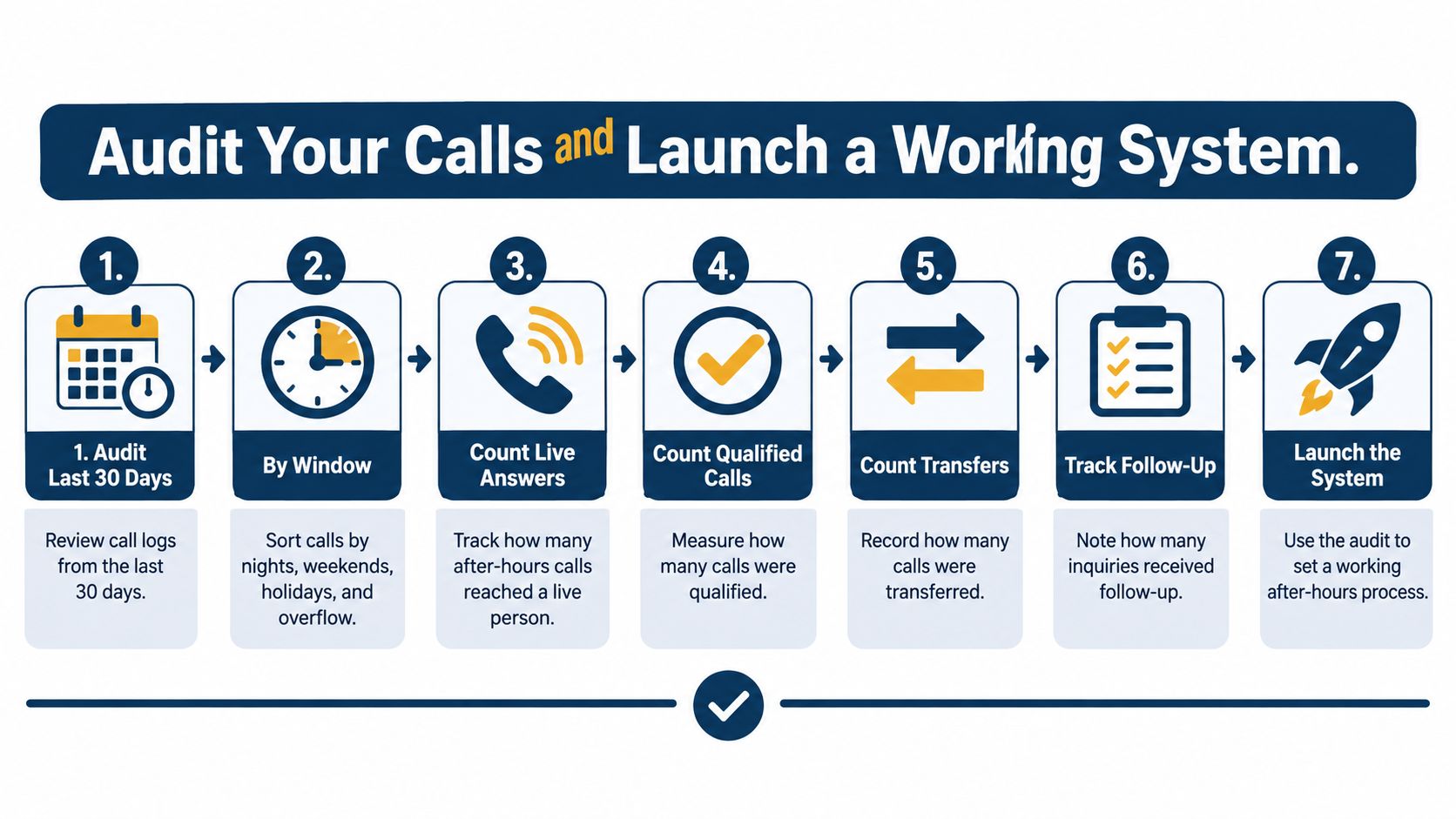
5. Build the script from the minimum data set
Use the intake fields that support a conflict check plus the escalation rules the attorneys signed off on. Common slip: a script written by marketing, approved by nobody, that invites callers to explain everything at 10 PM.
6. Set the KPIs and reporting cadence before launch
Morning review of the overnight log, weekly review by segment, monthly review of retained matters. Why: the first week then produces comparable numbers instead of a vague impression. Common slip: a dashboard that counts automated replies as contacts.
7. Pilot for two weeks, then adjust
Run nights and weekends first, read the log every morning, and change one thing at a time. Two weeks is enough to see whether your answer rate moves and whether the qualification criteria survive contact with real callers.
What to ask a provider before you sign
- Time zone alignment: does coverage line up with your business hours for handoffs, or does the overnight team disappear at 9 AM your time? Every plan we run includes U.S. time zone alignment, so the person working your business hours is awake for them.
- Coverage during absence: what happens when your assigned staff member takes PTO or gets sick? Ours continues, so the firm isn't left uncovered midweek.
- What the log contains: every call, inquiry and outcome, or a summary count? Ask to see a sample before you buy.
- Who writes and maintains the scripts: you, the provider, or a shared document nobody updates after month one.
- Who has authority to escalate: a named role, a phone number, and a rule for how fast.
- Spanish-language handling: live specialists or a callback promise.
Run the audit first. It costs nothing, requires no vendor conversation, and produces the only number that matters here: how many inquiries your firm is already receiving and not converting. Once you have that, adding 24/7 live intake through Frontline or dedicated full-time support through Staffline becomes a decision with a denominator. Until you have it, it's a mood.
Your firm already paid for those after-hours calls through marketing, referral relationships and reputation. The only open question is whether anyone answers them. Attorney Assistant provides 24/7 live intake through Frontline that answers, qualifies, follows up and signs cases in English and Spanish, along with dedicated full-time legal support through Staffline for the records, scheduling and case work that piles up behind the intake queue. Start with the 30-day audit, bring the numbers, and the right mix of coverage and staffing becomes a straightforward conversation rather than a leap of faith.
Related Articles

Call Screening Service for Law Firms: A Practical Guide
Learn how law firms set up a call screening service: intake criteria, routing rules, consent checks and the metrics that prove it works.
Legal Staff Solutions: Models, Costs and How to Choose
Compare in-house, outsourced and co-managed legal staff solutions, with real cost drivers, pros and cons, and a way to choose the right model.

Client Service Questionnaire Templates for Law Firms
Build a client service questionnaire for your firm: sample questions by stage, send timing, response metrics, and how to route results into intake.