Your phone rang tonight while everyone with authority to help was at dinner, in court prep, or finally not thinking about work. The caller needed a lawyer, got voicemail, and kept dialing. A business telephone answering service should stop that loss, but only if it does more than sound pleasant and promise a callback. For a law firm, the phone isn't administrative overhead. It's intake, risk control, and often revenue.
Table of Contents
- The Call Your Firm May Have Already Lost
- What a Business Telephone Answering Service Actually Does for a Law Firm
- Core Capabilities That Separate Legal Intake From a Generic Answering Service
- The Intake Metrics You Should Actually Track
- How Answering Services Price Their Work and What Each Model Really Costs
- Where AI Helps and Where a Human Voice Is Still the Better Answer
- Evaluating Vendors and When a Co-Managed Intake Partner Makes More Sense
The Call Your Firm May Have Already Lost
A personal injury prospect calls at 7:40 p.m. She's not shopping for brochures. She's worried about medical bills, missed work, and whether she said the wrong thing to an insurer. Your office recording tells her to leave a message. She does, politely, and then calls the next firm on her list.
Someone finds the message the next morning between hearings. They call back, reach voicemail, and make a note somewhere. Technically, that's follow up. It isn't particularly useful follow up. The prospect has already spoken to a live person elsewhere, answered qualification questions, and booked a consultation.
Taking a message is not intake.
That distinction decides whether a business telephone answering service protects revenue or merely documents missed revenue. A message service records a name and number. A legal intake operation identifies urgency, screens against your criteria, routes the matter correctly, books the next step, documents the disposition, and keeps trying when the first attempt fails.
Why good marketing dies at the front door
Most firms don't have a pure lead problem. They have an intake and follow up problem. They pay to make the phone ring, then rely on whoever happens to be free, which is another way of saying nobody in particular owns the outcome.
Understanding how inbound calls work in a law firm helps you see where that chain breaks, from first ring to qualified next action. If your aim is to convert more traffic into signed cases, the website and ads can't compensate for a call nobody answers properly.
By the end of this guide, you'll be able to judge any provider on the same basis an operations manager would. Can it answer live, qualify consistently, route accurately, follow up persistently, document everything, and prove performance with numbers you can inspect yourself?
What a Business Telephone Answering Service Actually Does for a Law Firm
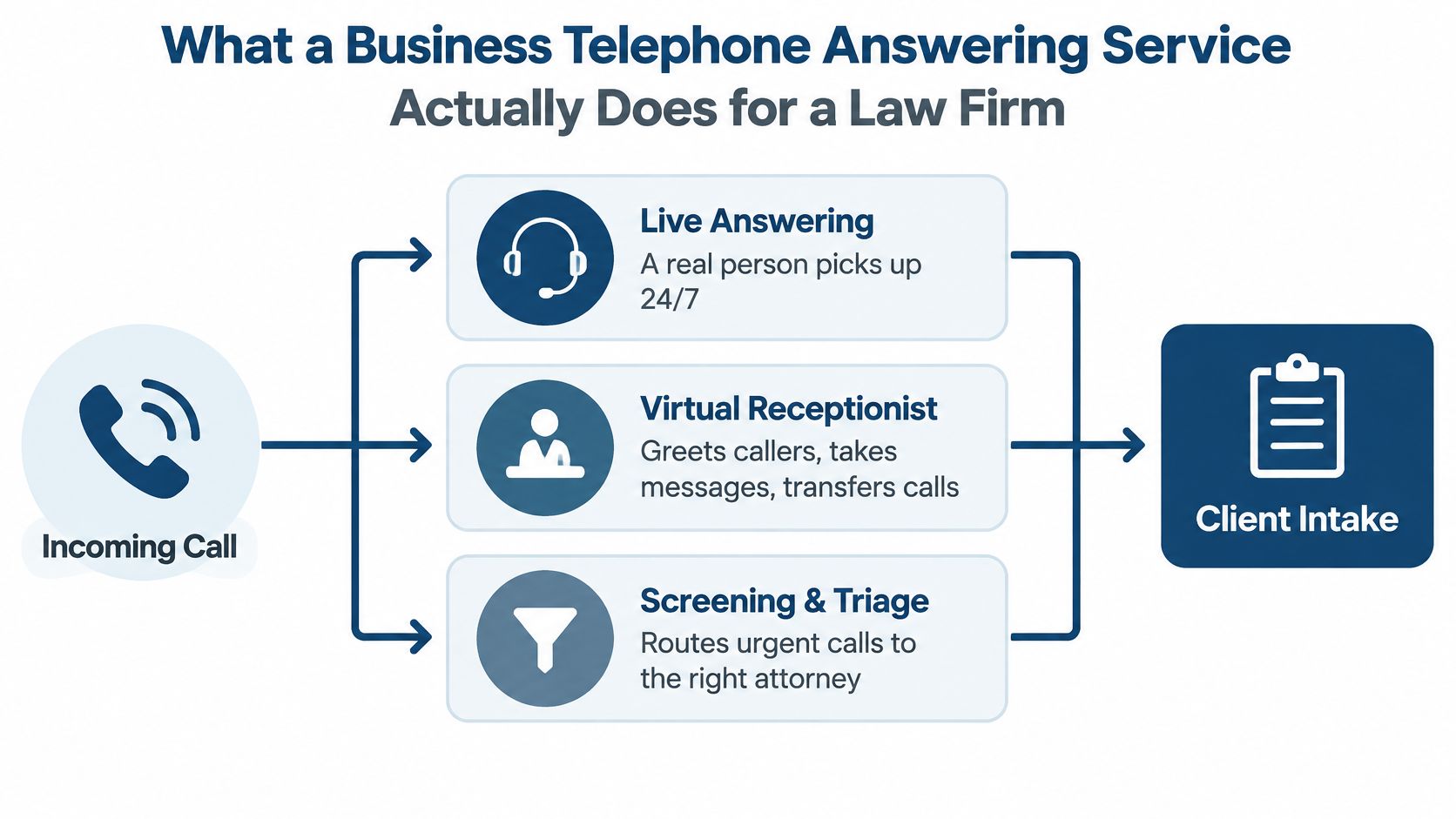
A modern business telephone answering service sits on top of your existing phone system and handles calls according to rules you approve. The category includes basic live answering, virtual receptionist support, overflow coverage, and full 24/7 live intake. Those labels matter less than the workflow behind them.
The live workflow step by step
A trained specialist answers in your firm's name and establishes who's calling and why. For a new matter, they use your approved script to capture contact details, incident or matter type, relevant dates, jurisdiction, opposing party where appropriate, referral source, and urgency. They don't give legal advice or promise representation.
Next comes routing. A qualified injury caller might receive a warm transfer to an intake specialist or on call attorney, meaning the receiving person gets context before speaking. An existing client goes to reception or case administration. An urgent matter follows your escalation path instead of sitting politely in an inbox until Monday.
The final step is disposition. The service records whether the caller qualified, booked, transferred, requested a callback, fell outside your criteria, or needs another attempt. Without that record, your CRM can't follow up with a lead nobody entered into the CRM.
Two calls, two different jobs
Consider a family law caller who prefers Spanish and needs a consultation but has no emergency. The right outcome is a bilingual screening, accurate calendar booking, and a documented summary. Now consider an injured caller whose facts may fit your criteria. The right outcome may be immediate transfer or scheduled follow up, not a sticky note with heroic intentions.
Speed matters because delay is common. A 2025 study of 1,333 U.S. law-firm websites found a 13 minute median response time, only 56% responding within one hour, and 26% never responding. A live answer only helps if it shortens the distance between first contact and a qualified next action.
Core Capabilities That Separate Legal Intake From a Generic Answering Service
Generic call centers are built to handle contacts. Legal intake has to protect a prospective client relationship, screen risk, and move the right matters forward. That requires operational controls, not friendly improvisation.

Coverage when your office is closed or overloaded
24/7 coverage should include nights, weekends, lunch periods, holidays your firm observes, and overflow when several calls arrive together. Staffing to average volume fails exactly when advertising works or two people call during the same deposition. Ask how the provider handles concurrent calls, queues, and abandonment, then ask for reporting by hour.
The intake gap is not hypothetical. Across 85 businesses in 58 industries, only 37.8% of inbound calls reached a live person, 37.8% went to voicemail, and 24.3% received no response. That dataset isn't legal specific, so treat it as directional. Your own call records should tell you whether your firm is doing better.
Qualification and routing your attorneys can trust
Require firm approved scripts by practice area. The script should define required fields, disqualifying answers, jurisdictional limits, language for declining to give legal advice, and what happens when facts are incomplete. Conflict screening needs clear boundaries. Intake staff can collect identifying information for your process, but they shouldn't decide conflicts unless your firm has deliberately defined and supervised that role.
- Warm transfers with context: The receiver hears who is calling, why, and what has already been captured.
- Bilingual coverage: English and Español routing should be available without making callers repeat sensitive facts through a workaround.
- Persistent follow up: Missed connections get structured repeat attempts, with each attempt logged.
- Calendar and CRM integration: Bookings, notes, recordings or transcripts, and dispositions land where your team works.
Quality assurance ties those pieces together. Sample calls for consent handling, screening accuracy, tone, routing, and documentation. Review misroutes by category, not as isolated embarrassments. Consistency is the product. Your firm doesn't need one excellent call followed by creative silence. It needs the same competent process every time the phone rings.
The Intake Metrics You Should Actually Track
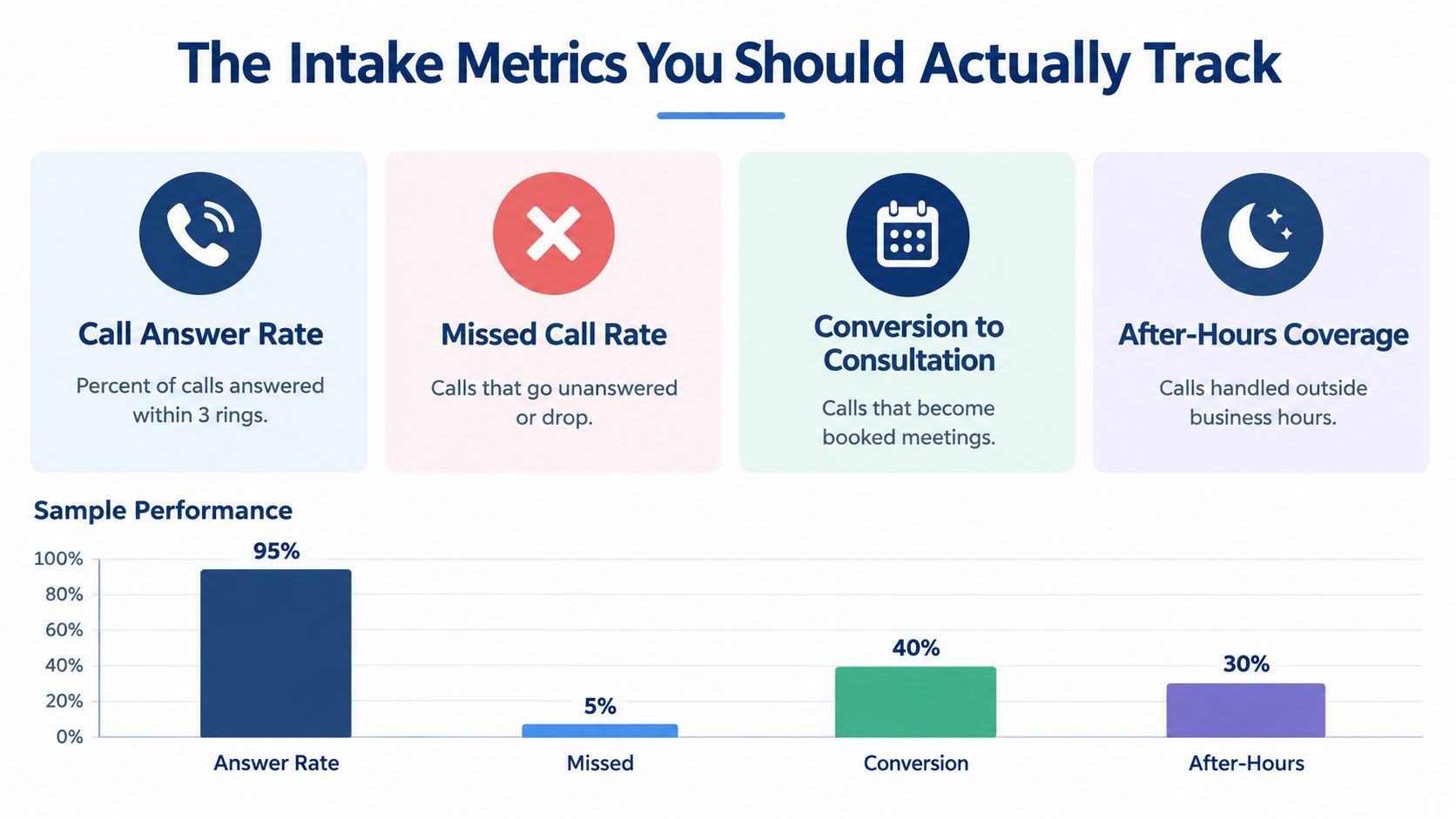
Vendor reports love total calls handled because that number almost always looks busy. It tells you very little about signed matters. Track the path from ring to retained case, and segment every measure by source, hour, practice area, and disposition.
Start with access and speed
Speed to human response measures elapsed time from submission or first ring to live human contact. Live answer rate shows the share of calls answered by a person, separated for business hours and after hours. Abandoned before answer rate exposes queue failure, understaffing, and callers who gave up before your carefully written greeting could finish.
Those numbers need context from your phone system. Reviewing call tracking fundamentals for law firms can help you connect source, timestamp, duration, recording, and outcome instead of managing intake from memory and optimism.
Then measure whether contact becomes a case
- Qualified contact rate: Live contacts that meet your screening criteria, showing whether routing and marketing sources are aligned.
- Warm transfer success rate: Attempted transfers that reach the intended person with context intact.
- Appointment show rate: Booked consultations that occur, which reveals reminder and confirmation quality.
- Follow up completion: Required attempts completed within your defined cadence, not merely attempted eventually.
- Signed matter rate: Qualified contacts that become retained matters under your firm's process.
If your intake process lives primarily inside someone's memory, you've built the world's least reliable CRM.
Weak performance is widespread. Only 40% of firms answered a prospective client's first call in 2024, down from 56% in 2019, and only 20% of missed calls were returned. Establish your baseline before hiring anyone. Otherwise, you'll have no credible way to tell whether the service improved intake or merely sent cheerful monthly summaries.
How Answering Services Price Their Work and What Each Model Really Costs
Pricing models shape behavior. A cheap structure can punish thorough intake, while a predictable one can still waste money if it charges for actions your firm doesn't need. Compare models against your actual call pattern, average handle time, after hours share, and complexity by practice area.
Common Answering Service Pricing Models Compared
| Model | How It Bills | Best Fit | Watch Out For |
|---|---|---|---|
| Per call | A charge for each handled call | Short, predictable calls with simple routing | Long qualification calls may feel rushed or misclassified |
| Per minute | Talk time, sometimes including wrap up time | Low volume or brief inquiries | Complex, emotional, or bilingual calls can become costly |
| Subscription or action based | Monthly fee for defined actions or included capacity | Firms wanting predictable coverage and specified outcomes | Included actions may not match your real workflow |
Match the model to the call, not the sales page
Per call pricing looks clean until one caller needs careful screening and another only wants office hours. If both count the same, ask what counts as a call, how spam and wrong numbers are treated, and whether follow up attempts bill separately.
Per minute pricing creates a subtler problem. Good legal intake sometimes requires patience. A distressed caller doesn't become clearer because someone is watching a meter. Ask whether hold time, transfers, after call documentation, recordings, and summaries bill as minutes.
Subscription or action based pricing can work well when the actions are precise. Define an answered call, qualified intake, warm transfer, booked appointment, follow up attempt, and completed follow up. Vague nouns become expensive later.
When budgeting adjacent operational tools, you can compare MatterAlert pricing as a reminder to inspect what's included, what's metered, and what triggers overages before signing.
Before you agree to anything, ask about setup charges, after hours premiums, holiday rules, CRM and calendar integration, call recording access, bilingual coverage, quality assurance reporting, minimum terms, and overage rates. Then model a busy month, not your calmest one. Firms rarely lose cases during the calm month.
Where AI Helps and Where a Human Voice Is Still the Better Answer
AI can make a human intake team faster and more consistent. That doesn't make AI a safe substitute for judgment on every legal call. The useful question is narrower. Which tasks can be automated without creating confusion, risk, or a poor first impression?

Put AI behind the workflow
Use AI enabled tools for transcription, call summaries, intent detection, structured field extraction, scheduling support, and routing signals. Those functions reduce typing, improve record quality, and help supervisors find calls that need review. A human should verify consequential fields before your firm relies on them.
Adoption in intake remains limited. A 2025 legal technology survey placed client intake among the smaller AI adoption areas at 13.8%. That doesn't prove AI has no role. It suggests firms are still working out where automation belongs in a sensitive, attorney supervised process.
Keep humans in charge of risky conversations
Route emotionally distressed callers, multilingual conversations, disability accommodations, jurisdiction sensitive screening, possible emergencies, and requests for immediate legal advice to trained people. A caller who hears an answer as legal advice won't be calmed by the explanation that software generated it. Non legal staff need firm approved language that avoids advice, guarantees, and promises of representation.
Your professional duties don't transfer to a vendor. Competence, diligence, and communication still require attorney oversight, reliable escalation, confidentiality, and accurate status records. Intake staff may collect facts and schedule the next step, but your firm remains responsible for ensuring promised follow up happens.
Require audit trails, secure transfer of notes, clear data retention rules, recorded consent policies where required, and mandatory human review for high risk categories. The goal isn't maximum automation. It's minimum unsafe automation, paired with rapid human response.
Evaluating Vendors and When a Co-Managed Intake Partner Makes More Sense
Don't evaluate vendors by demo personality. Evaluate them by evidence, controls, and what happens on an ordinary Tuesday when three calls arrive while your receptionist is helping a client in the lobby.
The vendor checklist that exposes weak operations
- Live answer performance: Results by hour, including abandonment and overflow handling.
- Coverage proof: Nights, weekends, holidays, concurrent calls, and escalation coverage.
- Qualification discipline: Practice specific scripts, required fields, and no legal advice language.
- Transfer protocol: Warm transfer rules, fallback steps, and context passed to your team.
- Follow up cadence: Number, timing, channels, ownership, and completion reporting.
- Quality assurance: Call sampling, scoring, coaching, and misroute review.
- Systems access: CRM, calendar, records, security controls, retention, and user permissions.
- Commercial terms: Pricing triggers, overages, setup, cancellation, and month to month flexibility where available.
Call the service as a test prospect after hours. Then inspect the resulting record. If the note says "wants attorney," you've bought a very articulate voicemail box.
A co-managed intake partner makes more sense when missed calls persist despite marketing spend, leads cool between form submission and human contact, follow up depends on individual memory, or attorneys keep getting pulled into screening and scheduling. Those symptoms point to a capacity problem across intake and operations, not just phone coverage. Exploring dedicated virtual staffing models for law firms can clarify whether you need shared answering support, embedded intake help, or broader case support.
That capacity drain is measurable. Bloomberg Law's 2024 survey of 1,054 legal professionals found attorneys spent roughly two of every eight hours on administrative activities, about 10 hours per week. Attorney Assistant is one option in this category, offering Frontline 24/7 live intake designed to answer, qualify, follow up, and help sign appropriate cases, alongside Staffline dedicated legal support professionals who work inside one firm's systems. Frontline signs the case. Staffline carries it. Judge that model, and every competitor, against the metrics and controls above.
If missed calls, slow follow up, and attorneys doing intake administration are limiting your caseload, Attorney Assistant can provide Frontline 24/7 live intake in English and Español plus Staffline dedicated legal support embedded in your workflows. Start by examining your live answer rate, follow up completion, and signed matter rate, then visit us to discuss where additional capacity would recover the most time and opportunity.
Related Articles
Call Flow Customer Service for Law Firms: A Practical Guide
Design a call flow customer service system for your law firm that captures leads, qualifies matters, and signs cases. Practical guide
Appointment Setting Online: A Law Firm Guide
Master appointment setting online for law firms with proven strategies that turn leads into booked consultations and grow your practice.

Keep the Conversation Going: 8 Intake Follow-Up Tactics
Learn how to keep the conversation going with law prospects using eight practical intake and follow-up tactics, from speed-to-lead to attorney handoffs.