It's 7:40 p.m. on a Tuesday and a prospective client is sitting in a parked car, phone in hand, calling the firm whose ad she just saw. Someone answers. She's polite, explains the accident, gives her name and number, and hears that an attorney will call her back. Nobody books anything. Nobody owns the callback. By Thursday, she's signed with someone else. That's not a marketing failure. That's call flow customer service doing exactly what it was designed to do, which in most firms is very little beyond picking up.
Table of Contents
- Why Most Law Firm Call Flows Leak
- The Closed-Loop Intake Flow
- Building the Intake Script That Actually Qualifies
- Routing Logic That Reaches the Right Human
- The Callback and Recovery Loop
- Ethics, Confidentiality, and Supervision Controls
- KPIs and the QA Checklist That Keep It Honest
Why Most Law Firm Call Flows Leak
The pattern is dull because it's so common. A caller reaches a human, or something close to one. They describe an injury, a divorce that just turned hostile, a letter they don't understand. The person on the phone is friendly. They take a few details on a notepad, in a spreadsheet, or in a CRM field nobody checks. Then the call ends with vague reassurance instead of a defined next step.
That gap is measurable. Clio's 2024 mystery-shopper research found that only 40% of contacted law firms answered phone calls, and after returned calls were counted, 48% were effectively unreachable by phone. Answering is only the first leak. The second is what happens after someone does answer and still doesn't route, qualify, or schedule anything.
Answered Is Not Handled
A firm can show a decent answer rate and still lose most of its opportunity. The call gets logged as handled because a conversation occurred. But there's no consultation on the calendar, no warm transfer, no callback with a deadline and an owner. Taking a message is not intake. It's message taking with better intentions.
Speed compounds the problem. Service level convention is the 80/20 standard, meaning 80% of calls answered within 20 seconds, and recent benchmark reporting puts average phone speed of answer at approximately 28 seconds in 2025, with abandonment at 60 to 90 seconds reaching 16.4% compared to 7.1% at 30 to 45 seconds. For a support caller, a wait means delay. For a prospect, a wait often means they're calling the next firm on the list.
If your intake process lives primarily inside someone's memory, you have built the world's least reliable CRM.
None of this is usually the front desk's fault. They're working inside a design that asks them to greet, judge urgency, collect sensitive facts, check calendars, and remember follow-up, often while the next line is already ringing. When attorneys own the queue instead, routine calls compete with depositions and drafting, and the queue loses. The leak isn't effort. It's that nobody built a flow with ownership at each stage, so good cases drift into voicemail and sticky notes while everyone involved believes they did their part.
The Closed-Loop Intake Flow
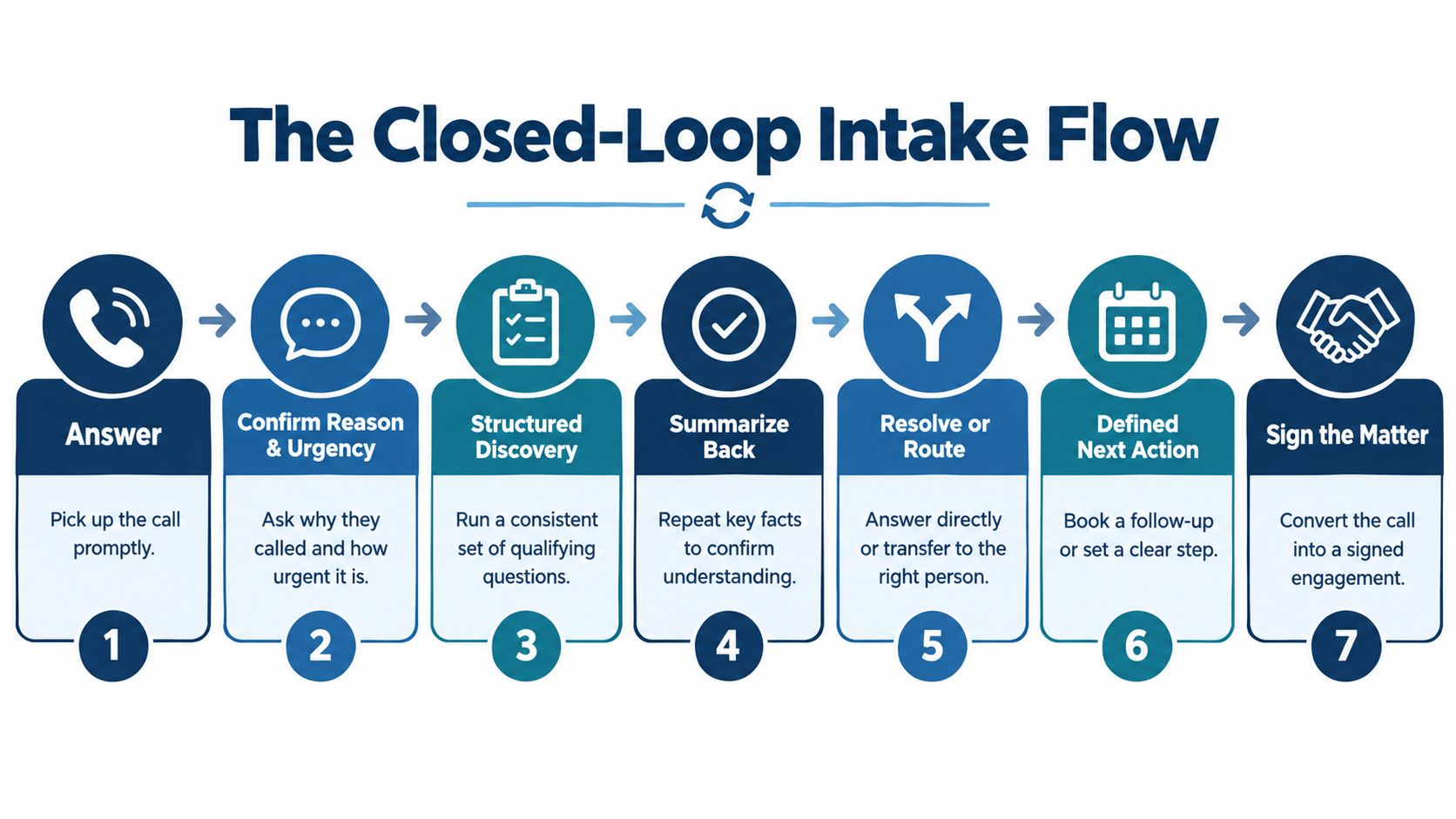
A closed loop means every call ends somewhere deliberate. Not in a notepad. Not in a hope. The flow has seven stages, and each one produces something the next person can act on without calling the prospect back to ask the same questions again.
The Seven Stages
- Answer and identify. Pick up fast, confirm who's calling and how to reach them if the call drops.
- Confirm reason, urgency, and eligibility. Matter type, timing, and whether this firm handles it at all.
- Run structured discovery. The same qualifying questions every time, in the same order.
- Summarize back. Repeat the key facts so errors surface on this call, not in the file.
- Resolve or route. Answer within scope or hand to the correct owner with context attached.
- Complete a defined next action. Book it, transfer it, request the document, or create the follow-up task.
- Record the disposition. Consent, ownership, deadlines, and outcome go in the CRM before the headset comes off.
Stage six is the control point. A 2026 analysis of more than three million law firm calls reported that approximately two-thirds of qualified leads disconnected without a defined next step, while firms saw 64% conversion when qualified callers could book immediately compared to 12% without real-time scheduling and 7% after hours. So the benchmark that matters isn't answer rate alone. It's the share of qualified calls ending with a consultation booked, a warm transfer made, a retainer workflow started, or a callback with a named owner.
Run it with a personal injury caller and it gets concrete. She's answered quickly, confirms a rear-end collision last month, completes discovery on treatment and insurance, hears her facts repeated back accurately, and gets a consultation booked before she hangs up. The disposition shows qualified, consultation set, records request pending, owner assigned.
The failure version of that same call ends with information provided in the notes. It looks productive. It produces nothing. Required controls keep the difference visible: disposition codes, mandatory fields, callback deadlines, duplicate checks, conflict-screening escalation, and a daily reconciliation of calls with no outcome.
Building the Intake Script That Actually Qualifies
A good script isn't a teleprompter. It's a structured questionnaire with judgment points, closer to a checklist a pilot runs than lines an actor memorizes. If your intake staff sound like they're reading, the document is written wrong.

Build It in Blocks
- Opening disclosure. Identify the firm and the speaker's role, and state plainly that intake doesn't create an attorney-client relationship.
- Contact and matter capture. Name, best number, email, matter type, and how they found the firm, in that order, before the narrative starts.
- Date and deadline flags. Incident date, service date, any court date, so statute-of-limitations problems trigger escalation instead of a routine queue.
- Qualification checkpoints. The firm's actual criteria, sequenced like the intake qualification questions your attorneys would ask themselves, not a generic list.
- Conflict triggers. Opposing party names and related parties, collected early and routed for screening before anyone discusses strategy.
General call handling references such as an expert guide to B2B call scripts are useful for structure and branching logic. Legal intake needs one thing those guides don't cover, which is a hard line around what staff must never say. No assessments of case value. No predictions. No advice dressed up as reassurance. The script should include approved language for exactly that moment, because callers will ask and a well-meaning staffer will want to help.
Emergencies need their own branch. A caller describing an arrest tonight, a protective order, or a deadline tomorrow shouldn't move through the same sequence as someone shopping for an estate plan. The script should route those calls to an attorney immediately and say what to do when no attorney is reachable.
Treat the document as a controlled one. Version it. Date it. When the firm drops a practice area or changes its case criteria, the script changes that week, not whenever someone remembers. An outdated script doesn't just waste calls. It qualifies the wrong matters confidently.
Routing Logic That Reaches the Right Human
Routing is where call flow customer service stops being about phones and starts being about decisions. Most firms make one of two mistakes. Everything goes to the same overloaded person, or everything goes to voicemail and gets sorted eventually, which callers experience as never.
The logic has four layers. Skills-based routing sends matters by practice area, so the injury caller doesn't spend eight minutes explaining a collision to the family law paralegal. Urgency tiers pull deadlines, arrests, and safety issues out of the normal queue entirely. Overflow rules decide what happens when the primary person is already on a call. After-hours paths decide what the firm offers at 9 p.m., which should be a designed answer rather than an accident of staffing.
Caller Type to Routing Destination
| Caller Type | During Business Hours | After Hours |
|---|---|---|
| New inquiry, in-scope matter | Intake specialist, then warm transfer or booked consultation | Live intake, qualify, book or set owned callback |
| Urgent deadline or emergency | Direct to covering attorney | Attorney on-call escalation, no voicemail |
| Existing client | Assigned case team with file context | Message with next-business-day owner and deadline |
| Out-of-scope inquiry | Brief screening, referral where appropriate | Brief screening, documented disposition |
| Vendor or administrative | Operations or office manager | Voicemail is acceptable here |
Warm transfer versus scheduled callback is a judgment call worth defining in advance, and the trade-offs in choosing between a warm transfer and a cold transfer apply directly here. A warm transfer suits a qualified, ready-to-talk caller when the attorney is genuinely available. A booked callback at a stated time beats a transfer into a hold queue that ends in voicemail anyway.
You can't fix routing you can't see. Call attribution matters for the same reason it matters in other service businesses, and a guide to call tracking for logistics makes the operational point well even outside legal: tying each call to its source and outcome is what turns routing from folklore into something you can redesign. Apply that to intake and you can see which sources produce qualified matters, which hours produce abandonment, and which destinations produce dead ends.
Sketch it on a whiteboard before buying anything. If a managing partner can't draw the path for each caller type in ten minutes, the staff answering the phones can't follow it either.
The Callback and Recovery Loop
The uncomfortable fact about live answering is that sometimes it fails anyway. Lines spike, staff get sick, a caller hangs up during the menu. A flow designed only for the calls you answer perfectly has no answer for the ones you don't.
Caller patience is thinner than most firms assume. A 2025 U.S. survey of 2,243 adults found that 65% considered voice the fastest way to resolve a customer service issue, while more than 10% abandoned after only one or two menu options. Keeping those callers in a longer queue isn't a strategy. Recovering them is.
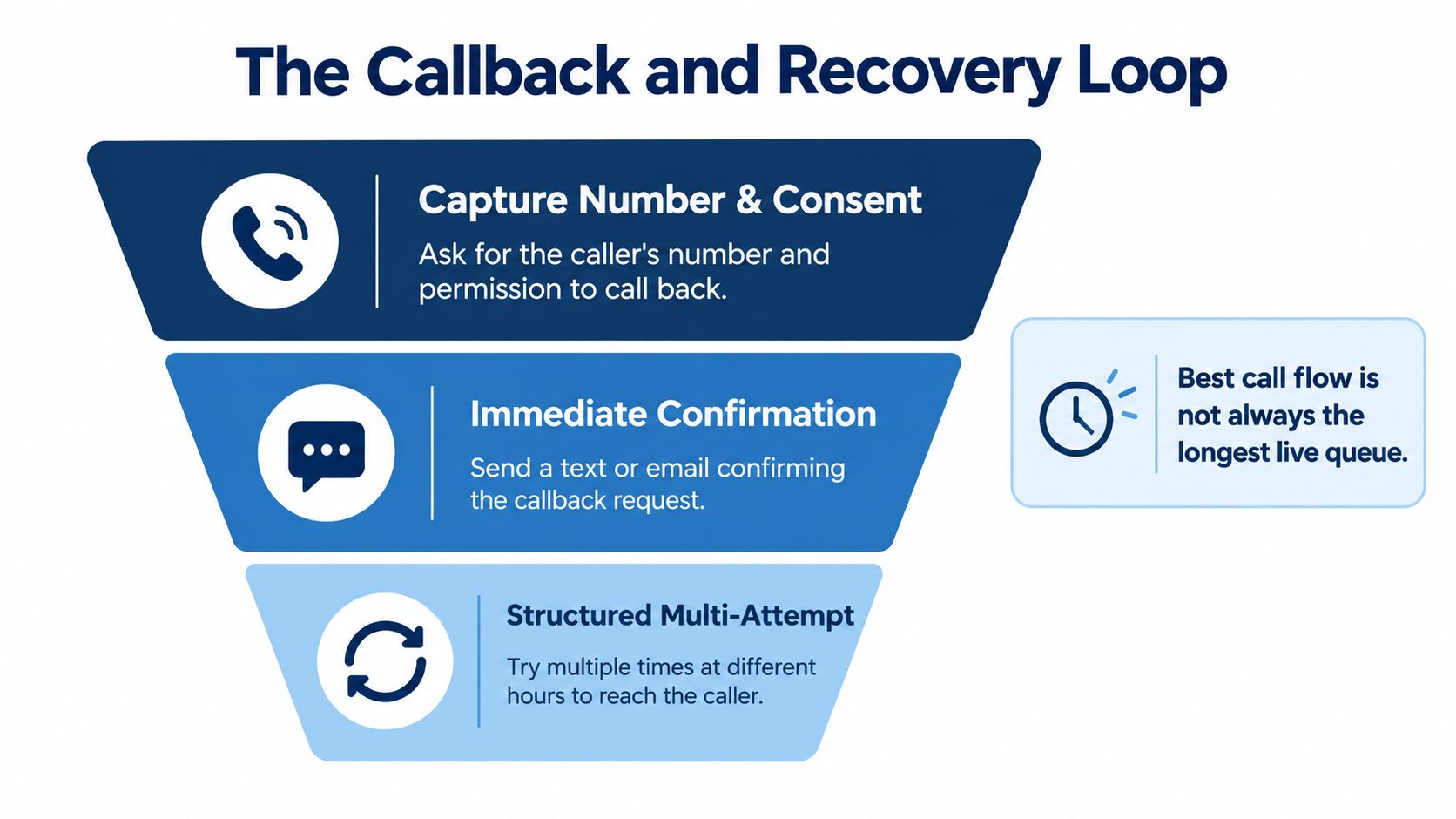
How Recovery Runs
Capture the number and preferred time early, with consent to call and text. Confirm immediately by text or email so the caller knows the request landed somewhere real. Then run structured multi-attempt outreach across phone, text, and email at varied times, with an explicit stop rule so persistence doesn't become harassment. This is the sequencing a proper lead follow-up system built for law firms exists to enforce, because your CRM can't follow up with a lead if nobody puts the lead in the CRM.
Timeliness expectations are unforgiving. Clio research reported that 82% of prospective clients considered timeliness important and 79% expected a response within 24 hours, while more than half of firms didn't respond to voicemail within 72 hours. Technically, calling someone back four days later is follow-up. It is not particularly useful follow-up.
Measure recovery, not just abandonment. Track callback completion, contact rate, qualified consultations recovered, retained matters, and time to first human contact, broken out by after-hours period. A 24/7 operation shouldn't promise every caller an instant specialist. It should promise something more honest and more valuable, which is a reliable path to the right human with expectations stated clearly.
Ethics, Confidentiality, and Supervision Controls
A retail call flow that mishandles a caller produces a bad review. A legal intake flow that mishandles a caller can produce a conflicts problem, a confidentiality breach, or a prospect who reasonably believed an attorney just advised them. The stakes change the design requirements.
Availability pressure makes cutting corners tempting. The American Bar Association reported that only 40% of law firms answered phone calls in a secret-shopper study, down from 56% in 2019. But the same coverage discusses ABA Formal Opinion 512 and its emphasis on attorney supervision of AI, confidentiality, and competence. Routing everything to automation or unsupervised staff fixes the ringing phone and creates a different problem.
Controls That Belong in the Flow
- Relationship disclosure on every intake call. The caller hears that this conversation doesn't create an attorney-client relationship and that no advice is being given.
- Data minimization. Collect what's needed to qualify and screen. Medical, financial, and incident detail beyond that waits for a secure channel and an engagement decision.
- Consent documented. Recording consent, contact consent, and communication preferences recorded in the file, not assumed.
- Conflicts escalation path. Opposing party information goes to attorney review through an auditable handoff, with the file flagged until cleared.
- Scope boundaries staff can recite. Approved language for declining to assess value, timelines, or likely outcomes.
The fastest flow can be the riskiest one if it optimizes conversion while obscuring supervision, privacy, or scope.
The practical question for any firm using nonlawyer staff or AI-assisted intake is which steps can be automated, which must trigger human escalation, and what information should never be collected in an unsecured channel at all. Personal injury and mass tort practices carry the sharpest version of this because callers volunteer medical and financial details freely. Design the boundaries before the calls arrive. Retrofitting them after a complaint is a worse project in every way.
KPIs and the QA Checklist That Keep It Honest
A flow nobody measures decays back into habit within a quarter. The metrics below turn the design into an operating system, and most of them can come out of systems the firm already has.
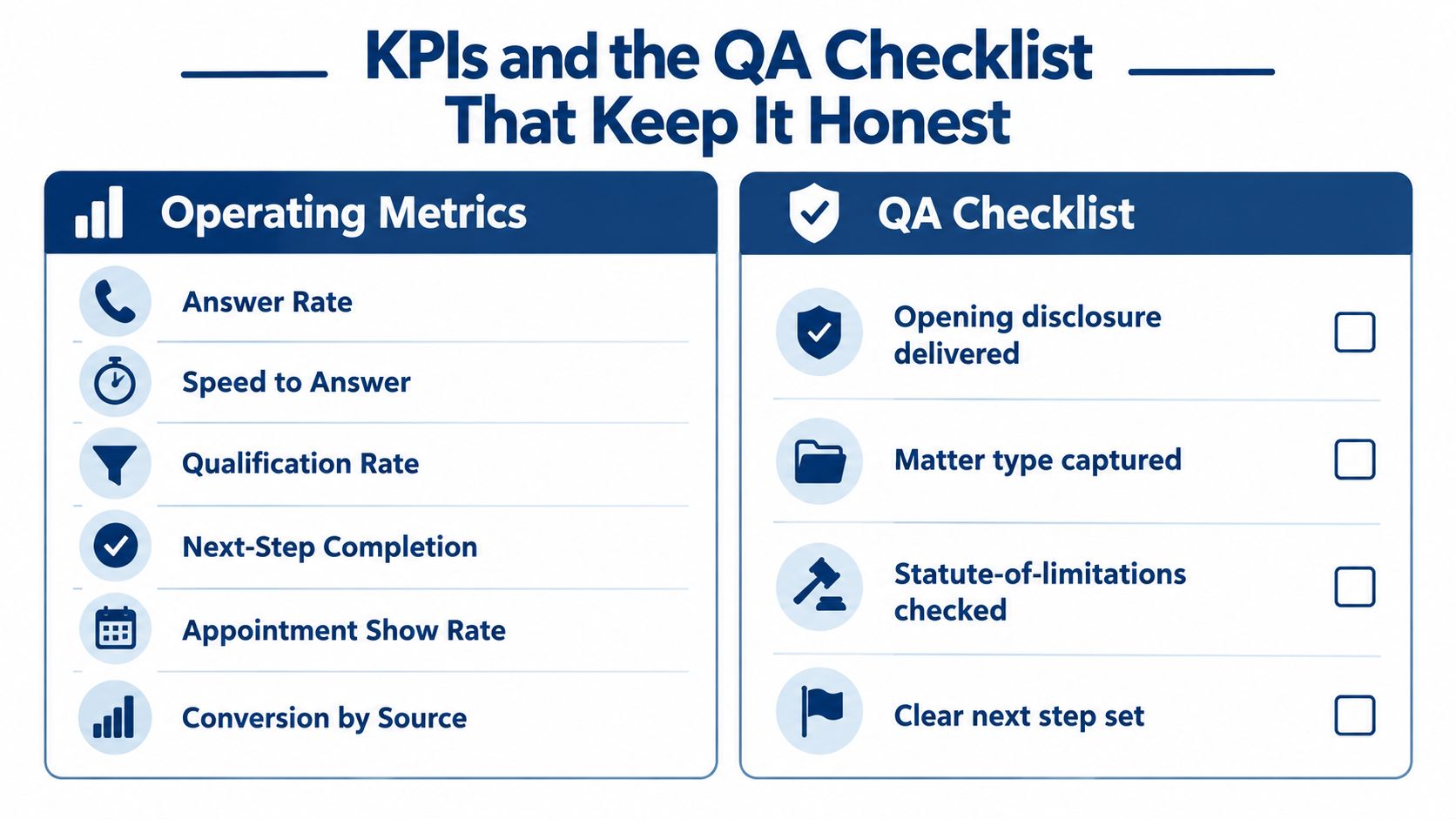
What to Track
- Answer rate and speed to answer. Split by hour, because a good average hides a bad evening.
- Qualification rate. Qualified matters as a share of new inquiries, by source.
- Next-step completion. The single most honest number in intake. Qualified calls ending with a booking, transfer, or owned callback.
- Appointment show rate and conversion. By source, hour, and agent, so patterns show up.
- Recovered-lead outcomes. Abandoned and missed calls that became consultations.
- First-contact resolution for service calls, defined consistently. Industry benchmark material places average FCR near 70%, with 70 to 79% considered good, 80% or higher described as world-class, and only about 5% of contact centers reaching that tier.
QA sampling verifies what the numbers can't. Pull recordings weekly and score them against a short checklist: disclosure delivered, matter type captured, deadline checked, conflicts information collected, facts summarized back, next step completed, disposition accurate. Count a call resolved only when the promised action happened, not when someone promised a callback. Speed-only targets corrupt this fast, because staff learn to close records instead of finishing work.
Review operationally on two clocks. Weekly, reconcile calls without dispositions, review callback deadlines missed, and listen to a sample. Monthly, look at conversion by source and hour and change routing or script language where the data points. The point isn't a prettier report. It's redesigning based on evidence.
Fix These First
In the next 30 days, the highest-value work is unglamorous. Get the answer rate honest. Make next-step completion a reported number. Build the callback loop. Add the disclosure and conflicts controls. And get this work off attorneys' desks, because a Thomson Reuters survey of more than 400 solo and small-firm lawyers found 74% said they spent too much time on administrative tasks instead of practicing law. Firms handle that staffing gap in different ways, including dedicated internal roles or an embedded provider such as Attorney Assistant, whose Frontline team handles 24/7 live intake, qualification, and follow-up. Either way, the principle holds. Frontline signs the case. Staffline carries it. Your attorneys went to law school to practice law. Ideally, they should occasionally get to do that.
If your call reports show answered calls but your calendar doesn't show consultations, the gap is operational, and it's fixable. Attorney Assistant provides 24/7 live intake through Frontline and dedicated full-time legal support staff through Staffline, so intake, follow-up, and case support get handled by people whose actual job it is. Take a look and see whether that's the capacity your current call flow is missing.
Related Articles

Appointment Setting Online: A Law Firm Guide
Master appointment setting online for law firms with proven strategies that turn leads into booked consultations and grow your practice.
Keep the Conversation Going: 8 Intake Follow-Up Tactics
Learn how to keep the conversation going with law prospects using eight practical intake and follow-up tactics, from speed-to-lead to attorney handoffs.
1st Dollar Coverage in Law Firm Retainers: A Practical Guide
Understand 1st dollar coverage in legal and insurance contexts. Learn how it shapes intake, retainer strategy, firm revenue, and risk.