You're trying to reconstruct a client call from days ago. The attorney remembers an instruction, the paralegal remembers a different deadline, and the file says only, “Discussed case.” Everyone was busy. Nobody was trying to create a small archaeological project.
Case management notes are structured records of matter-related events, communications, decisions, and follow-up. Done properly, they let the next authorized person understand what happened, what remains unresolved, and who owns the next action without interviewing everyone who touched the file.
Table of Contents
- Why Case Management Notes Deserve a Real System
- What a Defensible Case Management Note Includes
- How to Write Case Management Notes That Hold Up
- Keeping Case Notes Privileged and Compliant
- Tips for Notes That Survive Handoffs and Busy Weeks
- Who Should Own Case Notes at Your Firm
- Putting Your Note System to Work
Why Case Management Notes Deserve a Real System
A personal reminder only has to make sense to its author. A defensible matter record needs to make sense to someone who wasn't on the call, didn't attend the meeting, and can't fill the gaps from memory.
That distinction matters when an attorney is unavailable, a client disputes an instruction, or staff need to establish whether a deadline changed. “Client called about records” might jog someone's memory. It doesn't establish which records, what the client requested, or whether anyone acted.
Documentation competes with legal work
The commercial pressure isn't imaginary. The 2017 Legal Trends Report found that lawyers averaged 2.3 hours of billable work daily, approximately 29% of an eight-hour workday, while administration accounted for 48% of non-billable time, according to the report's published findings.
That research describes a broader administrative workload, not time spent specifically writing case notes. Still, recording communications, updating matter status, and preserving a usable chronology belong to the operational work competing for attention.
The answer isn't to stop documenting. It's to stop paying for the same documentation repeatedly: first when someone writes an incomplete note, again when a colleague investigates it, and again when an attorney resolves the uncertainty.
Operational test: Could an authorized colleague take the correct next action using this note and its linked records, without asking the author what they meant?
A workable system gives staff a consistent record structure, a capture-and-review habit, confidentiality guardrails, and clear ownership. Managers also need a way to detect unreliable entries before someone relies on them.
The objective isn't beautiful prose. It's a file that remains usable when the person who knows everything takes a vacation, which should not qualify as a business-continuity incident.
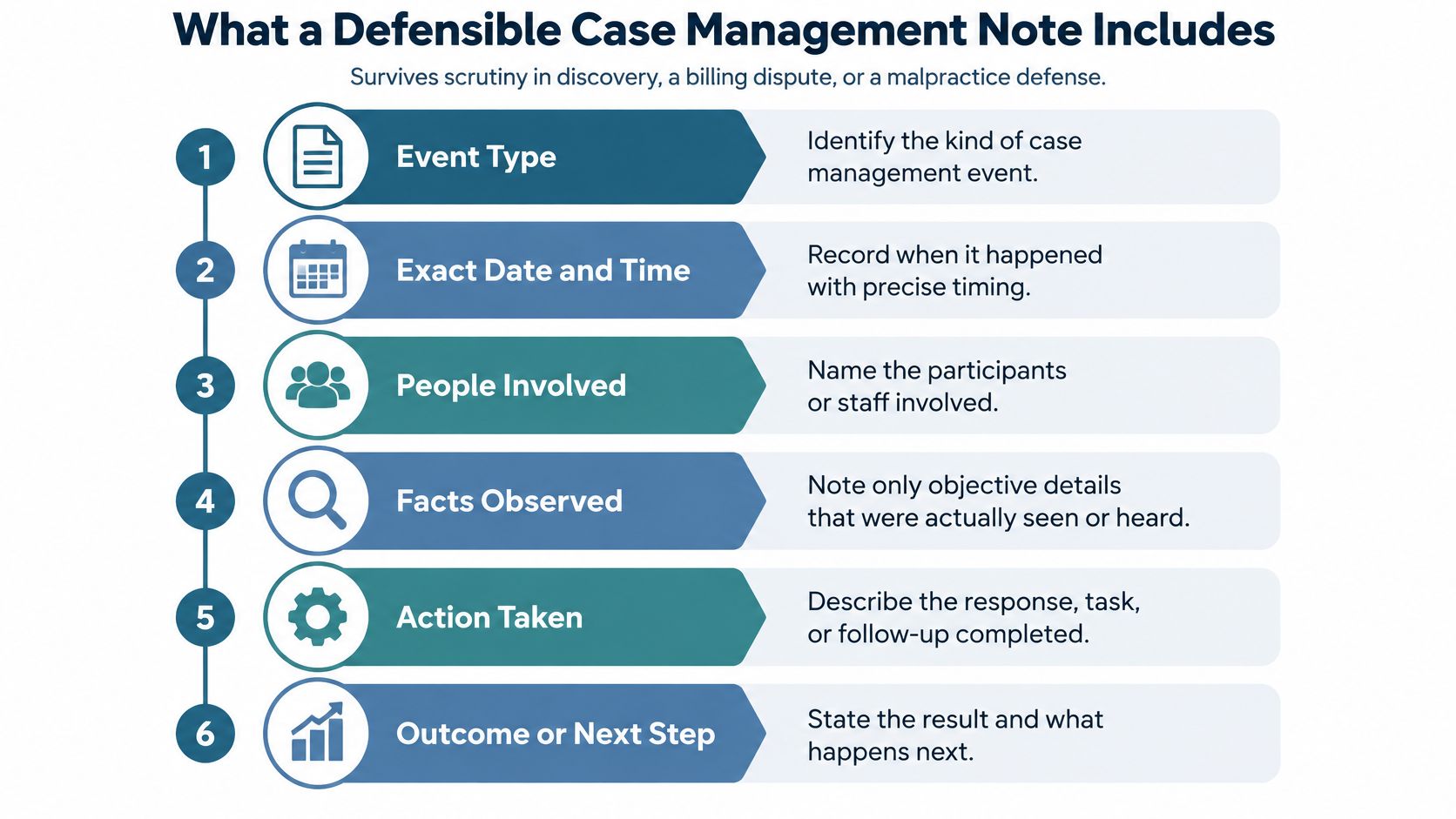
What a Defensible Case Management Note Includes
Write each note as an event record, not an uninterrupted account of everything the author remembers. Structure helps a reviewer distinguish the event itself from the work it triggered.
The following fields adapt the event type, timing, source, outcome, and identity principles in NIST's audit-record content guidance to legal operations. They're a practical design standard, not a guarantee that any particular note will satisfy a court or professional obligation.
Required fields in a usable matter record
- Event type. Identify the activity using a controlled value, such as client call, filing, deadline change, or records request.
- Exact date and time. Record when the event occurred, preferably with its time zone. Keep the event time distinct from the entry time when documentation is delayed.
- Source or location. Identify the phone call, email thread, client portal, court system, or other origin.
- Responsible identity. Record the author or system identity and identify relevant participants. A shared login defeats the purpose.
- Action and outcome. Explain what the person did and what resulted. Attempted contact and completed contact aren't interchangeable.
- Matter linkage and resulting work. Connect the note to its matter, supporting documents, and any resulting task or deadline.
Replace vague narrative with usable evidence
Consider the weak training example: “Called client, discussed case.”
A repaired version should pull actual values from the underlying event rather than manufacture missing details. This illustrative entry shows how that can look without inventing client information:
| Field | Illustrative completed content |
|---|---|
| Event type | Outbound client call, completed |
| Event time | Exact call-start timestamp and time zone imported from the phone log |
| Source | Outbound phone record linked to the matter |
| Responsible identity | Assigned case assistant's authenticated account; client participated |
| Action and outcome | Client reported additional treatment. Assistant requested provider details through the approved portal. No records request sent pending identification. |
| Linked work | Current matter and call log linked; provider-verification task assigned to the case assistant, due before close of business |
For personal injury teams, Ares's resource on stronger personal injury case workflows is a useful companion when connecting note fields to the wider matter process.
Make the fields mandatory where practical, standardize event and outcome dropdowns, and synchronize system clocks. Permit “unknown, verification assigned” when appropriate rather than encouraging staff to guess just to save an entry.
Never overwrite a finalized note without a trace. Append an amendment identifying the original entry, amendment author, timestamp, and reason. Preserve the earlier version so a reviewer can distinguish what was known originally from what was corrected later.
How to Write Case Management Notes That Hold Up
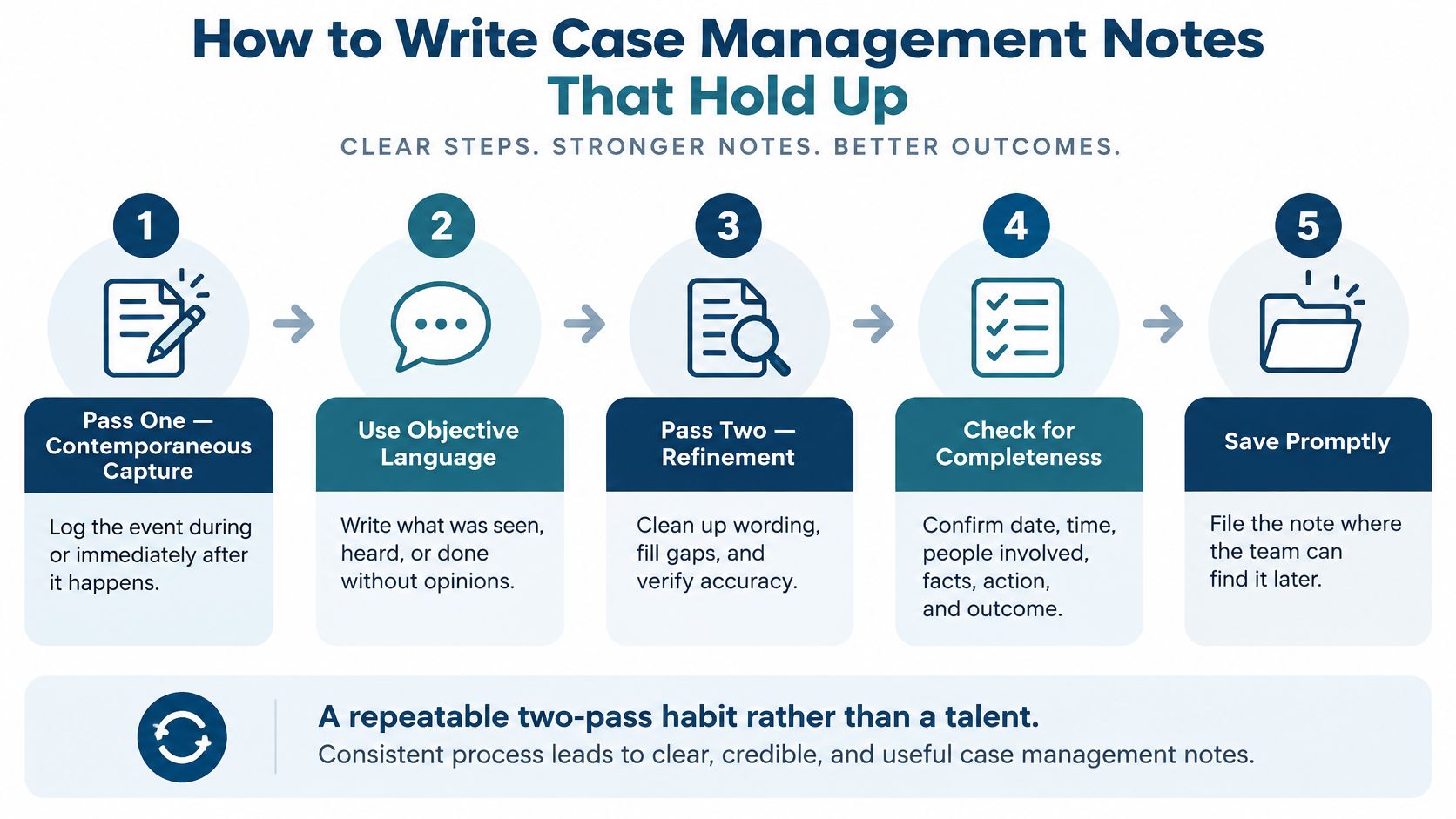
Reliable documentation is a repeatable habit, not a writing talent. Give staff separate moments to capture the event and verify the record before treating it as final.
That distinction is especially useful when calls interrupt other work. The person answering the phone shouldn't have to choose between listening properly and producing polished prose while the client is still speaking.
Capture contemporaneously without turning reports into facts
During or immediately after the event, record what was communicated, observed, or completed. Use explicit attribution so the reader can tell whether information came from the client, a document, or independent verification.
- Client states. Use this for the client's account, including reported treatment, instructions, or concerns.
- Records show. Identify the supporting document rather than presenting the writer's recollection as documentary evidence.
- Staff verified. State how verification occurred and link the confirming record where available.
- Attorney advised. Attribute legal advice to the attorney who gave it, with access and placement governed by firm policy.
Keep fact, allegation, advice, and planned action distinct. “Client reports the provider sent records” is not the same as “Records received.” Someone still needs to check the actual file.
If the note is late, label it accordingly and preserve both the event date and entry date. Don't backdate the record or imply contemporaneous certainty that the author doesn't have.
Review the details that change meaning
Before finalization, check names, dates, dollar amounts, deadlines, and negations against the available source material. “Client will not settle” and “Client will now settle” are separated by very little typing and a considerable amount of trouble.
There's a useful caution from another documentation-heavy profession. A medical-liability analysis reported an average error rate of 7.4% in unreviewed dictated notes, falling to 0.4% after transcriptionist review, as described in this medical-office communication and liability analysis. Those are healthcare findings, not a forecast of legal-note performance, but they illustrate why dictated text shouldn't be mistaken for verified text.
Review for completeness as well as transcription accuracy. Did the client authorize an action, merely ask about it, or say they wanted to discuss it with counsel?
An unresolved question belongs in a task queue, not buried in the final sentence of a note.
Convert each open issue into a task with a named owner, due date, and escalation rule. Vision's best practices for documenting requirements can serve as an adjacent resource for defining expected actions clearly, without treating product documentation as legal authority.
Require second-person review before close of business for entries involving limitation periods, settlement authority, client instructions, or court deadlines. Urgent issues need immediate escalation rather than waiting for the review queue.
If a material detail can't be confirmed, mark it unverified, route it to the appropriate reviewer, and prevent downstream staff from treating it as settled. A correction that nobody sees is only marginally more useful than no correction at all.
Keeping Case Notes Privileged and Compliant
More documentation isn't automatically safer documentation. A useful note preserves material information; an indiscriminate transcript may preserve sensitive material that nobody needed to duplicate.
NIST's audit-trail guidance identifies accountability, event reconstruction, intrusion detection, and problem analysis as central purposes of audit records. It also emphasizes protecting their integrity through access controls, particularly when records may become legal evidence.
For a firm, that supports treating notes as controlled business records. Preserve authorship and change history, restrict access by role and matter, and make retrieval reliable. The firm's legal documents management practices should govern notes alongside their supporting files, rather than leaving them in a separate administrative universe.
A privilege-preserving protocol for AI notes
Cloud transcription deserves its own approval process. The ABA's discussion of confidentiality risks in meeting transcription and note-taking software warns that third-party access, retained transcripts, and confidential uploads can create privilege and discoverability risks.
Neither an AI-generated summary nor a “privileged” label resolves those questions. The responsible attorney must assess the particular communication, applicable obligations, and proposed tool.
Adopt a written protocol covering:
- Permission to transcribe. Prohibit automatic transcription of privileged meetings unless approved. Address applicable recording and consent requirements before capture begins.
- Source retention. Decide whether raw audio and full transcripts are necessary. Document the approved retention treatment before creating them.
- Draft access. Restrict unverified summaries to authorized reviewers. Don't automatically distribute drafts to broad channels or everyone on a calendar invitation.
- Human verification. Require an authorized person to compare the summary with approved source material before filing it as a final note.
- Correction handling. Use the firm's amendment process, including reviewer identity and the reason for material changes.
- Deletion authority. Apply approved retention schedules and preservation obligations. Staff shouldn't delete source material just because a summary looks finished.
Ask vendors operational questions
Request written answers about data retention, data sharing, model training, subprocessors, access permissions, and deletion. Ask whether those settings apply to prompts, recordings, transcripts, summaries, backups, and connected applications.
Vendor-review guidance reproduced by the Association of Corporate Counsel emphasizes evaluating retention, sharing, and self-learning policies. A general assurance that a product is secure doesn't answer what happens to a client conversation after upload.
Use purpose-based minimalism: capture enough to support the next authorized action and preserve material decisions, without copying irrelevant sensitive details. Separate factual chronology from legal analysis through appropriate classification and permissions, while recognizing that placement alone doesn't determine privilege.
Tips for Notes That Survive Handoffs and Busy Weeks
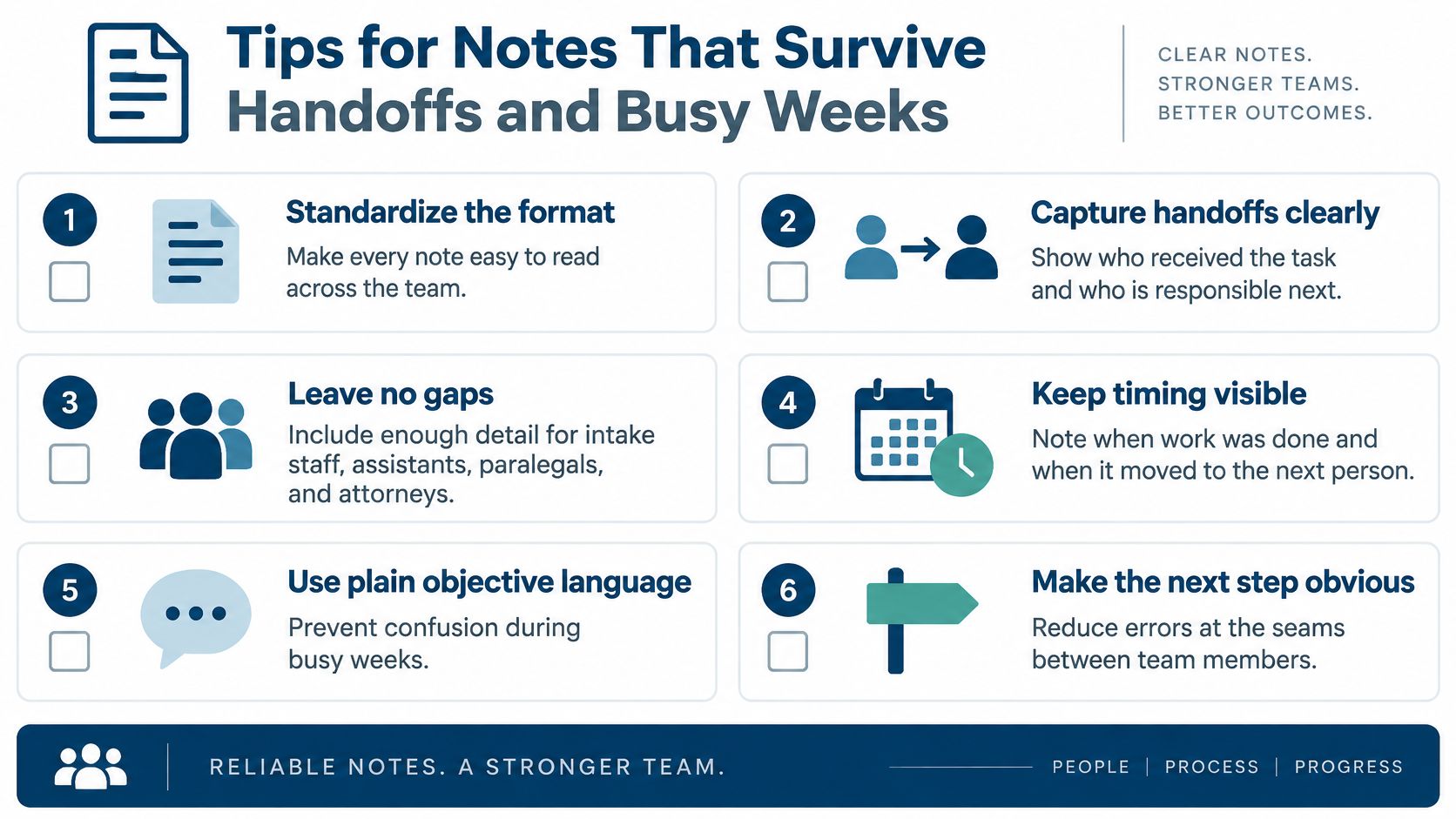
A note can be accurate and still be unsafe to rely on. It may describe yesterday's status, omit a conflicting instruction, or leave the next task assigned to someone who has already handed off the matter.
Treat reliability as a team control, not an individual writing preference. The receiving person needs to know both what the note says and whether its contents have been verified.
Score usefulness, not literary quality
Use a simple review framework that works regardless of the case-management platform:
| Review dimension | What the reviewer checks |
|---|---|
| Factual completeness | Material event details are present; unknowns are visible |
| Source attribution | Reports, documents, and verified facts are distinguishable |
| Next-action clarity | An authorized person can identify what to do next |
| Deadline accuracy | Due dates match the controlling source and calendar |
| Confidentiality classification | Placement and permissions match the content |
| Verification status | Draft, reviewed, amended, and unresolved states are clear |
Mark each dimension as complete, incomplete, or requiring escalation. A free-text compliment from the reviewer is pleasant, but it isn't a quality-control method.
The handoff itself also needs acceptance. The sender assigns the work; the receiving owner acknowledges responsibility or routes the assignment to someone who can act.
Measure omissions as well as completed work
Track mandatory-field completion, correction rate, overdue-task rate, and reviewer-discovered error rate monthly. Define the denominator for each measure so different supervisors aren't producing incompatible reports.
Interpret them together. A rising correction rate might reflect better review rather than deteriorating work; a low error rate means little if nobody examines the underlying records.
Use routine sampling across authors, event types, and handoffs. Expand review around recurring defects and high-risk entries, then fix the cause through template changes, clearer routing, or targeted training.
Management rule: “Be more careful” isn't a corrective action when the form permits missing owners and the workflow has no review step.
Intake needs the same discipline. A review of an audit involving 500 U.S. law firms reported that only 33% responded to email inquiries and 40% answered telephone calls, according to 2Civility's discussion of the 2024 findings.
Log every inbound communication as answered, missed, voicemail, or unanswered email, with the follow-up owner and due time. Recording only completed conversations makes the unsuccessful attempts conveniently invisible.
Build these checks into the firm's case management workflow, not a parallel spreadsheet that someone updates when there's time. Sampling should be routine operational hygiene, with findings used to improve the process rather than surprise staff at performance-review time.
Who Should Own Case Notes at Your Firm
The person best positioned to capture an event isn't always the person who should maintain the entire documentation process. An attorney should preserve the substance of their advice and judgment; support staff can organize the record, identify missing information, and keep resulting work moving.
Choose ownership based on event risk, workload, and available supervision. Delegation without boundaries produces confident entries from people who weren't authorized to make the underlying decision.
Comparing Case Note Ownership Models
| Ownership Model | Strengths | Weaknesses | Best For |
|---|---|---|---|
| Attorneys writing their own notes | Direct context; immediate capture of advice and reasoning | Uses attorney capacity; documentation may wait behind legal work | Sensitive advice, strategy, and decisions requiring attorney judgment |
| Shared in-house staff | Familiar with colleagues, clients, and office procedures | Competing priorities can leave ownership unclear during workload spikes | Firms with sufficient capacity and a reliable assignment process |
| Dedicated support staff | Clear operational ownership; familiarity with templates and recurring work | Requires onboarding, permissions, supervision, and backup coverage | Firms with sustained documentation, case-support, or CRM backlogs |
Shared staff can work very well when responsibilities are explicit and capacity is truly available. There's no operational virtue in replacing a functioning arrangement just because another staffing model exists.
Dedicated support becomes useful when documentation repeatedly slips despite clear standards. That pattern calls for a workload review, not another reminder email written in progressively firmer bold text.
Separate administrative ownership from legal judgment
Attorney Assistant's Staffline is a dedicated-support option, with a professional assigned to one firm for 40 hours per week; firms evaluating that model can consider the responsibilities outlined in its case management aide resource. Case management and CRM hygiene are among the functions Staffline can support.
AA sources, vets, and trains professionals on legal support fundamentals. The firm then trains the assigned person on its templates, systems, event definitions, preferences, and escalation rules, with AA helping co-manage performance.
A useful division of responsibility looks like this:
- The event participant supplies the substantive account and identifies instructions or decisions.
- The support owner checks structure, links documents, creates tasks, and routes uncertainties.
- The supervising attorney resolves legal ambiguity and reviews matters requiring legal judgment.
- The operations lead monitors quality, workload, access, and coverage.
Give the support owner authority to return an incomplete entry, not authority to invent what's missing. An assistant can flag conflicting settlement instructions; counsel must resolve them.
Measure the arrangement by current records, completed follow-up, and reliable escalation. Hours logged tell you whether someone was working. They don't establish whether the file is usable.
Putting Your Note System to Work
Start with a small sample of recent notes from active matters. Include an intake interaction, a client instruction, a records update, and a handoff rather than selecting only the cleanest entries.
Apply the field and reliability checks already established. Don't repair the notes before assessing them, because the current condition is the point of the exercise.
Diagnose the actual constraint
- A writing problem appears when staff have the necessary information but record it ambiguously.
- A standards problem appears when authors use incompatible formats, statuses, or routing rules.
- A capacity problem appears when trained people understand the process but can't keep up.
- A governance problem appears when permissions, transcription approval, or retention decisions are unclear.
Assign an owner to the recurring defect and make a concrete change. That might mean revising a dropdown, requiring task acceptance, disabling an unapproved meeting bot, or reallocating case-support work.
If reviewers can't reliably find the supporting material, fix retrieval alongside note quality. FaxZen's overview of digital filing systems for small businesses is a useful adjacent resource for considering filing structure, with the firm's legal confidentiality and retention requirements controlling implementation.
Case management notes should reduce the effort required to understand a matter, not create another investigation. When the standards work but nobody has time to maintain them, evaluate whether dedicated Staffline capacity would be more useful than asking already-overloaded attorneys to become better administrators.
Attorney Assistant provides trained legal support staff and 24/7 live intake, combining dedicated teams with AI-enabled systems for law-firm operations. If your case notes and CRM updates keep falling behind, visit Attorney Assistant to discuss how a dedicated Staffline professional could maintain those workflows inside your existing systems, with your attorneys retaining legal judgment and supervision.
Related Articles
Medical Records Coordinator: What the Role Actually Does
A medical records coordinator manages records retrieval, summaries, billing, and liens for law firms. Learn duties, KPIs, and when to outsource vs hire.
Medical Records Request: A Practical Guide for Law Firms
Run a clean medical records request with HIPAA-compliant steps, sample language, timelines, fees, and follow-up tactics built for law firm operations.
Litigation Support Services: What Law Firms Need to Know
Discover how litigation support services streamline discovery, reduce costs, and improve case outcomes. Learn what to look for in a provider.