
A client experience coordinator documents, routes, and follows every client contact through the next completed step so your firm isn't relying on an attorney's memory. It's a dedicated operational role, not another reason for the attorney to check the inbox.
Your receptionist has a message, your intake team has an incomplete form, and your partner has a client asking for an update nobody recorded. Each person handled something. Nobody owns what happens next. That's the vacancy this role should fill.
Table of Contents
- What the Client Experience Coordinator Is
- Work the Coordinator Owns on Every Matter
- Skills That Separate Coordination From Courtesy
- Communication Rules Clients Already Expect
- Three Firm Moments This Role Changes
- Jobs People Mistake for This One
- Decide Whether the Seat Needs Filling
What the Client Experience Coordinator Is
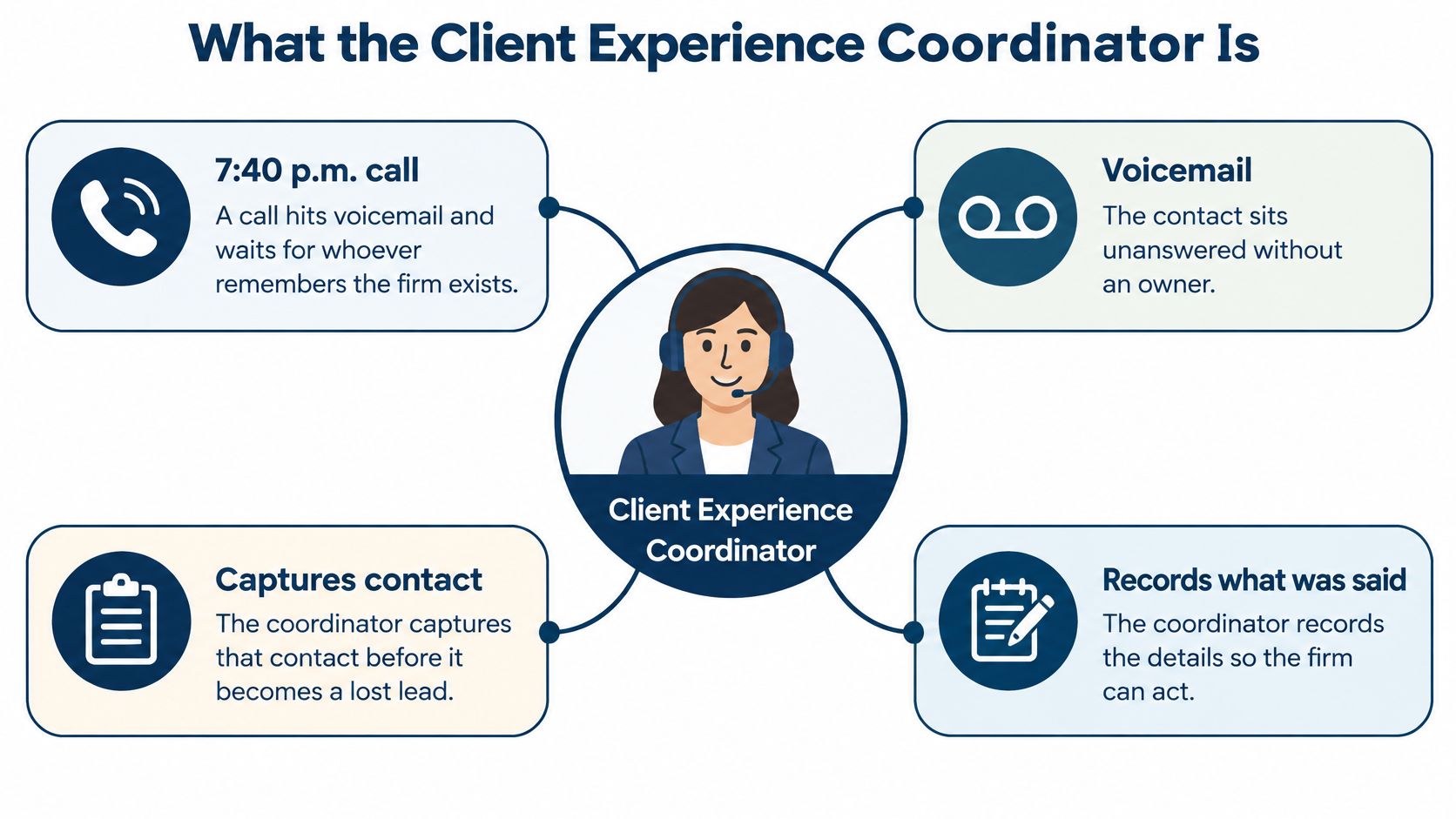
Say a prospective client calls at 7:40 p.m. The call hits voicemail and waits for whoever remembers the firm exists the following morning. By then, the caller may have moved on, and the only surviving record is an audio file nobody has claimed.
A client experience coordinator captures that contact, records what was said, routes it to the appropriate person, and follows it until the next step is completed. Routing alone isn't enough. Forwarding an email transfers a message, not necessarily responsibility.
The distinction is easier to see as a workflow than as a job title.
Hire for duties, not the title
The title sits within the broader customer-service occupation, rather than a single standardized government classification. The Bureau of Labor Statistics' May 2023 occupational profile counted 2,858,710 customer service representative jobs, with a mean annual wage of $43,520 and a mean hourly wage of $20.92.
Those are broad occupational figures, not a salary quote for a legal coordinator. For your hiring decision, the useful connection is the work: answering questions, recording contacts and actions, reviewing account information, and referring matters that require more experienced staff.
In a law firm, those functions become:
- Structured intake: Capture usable facts rather than an unexplained request to call someone back.
- Status communication: Relay approved information and identify the next action.
- Appointment coordination: Confirm that the client and responsible professional have the same appointment.
- Lead follow-up: Keep an unresolved inquiry assigned until it reaches a documented disposition.
- Case-team handoffs: Deliver context, outstanding questions, and a clear owner.
Define the seat before shopping for candidates
A polished customer-service resume won't tell you whether someone can manage an unresolved queue. Write the duties, authority limits, and reporting relationship before comparing candidates or providers.
LatHire's guide to the best place to hire legal virtual assistants can help organize the sourcing decision. Use it after defining the work, not instead of defining it.
Hiring rule: The person should own the next operational action without pretending to own the legal answer.
This seat is neither the lawyer nor a message pad. Its value comes from clear boundaries, reliable records, and enough authority to chase an unfinished task without asking a partner's permission each time.
Work the Coordinator Owns on Every Matter
Who owns each stage of the client journey
| Stage | Coordinator owns | Stays with attorney or case team |
|---|---|---|
| First contact | Answer or prompt callback, source capture, conflict questions, practice-area triage | Legal advice and the decision to accept the matter |
| Qualification | Fit facts, consult scheduling, documented disposition | Strategy and whether the case belongs at the firm |
| Engagement | Fee or retainer delivery, signature tracking, file-opening checklist | Counseling on terms and legal scope |
| Active matter | Status cadence, appointments, document-request chasing | Analysis, hearings, and negotiation |
| Records and vendors | Record and bill requests, receipt logging, vendor nudges | Medical judgment and lien decisions |
| Stall or close | Multi-attempt follow-up and CRM notes on quiet leads | Final legal outcome |
Delegate the process without delegating judgment
The coordinator should use your approved intake questions, not improvise a conflict analysis. They can collect names and relevant relationships, flag a potential issue, and route it for review. They shouldn't tell the caller that a conflict has been cleared unless the firm's authorized process establishes that result.
Qualification works the same way. Your coordinator confirms fit facts, books the consultation, and records the disposition. The attorney decides whether the matter belongs at the firm and what legal strategy makes sense.
Engagement creates a particularly useful boundary. Sending approved fee materials and tracking signatures are coordination. Explaining how disputed terms affect the client's rights requires the appropriate legal professional. A client asking where to sign is different from a client asking what they're giving up.
During an active matter, the coordinator can maintain the update schedule, arrange appointments, and chase documents. For records and vendors, they request bills, log receipts, identify missing items, and follow up. They don't interpret medical significance or decide lien strategy.
Make the handoff a completed transaction
A handoff needs more than a recipient. Require the receiving person to have the relevant facts, the outstanding action, and a due date or trigger. Keep the task open until someone accepts ownership.
For a stalled intake, the coordinator logs each attempt and the reason for stopping. For a closed matter, they complete the administrative checklist under case-team direction. The attorney remains responsible for the final legal outcome and any advice associated with closure.
This division protects expensive attention. Bloomberg Law's 2024 Attorney Workload and Hours Survey, which included 1,054 legal professionals, found attorneys spent approximately two of every eight hours, about 25% of a typical workweek, on administrative activities such as tracking hours and managing projects.
Not all administrative work belongs with this coordinator. Time-entry decisions, supervision, and substantive review may still require attorney involvement. But attorneys shouldn't become the default owners of scheduling, receipt confirmation, and unanswered document requests merely because nobody assigned those tasks elsewhere.
Use the table as an operating audit:
- Mark inbox ownership: Flag any row currently managed through a partner's unread messages.
- Mark memory ownership: Flag any row where the next action exists only in someone's head.
- Assign the exception path: Name who resolves blocked tasks when the coordinator can't proceed.
Your attorneys went to law school to practice law. Ideally, the task assignment system should permit it.
Skills That Separate Coordination From Courtesy
Courtesy gets someone through the interview. Judgment determines whether you can trust them with the queue. Test the work itself rather than asking whether the candidate considers themselves organized.
Test writing, records, and calendar control
Start with status writing. Give the candidate a vague checking-in email and ask for a rewrite that states what happened, what happens next, and who owns it. A strong answer distinguishes a confirmed event from an expected development and avoids settlement predictions or invented legal conclusions.
Then test CRM hygiene. Present a lead with no notes and scattered correspondence. Ask the candidate to reconstruct the contact history, identify missing facts, and create a next-action task in a sample record.
Use the system your firm runs, whether that's Filevine, Litify, Clio, CASEpeak, or SmartAdvocate. The exercise should reveal whether the candidate distinguishes facts from assumptions. A note in a personal inbox isn't a file, however reassuring its folder name may be.
For calendar control, provide conflicting client calls, an internal meeting, and a court-related commitment. Ask what they would move, what requires confirmation, and who must approve a change. Look for attention to time zones, preparation time, and authority, not merely an attractive calendar.
Test composure, escalation, and consistency
Use these practical exercises for the remaining skills:
- Calm phone handling: Role-play an injured, frustrated caller who keeps interrupting. The candidate should acknowledge the concern, gather necessary facts without interrogation, and recognize when continued questioning is making matters worse.
- Escalation judgment: Include a conflict-sensitive detail, ambiguous qualification, a language or accessibility need, and a question about retainer terms. Ask what they would record, what they would stop discussing, and whom they would contact. They shouldn't freelance the conflict answer or negotiate terms.
- Checklist discipline: Give the candidate an ordinary intake checklist, then add competing requests halfway through. Ask them to show completed steps, outstanding work, and the order of recovery. Speed matters less than whether required steps are missed.
Many strong candidates come from customer-service work in legal or professional settings. That background can provide composure and documentation habits, but it doesn't substitute for training on your scripts, systems, preferences, and procedures.
Charm can soften a difficult call. It can't reconstruct a contact history nobody recorded.
Set a clear pass-fail standard: if the candidate can't keep the record current, the charm doesn't matter. You're hiring someone to make the next action dependable, not just pleasant.
Communication Rules Clients Already Expect
The Law Firm Marketing Club's 2026 client-expectations survey summary reported that 88% ranked direct contact details as important, 85% expected at least weekly updates, 83% expected same-day responses, and 81% valued an online account for updates and documents. Those expectations need operating rules, not a general promise that the firm communicates well.
Client expectations and the coordinator rule
| Expectation | Share of clients | Coordinator rule |
|---|---|---|
| Direct contact details | 88% | Named owner and a published way to reach that person |
| Weekly updates | 85% | A set cadence on every matter, including weeks when nothing moved |
| Same-day response | 83% | Same-day reply during published office hours |
| Online account for updates and documents | 81% | One place where status and documents match what staff say by phone |
The coordinator turns that promise into a matter-level plan.
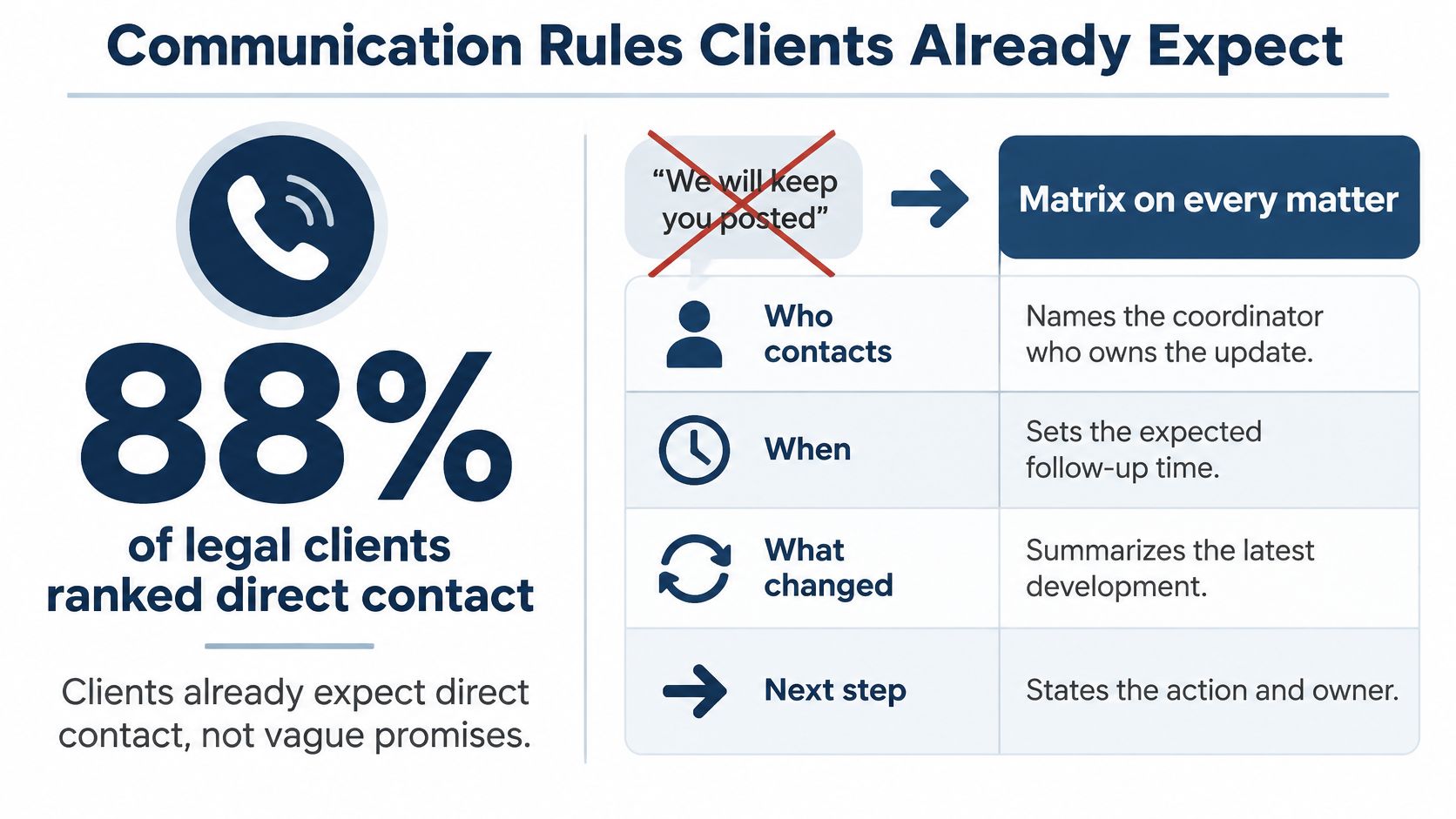
Put the communication matrix in the file
Record these fields in order: responsible staff member, permitted channels, update cadence, response deadline, escalation owner, and event-triggered notifications. The client-facing contact should be a named person with a working number or approved messaging route, not a mysterious team address that everyone assumes someone else monitors.
Event triggers should include a filing, record receipt, settlement step, or missed appointment. Give each trigger an approved status description and an owner. A settlement development, for example, may require attorney review before the coordinator sends anything.
A quiet week still warrants an accurate update: the requested records haven't arrived, the request remains assigned, and the coordinator will chase the provider. Don't manufacture progress to make the email feel worthwhile.
Predictable ownership reduces the client's need to repeat the same question to different staff members. It also lets attorneys review defined exceptions instead of receiving a procession of interruptions with no context. Our guide to responsiveness in the legal client experience offers additional practical guidance for setting those expectations.
Publish the after-hours boundary
State when a human answers, what the firm treats as urgent, and who receives an escalation. Distinguish acknowledging a message from providing a substantive legal answer. Round-the-clock intake doesn't mean an attorney must analyze every routine question at midnight.
Avoid promises the staffing model can't support. If a response requires attorney review, the coordinator should explain that clearly and give the next expected contact point.
Audit a sample of files against these checks:
- Response-time compliance: Did someone respond within the published rule?
- Update frequency: Was the promised cadence maintained?
- Accurate status language: Did staff distinguish confirmed facts from pending work?
- Documented consent: Were communication preferences and required permissions recorded?
- Completed handoffs: Did intake, legal staff, and records or billing acknowledge ownership?
A communication policy nobody checks is mostly stationery.
Three Firm Moments This Role Changes
The coordinator changes who owns the next step when a client, lead, or attorney is waiting. These composite operating illustrations show the difference between recording a problem and carrying its operational handoff through.
The work can start before an attorney opens the file.
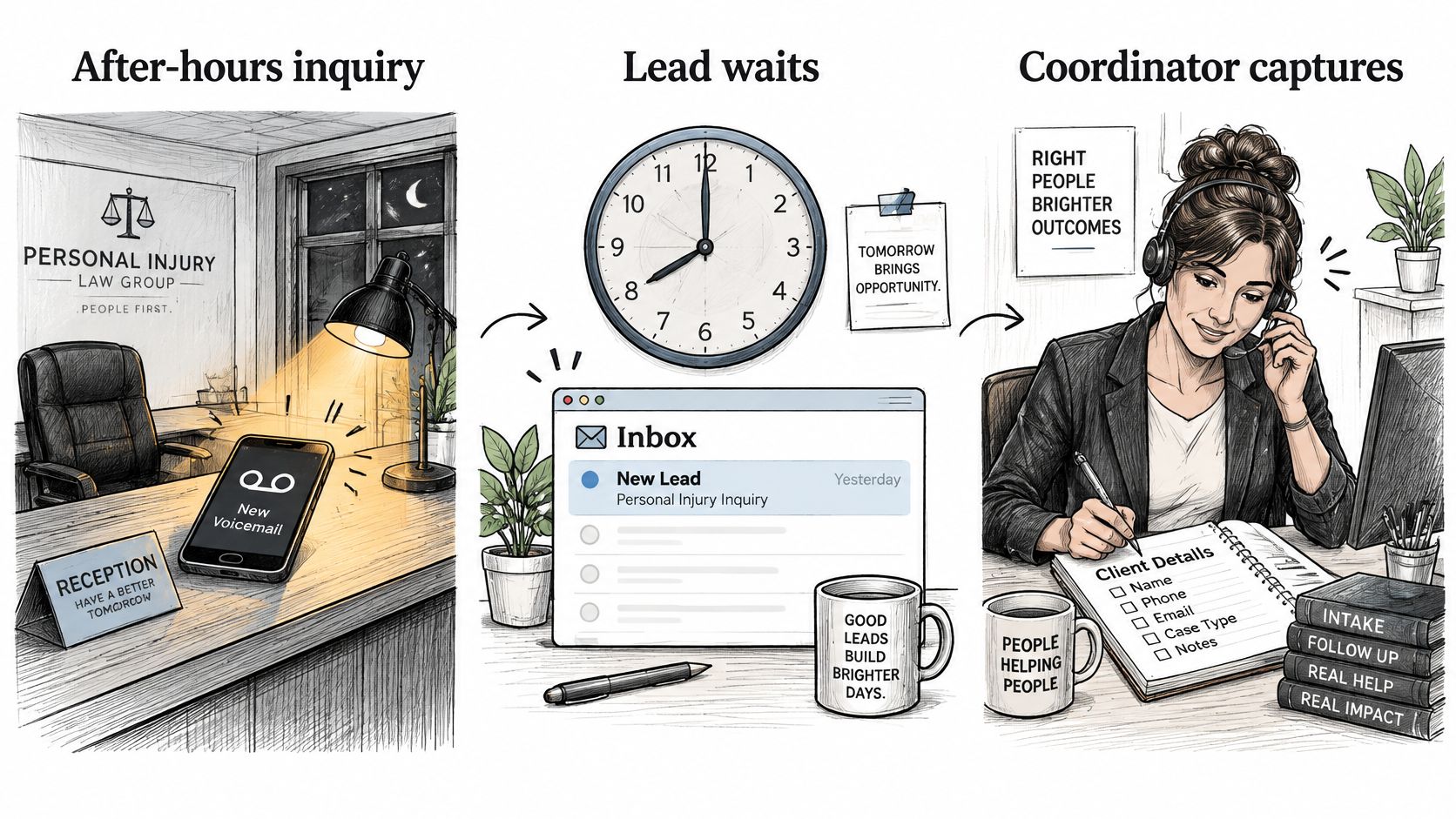
An after-hours personal-injury inquiry
Without an assigned owner, the inquiry can sit until morning while the caller contacts other firms. With a coordinator standard, the contact is logged, live outreach is assigned, and the attorney can review the disposition at the start of the day.
Track time to human contact, not merely the automated acknowledgment. Record whether the attorney received enough detail to act without repeating intake questions. A voicemail timestamp is not a completed handoff.
The intake form that never returns
The 2026 Clio Legal Trends Report examined 441,153 stalled U.S. matters. Among matters where an intake form was sent and remained unreturned for seven days, only 9.5% received follow-up within 30 days. Matters followed up within the first 24 hours had a 37% hire rate, compared with a 29% baseline. Across 356,229 first contacts, the median firm took approximately 21 hours to make initial human contact.
Those figures show an association, not proof that faster outreach causes a hire. They do make a practical case for assigning follow-up instead of treating silence as a decision.
Use a planned four-touch sequence, subject to the firm's consent and contact rules:
- Call: Check whether the person received the form and ran into a barrier.
- Approved message: Send a concise email or permitted text identifying the outstanding action.
- Second live attempt: Try another approved contact window and offer help completing the process.
- Final notice: Explain how to resume contact, then apply the documented closure or nurture rule.
Stop if the person declines, withdraws permission, signs, or reaches the approved attempt limit. Log each disposition so the next staff member does not restart the sequence from memory.
Thursday disappears into update calls
Suppose an attorney spends Thursday afternoon answering questions already resolved in the file. The coordinator sends scheduled updates and routes exceptions, such as stalled treatment or a moved deadline, for the appropriate review.
Measure overdue updates and attorney interruptions, not email volume. Strong case management experience depends on seeing which file needs operational attention, not responding to whoever called most recently.
The coordinator does not create demand. The role keeps existing opportunities and open matters from sitting unworked in a queue.
Jobs People Mistake for This One
Taking a message records that someone called. It doesn't qualify the matter, book the consultation, or try again when the caller doesn't answer. A receptionist can own those duties, but only if the firm assigns them.
This is the distinction to make before buying coverage.
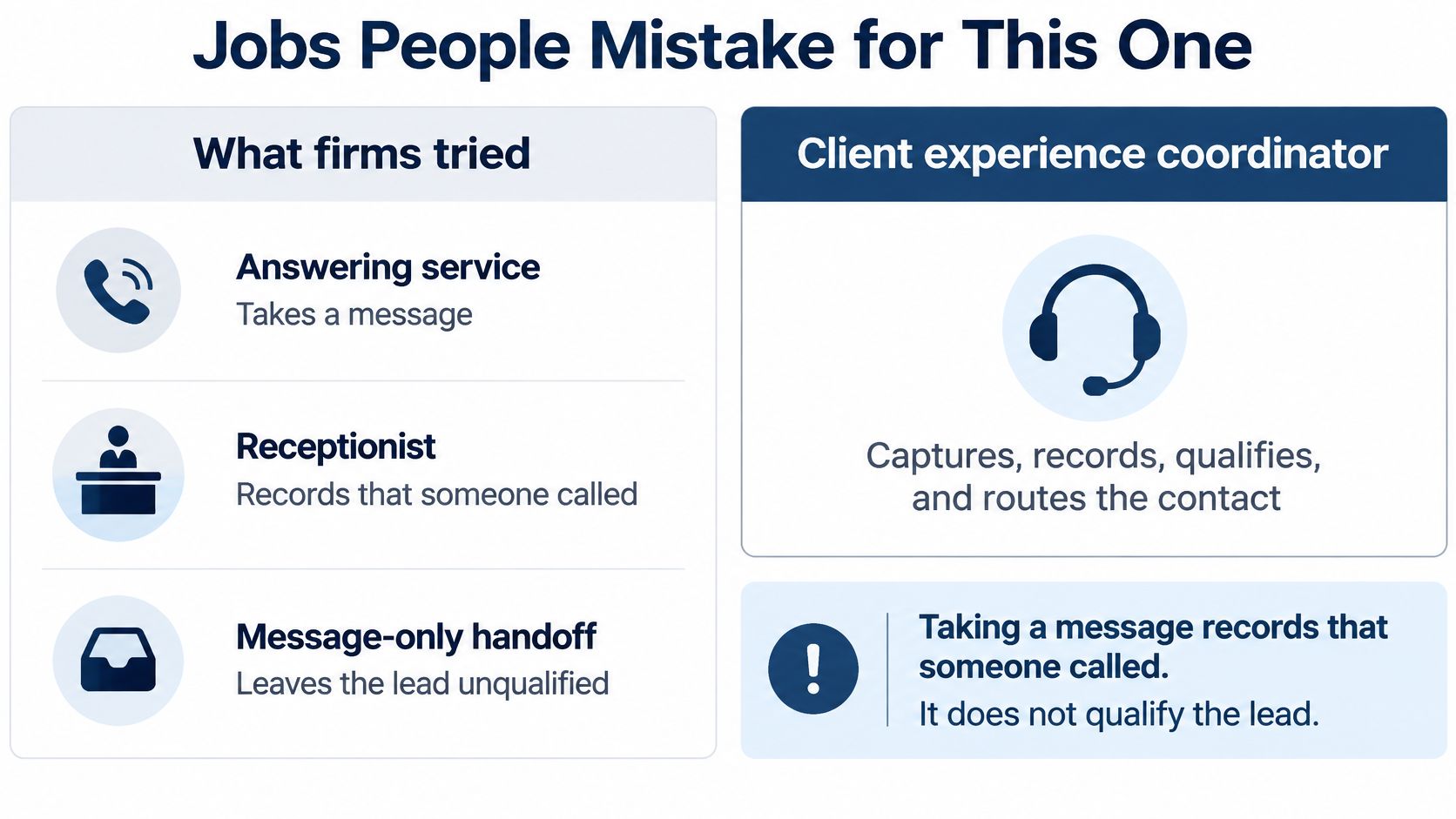
Automation is support, not ownership
The Law Firm Marketing Club's 2026 survey reported 89% of consumers preferred a real person rather than AI when contacting a law firm, up from 84% in October 2025, while 58% associated a human answer with valuing customers and 45% with professionalism.
Speed still requires attention: Hennessey Digital's study of 1,333 U.S. law-firm websites, summarized in Pareto Legal's intake statistics, found a 13-minute median response time, with 39% taking more than two hours or never replying.
The practical split is straightforward:
- Automate administrative repetition: Acknowledgments, reminders, routing, and structured data capture.
- Assign human intervention: Distressed callers, conflict-sensitive facts, unclear qualification, language or accessibility needs, and retainer questions.
- Build a failure route: Send tool-failure alerts to a named person and divert new contacts to live coverage or a monitored callback queue.
A broken chatbot is just a quieter voicemail. Someone must notice the failure and work the contacts it missed.
Another attorney solves a different shortage
Hiring an attorney adds legal capacity. It doesn't automatically establish callback ownership, current records, or a functioning escalation queue.
Likewise, distinct legal support jobs shouldn't become interchangeable because they all involve a computer and a telephone. The distinction between a legal secretary and a paralegal helps clarify why firms should assign responsibilities by function rather than by whoever happens to be available.
Measure whether the client reached the right person and understood the next step, not how quickly software said hello.
Evaluate the blended system through completed contacts, qualified matters, client comprehension, retention, and complaints. Fast acknowledgment is useful. Fast acknowledgment followed by silence is merely efficient disappointment.
Decide Whether the Seat Needs Filling
Fill or formally assign the seat when these checks expose unowned work:
- Memory-based intake: New inquiries wait for someone to remember them.
- Attorney interruptions: Routine status calls repeatedly pull lawyers away from substantive work.
- Unsigned forms: Nobody owns follow-up.
- Stalled records: Requests have no assigned chaser.
- Incomplete CRM histories: Open matters lack the latest client contact.
Don't add this title if the actual shortage is case strategy or courtroom capacity. A coordinator can keep work moving toward a legal decision, but can't supply the legal judgment.
Assign ownership before posting the job
Name an owner for intake through file opening and an owner for ongoing updates, records chasing, and calendar control. Write the response rule and weekly cadence before hiring. Otherwise, the new employee inherits ambiguity with system access.
Where dedicated capacity is missing, Attorney Assistant can support both sides of the journey. Frontline provides 24/7 live intake to answer, qualify, follow up, and sign appropriate matters in English and Spanish, rather than take messages; Staffline provides a dedicated, full-time legal support professional working with one firm, 40 hours per week, inside its systems on case support, records, updates, and administration.
Pairing live intake with dedicated support covers the firm from first call to case resolution, with the mix scoped on a discovery call. Implementation follows role scoping, match and onboarding, case-management-system integration, and co-management with quality assurance and coaching.
Consultations require no commitment. A Client Success Consultant learns the workflow and builds a custom pricing package around the firm's needs.
Before adding another title to the organization chart, trace this week's unanswered leads and routine update calls. If nobody can identify who owned the next action, your client experience coordinator seat is already empty.
Attorney Assistant combines trained legal support staff, live intake, and AI-enabled systems to help firms build capacity without making attorneys the switchboard. Visit Attorney Assistant to discuss where your intake, follow-up, or ongoing client communication needs a dedicated owner. Bring a stalled lead and an overdue update, and start with the work that needs doing.
Related Articles

Answering Service for Business: A Practical Guide for 2026
Learn how an answering service for business works, which options exist, and how fast, consistent call handling protects leads, intake and client trust.

Law Firm Lead Generation: 7 Intake and Follow-Up Tools
Law firm lead generation fails without fast intake and steady follow-up. Compare seven tools and what each one actually delivers for your firm.

Legal Intake Software: How It Works and When to Add People
Legal intake software captures, qualifies, and tracks new matters. See the workflow it supports, the features worth paying for, and where live intake fits.