Customer Service Calls: How to Handle Them Well

Your receptionist is on another call, an attorney is asking whether anyone returned yesterday's inquiry, and the CRM says a prospective client is “pending.” Pending what, exactly, remains a team mystery. Meanwhile, someone who needs help is deciding whether to call another firm.
Good customer service calls end with a known outcome and an owned next step. Answering matters, but it's only the beginning. For law firms, the core work is getting the right information to the right person without making the caller manage the process.
Table of Contents
- The Six Stages of a Customer Service Call and Where They Break
- Why Phone Support Still Carries the Most Weight
- Performance Metrics That Show Whether Calls Work
- How to Script a Call That Moves Customers Forward
- Scoring Call Quality With a Call Review Scorecard
- Technology and Staffing Choices That Keep Calls Answered
- Audit One Week of Calls Before You Change Anything
The Six Stages of a Customer Service Call and Where They Break
A customer service call is a relay race, and the baton is the information and the next step. It has to pass cleanly from caller to agent to whoever owns the follow-up, not disappear somewhere between reception and an attorney's inbox.
A customer service call is a live conversation with a purpose: solve a problem, answer a question, qualify a request, or move a transaction forward. An inbound call starts when the customer rings your business; an outbound call starts when your team contacts them. Both follow the same stages, although an outbound opening must explain why you're calling and check whether it's a suitable time.
The six stages of a customer service call
| Stage | What the agent does | Common failure |
|---|---|---|
| 1. Connection | Caller reaches a person or a menu within a reasonable wait | Long holds and dead-end menus |
| 2. Identification | Agent confirms who the caller is and which account or matter applies | Asking for details the system already holds |
| 3. Discovery | Agent asks what happened and what outcome the caller wants | Jumping to a fix before the problem is understood |
| 4. Resolution | Problem is solved, or a clear path to solving it is set | Promising a fix that nobody can deliver |
| 5. Next step | Caller knows what happens next and when | Vague wording such as someone will get back to you |
| 6. Documentation and close | Notes are logged, an owner is assigned and the caller is thanked | Notes missing, so the next person asks the same questions |
The handoffs matter as much as the individual stages.
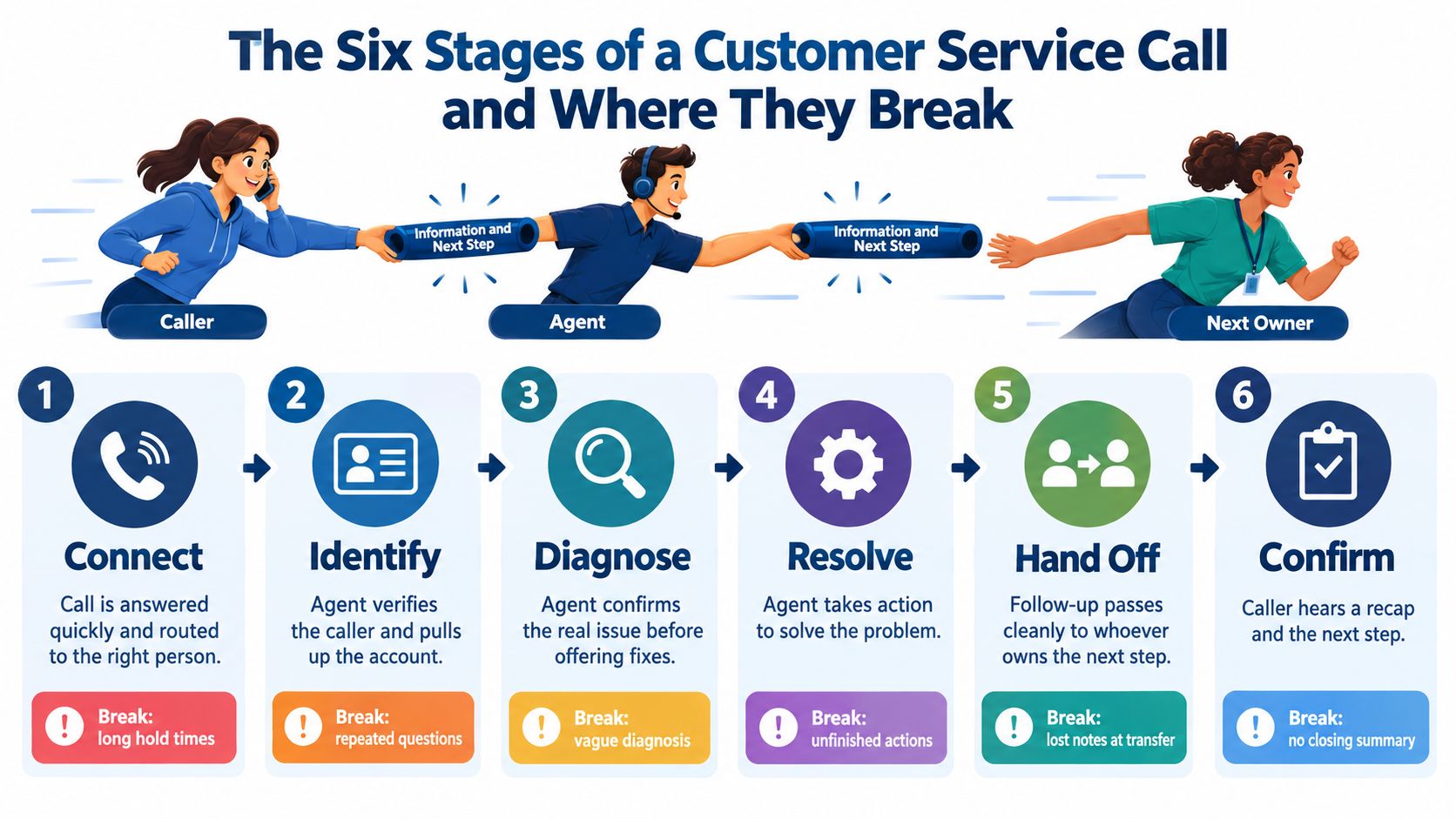
Replace the habits that break the handoff
Counting answered calls as success rewards availability without checking usefulness. Track whether the request was resolved or accepted by a named follow-up owner. A receptionist who identifies an urgent attorney question and arranges a confirmed callback has advanced the work, even though they haven't answered the legal question.
Transferring without context turns the caller into your internal messenger. Replace the blind transfer with a concise summary of the issue, the relevant matter, and the action needed. Confirm the receiving person can take ownership before leaving the conversation.
Promising callbacks without an owner creates an obligation nobody has personally accepted. Put the responsible person and due time in the log. A shared inbox can hold the record, but it can't be accountable for making the call.
Overpromising timelines usually starts with a good intention: calm the caller down. Replace reassurance you can't support with a window the team can reliably meet. If an attorney's availability is uncertain, promise a status update rather than an attorney conversation.
Practical rule: Distinguish what the representative can complete from what requires someone else's decision. Never disguise the second as the first.
Say a prospective client explains an accident to reception, repeats it to intake, then tells an attorney the same story that afternoon. Each person may have been polite. The process still made the caller perform unpaid clerical work for the firm.
The fix isn't to stop asking necessary verification questions. It's to preserve the caller's account, identify what remains unknown, and ask only the questions needed for the next decision. Staff should distinguish information the caller reported from information the firm has verified.
A call is complete only when the caller knows what happens next, when it happens, and who is responsible. If the request is fully resolved, say so. If it isn't, explain the remaining action without implying that a scheduled consultation means the firm has accepted representation.
Map your last ten calls onto these stages. Mark the first point where progress stopped, not just the final complaint. That's where you'll usually find the dropped baton.
Why Phone Support Still Carries the Most Weight
Digital support has grown, but people still reach for the phone when a problem is messy, urgent, or emotionally loaded. A Fluent Support compilation reports that more than 76% of customers preferred calling a support representative, 54% believed a live-agent call resolved problems faster, and 75% of phone-support customers felt calls took longer than expected.
Trust raises the stakes: 59% of surveyed consumers named phone calls their most trusted customer-service channel in a 2024 Dynata survey reported by CMSWire. Customers choose the channel expecting useful human intervention, not a spoken version of an unhelpful webpage.
Access is still a law-firm problem
A 2024 Clio secret-shopper study contacted 500 law firms and found 40% answered, down from 56% in 2019, while 52% were reachable once returned calls were included. Separately, an audit reported by Law Firm Newswire found 35% of 1,200 calls to small and midsized U.S. firms went unanswered, and 80% of callers reaching voicemail left no message.
Delay matters too. The American Bar Association's discussion of the MIT Lead Response Management Study reports that contact odds fell 100-fold, and qualification odds 21-fold, when the first call occurred after 30 minutes rather than within five minutes.
Turn preference into coverage
Say a client calls about a billing dispute at 7 p.m. They want someone to understand the charge, not a chatbot to congratulate them on submitting a ticket.
- Cover demand peaks. An available representative can capture the dispute even when billing staff have left.
- Shorten the path to a human. Route the caller directly instead of making them navigate unrelated practice-area menus.
- Recover missed interactions. Create a scheduled billing callback with the disputed charge attached, rather than leaving a voicemail notification unassigned.
These are practical ways to prevent bad client service. A missed call is a lost interaction, not merely a service complaint.
Performance Metrics That Show Whether Calls Work
A foundational banking call-center study analyzed approximately 1.2 million calls over a complete year: roughly 62.5% ended in automated service, 37.5% requested an agent, and, among those requesting an agent, about 80% were served while 20% abandoned before receiving help. This is a banking-sector benchmark, not a law-firm figure.
Its operational lesson transfers to intake: total volume hides what happens in the agent queue. Separate self-served contacts, agent requests, completed conversations, and abandoned calls. A menu answering the telephone isn't the same event as a prospective client reaching intake.
Core customer service call metrics and their blind spots
| Metric | What it measures | Watch for |
|---|---|---|
| Answer rate | Share of inbound calls picked up by a person | Looks healthy while callers hang up in the queue, especially if queue exits are excluded |
| Abandonment rate | Share of callers who hang up before reaching someone | Spikes at peak hours and during long queues |
| Average speed to answer | Average wait before a person picks up | Averages hide the worst waits; check the slowest tail as well |
| Average handle time | Average call length including after-call work | Shorter is not better if resolution falls |
| First-call resolution | Share of calls solved without a repeat contact | Hard to measure without consistent case notes |
| Containment rate | Share of contacts fully handled by self-service | High containment can hide callers who gave up |
| Callback completion | Share of promised callbacks made within the stated window | Promised callbacks that never happen are the costliest gap |
| Customer satisfaction (CSAT) | Post-call rating given by the customer | Low response rates; read it alongside call review scores |
Define the denominator before celebrating
Choose four or five metrics for a weekly management view. For a firm losing prospective clients before intake, I'd start with answer rate, abandonment, speed to answer, callback completion, and a quality measure.
Define each calculation in writing. For abandonment, decide how to classify callers who disconnect during the menu. For callback completion, distinguish an attempt made on time from a successful conversation. Otherwise, separate managers can produce different results from the same call log and both arrive prepared to defend their spreadsheet.
Read results by hour and channel, including calls generated by web inquiries. A weekly average can make lunch-hour understaffing almost invisible. Also separate new inquiries from existing-client calls, since their purposes and required actions differ.
For dashboard planning, SignalZen's guide to contact center analytics offers a useful resource for thinking about how operational measures fit together. A law firm's call-tracking setup should also preserve attribution without replacing the intake record.
A faster call isn't automatically a better call. Check what happened to the work after the conversation ended.
Treat handle time as a diagnostic, not a contest. A long call might reflect difficult facts, poor system access, or an agent searching for an answer. Listen before deciding which one needs fixing.
How to Script a Call That Moves Customers Forward
A useful script is a set of branches, not a paragraph employees must recite while the caller tries to interrupt. Build separate paths for new inquiries, existing-client updates, billing questions, urgent concerns, and calls outside the firm's scope.
Keep approved answers and escalation rules beside each branch. Representatives need to know what they can say, what they can do, and where their authority ends.
A simple flowchart makes those choices easier to follow during a live conversation.
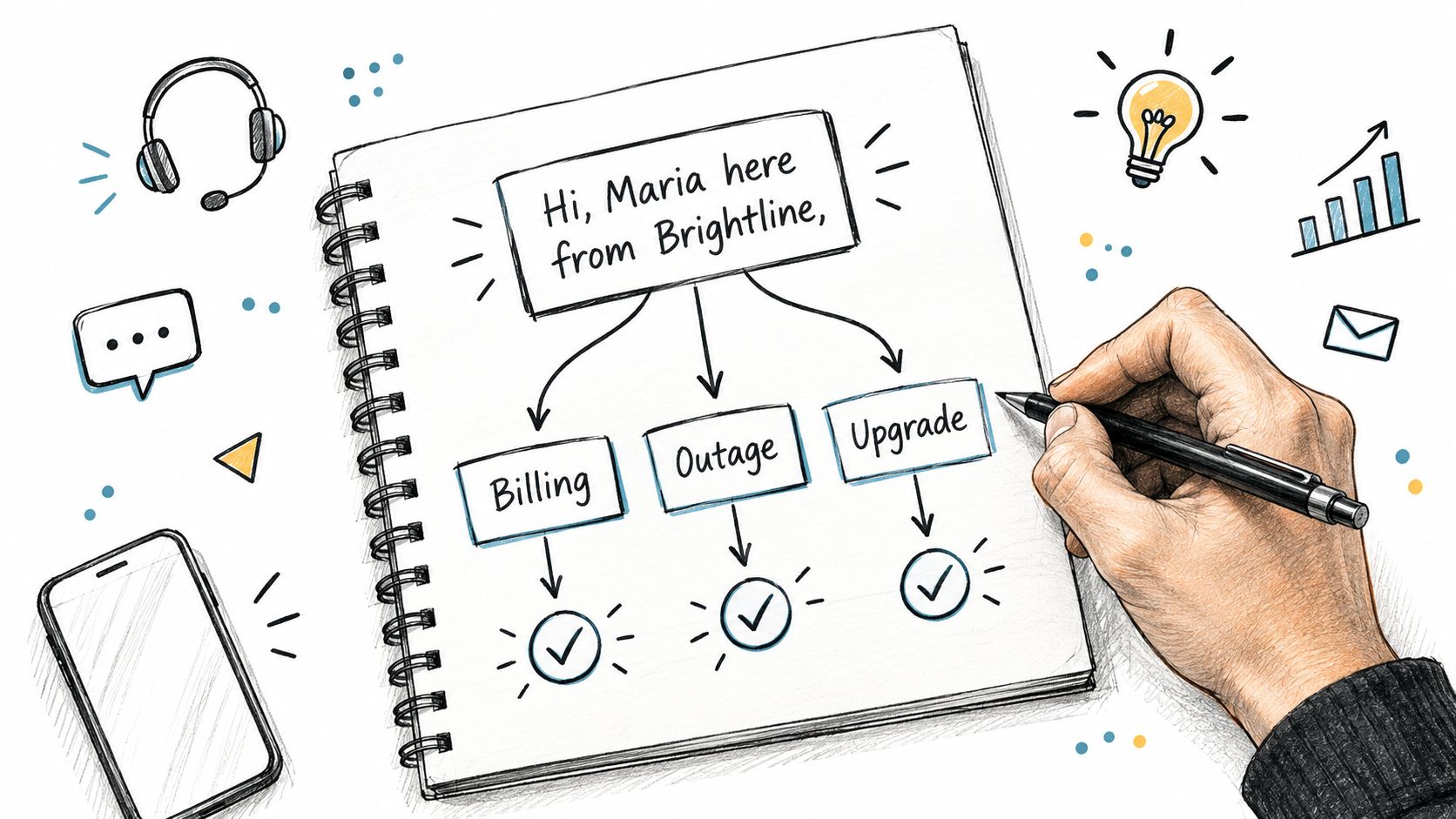
Give agents a usable conversation path
The following sample lines illustrate a hypothetical firm's script, not a required word-for-word performance.
Open with identity and purpose.
Thanks for calling Northside Law. This is Dana. How can I help?
For outbound calls, identify the firm, explain the reason, and check whether the person can speak privately before discussing sensitive details.Verify with the fewest questions permitted.
Before we discuss the file, may I confirm the identifying details required by our process?
Pull up the existing record first. Follow the firm's verification procedure before disclosing matter information; recognizing a telephone number isn't a substitute.Ask openly, then narrow the issue.
What happened, when did it start, and what would you like us to help you do?
Let the caller finish the initial explanation before asking targeted questions. For legal intake, gather facts without suggesting a legal conclusion.Summarize before acting.
You've received a document you don't understand, and you need the team to review it before you respond. Have I understood correctly?
This check prevents the representative from efficiently solving the wrong problem, an impressively common administrative achievement.Resolve or assign the next action.
Sam will review the billing entry and call you tomorrow afternoon. I've assigned the task to Sam.
Use only an approved, achievable timeframe. Escalate urgent concerns through the firm's designated procedure rather than improvising a deadline assessment.Close with confirmation.
Sam will call tomorrow afternoon about the disputed charge. Is there anything relevant I haven't captured?
Confirm the best contact method and any restrictions before ending the call.
Make transfers carry context
A useful transfer bridge sounds like this:
I'm connecting you with Sam in billing. I've noted that the same charge appears twice on your statement, so you won't need to explain that again.
Give Sam the summary before connecting the caller. If Sam can't accept the transfer, retain responsibility until a callback task has been accepted.
The habit that wrecks every script is asking callers to repeat information the team already holds. Ask them to confirm a critical fact when necessary, but explain why. There's a difference between careful verification and discovering your colleagues took no usable notes.
Scoring Call Quality With a Call Review Scorecard
Only 11% of surveyed consumers said all their customer-service inquiries were resolved, while 13% said their issues were rarely or never addressed effectively, according to a consumer survey reported by Retail Insider. A courteous call still fails if the caller leaves without an outcome or an owned next step.
Clio's 2019 Legal Trends research examined whether firms answered questions, described relevant experience, explained how to learn about rates or costs, and outlined next steps. The research also found 82% considered timeliness important and 79% expected a response within 24 hours.
Call review scorecard with suggested weights
Review a weekly sample of calls to assess the work and coach specific behaviors. These weights are a suggested starting point, not an industry benchmark.
| Criterion | Suggested weight | What a top score looks like |
|---|---|---|
| Greeting and identification | 10% | Caller knows who they reached and why within the first sentences |
| Discovery and listening | 20% | Caller explains the problem once; agent asks targeted follow-up questions |
| Accuracy of information | 20% | Answers and policies match current guidance, with no guessing |
| Resolution or clear next step | 25% | Problem is solved, or the next step has an owner and a timeframe |
| Documentation | 15% | Notes are complete enough that the next person asks no repeat questions |
| Tone and close | 10% | Caller's issue is summarized, anything missing is asked for, and the call ends cleanly |
Resolution or a defined next step carries the largest weight because a friendly call does not complete the work. Keep critical errors, such as unauthorized disclosure or unsupported legal advice, visible separately. Otherwise, strong marks for tone can obscure a serious failure.
Check the record as well as the recording
Review the minimum viable intake record alongside the call: matter type, jurisdiction, incident date, conflicts-screening data, contact permission, urgency, referral source, agreed follow-up, owner, and due date. Mark fields that do not apply instead of asking staff to fill gaps with invented information.
For personal-injury and mass-tort inquiries, separate caller-reported facts from qualification decisions. Record what still needs attorney review. A blank field should not be treated as a negative answer.
Before using scores to coach, have two reviewers independently score the same ten calls as a calibration exercise. Compare the evidence behind disagreements, then revise criteria that leave room for conflicting interpretations. Score the recorded behavior, not the reviewer's assumptions.
Coach one observable action at a time, such as confirming the desired outcome before a transfer. A score is useful only when reviewers apply it consistently and the caller's work has a known outcome or an owner for the next step.
Technology and Staffing Choices That Keep Calls Answered
A call can be answered and still leave the caller with no outcome. Set the operating rules before choosing a phone platform or staffing model: each contact needs a clear disposition, and any unfinished work needs an owner and a due date.
Build the operating layer
Routing and menus. Use skills-based routing or ring groups to direct billing, intake, and existing-client requests to people authorized to handle them. Set an overflow path for busy periods, with a callback option instead of a silent queue.
Keep the interactive voice response menu shallow, and make a live representative available from the first menu. Check what each menu choice actually accomplishes. Ending a call is not the same as resolving the request.
Logging. Each call should create or update a CRM record with a disposition. For resolved calls, record the completion clearly. For unresolved work, assign an owner and due date. Test for duplicate records and failed task creation, not just whether the phone icon appears in the CRM.
Make the routing arrangement visible to the person responsible for maintaining it.
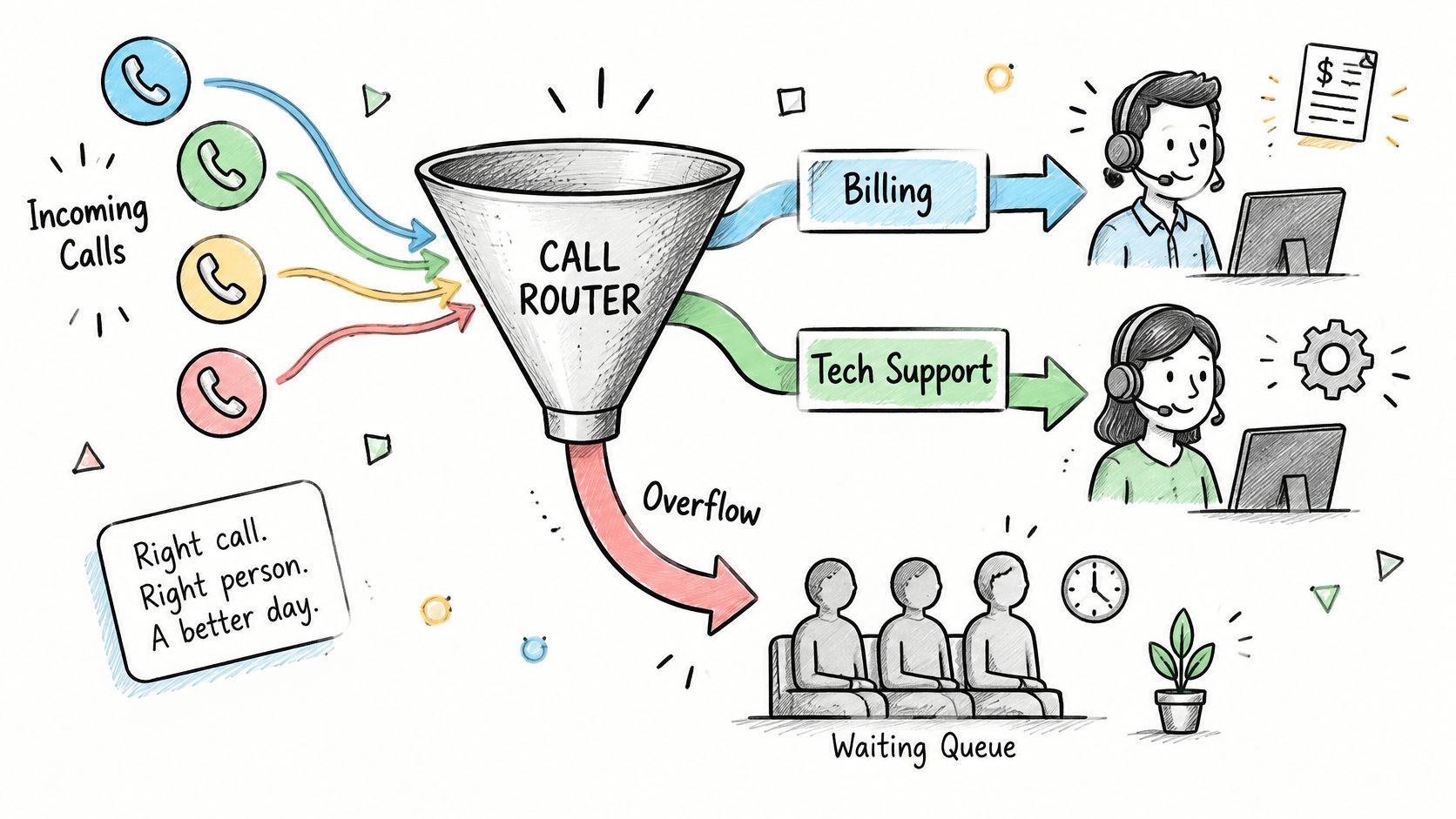
Reporting and connectivity. Send the working dashboard to the manager who can adjust schedules and assignments. Break results down by hour and channel, and flag overdue work so it does not surface first through a client complaint.
For distributed teams, internet calling across phones and laptops makes connectivity part of the operating setup. Assess connection reliability, headset quality, access permissions, and outage fallback alongside routing features. A remote extension is useful only when someone is available to answer it.
Match capacity to the actual workload
Staffing. Use four weeks of hourly call volume to plan coverage. Compare demand with staff availability after allowing for consultations, breaks, documentation, and other assigned work.
- Cover the peaks. Stagger schedules where feasible instead of assuming ordinary office hours match demand.
- Train overflow support. Cross-train two people on approved opening, qualification, and escalation procedures.
- Assign after-hours ownership. Specify who answers, who reviews overnight activity, and who receives unfinished work.
- Protect delivery capacity. Avoid assigning continuous phone coverage to someone already responsible for a full case-support workload.
In-house scheduling, cross-trained reception, and outsourced live teams each address different gaps. Choose based on the workload that needs coverage, not a general desire for more help.
Frontline provides 24/7 live intake for answering calls, qualifying inquiries, structured follow-up, and quality assurance. Staffline provides dedicated full-time legal support professionals assigned to one firm. Support can include intake, CRM hygiene, case management, records, file opening, and administration.
When comparing round-the-clock phone coverage, define how after-hours work reaches daytime operations. Coverage only counts as complete when the caller has a known outcome or an owned next step. Without a defined handoff, another person or tool can keep the line answered while the work remains unfinished.
Audit One Week of Calls Before You Change Anything
Run a bounded audit before replacing your phone platform or adding another marketing campaign. Use the call log, CRM tasks, and lawfully available recordings together; each shows a different part of the work.
- Export a complete week. Include answered calls, abandoned calls, voicemail-only contacts, outbound attempts, and promised callbacks. Preserve timestamps and dispositions.
- Calculate hourly gaps. Measure abandonment and callback completion by hour of the day. Keep callback attempts separate from successful contact so activity doesn't conceal unreachable callers.
- Review a random sample. Score twenty calls using the scorecard. Have two reviewers independently assess five of them to check that their interpretations remain aligned.
- Locate the first failure. Assign each breakdown to a call stage and count where failures concentrate. Separate routing problems from missing information, inaccurate answers, and unfinished follow-up.
- Change one stage. Adjust a script branch, routing rule, or logging requirement. Name the person responsible for implementing the change and checking compliance.
- Repeat the measurement. Compare the following week hour by hour, accounting for unusual demand or staff absences. Check whether the fix reduced failures without creating a different bottleneck.
Audit discipline: Don't use a process review as a surprise employee ranking exercise. Staff need to report workarounds honestly.
Keep the intervention narrow enough that you can tell whether it helped. If the audit identifies a coverage gap rather than a process defect, consider Frontline for live intake or Staffline for dedicated operational capacity.
Attorney Assistant offers Frontline for 24/7 live intake and Staffline for dedicated full-time legal support, connecting customer service calls with the operational work that follows. Bring your audit findings to Attorney Assistant to discuss whether you need broader coverage, stronger follow-up, or more capacity to carry the work after the phone stops ringing.
Related Articles
Medical Record Review for Attorneys: A Step-by-Step Guide
Medical record review for attorneys, step by step: request records, build a verified chronology, audit summaries, and know when to delegate the work.
Case Management App for Law Firms in 2026: How to Choose
Compare case management app options for law firms on intake, documents, calendaring, security and pricing, with a checklist to pick the right fit.
Call Answering Service for Law Firms: What Actually Works
A call answering service for law firms should sign cases, not take messages. Learn pricing models, vendor criteria, and 24/7 intake that converts.