Your intake coordinator sees an unfamiliar number, lets it ring out, and writes "call back later" on a sticky note that will soon achieve archaeological status. The callback isn't hard. She just doesn't know who'll answer, what they'll ask, or whether she'll say the wrong thing while three other tasks compete for attention. That's the fear of talking on phone calls in a working law firm. It's rarely about the device. It's uncertainty, fear of judgment, and a workload that makes every ring feel like an ambush.
The seven strategies below start with the thoughts and physical tension that show up before dialing. They then move to graded practice, short scripts, call sheets, documented next steps, feedback, and smarter routing. You can use them today, without staging an inspirational seminar in the break room. They're meant for ordinary workplace anxiety, not as a substitute for professional mental health or medical care. If uncertainty itself is the persistent driver, it may help to find intolerance of uncertainty treatment and discuss the pattern with a qualified clinician. For the office version, the goal is simpler. Make the next call more predictable, then make the one after that easier.
Table of Contents
- 1. Reframe Catastrophic Predictions Before the Call
- 2. Build a Graded Exposure Ladder
- 3. Script the Opening and Structure, Not the Entire Call
- 4. Use a Short Pre-Call Routine to Lower Physical Arousal
- 5. Prepare a Call Sheet and Close Every Call with a Next Step
- 6. Practice with Role-Play and Review Recorded Calls
- 7. Route Calls That Do Not Need You to a System Built for Them
- 7-Point Comparison Guide to Overcoming Phone Anxiety
- Build a Phone System Your Staff Can Actually Use
1. Reframe Catastrophic Predictions Before the Call
Phone fear usually arrives wearing a very specific costume. The caller will ask something you can't answer. You'll sound incompetent. There'll be an awkward silence long enough to qualify as a deposition break. Cognitive reframing, used in cognitive behavioral therapy and Albert Ellis's rational emotive behavior therapy, treats that prediction as a hypothesis, not a prophecy.
Write down the exact thought, rate how strongly you believe it, then record what happened. A paralegal who dreads intake might log, "The caller will ask about a case I can't evaluate." Afterward she records that she transferred the call to the attorney and the caller thanked her. Do that repeatedly and the prediction loses credibility. It also helps to remember the spotlight effect. People tend to overestimate how much others notice them. Your caller is mostly thinking about an accident, a bill, or a court date, not grading your vocal performance.

Make the log do the arguing
- Capture the sentence: Write your pre-call prediction word for word and rate belief from 0 to 100.
- Borrow a colleague's view: Ask what you'd tell someone else who had that thought.
- Review weekly: Look for predictions that keep failing to come true, and keep the counterexamples.
This isn't rare or shameful. In a 2024 peer-reviewed study of 300 medical students, 42% showed some degree of telephobia, including 33.0% with mild symptoms, 7.67% with moderate symptoms, and 1.33% with severe symptoms. That was a specific student group, so don't generalize it to everyone. Still, it beats assuming you're the only competent adult negotiating with a ringing phone. If anxiety shows up across most situations, work with a licensed therapist trained in CBT rather than relying on a desk log alone.
2. Build a Graded Exposure Ladder
Avoidance is an excellent short term strategy and a terrible training program. Every postponed call gives immediate relief, which teaches your brain that escape worked. Graded exposure, rooted in Joseph Wolpe's systematic desensitization, reverses that lesson in manageable steps. You rank phone situations from mildly uncomfortable to intimidating, then stay on each rung until it becomes boring enough to move up.
A new legal assistant might start by checking voicemail and returning an internal message. Next she calls the firm's front desk, then a court clerk with one prepared question, then a vendor, and finally an inbound intake call with a supervisor nearby. A managing partner who avoids former clients could begin with a scripted voicemail, then a live call with a clear, short agenda. Neither person needs to start with an angry caller and a mystery deadline.

Rules that keep the ladder useful
Tape the ladder near your desk so progress is visible. Set a minimum number of repetitions before advancing, and return to the same rung after a rough call instead of declaring the experiment over. Pair each attempt with the reframing log from the previous strategy, because the thoughts will absolutely attend the practice session.
A difficult call is data about that call. It isn't a verdict on your ability to use a phone professionally.
Familiarity matters. In a 2019 survey of 1,037 South Korean respondents, 46.5% said they'd developed a telephone call phobia, and 49.2% of that group attributed it to being more accustomed to mobile messengers or texts. Graded practice rebuilds familiarity deliberately. If you want professional support while doing it, read about what to expect in anxiety therapy before booking.
3. Script the Opening and Structure, Not the Entire Call
A word for word script looks reassuring until the other person says something unscripted, which people insist on doing. Then the speaker panics, searches the page, and sounds like a GPS recalculating. Script the opening, the purpose, the key questions, and the close. Leave room for an actual human conversation in between.
A records coordinator could use this structure. "Hi, this is Alex from the firm. I'm calling about the records request for our client. I need to confirm the date range, the best fax number, and whether the authorization is on file. Does that work?" The close is equally plain. "Thanks. I'll send confirmation by email today." Intake needs the same discipline around identity, matter type, urgency, and next step, without pretending every caller's story will arrive in neat paragraphs. A practical refresher on how to answer and handle professional calls can help staff tighten those basics.

Build a structure you can abandon gracefully
- Rehearse only the opening: Say it out loud until it feels routine.
- Use a one sentence purpose: Put it on a sticky note where you can see it.
- Keep a fallback line: "Let me make sure I have that right before we continue" buys thinking time without bluffing.
Control is central here. A 2025 study of adults in their 20s to 50s found that perceived controllability of texting, especially preparing and editing, helped explain stronger call anxiety among younger adults. You can't edit a live sentence. A short structure restores some control without turning you into a courtroom exhibit being read into the record. Review scripts quarterly so they match current forms, routing rules, and practice areas.
4. Use a Short Pre-Call Routine to Lower Physical Arousal
Sometimes the mind is willing and the shoulders are located somewhere near your ears. A racing heart, shallow breathing, and tight jaw make your voice thinner and your thoughts faster. That physical state then becomes false evidence that the call is dangerous. A short pre-call routine interrupts the loop before you dial.
Use slow breathing with a longer exhale. Before returning a difficult client call, a practice manager might take six slow breaths, inhaling for four counts and exhaling for six, then review the call sheet. An intake specialist might stand, stretch, and use two minutes of paced breathing between calls during a hectic afternoon. It's symptom management, not a cure for an anxiety disorder, and it shouldn't become a twenty minute ceremony that conveniently prevents dialing.
Keep it brief enough to repeat
- Practice while calm: Learn the breathing pattern before you need it under pressure.
- Attach a physical cue: Place the phone in front of you, open the file, breathe, then dial.
- Use it before hard scheduled calls: Don't wait until panic is already chairing the meeting.
Practical rule: Regulate first, dial second, but set a timer so regulation doesn't become avoidance with better branding.
The mechanism fits broader anxiety patterns. A 2022 peer-reviewed study on social anxiety and intolerance of uncertainty linked higher social anxiety with increased phone dependency and greater phone use in social groups, partly as an anxiety reduction strategy. In plain English, people reach for the version of communication that gives them distance and control. If panic attacks, chest pain, or severe physical symptoms occur, consult a medical professional rather than treating breathing exercises as the whole answer.
5. Prepare a Call Sheet and Close Every Call with a Next Step
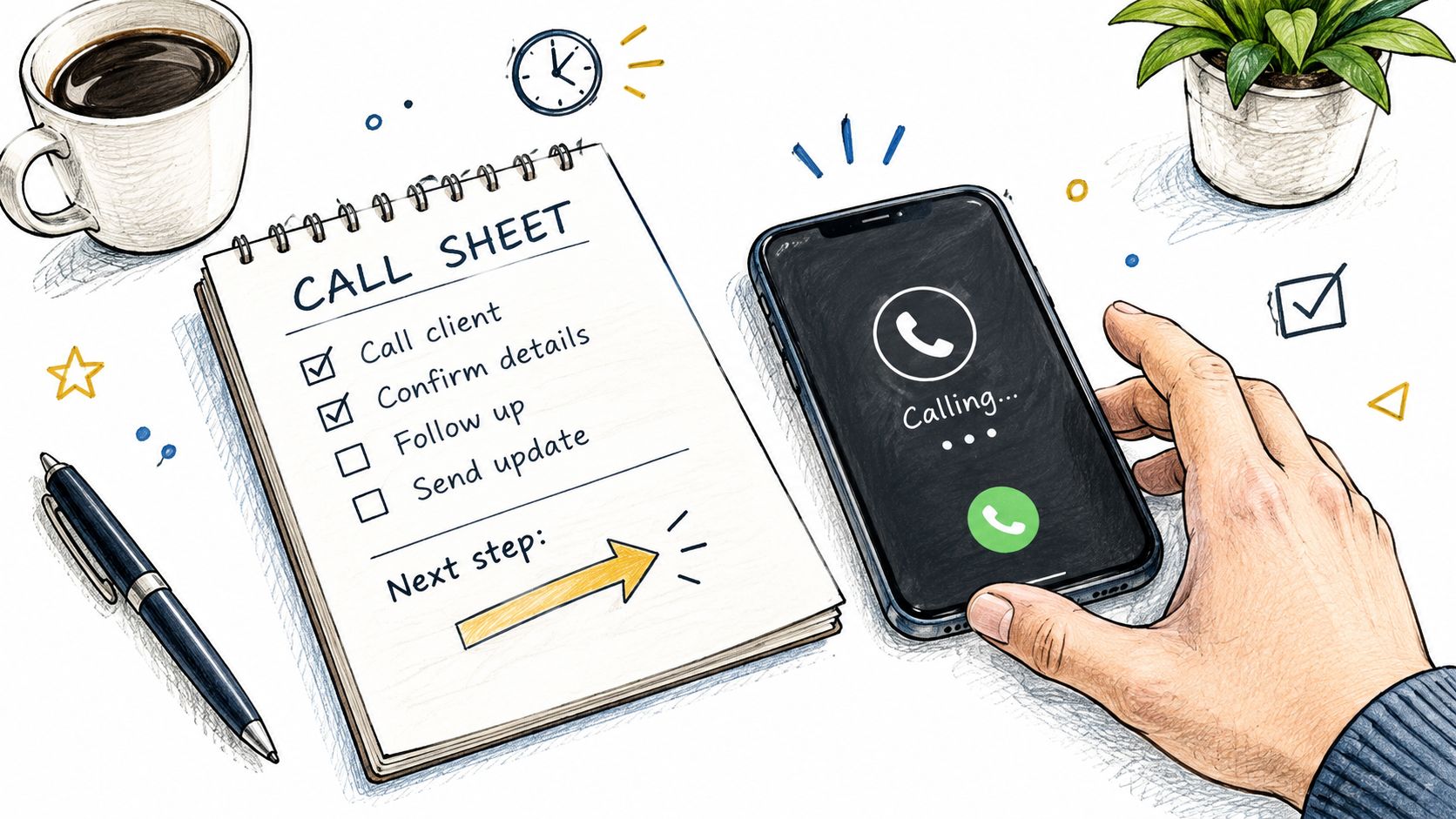
Uncertainty shrinks when the facts are sitting in front of you. A one page call sheet should show who you're calling, why, what you already know, what you still need, and what outcome counts as done. It's also a memory aid for people whose brains helpfully delete names the second someone says hello.
For a stalled intake, the sheet might list the prospect's name, first contact date, the open treatment question, prior attempts, and the next attempt date. The call closes with, "I'll email the consultation options and call again Thursday at 10." For a provider records call, include the request date, required pages, fax number, and escalation contact. Voice quality matters too, so pair preparation with basic work on improving how your voice sounds on calls if rushing or mumbling is part of the problem.
What belongs on the sheet
- One template per call type: Intake, records, lien, scheduling, and follow-up don't need identical fields.
- A mandatory next step: Require it in the CRM before the call can be logged complete.
- A thirty second scan test: If the sheet takes longer to read, it's a memo wearing a disguise.
This matters for callers as well as staff. A 2024 Uswitch survey of 2,000 U.K. adults found almost 25% of adults aged 18 to 34 never answer calls, while about 61% prefer a message instead of an audio call. If an anxious prospect finally answers, don't reward that courage with a vague "someone will follow up." Give a person, an action, and a time. Then review logged next steps daily. Your CRM cannot follow up with a lead if nobody puts the lead in the CRM.
6. Practice with Role-Play and Review Recorded Calls
Most employees receive less feedback on phone skills than they receive on the office coffee order. They're told to be confident, professional, and empathetic, then left alone with a ringing line. Role-play and recorded call review close that gap because they replace imagined performance with observable behavior.
Run a twenty minute weekly practice. One person plays a frustrated client asking why a demand letter hasn't gone out. The other practices acknowledging the concern, checking the file, and giving a specific timeline without inventing one. A supervisor can also review anonymized intake calls with a new hire, identify two strong moments, and isolate one question that should've come earlier. Confirm consent and firm policy before reviewing recordings. Start with easy scenarios and increase difficulty as confidence grows.
Feedback that people can actually use
- Coach one skill at a time: Tone, pacing, questioning, or closing. Not all four before lunch.
- Let the speaker self-assess first: They often spot the issue before the coach says it.
- Name the moment: "You answered before confirming the matter number" beats "sound more polished."
You usually sound more capable on the recording than you did inside your own head during the call.
Workplace stakes are real. A 2024 survey of 2,000 UK office workers reported 65% had experienced some level of phone anxiety in the previous twelve months, and more than 40% had avoided answering a work call because of anxiety. That research was commissioned by a commercial call answering business, so read it cautiously. Even with that caveat, firms shouldn't build quality assurance around hoping nervous staff improve through exposure to live prospects. Practice somewhere cheaper than a real lead.
7. Route Calls That Do Not Need You to a System Built for Them
Some phone anxiety is personal. Some is an operations problem wearing a headset. If one receptionist must greet visitors, scan mail, schedule consultations, chase records, and answer every ring, the phone becomes an interruption machine. Routing predictable calls isn't surrender. It's workload design.
A personal injury firm might send after-hours and overflow inbound calls to a 24/7 live intake team that qualifies matters and books consultations, so the morning starts with appointments instead of a voicemail apology tour. A smaller firm might use Legal Receptionist support for lunch and spike coverage, while internal staff keep complex client conversations. Attorney Assistant's Frontline is built to answer, qualify, follow up, and sign appropriate cases in English and Español, with quality assurance. Taking a message is not intake. When comparing options, look closely at how a 24/7 phone answering service differs from structured intake and follow-up.
Route by call type, not by panic level
- Map last month's calls: Group them by type, volume, time, and required judgment.
- Write escalation rules: Define exactly when a call reaches senior staff or an attorney.
- Review outcomes weekly: Check speed to lead, qualification quality, transfers, and booked consultations.
Technology can support routing, summaries, and after-call work, although tools shouldn't replace consent, context, or a live option for urgent matters. It's worth tracking voice customer service AI trends while keeping human accountability for qualification and handoffs. Staff who retain complex calls still need scripts, call sheets, and practice. Frontline signs the case. Staffline carries it. Attorney Assistant's Staffline professionals are dedicated full time to one firm, so records, CRM hygiene, scheduling, and case support don't keep elbowing the phones aside.
7-Point Comparison Guide to Overcoming Phone Anxiety
| Strategy | Implementation Complexity | Resource Requirements | Expected Outcomes | Ideal Use Cases | Key Advantages |
|---|---|---|---|---|---|
| Reframe Catastrophic Predictions Before the Call | 🔄 Low; brief, regular thought tracking | ⚡ Minimal; about five minutes and a written log | 📊 Gradually reduces unsupported fears and avoidance | Calls driven by fear of mistakes, judgment, or difficult questions | ⭐ Builds evidence-based perspective; requires no equipment |
| Build a Graded Exposure Ladder | 🔄 Moderate; plan and repeat steps in sequence | ⚡ Practice time; a discomfort scale and call tasks | 📊 Measurable progress toward handling more challenging calls | Persistent avoidance of phone tasks | ⭐ Encourages gradual practice using real work situations |
| Script the Opening and Structure, Not the Entire Call | 🔄 Low; create and periodically update a call outline | ⚡ Minimal; short scripts and rehearsal | 📊 More focused calls with less hesitation and a clear close | Intake, follow-up, and other calls with predictable purposes | ⭐ Reduces blank-mind moments while allowing flexibility |
| Use a Short Pre-Call Routine to Lower Physical Arousal | 🔄 Low; repeat a brief breathing and posture routine | ⚡ Minimal; under two minutes, no equipment | 📊 May lower immediate physical tension and anxiety | Scheduled or difficult calls when physical arousal interferes | ⭐ Easy to use between calls; works in most settings |
| Prepare a Call Sheet and Close Every Call with a Next Step | 🔄 Low to moderate; make templates and maintain call records | ⚡ Preparation time; a call sheet or CRM | 📊 Reduces uncertainty and improves follow-through | Recurring calls that need specific information or outcomes | ⭐ Supports consistency, accountability, and clear handoffs |
| Practice with Role-Play and Review Recorded Calls | 🔄 Moderate; schedule practice and provide feedback | ⚡ Staff or coach time; recordings only when permitted | 📊 Builds skills through repetition and specific feedback | Teams preparing for challenging or sensitive calls | ⭐ Offers safe practice and observable coaching targets |
| Route Calls That Do Not Need You to a System Built for Them | 🔄 Moderate to high; define routing, escalation, and oversight | ⚡ Staff or service capacity; setup and quality monitoring | 📊 Reduces individual call load and supports consistent handling | High-volume, routine, after-hours, or overflow calls | ⭐ Protects staff and attorney time; improves routing consistency |
Build a Phone System Your Staff Can Actually Use
Give the plan thirty days. In week one, choose one manageable rung on the exposure ladder and log the prediction before each attempt. Don't begin with the caller who has already left three increasingly theatrical voicemails. Begin where success is plausible, repeat it, and collect evidence.
In week two, script the opening and structure for your most common call. Build a one page call sheet for that same call type, then require a documented next step before anyone marks it complete. In week three, schedule two short role-play sessions and review one recorded call, with consent and policy handled properly. Coach one skill at a time. Confidence grows faster when feedback is specific enough to practice before the next ring.
A simple thirty day sequence
- Days 1 to 7: Pick one exposure rung, use the breathing routine, and log predictions against outcomes.
- Days 8 to 14: Add a call structure, a call sheet, and a mandatory next step field.
- Days 15 to 21: Role-play common and difficult scenarios, then review real call patterns as a team.
- Days 22 to 30: Map call types, write escalation rules, and decide which calls should be routed elsewhere.
By day thirty, look beyond individual nerves. Which calls consume the most staff capacity? Where do callbacks, records requests, or new leads fall through the cracks? Which employees are avoiding the phone because they're anxious, and which are avoiding it because they're doing four jobs and the phone is the fifth? Those are different problems. Treating both as a confidence issue is convenient, but not particularly accurate.
The answer also isn't forcing one anxious employee to become an overnight telephone performer through sheer managerial optimism. Build evidence through practice, reduce uncertainty through structure, and remove predictable volume from people who don't need to carry it. Some firms can do that internally with better staffing and supervision. Others need Frontline for live intake and persistent follow-up, Staffline for dedicated records and administrative capacity, or both. Start by auditing response times, missed calls, CRM next steps, and after-hours coverage. You'll usually find the fear of talking on phone calls is only part of the story. The other part is a system that makes every call feel like a surprise exam.
If missed calls, delayed callbacks, and overloaded staff are turning good inquiries into lost matters, Attorney Assistant can provide Frontline 24/7 live intake and dedicated Staffline legal support built for law firm workflows. Visit Attorney Assistant to review where your firm is losing capacity and which calls should stop depending on whoever happens to be nearest the phone.
Related Articles
Preferred Method of Contact for Law Firm Intake
Discover how to capture and use the preferred method of contact in legal intake to improve conversions, ensure compliance, and streamline law firm operations.

White Glove Support for Law Firms
Discover how white glove support transforms law firm intake and operations. Learn the metrics, staffing models, and workflows that actually sign cases.
Virtual Staffing Solutions for Law Firms
Discover how virtual staffing solutions build real operational capacity for law firms. Learn about co-managed models, dedicated legal support, and 24/7 intake.