How intake technology boosts PI firm conversions

TL;DR:
- Most personal injury firms fail to maximize leads because their intake technology focuses on automation rather than process improvement. Implementing well-structured, automated intake workflows and ensuring timely, personalized responses significantly increase client conversion. Continual review and refinement of intake processes are crucial for sustained growth and revenue recovery.
Most personal injury law firms believe their growth problem is a marketing problem. They budget for more ads, more clicks, more form fills. But average web form conversion sits at just 1.7%, which means nearly every prospective client who lands on your website leaves without becoming a lead. The real leak is not traffic. It is what happens after someone reaches out. Intake technology addresses that leak directly, helping firms capture more of the leads they already paid to attract, respond faster, and sign more cases without spending another dollar on advertising.
Table of Contents
- Why intake technology matters for personal injury firms
- Key features of effective law firm intake technology
- Common pitfalls and missed opportunities
- How to implement and optimize intake technology for results
- A fresh perspective: Why most intake tech fails (and what actually works)
- Get more cases with smart intake technology
- Frequently asked questions
Key Takeaways
| Point | Details |
|---|---|
| Boost conversions | Modern intake technology turns more inquiries into signed cases by improving response and follow-up. |
| Fix workflows first | Document and improve your intake process before automating to avoid simply digitizing inefficiency. |
| Track the right KPIs | Measure response time, lead conversion rate, and missed cases to see real impact on your bottom line. |
| Stay agile | Regularly revisit and refine your intake approach as your firm grows and client behaviors shift. |
Why intake technology matters for personal injury firms
Intake technology refers to the tools and software that handle capturing, qualifying, and responding to new client inquiries. Think of it as the front door of your firm. If the door is slow to open, confusing to walk through, or unmanned at the wrong hour, potential clients walk away. For personal injury firms, where case value can run into six or seven figures, even one missed sign-up per week represents enormous lost revenue over the course of a year.
The data on call-based intake versus form-based intake tells a clear story. 61% of callers speak with a live person, and 37% of those callers convert during that same conversation. Compare that to web form conversion rates, which lag far behind call conversions across nearly every industry. When a prospective client picks up the phone after a car accident or a slip-and-fall, they are often scared, overwhelmed, and ready to hire someone right now. If that call goes to voicemail or gets mishandled, you likely lost that case permanently.
| Channel | Typical conversion rate | Key risk factor |
|---|---|---|
| Phone call (answered live) | 30-40% | Missed calls, poor intake script |
| Web form submission | 1-3% | Slow follow-up, weak qualification |
| Chat widget | 5-10% | Delayed responses, no escalation path |
| After-hours contact | Near 0% (without tech) | No coverage, no callback system |
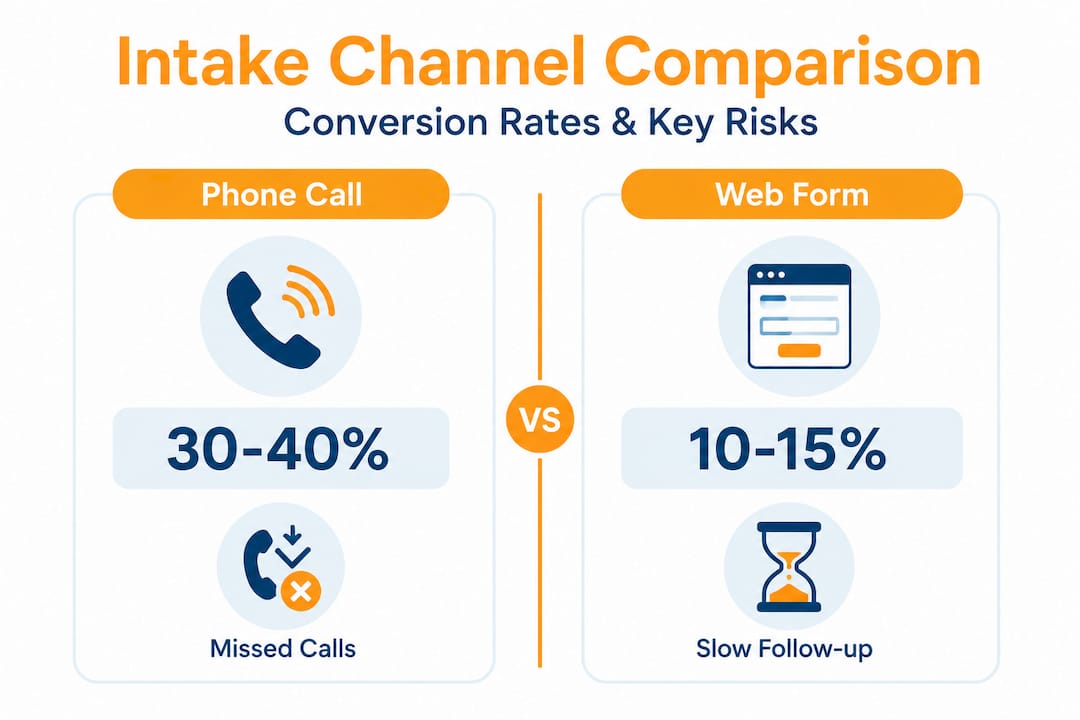
Understanding these differences helps PI firm owners prioritize where technology will make the biggest impact. Reviewing intake best practices gives a strong foundation for making those decisions. But the bigger insight is this: your phone is still your highest-converting channel, which means any technology investment that keeps calls answered and handled well pays off faster than almost anything else.
Learning how intake shapes successful client onboarding also reveals that the first impression clients get during intake influences their trust and retention for the entire duration of the case. Firms that handle intake well keep clients. Firms that rush or fumble it create problems that haunt the relationship long after the case file is opened.
Key reasons PI firms need dedicated intake technology:
- After-hours leads are lost without automation. Personal injury incidents happen at all hours, and injured people do not wait until 9 a.m. to look for help.
- Manual tracking creates data gaps. Staff using notebooks or spreadsheets miss follow-up deadlines and lose lead details.
- Speed to first response is a competitive differentiator. Leads contacted within five minutes of inquiry convert at dramatically higher rates than those contacted after an hour.
- Unstructured intake leads to compliance risks. Missing required information on intake creates downstream problems with case documentation.
Key features of effective law firm intake technology
Understanding the “why” leads naturally to evaluating the “how,” so what should you look for in intake technology?
Effective law firm intake technology is built around three core functions: streamlined call answering, automated workflows with structured tasks, and instant lead follow-up. Any tool that does not address all three is only solving part of the problem.
Streamlined call answering means every inbound call is answered, routed, and documented, whether your staff is available or not. This includes live answering services, call routing rules, and voicemail-to-task automation so no call falls through the cracks.

Automated workflow with structured forms and tasks means the information collected during intake flows automatically into your case management system and triggers the right next steps. No manual data entry. No missed follow-up reminders. Intake tech should be built around your verified firm workflow, not just a digital replica of a paper form, which prevents automation failures and efficiency gaps.
Instant lead follow-up means that when a web form is submitted or a missed call is logged, the system triggers an immediate outreach, whether by text, email, or callback, within seconds rather than hours. This single feature alone can meaningfully lift conversion rates for firms that previously relied on staff manually checking for new leads.
| Feature | Manual intake | Tech-enabled intake |
|---|---|---|
| Response speed | Hours or next day | Seconds to minutes |
| Error rate | High (data entry mistakes) | Low (structured fields) |
| Reporting capability | Limited or absent | Real-time dashboards |
| After-hours coverage | None | Automated or live coverage |
| Staff time per lead | 15-30 minutes | 3-5 minutes |
Must-have intake features for PI firms:
- Live call answering or overflow coverage to ensure no call is missed during business hours or after.
- Automatic lead logging that captures caller information and inquiry type without manual entry.
- Instant follow-up triggers via text or email when a form is submitted or a call is missed.
- Structured intake questionnaires with required fields specific to personal injury case types.
- Integration with your case management system so intake data flows directly to case files without duplicate entry.
Before choosing a tool, spend time organizing your intake team around clearly defined roles. Technology amplifies what your people do. If ownership of the intake process is unclear internally, no software will fix that confusion. Pairing smart tools with solid intake management strategies is what separates firms that see measurable gains from those that end up with expensive software nobody uses consistently.
Pro Tip: Before selecting any intake tool, map your current process on paper, step by step, from first contact to signed retainer. Identify where delays and drop-offs happen. Then choose technology that solves those specific gaps. Automating a broken process just makes the breaks happen faster.
Common pitfalls and missed opportunities
Knowing what works is only half the battle. Now let’s avoid what often doesn’t.
The most common mistake PI firms make when adopting intake technology is digitizing their existing process without first questioning whether that process is actually good. If your current intake is slow, inconsistent, or unclear, adding software on top of it does not fix any of those problems. It just makes them harder to see.
“Automation that accelerates bad processes just means you make mistakes faster.” This is true whether you are running an assembly line or a personal injury intake system. The technology is neutral. It will faithfully execute whatever workflow you give it, flawed or not.
Digitizing an imperfect process without first verifying workflow creates automation that speeds up bad handoffs rather than fixing them. That means leads still fall through the cracks, they just fall through faster and with a digital paper trail that is harder to untangle.
The four most damaging pitfalls in PI intake technology adoption:
- Copying disorganized processes into software. If your staff does not know who is responsible for following up on a web inquiry, your software will not know either.
- Delayed follow-ups even with automation in place. Firms often set up intake tools but configure follow-up delays of 24 hours or more, completely canceling out the conversion benefit.
- Information silos between intake and case management. When intake data lives in one system and case files live in another, staff re-enter data manually and errors multiply.
- Poor form and UI design. Long, confusing intake forms with too many required fields drive prospective clients away before they ever submit. Shorter, mobile-friendly forms consistently outperform desktop-heavy ones.
For high-volume PI firms, lacking structured intake leads to downstream errors and reporting inconsistencies that hurt scalability over time. When you cannot accurately report on how many leads came in, how many were contacted, and how many signed, you have no reliable way to improve the system. Improving client intake communication strategies is one practical step that addresses the human side of this problem without requiring major software changes.
Pro Tip: Document your current intake process in detail, including every handoff point and every tool currently used. Then test potential improvements on paper before automating them. A one-week manual pilot of a new process reveals problems that would take months to diagnose inside a live software configuration. Once the manual version works cleanly, boosting intake automation becomes much more effective.
How to implement and optimize intake technology for results
Now, let’s take what you’ve learned and see exactly how to put it into action in your firm.
Rolling out intake technology without a clear implementation plan is one of the main reasons firms end up with tools they paid for but do not fully use. A structured approach protects your investment and maximizes the conversion improvement you actually see.
Step-by-step implementation guide:
- Audit your current intake. Record how leads currently arrive, who handles them, how fast responses go out, and where leads get lost. Be honest. Most firms discover response times are far longer than they assumed.
- Define your ideal intake workflow. Before touching any software, map the process you want. Who answers calls? Who handles after-hours? What information must be collected on first contact? What triggers a follow-up?
- Choose technology that matches your workflow. Select tools that support your defined process rather than requiring you to adapt your process to the software’s defaults.
- Set up structured data fields, not open text boxes. Templates and structured workflows create downstream clarity for case management, not just a cleaner user interface. Structured fields allow reporting, filtering, and automation that free-text forms simply cannot support.
- Train staff on the new workflow, not just the software. People need to understand why the process changed, not just how to click through a new tool.
- Launch a pilot with a small group first. Let two or three team members run the new system for two weeks before full rollout. This catches configuration problems early and builds internal advocates for the change.
- Set measurable targets and review weekly for the first 90 days. Treat implementation as an active project, not a one-time event.
Key performance indicators to track after implementation at your firm’s effective intake processes:
- Average response time from first contact to first outreach
- Lead-to-consultation conversion rate
- Consultation-to-signed-retainer conversion rate
- Percentage of leads contacted within five minutes
- Number of missed calls per week (and the follow-up rate on those)
- Percentage of intake forms fully completed on first contact
Pro Tip: Run the new system in parallel with your old system for the first two weeks of the pilot. This lets you compare outcomes directly and gives your team a safety net if something in the new setup needs adjustment. Cutting over completely before the new process is proven creates unnecessary risk.
A fresh perspective: Why most intake tech fails (and what actually works)
With practical steps outlined, it’s time for some real talk. What actually separates PI firms that see measurable gains from intake technology from those that keep struggling despite investing in tools?
The honest answer is that most intake tech failures are not technology failures. They are process and culture failures wearing a technology costume. Installing a new intake platform and calling it “done” is the equivalent of paving cow paths. You are making it easier to travel the same inefficient route, not building a better road. The firms that win with intake technology are the ones that treat the technology implementation as an opportunity to rethink the process entirely, not just digitize what already exists.
Here is a contrarian take that we have seen hold up in practice: sometimes, ditching the traditional intake form altogether produces better results. Templates with structured fields that guide a conversation, rather than a static list of blanks to fill in, increase completion rates and produce cleaner data. When an intake specialist walks a prospective client through a guided template during a phone call, the experience feels personal rather than bureaucratic. That matters more than most firms realize, especially for personal injury clients who are often distressed and looking for reassurance as much as legal help.
The other thing that separates winners from laggards is accountability culture. You can have the best intake software on the market and still lose leads if there is no clear owner for the follow-up process, no expectation of response time, and no review of the numbers. Training your intake specialists with clear performance standards and reviewing intake metrics weekly creates the kind of accountability that technology alone cannot generate.
Finally, intake optimization is not a one-time project. The best PI firms we work with revisit their intake process quarterly. They look at conversion rates by lead source, identify where drop-off is happening, and make small adjustments regularly. That discipline of continuous review is what keeps their intake performing at a high level year after year, while competitors set something up once and wonder why it stopped working.
Get more cases with smart intake technology
Your firm is likely losing cases not because of a lack of leads, but because the leads you already have are slipping through the cracks. Every missed call, slow follow-up, or incomplete intake form represents real revenue that never reaches your bottom line.
Attorney Assistant works directly with personal injury firms to plug those gaps. Our intake technology experts handle inbound calls, structure your intake workflow, and ensure every lead gets a fast, consistent response. Our lead follow-up support ensures that no inquiry sits unanswered while your staff focuses on active cases. If you want to see how this works in practice for a firm like yours, join our free virtual webinar and walk away with a clear action plan for improving conversion immediately.
Frequently asked questions
What is intake technology for a PI law firm?
Law firm intake technology digitizes and organizes the process of capturing, qualifying, and responding to new client inquiries, replacing manual tracking with structured, automated workflows that speed up the path from first contact to signed retainer.
How does intake technology improve conversion rates?
Intake technology speeds up first response, automates data capture, and reduces dropped leads. Since 37% of qualified leads convert during the initial call, any system that ensures those calls are answered and handled correctly directly raises your sign-up rate.
What are the biggest mistakes to avoid when adopting intake tech?
Avoid automating messy, undocumented processes and skipping staff training on the new workflow. Workflow must be documented and improved before automation begins, because technology faithfully executes whatever process you give it, flawed or not.
How should my firm measure the ROI of intake technology?
Track response time, lead-to-client conversion rates, and the reduction in missed cases week over week. PI firms should measure conversion speed and follow-up rates consistently, because these metrics directly correlate with revenue recovered from leads that were previously lost.
Recommended
- Intake specialists: the key to higher PI case conversion | Attorney Assistant
- Boost lead conversion with consistent client intake | Attorney Assistant
- What is intake performance? Boost law firm conversions | Attorney Assistant
- Master legal intake to boost PI case conversions by 40% | Attorney Assistant
Related Articles

Business Telephone Answering Service for Law Firms
How a business telephone answering service works for law firms, including 24/7 intake, qualification, warm transfers, pricing models, and what

Call Flow Customer Service for Law Firms: A Practical Guide
Design a call flow customer service system for your law firm that captures leads, qualifies matters, and signs cases. Practical guide

Fear of Talking on Phone: 7 Practical Confidence Tips
Overcome fear of talking on phone with practical scripts, role-play, exposure exercises, and intake tools built for legal teams.