How to Acquire Medical Records for Law Firms Without Delays

A client says they treated at three hospitals, visited an imaging center, changed insurance during recovery, and used a patient portal for follow-up. The firm sends one authorization to the first hospital, waits, follows up twice, and then discovers the imaging report came from a separate facility and the billing records sit with a payer. The case hasn't moved. Everyone has an inbox explanation. Nobody has a complete file.
That's the practical problem behind how to acquire medical records for a law firm. Permission matters, but permission alone won't make a provider identify the right patient, export a usable file, answer a follow-up, or locate records maintained in another system. Medical record retrieval is a case-support operation, with owners, deadlines, source mapping, quality control, and escalation.
Table of Contents
- Why Medical Record Retrieval Stalls Cases and How to Fix It
- Getting Authorization and HIPAA Compliance Right the First Time
- Where Medical Records Actually Live Beyond the Hospital
- A Repeatable Workflow to Acquire Medical Records Without Chasing
- Choosing Between In House Vendor and Hybrid Retrieval Models
- Troubleshooting Delays Denials Fees and Incomplete Files
Why Medical Record Retrieval Stalls Cases and How to Fix It
A personal injury file can have a signed retainer, a promising liability theory, and a client who has complied with every request. Then the records queue becomes the limiting factor. The attorney needs treatment chronology, imaging, bills, medication history, or evidence of prior care. The provider's records department has the request somewhere in a fax queue, the client remembers only the hospital name, and the staff member who knew the portal password is out sick. The case sits.
The delay creates more than an administrative annoyance. Attorneys spend time asking whether a request was sent, clients wait for updates the firm can't provide, and demand preparation remains dependent on documents no one can confidently locate. Marketing and intake can bring in a matter, but those gains don't help much if the firm lacks the capacity to move the matter after signing.
Practical rule: Treat every records request as an open work item, not a letter.
The federal access framework gives patient-directed requests a concrete clock. Covered entities generally must act within 30 days of receiving a medical-record request. If the records are off-site, the provider may have up to 60 days, and one additional 30-day extension is permitted when the patient receives written notice explaining the delay and identifying a new completion date. The Government Accountability Office's discussion of HIPAA access rules explains the operational significance of that framework, including the ability to provide paper copies, electronic copies, or direct transmission to another provider or entity.
That clock doesn't solve ownership. Someone still has to confirm receipt, calendar the deadline, identify missing sources, and escalate when the provider's response is incomplete. A request tracker does that better than memory, and memory is already carrying enough of the firm.
The operational model that holds up
A workable system separates three jobs:
- Permission: Confirm the legal basis, authorization, identity, scope, and recipient.
- Production: Send the request through the custodian's accepted channel and monitor the response.
- Usability: Review what arrived, identify gaps, name files consistently, and place the documents in the correct matter.
The division matters because each job fails differently. A compliant authorization can still go nowhere if nobody confirms delivery. A complete production can still be useless if it lands in the wrong file or arrives without the imaging viewer needed to read it.
Attorney Assistant's operating idea fits this distinction: Frontline signs the case, Staffline carries it. For records work, the point isn't a slogan. It's that intake, case administration, and retrieval need continuity after the retainer is signed. A firm can assign the work to its existing team, a dedicated support professional, or a specialized vendor. It shouldn't assign it to “whoever notices the email.”
Getting Authorization and HIPAA Compliance Right the First Time
The cleanest retrieval workflow starts before the first fax, portal upload, or records-department phone call. Providers must verify the identity of a person requesting protected health information and, when necessary, verify that person's authority to receive it. The HHS access guide on identity and authority verification makes clear why vague requests stall: the provider has to determine who is asking and whether that person may receive the records.
A law firm should build an authorization packet that lets a records department answer those questions without detective work.
Build the packet around the request
At minimum, the packet should identify the patient consistently and state what the provider may disclose, to whom, and for what purpose. Include the patient's full name, date of birth, current or former address where relevant, treatment dates or a clearly defined treatment range, the requested categories of records, the recipient's name and contact information, the purpose of disclosure, a signature and date, and an expiration date or event.
Don't use “all records” as a substitute for thought. Broad language may be appropriate in some matters, but the request still needs to match the authorization and the provider's record systems. If the firm needs clinical notes, diagnostic reports, imaging, billing records, itemized statements, and correspondence, say so. If psychotherapy notes or specially protected substance-use records are involved, handle those categories with additional care rather than assuming a general release covers everything.
The packet should also include documents that reduce identity friction. A provider may ask for government identification, a patient account number, an insurance identifier, or a prior address. Requirements vary, so the firm should capture the information during intake instead of sending a beautiful authorization with no way to match it to the chart.
Handle signature and authority questions deliberately
The patient usually signs the authorization, but unusual circumstances require documentation of authority. For a minor, the requester may need to establish parental or legal authority, subject to applicable state rules and the provider's procedures. For a deceased patient or an incapacitated patient, the packet may require personal-representative, guardian, or other authority documents. The right response isn't to guess. Ask the custodian what proof it requires and record that answer in the request log.
A request also has to identify the correct custodian. A hospital system may operate separate hospitals, outpatient clinics, imaging centers, physician groups, and billing entities. Sending the request to a familiar hospital name can be the administrative equivalent of mailing a package to a shopping mall and hoping someone claims it.
Use legal document management practices for organized matter files to keep the signed authorization, authority documents, request copy, proof of transmission, and responses together. That record supports follow-up and gives the firm an audit trail when a provider disputes receipt.
Keep the compliance checklist visible
- Confirm the signer: Match the signature to the patient or document the signer's authority.
- Define the scope: List the record categories and treatment period the firm needs.
- Name the recipient: Identify the firm, responsible team, delivery address, and secure channel.
- Set expiration: Use a defined date or event so the authorization doesn't lapse.
- Match the custodian: Verify the provider, facility, imaging center, payer, or portal owner.
- Document exceptions: Flag minors, deceased patients, incapacitated patients, psychotherapy notes, and substance-use records for separate review.
- Protect the packet: Send through the custodian's accepted secure channel and retain proof of delivery.
For firms reviewing their privacy procedures, the practical guidance on how to avoid HIPAA fines in 2026 is a useful compliance resource. It shouldn't replace legal review, but it can prompt a check of access controls, transmission practices, and staff handling procedures before volume increases.
Where Medical Records Actually Live Beyond the Hospital
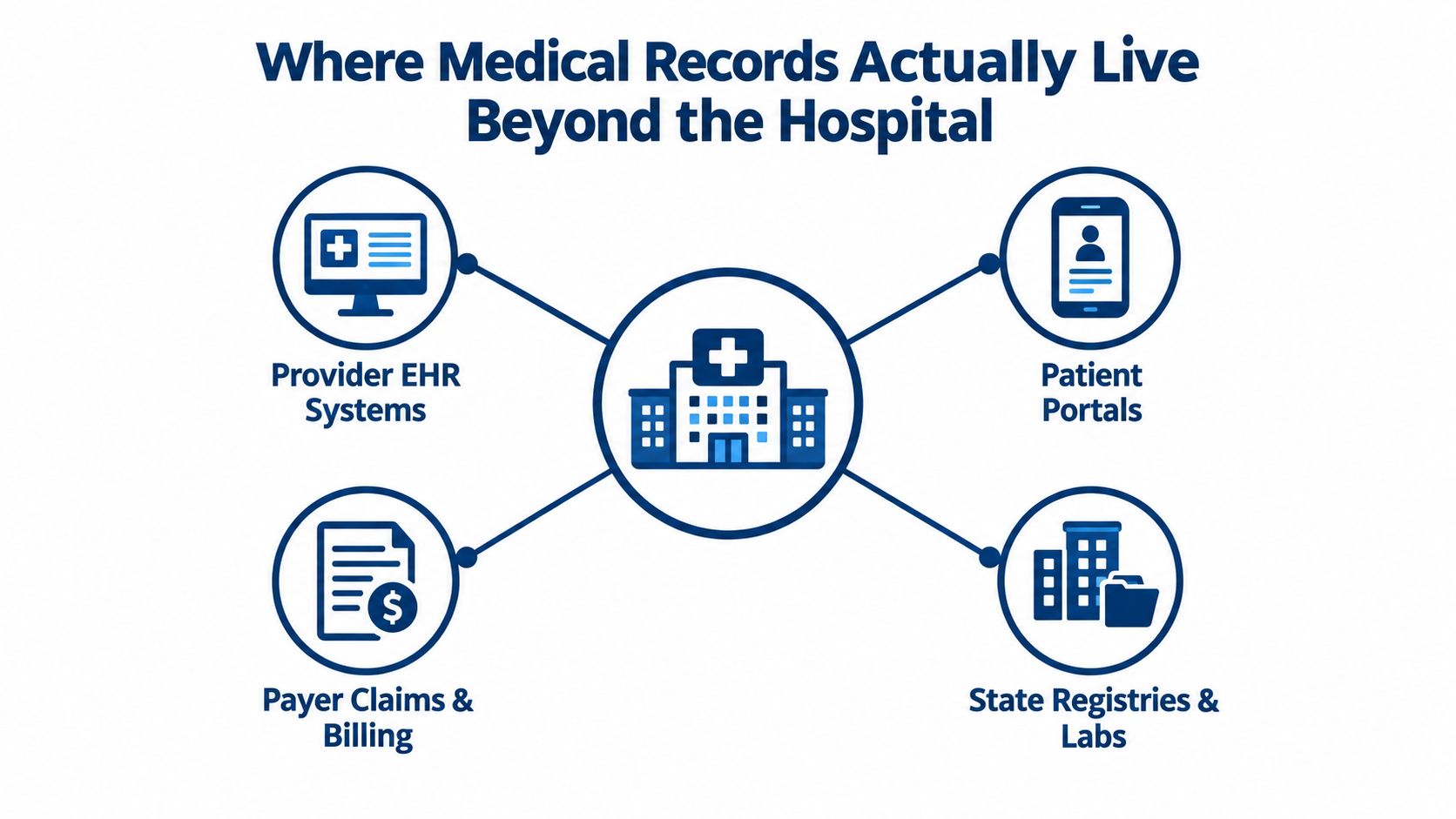
The hospital records department is only one stop. A complete legal file often spans the treating provider's EHR, a patient portal, a separate radiology or laboratory system, payer claims, billing records, and prior authorization documentation. The most efficient firms build the source list from the client's treatment history, not from the first facility that appears in the intake notes.
The distinction between clinical and administrative records matters. A chart may explain what a clinician diagnosed, while the payer file shows an authorization decision, denial, claim detail, or coverage history that helps explain when and how care occurred. CMS finalized interoperability and prior-authorization rules requiring impacted payers to provide certain prior-authorization information through APIs and give patients more visibility into decisions. Most operational requirements begin in 2026, with API requirements largely beginning in 2027, as described in the CMS interoperability and prior authorization final rule. Those changes point toward a mixed retrieval environment, not a hospital-only one.
Use a source matrix
| Record Source | What It Contains | When to Request It |
|---|---|---|
| Treating provider EHR | Progress notes, diagnoses, orders, medication information, discharge documentation, and treatment history | Request after identifying each treating provider and location |
| Patient portal | Visit summaries, messages, appointment information, test results, and documents made available to the patient | Check when the client reports portal access or when provider production is incomplete |
| Imaging center | Radiology reports and, where available, image files or viewing instructions | Request separately when imaging was performed outside the treating hospital |
| Laboratory | Test orders, results, and related reporting documentation | Request when tests affect injury, causation, treatment, or damages |
| Payer claims and billing | Claims data, payment information, coverage-related records, and billing artifacts | Request when the case requires proof of services, payment history, or a complete treatment timeline |
| Prior authorization system | Authorization submissions, decisions, and related payer documentation | Request when treatment approval, denial, delay, or medical necessity is relevant |
| Provider billing department | Itemized charges, statements, payment history, and account information | Request alongside clinical records when damages or lien analysis requires financial detail |
| State registries and specialty systems | Records maintained outside the primary provider environment | Investigate when the client identifies registry, specialty, or external diagnostic care |
A portal isn't automatically a complete medical record. It may be useful for locating dates and documents, but the firm should distinguish a patient-facing summary from the provider's designated record set. Likewise, a billing statement isn't a clinical record, and a clinical record often doesn't contain the itemized charges needed for damages work.
The exchange problem is increasingly technical. Hospitals have continued to report data-formatting and patient-matching problems, along with the need for customized interfaces, even as those issues improved from earlier reporting periods, according to the HIPAA Journal's summary of interoperability friction. In practical terms, “the records exist” doesn't necessarily mean the provider can export one clean, searchable PDF.
A complete file is assembled from sources. It rarely arrives as one magical download.
A Repeatable Workflow to Acquire Medical Records Without Chasing
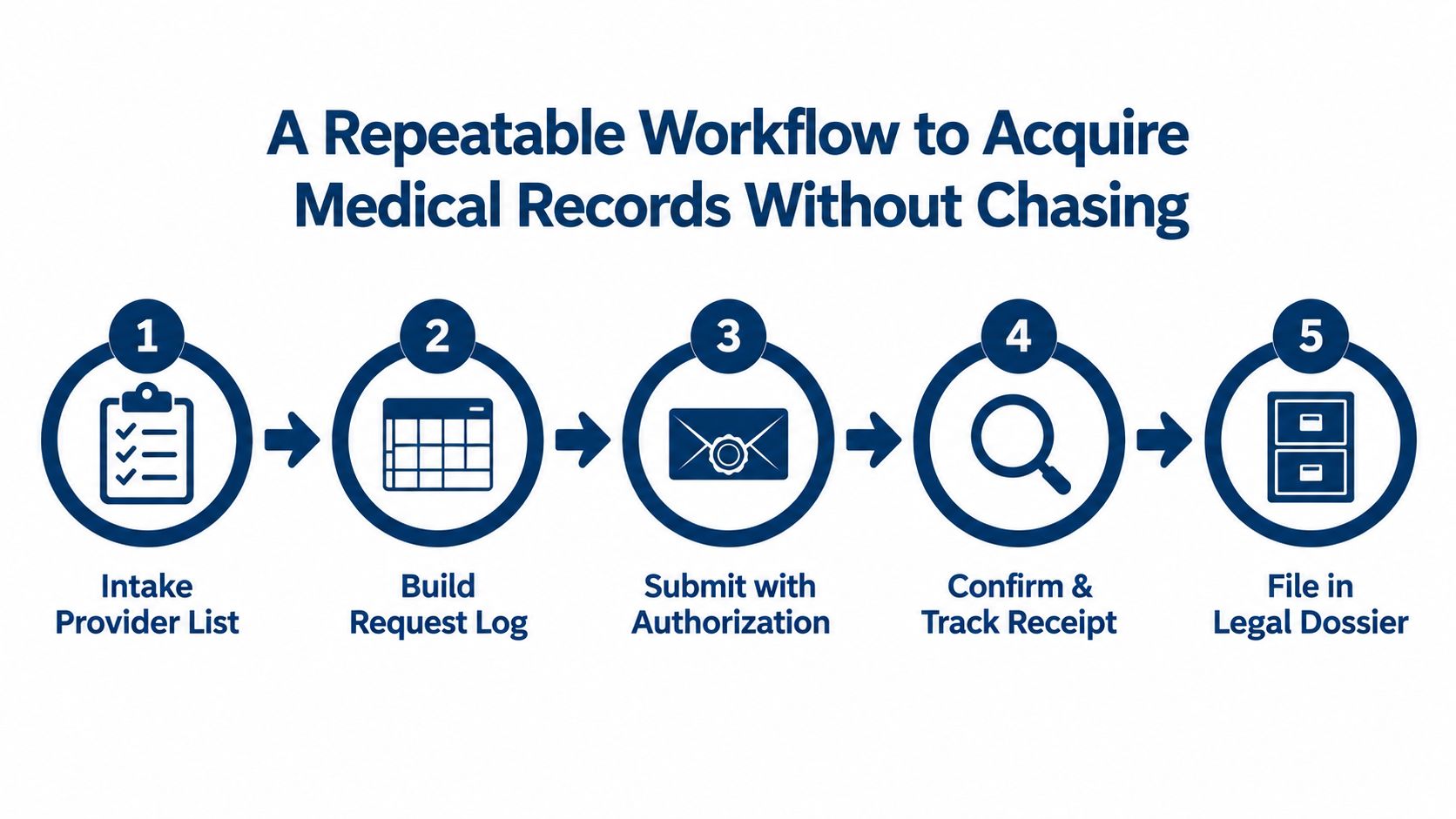
A workable retrieval process removes guesswork before a deadline becomes a problem. Each request enters a queue, one person owns it, the clock is calculated, contacts are logged, and returned files undergo review before the attorney receives a status update. That structure must hold during a quiet week and when one client identifies several additional facilities.
Start with intake, not a form
Ask the client where care occurred, including urgent-care centers, independent imaging facilities, laboratories, specialists, relevant pharmacies, ambulance providers, payers, and patient portals. Record former names, addresses, approximate treatment dates, and portal access. The provider list is a case fact. It should remain usable after intake rather than disappearing into a software field no one checks.
Create one request record for each custodian. The tracker should identify the matter, patient identifiers, source, record categories, authorization status, submission channel, date sent, confirmation details, deadline, follow-up dates, status, fees, and assigned owner. A shared spreadsheet can handle a small queue. Once several people work on the same matter, a case-management integration reduces duplicate outreach and conflicting updates.
Assign ownership and calendar the clock
The owner sends the request, confirms delivery, and updates the tracker. Attorneys should not need to ask three people whether a fax went through. For a patient-directed HIPAA request, calendar the 30-day response deadline and apply the permitted extension rules described earlier. For a request made under client authorization, identify the applicable state rule or the firm's service target. The federal patient-access deadline does not automatically govern every firm-submitted request.
Schedule follow-up when the request goes out. Use the same sequence each time: confirm receipt, ask whether the packet is complete, resolve fee or identity issues, request a production estimate, and escalate to a supervisor or privacy contact when responses stop. Every message should carry the request date, patient identifiers, authorization, and prior transmission proof. Re-sending an unexplained email creates another loose thread.
For a practical reference on medical record retrieval process for legal teams, the useful operating rule is straightforward: every request needs a next action and a next date.
Inspect the production before filing it
On arrival, verify the patient, treatment period, requested categories, page legibility, attachments, and imaging instructions. Compare the file with the source matrix. If a provider sends a summary instead of the requested chart, mark the request incomplete and list the missing categories. Filing the summary as complete only guarantees a second retrieval later, usually when the case is least interested in helping.
A dedicated support professional can manage drafting, status tracking, follow-up, file organization, and exception escalation. Attorney Assistant's Staffline provides dedicated full-time legal support professionals who work inside one firm's systems, learn its procedures, and support records and bill retrieval alongside broader case administration. That arrangement gives the queue a named owner instead of another shared inbox.
Technology should support the workflow rather than replace judgment. A clinical software development partner can help a firm or vendor configure integrations and data exchange. The firm still needs a defined legal basis, secure handling procedures, and human review for denials, scope changes, and sensitive records. A repeatable process connects providers, payers, portals, and internal systems without pretending they speak the same language.
Choosing Between In House Vendor and Hybrid Retrieval Models
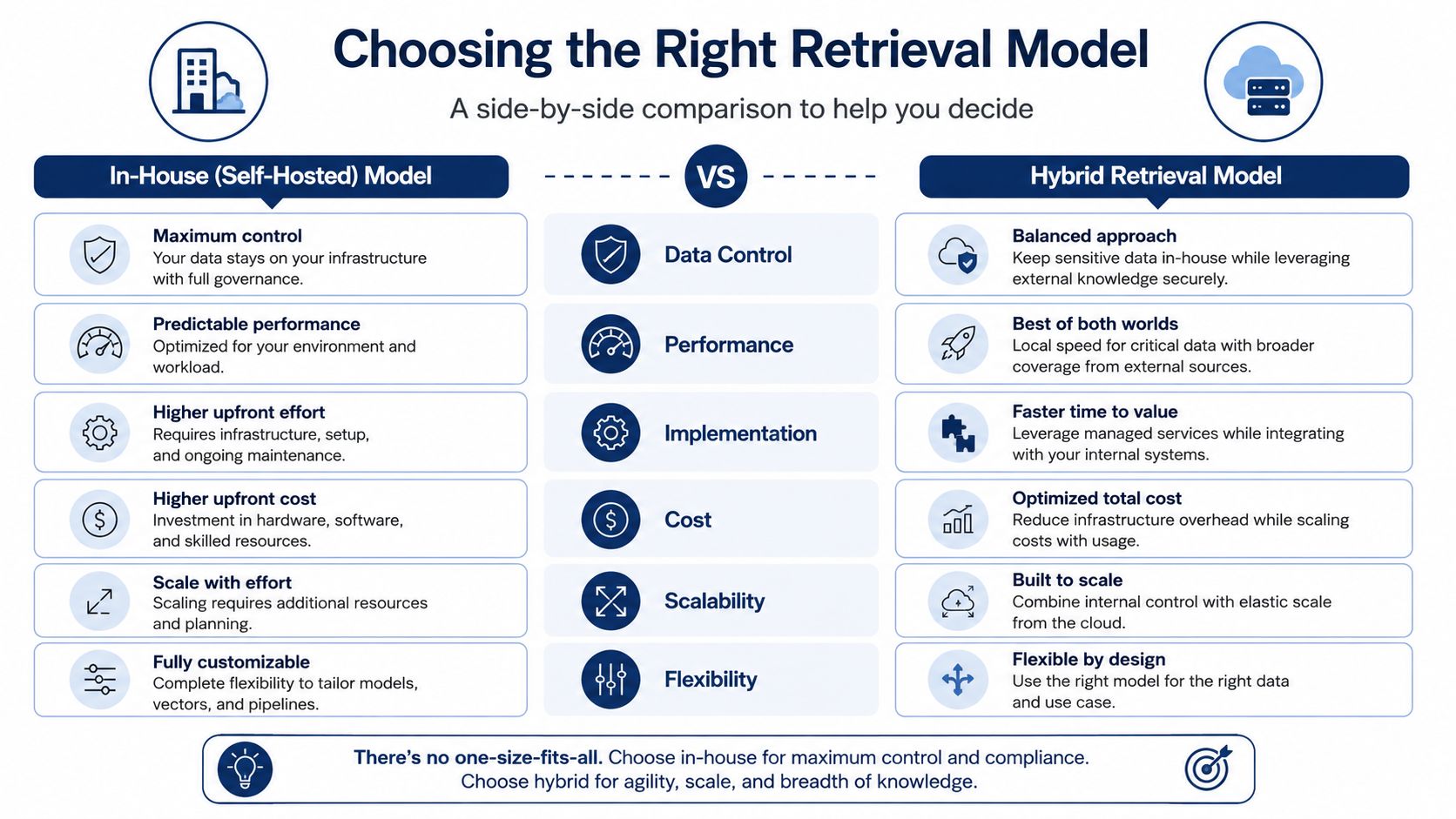
The right retrieval model depends less on ideology than on queue shape. A firm with occasional requests may keep the work with an existing paralegal. A growing personal injury practice may need dedicated capacity. A high-volume practice may use a vendor for routine outreach while retaining quality control and sensitive escalations internally.
In-house control
In-house staff understand the firm's case strategy, naming conventions, deadlines, and attorney preferences. They can notice that a missing operative report changes the next case task, rather than treating the request as a closed transaction. The trade-off is capacity. When the same person handles client communication, calendaring, discovery, billing questions, and records, retrieval becomes the task postponed until someone asks about it.
Hiring another full-time employee may solve volume, but it also creates recruiting, training, supervision, coverage, and retention responsibilities. More people without a tracker can produce more status notes and the same unanswered requests.
Dedicated support
A dedicated Staffline professional works with one firm for 40 hours per week, inside the firm's systems and processes. That structure provides continuity and makes records work one part of a broader legal support role, potentially alongside file opening, CRM hygiene, calendar management, lien reduction, and administrative tasks. Attorney Assistant sources, vets, and trains staff on legal support fundamentals, while the firm trains the professional on its specific workflow and preferences, with co-management available for performance.
The advantage is dedicated capacity without asking an attorney to become the records coordinator. The firm still has to define its process, grant appropriate system access, review quality, and manage the relationship. “Outsourced” doesn't mean “self-managing.”
Third-party retrieval vendors
Vendors can provide specialized experience, established provider contacts, and volume handling. They may be a sensible choice when the firm wants to purchase a defined retrieval task rather than build internal capacity. The costs are less flexible when requests are unusual, records are fragmented, or the vendor's process doesn't match the firm's matter structure.
A hybrid model often works when the firm separates routine volume from judgment-heavy work:
- Routine outreach: A support team or vendor submits standard requests and performs scheduled follow-up.
- Matter judgment: Firm staff decide scope, relevance, privilege, sensitive categories, and escalation authority.
- Quality control: One designated reviewer confirms completeness before the file moves to chronology, demand, or expert review.
- System ownership: The firm retains the request log, provider notes, and final documents in its case-management environment.
Use medical records retrieval services for law firms to evaluate what a provider handles, then ask direct questions about ownership, security, turnaround expectations, rejection handling, file organization, and handoff procedures. The cheapest model is not necessarily the least expensive when attorneys spend their afternoons repairing it.
Troubleshooting Delays Denials Fees and Incomplete Files
Even a well-built workflow eventually meets a provider portal that rejects the upload, a records department that says it never received the request, or a production containing four pages and a cheerful cover sheet. Troubleshooting works best when the firm treats each failure as a category with a standard response.
When the request disappears
Start with proof of delivery. Re-send the complete packet through the accepted channel, attach the original transmission evidence, and ask the custodian to confirm whether the request is complete, assigned, and pending production. Record the name or department that responds. If the request is a patient-directed access request, the federal clock remains the anchor, including the written-notice requirement for an extension. The HHS right-of-access guidance explains that an additional 30-day extension requires written explanation and a new completion date within the first 30 days.
If the provider claims the records are off-site, ask which categories are maintained remotely and whether the request has been routed to the correct custodian. “The records exist somewhere” is a reason to identify the next owner, not a status update.
When systems cannot produce a clean file
Ask for the available export format, the document index, and any separate attachments or viewers. Check patient matching details against the provider's chart. Recent interoperability reporting has identified formatting, matching, and interface problems, so a fragmented response may reflect system limitations rather than a simple refusal. That still leaves the firm responsible for identifying missing pieces and requesting them separately.
When fees look unreasonable
For a patient's own access request, federal guidance limits fees to reasonable, cost-based charges for copying labor, supplies, and postage, and excludes retrieval or search costs. The HIPAA fee guidance summarized by Medcurity is useful when a records department adds vague retrieval or administrative charges to a patient-directed request. The exact path can differ when a law firm requests disclosure to a third party, so confirm the request type and applicable state rules before disputing an invoice.
State schedules can change the analysis. Pennsylvania's 2025 medical-record fee schedule lists a $29.61 search-and-retrieval charge, but says that charge can't be billed when the requester seeks their own personal health record, as explained by the Pennsylvania Department of Health fee schedule. Ask the provider to identify the legal basis for the fee and document the response.
When production is incomplete
Compare the received file against the request matrix. Mark each category as received, absent, unreadable, or pending. Follow up with a specific deficiency list, such as missing imaging, itemized billing, or a treatment period, instead of writing “please send everything.” Specific requests give the records department something it can route. They also give the firm a defensible audit trail if escalation becomes necessary.
A final queue review should show one of three outcomes for every request: complete and filed, incomplete with a scheduled corrective action, or escalated with a named decision-maker. If your attorneys are still checking the queue themselves, the firm doesn't have a retrieval problem alone. It has a capacity problem.
Attorney Assistant provides dedicated legal support through Staffline for records acquisition, bill retrieval, file organization, and related case administration, while Frontline provides 24/7 live intake and structured follow-up for new opportunities. Visit Attorney Assistant to assess where your firm is losing attorney time and whether dedicated operational support can keep medical-record requests moving.
Related Articles

Medical Records Retrieval Services Explained for Law Firms
Learn how medical records retrieval services work for law firms, from HIPAA compliance and pricing to vendor selection and faster case support.

What Is a Medical Lien and How It Affects Your Case
Learn what is a medical lien, how it works in personal injury cases, who files one, and how it impacts your settlement and net recovery.

24/7 Virtual Receptionists for Law Firms That Sign Cases
Learn how 24/7 virtual receptionists help law firms answer every call, speed up intake and sign more cases with live after-hours coverage.