Most advice on how to find clients for cleaning business starts with buying more leads. That's backwards. If your phone goes to voicemail, your quote arrives two days late, and your best customer hasn't been offered a recurring plan, more leads just give you more people to disappoint efficiently.
You don't need a louder van wrap first. You need to be findable nearby, answer before a competitor does, and turn one good clean into the next twelve. New strangers are the slow route. Repeat work, referrals, and a five-minute response decide whether interest becomes paid work or another quote sent into the void.
Table of Contents
- Where Cleaning Clients Actually Come From
- How to Win Local Search Before the Quote
- How Repeat Customers Become the Next Client
- How to Answer and Follow Up Every Lead
- Partnerships Paid Ads and Social That Pay
- How to Price and Close Without Racing to the Bottom
- Choose the Channel That Books Paid Work
Where Cleaning Clients Actually Come From
Strip the marketing advice away and cleaning demand comes from a short list: people who hired you before, people they told, and people searching nearby tonight.
| Channel | Reported share | What it is best for |
|---|---|---|
| Word of mouth and referrals | 71% of residential-service business volume (ServiceTitan 2023); 59% of owners name referrals and repeat work as a leading lead source (Jobber 2026) | Trust-based residential and commercial work |
| Repeat customers | 39% of annual residential-service revenue (ServiceTitan 2023); commercial surveys point the same direction | Recurring contracts and forecastable revenue |
| Google Search | The usual first stop for nearby, high-intent searches | High-intent nearby buyers |
| Google Maps | A smaller share of local searches, strongest for service-area lookups | Service-area discovery |
| The social channel owners lean on for local reach; heavily used by carpet and floor cleaners | Photos and local proof | |
| Local Services Ads | A minority of owners name it a leading lead source | Paid local intent |
| Used by a minority of carpet and floor cleaners | Before-and-after proof | |
| Used by a minority of carpet and floor cleaners | Commercial and facility contacts |
The ServiceTitan and Jobber figures are summarized in a breakdown of cleaning referral programs and lead sources, which reported that a 2023 ServiceTitan survey of more than 1,000 U.S. residential-service contractors found 71% of business volume came from word-of-mouth referrals and 39% of annual revenue came from repeat customers. It also cited a 2026 Jobber survey of 1,050 business owners where 59% identified referrals and repeat work as their leading sources of leads.
Read the table top to bottom and the pattern is obvious. The two biggest rows cost nothing to generate and compound every time you do a good job. Search is where strangers compare you against whoever answers faster and shows more proof. Social mostly works as evidence a prospect checks after they already heard your name, which is why a dead Facebook page rarely books work on its own.
A cheap inquiry isn't a client, and a one-off deep clean isn't the same asset as a weekly account.
Sort Last Quarter Before You Spend
Tag every job from last quarter by source, first visit or repeat, service type, town, and rough gross margin after labor, travel, and supplies. You'll usually find a few accounts supporting the business and a channel producing inquiries that never survive the quote. Referrals tend to close with less selling because the trust arrives pre-sold. One-off inquiries from paid channels often need the most quoting labor for the smallest jobs, which is margin burned in the van before anyone signs.
Your website should support that sorting through more than tidy design. Resources on websites that bring cleaners more enquiries are useful if your pages don't show services, areas, and a clear quote request. Fix findability and follow-up first. Ads can wait until you know which work is worth finding more of.
How to Win Local Search Before the Quote
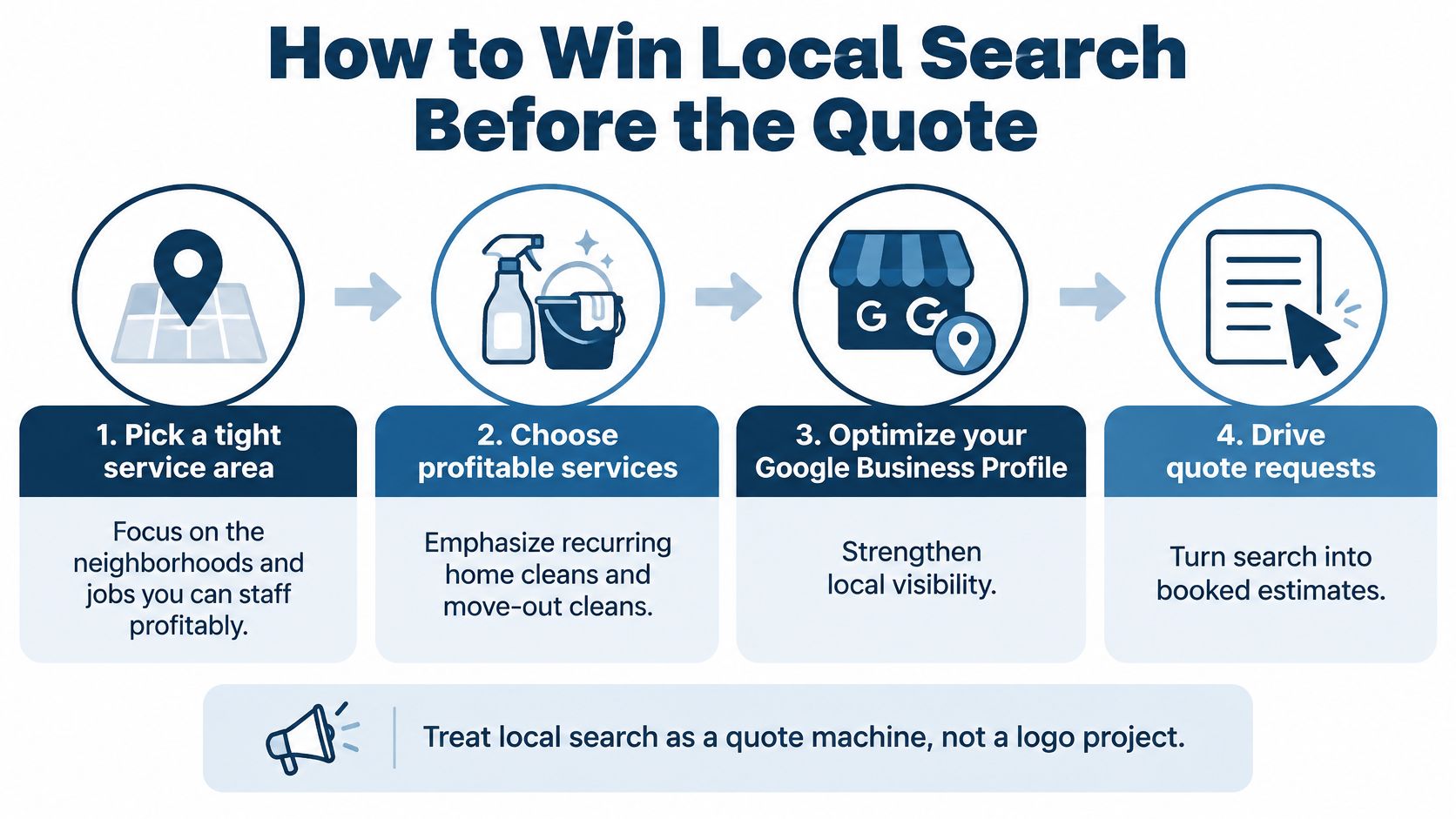
Treat local search as a quote machine, not a logo project. A prospect comparing three cleaners on a phone doesn't care about your brand story. They care whether you serve their street, clean what they need cleaned, show proof, and make asking for a price easy.
The visual below shows the setup in operating order.
Build in This Order
- Pick a tight service area: Choose neighborhoods and towns you can reach without burning margin in the van. List only jobs you can staff well, such as recurring home cleans, move-out cleans, and small offices.
- Build one real page per offer and priority town: Include scope, exclusions, arrival windows, recurring options, insurance or certification notes, photos, a short FAQ, and one estimate form. Don't clone a thin city page fifty times and change the postcode. Prospects notice. So does anyone reading it twice.
- Complete your Google Business Profile: Match it to those pages with your exact business name, local phone, hours, service areas, services, quote link, and current photos of real work.
- Ask for reviews right after finished jobs: Use a simple, non-incentivized request. Invite customers to mention the service and place naturally if they want to. Never script their words or invent a five-star review because Tuesday felt slow.
- Reply to every review: Answer complaints about lateness, access, supplies, or missed spots in plain language. Say what you'll fix. Don't argue with someone about their own bathroom in public.
The completeness point isn't decorative. BrightLocal's local SEO statistics reports Google-reported research associating complete Business Profiles with customers being 70% more likely to visit and 50% more likely to consider purchasing, and that customers are 2.7 times more likely to view a business as reputable when they find a complete profile.
Make the Page Do Operational Work
A good service page answers the questions you'd otherwise repeat on every call. What's included in a move-out clean. What's excluded. Who supplies products. How access works. Whether inside ovens, fridges, and windows cost extra. How rescheduling works for recurring visits.
For a deeper walkthrough of connecting pages, profiles, and quote requests, this guide to turn local searches into cleaning leads is a practical next read. Use it to tighten the basics before you chase another keyword tool.
Log every result in a spreadsheet or CRM. Track calls, form submissions, booked estimates, source, service type, geography, close rate, average contract value, and customer-acquisition cost.
Rankings and profile views aren't the scoreboard. A page can rank beautifully and still produce estimates for houses forty minutes away that you never wanted. Booked, profitable work is the metric that pays wages.
How Repeat Customers Become the Next Client
Retention is client acquisition with better manners. A first job that never repeats sends you back to buying strangers, which is an expensive way to feel busy.
The cycle below is the whole idea. Do the work, prove it, book the next visit, then earn the introduction.
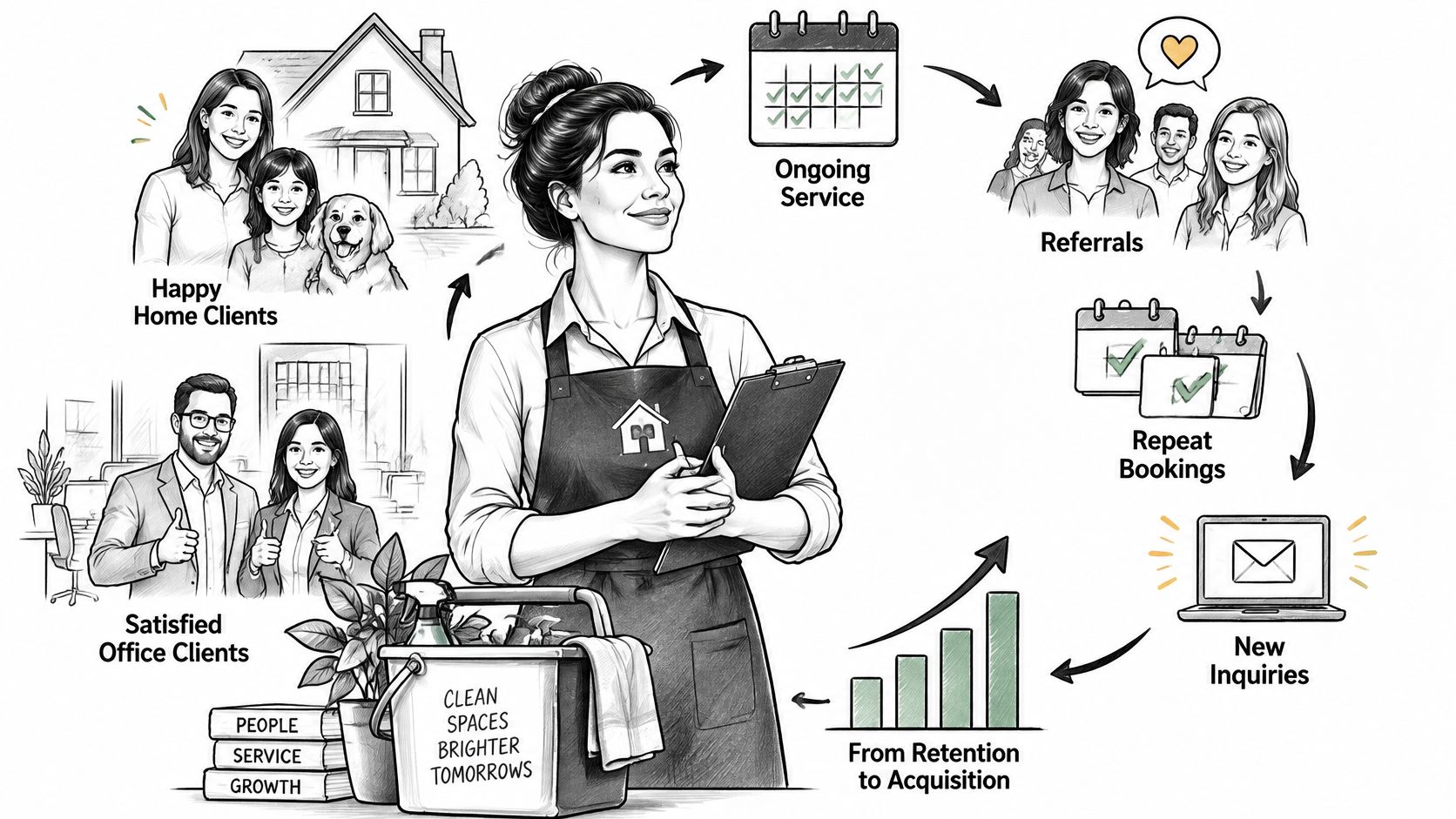
CleanLink's summary of the Aspire survey benchmarks reported that the 2025 Commercial Cleaning Insights survey of 1,022 companies found 53% of revenue came from ongoing work, repeat customers represented 40% of sales, and 57% identified customer retention as a primary concern.
Sell a Cadence, Not a One-Time Rescue
Put a simple menu in front of every satisfied customer.
- Weekly or biweekly homes: Best for steady routes and predictable crew hours.
- Nightly or weekly offices: Best when you can document tasks, keys, alarms, and quality checks.
- Quarterly deep cleans: A useful bridge for clients who won't commit to regular maintenance yet.
Each cadence needs a written checklist, a simple reschedule rule, and a renewal conversation before the current term ends. Don't wait until the client has already called someone else because your agreement expired.
After each visit, send short proof. Note what was done, anything skipped and why, and the next date. It takes little time and prevents the slow drift where a client can't quite remember what they're paying for. Consistent service communication matters in other appointment-based businesses too, as covered in this look at handling customer service calls without losing the thread.
The short video below is worth watching before you design your recurring offer, especially if your current plan is hoping clients remember to call.
Ask at the Right Moment, for a Named Person
I would ask after the second successful recurring visit, or immediately after a one-time job the client praised without prompting. That's when you've proved reliability, not just enthusiasm.
Make the request concrete. Ask for an introduction to the neighbor who mentioned needing help, the property manager who handled the move, the tenant next door, or the office down the hall. "Send us anyone you know" is easy to forget. A named introduction gives the client a specific person to picture.
A credit, discount, or upgrade for both sides can work. Don't tie it to writing a review. Buying praise is a fast way to turn trust into paperwork.
Track referral revenue separately from repeat revenue. A loyal account that renews isn't a lead source. A loyal account that sends you two neighboring offices is both. If you mix them, you'll underinvest in the relationships producing new clients.
Identify renewal-likely accounts by boring signals. They pay on time, access is stable, complaints are rare and specific, and the scope still fits the price. Friendly first calls are lovely. They are not a forecasting method.
How to Answer and Follow Up Every Lead
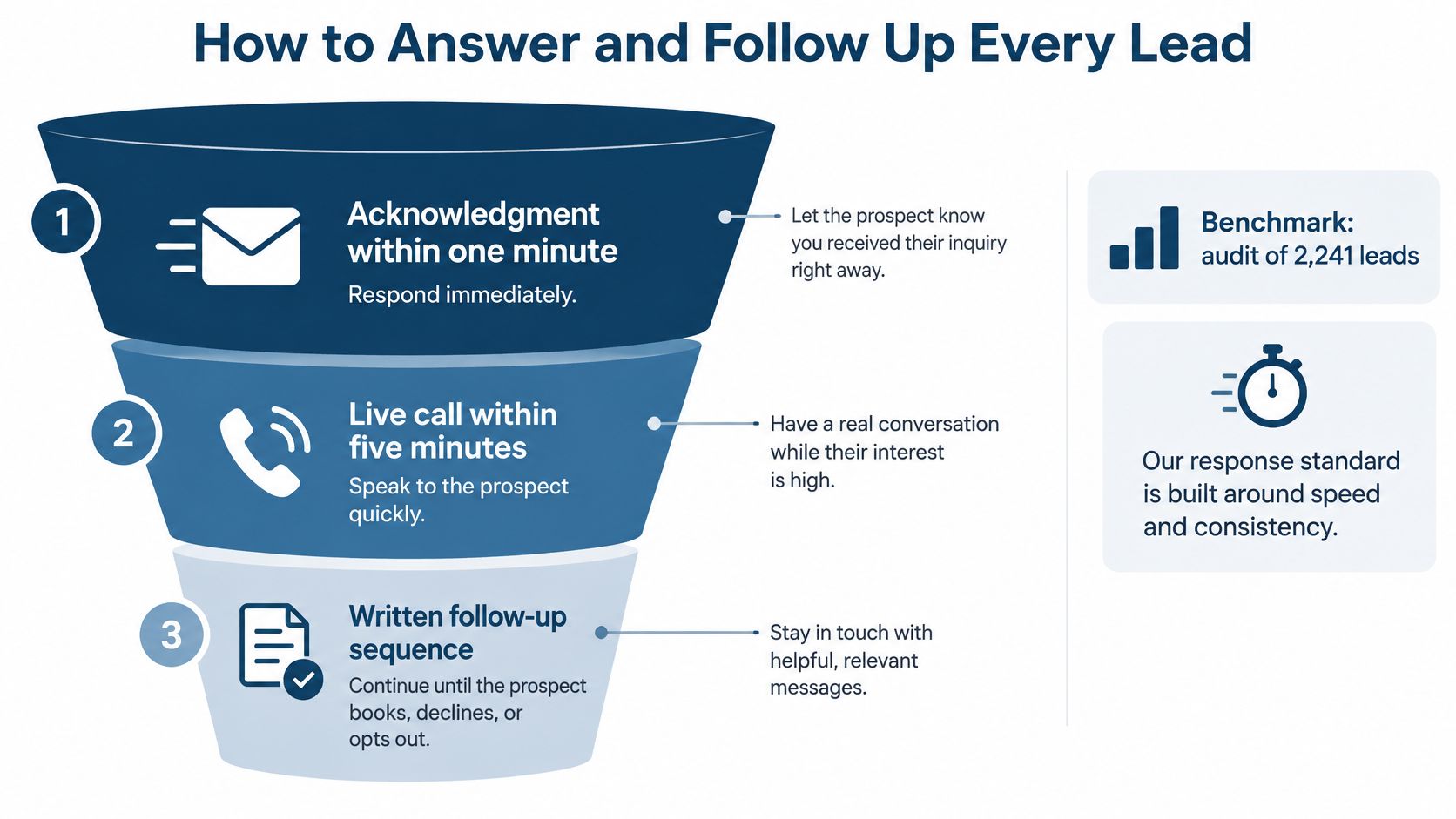
Your operating promise should fit on one line. Acknowledge within one minute, call within five minutes, then follow up in writing until the prospect books, declines, or opts out.
The funnel below shows that sequence.
The Clock Starts When They Ask
Route web forms, tracked calls, and voicemail alerts to a named person. Not an inbox that three people assume someone else is watching. If you accept urgent move-outs, decide who covers evenings before you advertise that you do.
- Send an acknowledgment within one minute: Confirm you received the request and say when you'll call.
- Call within five minutes: Use the number they gave you. If they don't answer, leave a short voicemail and follow with a text or email if they gave permission.
- Keep attempting: Call twice on day one, once on days two and three, then space further attempts over the next two weeks. Stop when they opt out or clearly decline.
- Qualify before you price: Ask about property type, approximate size, bathrooms, flooring, frequency, access constraints, desired start date, and whether they're comparing bids.
- Set one next step: Offer photos, a phone estimate, or an on-site walkthrough. Then send a written scope with an expiration date.
Leaving one voicemail and hoping is not a follow-up system. It's a small audio monument to optimism. Small businesses in other fields face the same leak, which is why phone answering coverage for small businesses focuses on ownership and response time rather than taking messages.
Operating rule: If nobody owns the lead by name, nobody owns the lead.
Why Speed Beats Another Ad
Cognautic's compilation of speed-to-lead statistics reported an audit of 2,241 U.S. companies where only 37% responded within an hour, 23% never responded, and the average response among responders was 42 hours. It also reported a separate analysis of 5.7 million inbound leads across more than 400 companies where conversion was approximately eight times higher when the first response occurred within five minutes rather than between five minutes and 24 hours.
Treat that eight-times figure as cross-industry and directional, not a guaranteed cleaning result. The direction still matters. A homeowner with a move-out deadline will not preserve your quote in a frame while waiting two days for a callback.
Separate residential urgency from commercial buying cycles. A family may book a deep clean today. An office manager may need insurance proof, a walkthrough, references, and approval from someone who is never in the building. Don't quote a nightly office contract from a three-line form.
Measure speed to first attempt, contact rate, estimate rate, close rate, revenue per lead, and gross margin by channel. Pause any source that produces plenty of inquiries and no profitable jobs. Activity is not acquisition.
Partnerships Paid Ads and Social That Pay
| Channel | Use it for | Start only if | Stop if |
|---|---|---|---|
| Real-estate and property-manager partners | Move-outs, turns, and make-readies | You can hit a short-notice arrival window | They send only unpaid estimates or jobs outside your area |
| Contractor and office-admin partners | Post-construction and small commercial | You have insurance proof and a written scope | The work is chronically rescheduled or underpriced |
| Local Services Ads or paid search | High-intent local quotes | Profile, form, and five-minute response already work | Estimate rate or margin trails unpaid leads |
| Facebook and Instagram | Photo proof for homeowners | You can post real recent jobs weekly | Posts do not match services you want to sell |
| Facility and office contacts | You sell recurring commercial work | You are a residential-only crew |
Partners Need a Reason to Remember You
Visit listing agents who need move-out cleans, property managers with regular turns, contractors who leave dust behind, and office managers who already dislike their current vendor. Bring a one-page scope, proof of insurance, your service area, typical arrival windows, and one named contact.
Don't bring a stack of brochures that will become expensive coasters. Partners refer cleaners who solve an urgent problem without creating three new phone calls.
Test one partner type at a time. Record every introduction, estimate, booking, and margin. If a partner sends only distant jobs, impossible deadlines, or price shoppers, thank them and stop building your week around their emergencies.
Paid Ads Come After the Plumbing Works
Paid search and Local Services Ads should start only after your profile, quote form, and five-minute response already work. Otherwise you're paying to fill a bucket and arguing with the hole later.
Set a test window in advance and compare paid leads with unpaid leads on estimate rate, close rate, and gross margin. If paid work trails on those measures, pause it. A lower cost per click doesn't rescue a job that loses money after drive time.
Social Is Proof, Not a Performance
Cleanfax's 2024 Carpet and Floor Cleaning Benchmarking Survey found 67% of carpet and floor-cleaning businesses used Facebook to attract customers, while 27% used Instagram and 18% used LinkedIn.
Use Facebook and Instagram for recent before-and-after photos, arrival windows, checklist details, and review screenshots. Use LinkedIn to reach facility and office contacts if you sell commercial work. If posting consistently is the bottleneck, a simple social media scheduler can help you batch real job photos instead of remembering at midnight.
Post the jobs you want more of. A weekly selfie from the van does not qualify you for a large lobby, and polished office photos won't persuade a homeowner who wants to see a kitchen like theirs.
Pick one partner type, one paid test with a kill number, and one social channel where past clients already look.
How to Price and Close Without Racing to the Bottom
The cheapest quote is a client-finding strategy only for people who enjoy unpaid drive time. Price from scope, not from fear of the other bid you haven't seen.
Put the Scope in Writing
Every quote should state these items clearly.
- Areas included: Name the rooms, floors, offices, restrooms, and shared spaces.
- Exclusions: State what's not included, such as inside appliances, exterior windows, laundry, or waste removal.
- Supplies and equipment: Say who provides products, vacuums, mops, and specialty tools.
- First clean versus maintenance: Show the heavier first-clean price separately from the recurring maintenance price.
- Frequency and arrival window: Confirm how often you'll come and when the crew is expected.
- Access rules: Cover keys, codes, parking, pets, alarms, and who lets the team in.
- Expiration date: Say how long the price remains open.
A blank "whole house" quote invites the prospect to imagine a different house. Usually a larger, dirtier one with a staircase nobody mentioned.
Give Two Clear Options, Not a Menu Maze
On the call, restate size, bathrooms, floors, pets, and access before you give the number. That short recap catches misunderstandings while they're still cheap.
Offer two options when it helps. For a home, that might be a one-time deep clean or biweekly maintenance after the first visit. For an office, it might be weekly service or a more frequent cadence with documented quality checks. Five packages with cute names mostly give the prospect five ways to postpone deciding.
For recurring work, place the maintenance price beside the first-clean price. The prospect can see why the first visit costs more and what ongoing service looks like. Check that labor, travel, supplies, and supervision still leave margin after a missed visit, a reschedule, or a room that takes longer than promised.
For commercial work, price the cadence and quality check, not one heroic clean. The client is buying a building that stays presentable, keys handled properly, restrooms stocked, and problems reported before tenants complain.
Send the written scope the same day you discuss it. Name the expiration date. Then follow up on the same multi-attempt calendar you use for new leads, because silence after a price is still a live prospect. They may be waiting on a partner, a manager, a closing date, or the courage to admit the oven has seen things.
Use your own numbers as the price test. Track close rate and gross margin by service type. If move-outs close often and lose money, the offer or scope is wrong. If recurring quotes sit unsigned, the scope may be vague, the first-clean jump unexplained, or the reply too late.
Showing up, answering, and completing the checklist will win work you can keep. Shaving a little more off a job you can't staff just makes the loss arrive on schedule.
Choose the Channel That Books Paid Work
Don't start a twelve-item marketing reboot on Monday. Pick the gap that's costing you booked work now.
If last quarter's jobs have no source tags, build that list before anything else. You can't improve a channel you can't identify, and guessing usually flatters whatever you did most recently.
If strangers already call and estimates die in voicemail, fix the five-minute response before buying ads. If your calendar is full of one-off cleans, sell a cadence and ask two happy accounts for a named introduction this week.
If people search your town and your profile is half empty, finish the profile and publish one real service page. If those basics work and one partner keeps sending fit jobs, visit that partner with a one-page scope and proof you can handle the next turn.
Booking friction matters at the end of all of this. A clear next step beats asking prospects to phone during office hours and hope someone is near the calendar, a point also covered in this guide to automated appointment booking for businesses.
Ignore a new logo, a new flyer route, and a new social network until one of those gaps moves. The score for the month is booked paid work and repeat bookings, not impressions, likes, or a colorful chart of people who saw your van.
A cleaner who can be found, remembered, and reached the same day doesn't need a louder ad. They need the next inquiry to land with a person who can qualify it, quote it, and book it before it cools off.
If missed calls, slow follow-up, and administrative work are eating the time your team should spend on clients, Attorney Assistant provides dedicated legal support staff through Staffline and 24/7 live intake through Frontline, built to answer, qualify, follow up, and help sign the right cases. Start by examining where inquiries stall in your own operation, then visit Attorney Assistant to explore support that fits the way your firm works.
Related Articles

Sentence for Counsel: 7 Examples Law Firms Can Use
Sentence for counsel examples for law firms: seven ready-to-adapt lines for intake replies, status updates, document requests, and engagement confirmations.

Customer Service Calls: How to Handle Them Well
Learn what customer service calls involve, which metrics matter, how to script and score them, and the tech and staffing choices that keep them working.

Medical Record Review for Attorneys: A Step-by-Step Guide
Medical record review for attorneys, step by step: request records, build a verified chronology, audit summaries, and know when to delegate the work.