How to Increase Client Conversion for Law Firms
TL;DR:
- Law firms increase client conversions by responding quickly within 5-15 minutes and using multi-channel follow-ups. Early qualification filtering ensures focus on prospects most likely to sign and reduces ineffective outreach. Implementing structured follow-up plans and proactive reporting improves retention and drives higher signed case rates.
Client conversion rate is defined as the percentage of inquiries that become signed clients. For law firms, professional services benchmarks sit between 2% and 7%, with high-performing firms targeting 10–20% quarterly improvement. Most firms that fall below that range do not have a lead volume problem. They have a follow-up and intake problem. The operational levers that move the needle are speed-to-lead, lead qualification, and a structured multi-step follow-up system. Attorney Assistant works with firms every day that are losing signed cases not from lack of inquiries, but from slow responses and inconsistent intake workflows.
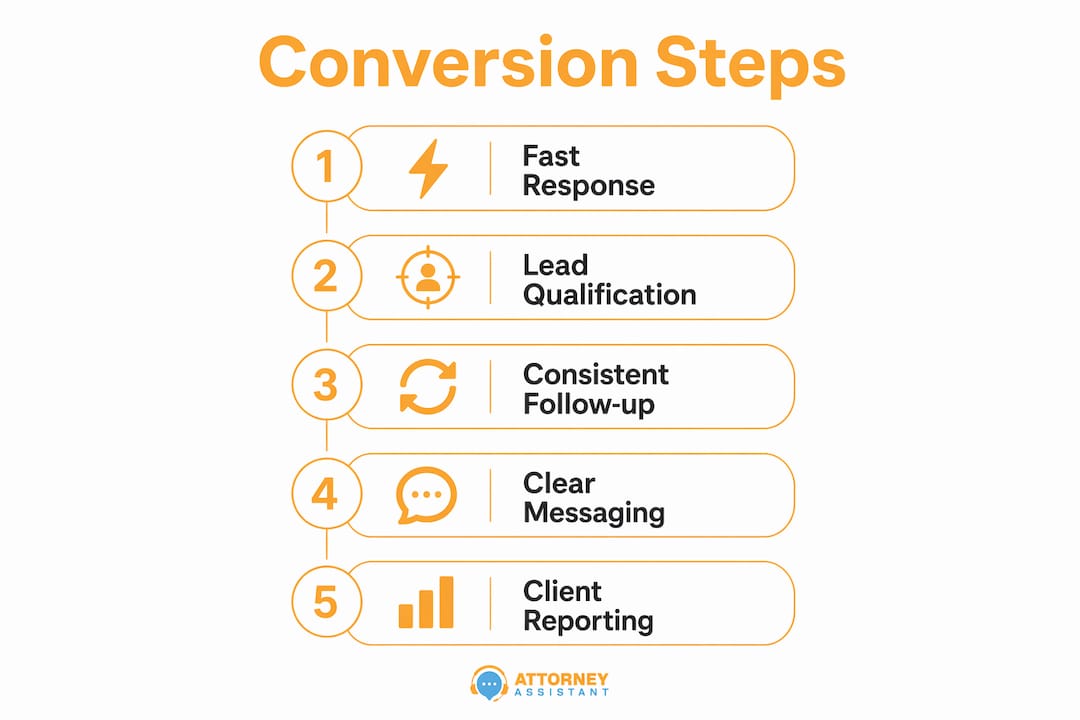
How to increase client conversion through faster lead response
The single most powerful change a law firm can make is responding to new inquiries faster. The first 5–15 minutes after a prospect submits a form or calls is the “golden window.” Delays beyond that window drop connection likelihood sharply. A prospect who does not hear back within the hour has often already called another firm.
Speed alone is not enough. The follow-up must reach the prospect through multiple channels. A 7–14 day multi-channel cadence combining phone calls, emails, and texts produces the most consistent results. Single-channel outreach, such as one email and no follow-up call, leaves most leads uncontacted.
Common pitfalls that slow response time include:
- Relying on a single staff member to monitor and return all new inquiries
- No after-hours coverage for calls and web form submissions
- Manual processes that delay the first outreach by hours
- No template responses ready for immediate email or text confirmation
Each of these gaps costs firms signed cases. The fix is not hiring more attorneys. It is fixing the intake workflow so the first contact happens within minutes, not hours.
Pro Tip: Set up automated text and email confirmations to fire the moment a new inquiry comes in. This speeds up early contact while your intake team prepares for the consultation call.
What is the best way to qualify leads before investing follow-up time?

Not every inquiry deserves the same level of attention. Lead qualification is the process of filtering prospects by their likelihood to become a signed client. Lead scoring systems prioritize prospects based on traits like case type, urgency, budget, and decision authority. This lets your intake team focus time on the leads most likely to convert.
A practical qualification framework for law firms covers four criteria:
- Case fit. Does the prospect’s situation fall within your practice area and jurisdiction?
- Urgency. Does the prospect have a deadline, statute of limitations concern, or active legal matter?
- Decision authority. Is the person calling the one who will sign the retainer, or are they gathering information for someone else?
- Budget alignment. Has the prospect acknowledged the general cost range, or do they expect free representation?
Leads that fail two or more of these criteria are unlikely to convert regardless of how much follow-up time you invest. Disqualifying them early frees your team to focus on high-value prospects who are ready to move forward.
Firms that skip qualification end up with bloated pipelines full of unresponsive or unfit leads. That creates the illusion of a volume problem when the real issue is poor filtering. Tracking qualification rates by case type also reveals which marketing channels bring the best-fit inquiries.
Pro Tip: Create a short intake script with four qualifying questions. If a prospect cannot answer two or more, flag the lead as low priority and reduce follow-up frequency rather than dropping it entirely.
What does an effective follow-up system look like?
A structured follow-up system is a scheduled, multi-step contact plan that continues until the prospect signs, declines, or becomes unreachable. Most firms stop following up after one or two attempts. That is where signed cases get left behind.
An effective cadence includes these elements:
- Day 1: Immediate automated text and email confirmation, followed by a live phone call within 5–15 minutes
- Day 2: A second phone call with a voicemail if unanswered, plus a follow-up email with a clear next step
- Day 4: A value-focused email addressing the most common objection for that case type
- Day 7: A third phone call and a text message checking availability
- Day 10–14: A final outreach sequence with a soft close and a clear deadline for scheduling
Each touchpoint should include a specific call to action. “Call us back when you’re ready” is not a call to action. “Reply to this email to schedule your free 20-minute consultation this week” is.
The table below shows how follow-up frequency affects contact rates across a 14-day window:
| Follow-up attempts | Typical contact rate | Recommended channels |
|---|---|---|
| 1–2 attempts | Low | Phone only |
| 3–5 attempts | Moderate | Phone and email |
| 6–8 attempts over 14 days | High | Phone, email, and text |
Tracking which stage of the follow-up sequence produces the most responses tells you where your cadence needs adjustment. Segmenting conversion rates by funnel stage gives you a clearer picture than looking at an overall conversion percentage. If most prospects go cold after day 4, your day 4 message needs work.
Consistency matters more than creativity here. A firm that sends the same clear, direct follow-up sequence every time will outperform one that improvises outreach based on staff availability.
How does clear messaging improve client retention and reduce churn?
Clear messaging at the intake stage sets expectations that carry through the entire client relationship. Prospects who understand exactly what your firm does, what the process looks like, and what results are realistic are far less likely to disengage or dispute fees later. Copy-driven improvements to headlines and language matching yield conversion lifts of 50–200%, far outpacing design changes that average 0–3%. The words you use in your intake call and follow-up emails matter more than your website’s color scheme.
Monthly client reports reinforce that trust after the retainer is signed. A one-page report covering what was done, what results were achieved, and what happens next gives clients a reason to stay engaged. Proactive monthly reporting reduces client churn by 15–30%. Clients using three or more services from the same firm show 40–60% higher retention rates. That is a direct argument for cross-service communication during intake.
The comparison below shows the difference between reactive and proactive client communication:
| Communication approach | Client behavior | Retention outcome |
|---|---|---|
| Reactive (respond only when asked) | Clients feel uninformed, escalate concerns | Higher churn, lower referrals |
| Proactive (scheduled updates and reports) | Clients feel confident, raise fewer disputes | Lower churn, higher referrals |
A legal consultation workflow that includes a structured communication schedule from the first contact through case resolution reduces misunderstandings and builds the kind of trust that generates referrals. Firms that treat communication as an operational function, not an afterthought, consistently outperform those that leave it to individual attorney preference.
Pro Tip: Write your value proposition in one sentence that a non-lawyer can understand. “We handle personal injury cases and fight to get you the maximum settlement” is clearer than “We provide comprehensive legal representation across tort law matters.”
Key Takeaways
Faster follow-up, disciplined lead qualification, and proactive client communication are the three operational changes that produce the largest gains in client conversion rate.
| Point | Details |
|---|---|
| Respond within 5–15 minutes | Contact in the golden window dramatically increases the chance of reaching a prospect before they call a competitor. |
| Qualify leads early | Use case fit, urgency, authority, and budget to filter prospects and focus follow-up on high-value leads. |
| Build a 14-day multi-channel cadence | Six to eight touchpoints across phone, email, and text produce the highest contact rates. |
| Use clear, plain-language messaging | Copy-driven intake language lifts conversion rates far more than design or branding changes. |
| Report proactively to retain clients | Monthly one-page updates reduce churn by 15–30% and increase multi-service retention. |
What most firms get wrong about client conversion
The firms I see struggle most with conversion are not short on leads. They are short on process. A firm generating 80 inquiries a month but converting at 3% is leaving 60 or more potential clients behind every single month. That is not a marketing problem. That is an intake problem.
The most common mistake is confusing activity with follow-up. Sending one email and logging a single call attempt is not a follow-up system. It is a gesture. Real follow-up means a scheduled sequence that runs regardless of how busy the team is that week.
I have also seen firms invest heavily in lead scoring tools while ignoring the fact that their intake team takes 24 hours to return the first call. No scoring system fixes a 24-hour response delay. Speed comes before sophistication.
The firms that improve fastest are the ones that segment their leads by readiness. A prospect who just had an accident and needs help today requires a different response than someone researching options for a future matter. Treating both the same way wastes time on the wrong end and loses urgency on the right end.
Automation handles the early minutes well. A text confirmation and a calendar link sent within 60 seconds of a form submission buys time for a human intake specialist to prepare a real conversation. The combination of automated speed and personal follow-through is what closes cases. Neither works as well alone.
— Nicole
How Attorney Assistant helps law firms convert more leads
Law firms that fix their intake and follow-up processes see measurable gains in signed cases without spending more on advertising. Attorney Assistant handles the operational side of that fix: intake reception, follow-up workflows, and the administrative processes that slow response time.
The intake and reception services from Attorney Assistant cover live call handling, lead qualification, and follow-up coordination so your team focuses on cases rather than chasing inquiries. For firms that want to build these skills internally, the virtual webinar covers intake best practices, follow-up cadence design, and conversion measurement in a practical format. If you want to see where your firm is losing signed cases, book a call and we will walk through your current intake process together.
FAQ
What is a good client conversion rate for a law firm?
A healthy conversion rate for professional services falls between 2% and 7%. High-performing firms target 10–20% quarterly improvement through faster follow-up and better lead qualification.
How quickly should a law firm respond to a new inquiry?
Firms should contact new leads within 5–15 minutes of inquiry. Delays beyond that window significantly reduce the likelihood of reaching the prospect before they contact another firm.
How many follow-up attempts should a law firm make?
Six to eight follow-up attempts spread across a 14-day multi-channel cadence produce the highest contact rates. Single-channel or one-to-two-attempt outreach leaves most leads uncontacted.
What is lead qualification and why does it matter for law firms?
Lead qualification filters prospects by case fit, urgency, decision authority, and budget. Qualifying leads early lets intake teams focus time on prospects most likely to sign, rather than chasing poor-fit inquiries.
How does monthly reporting help with client retention?
Proactive monthly reports reduce churn by 15–30% by keeping clients informed on progress and next steps. Clients who receive regular updates are less likely to disengage or dispute fees mid-case.
Recommended
Related Articles

Why Client Retention Is Important for Law Firm Growth
Discover why client retention is important for law firm growth. Learn how it boosts profits, lowers costs, and enhances stability today!

10 Business Finance Course Options for Law Firms
Compare 10 business finance course options by level, format, workload, and law-firm relevance, then choose the right fit for your role and goals.
10 Good VoIP App Options for Law Firms in 2026
Compare 10 good VoIP app options for small and mid-sized law firms, including security, integrations, pricing, mobile use, and desk-phone readiness.