
Friday evening. A prospective personal-injury client submits a web form, explains the accident, and waits for help. The form lands in an inbox nobody checks until Monday. By then, the prospect has retained another firm, and the original inquiry has become a line in a report about “lead quality.”
Most lost leads don't disappear because the conversation never started. They disappear because the conversation stopped at a predictable point, after the first ring, after an unanswered callback, before the consultation, during a staff handoff, or after the retainer was signed.
A law firm that wants to keep the conversation going needs more than a polite script. It needs ownership, timing, documented next steps, and enough staffing to keep the process alive when attorneys are in court and staff are already carrying a full caseload. These eight tactics map follow-up to the stage where intake usually stalls, from the first inquiry through case onboarding.
Table of Contents
- 1. Speed-to-Lead First Response
- 2. Structured Multi-Attempt Follow-Up Cadence
- 3. Lead Recovery for Stalled and Aged Prospects
- 4. After-Hours Coverage and Missed-Call Callback Protocol
- 5. Appointment Setting with Confirmations and Reminders
- 6. Warm Transfers and Structured Attorney Handoffs
- 7. Proactive Client Status Updates During the Case
- 8. Retainer-Stage Onboarding and Document Collection Check-Ins
- 8-Point Conversation Continuity Comparison
- Where Your Firm Should Start Tomorrow Morning
1. Speed-to-Lead First Response
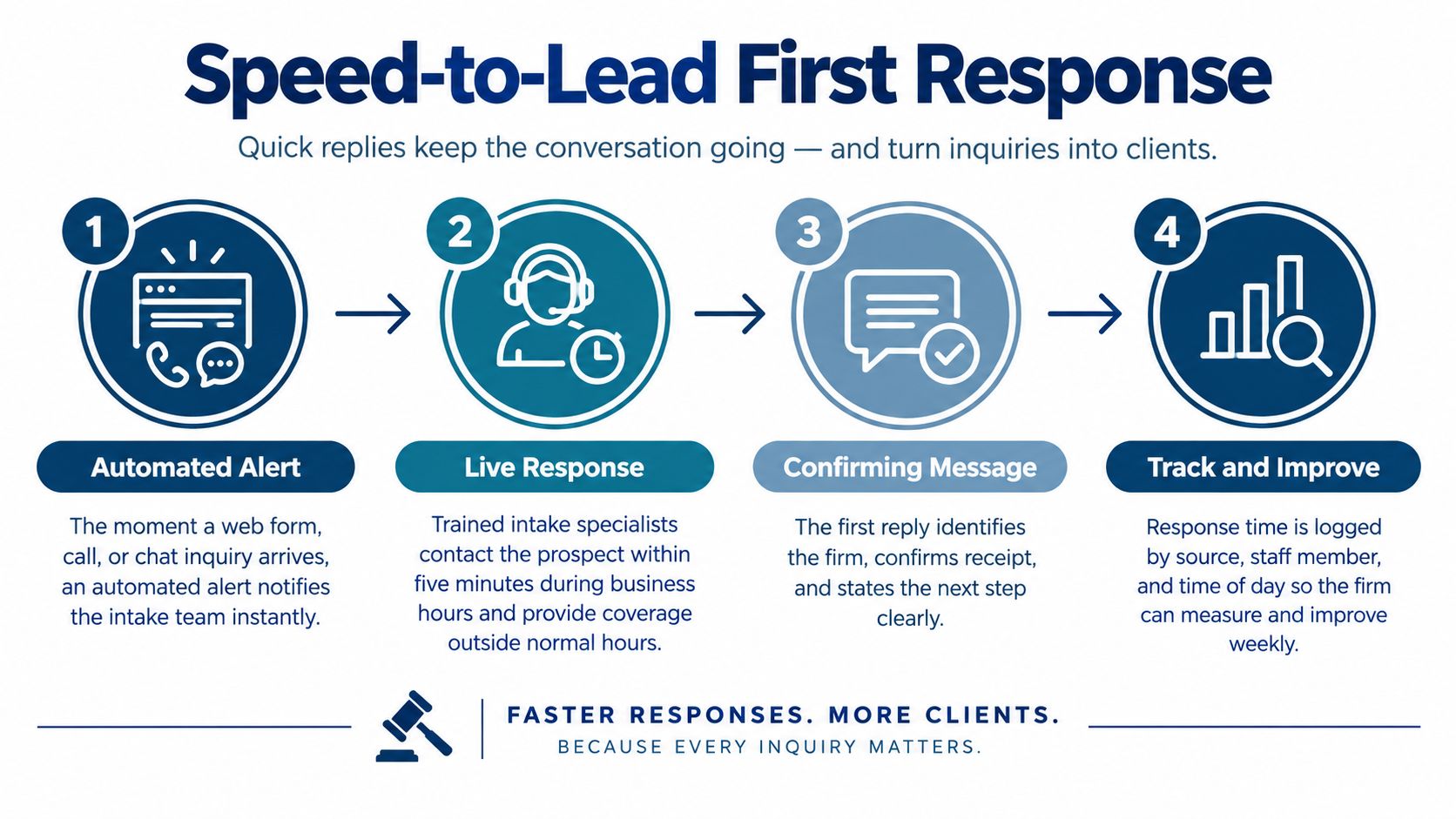
The first response determines whether the conversation starts at all. A web form that sits until the next business day is not waiting patiently. It is aging in public while another firm answers.
A Harvard Business Review study audited 2,241 U.S. companies by submitting test inquiries and tracking responses. Only 37% responded within one hour, while 23% never responded at all. Among companies that replied within 30 days, the average response time was 42 hours. The same research found that organizations attempting contact within one hour were nearly seven times more likely to qualify a lead than organizations that waited another hour. These findings are summarized in this overview of speed-to-lead research.
The practical standard should be immediate acknowledgment plus a human call, not an automated email sent into the administrative wilderness. A later Lead Response Management study reported that contacting a lead within five minutes, rather than waiting 30 minutes, made successful contact 100 times more likely and qualification 21 times more likely. The Lead Response Management report supports treating five minutes as an operating benchmark, not a motivational poster.
What to put in place
- Set a measurable standard: Record the inquiry time, first acknowledgment, first live attempt, and outcome. Review the numbers weekly.
- Use one intake queue: Route calls, forms, chat, email, and referral portals into a shared workflow. A prospect shouldn't depend on one employee remembering which inbox to check.
- Keep the first message concrete: State who you are, what you received, and what happens next. “We received your accident inquiry. A member of our intake team will call you now” is better than “Your request is important to us.”
For a deeper operating framework, see responding to inbound leads faster. Firms that need to respond to inbound leads faster should assign the responsibility to a person or team with coverage, not to an inbox with optimistic forwarding rules.
2. Structured Multi-Attempt Follow-Up Cadence
A prospect who misses one call may be in a meeting, dealing with a dead battery, or calming a child while trying to arrange legal help. Treating silence as rejection ends conversations that never had a fair chance to start.
A defined cadence gives intake staff a sequence to follow instead of leaving timing to memory. One workable pattern uses a call and text on day zero, a second call on day one, an email on day three explaining the next step, a check-in on day seven, and a close-the-loop message on day 14. Adjust the sequence for the practice area, consent requirements, and urgency of the matter. A documented cadence works best inside a structured lead follow-up system that assigns every attempt an owner and a due time.
Research summarized in the Lead Response Management best-practices report indicates that a few additional call attempts can increase contact rates by as much as 70%, while more than 30% of leads are never contacted at all. The familiar one-call-and-wait routine is less a process than a clerical superstition.
Every attempt needs a reason
“Just checking in” gives a prospect little reason to respond. Each contact should make the next action easier:
- Clarify the next step: Offer two consultation times instead of asking the prospect to call whenever convenient.
- Reference the matter: Mention the accident date, practice area, or question from the original inquiry.
- Use channels carefully: Combine calls, email, and text only after counsel reviews consent and jurisdiction-specific requirements.
- Close the loop: After the defined attempts, move the lead to nurture or closed status. An indefinitely open record is not persistence.
The team also needs a daily operating view. Build a full-day plan that reserves time for follow-up, rather than filling every hour with meetings and administrative debris. A CRM cannot continue a conversation nobody entered, assigned, or revisited.
3. Lead Recovery for Stalled and Aged Prospects
An old inquiry can sit in a CRM for months while the firm assumes someone else handled it. The prospect may still need counsel, may have chosen another firm and become dissatisfied, or may never have received a useful response after an intake employee changed roles. Recovery starts by finding out which situation applies.
Begin with a record review, not a mass message. Remove duplicates, verify phone numbers, identify people who retained other counsel, and separate clearly disqualified matters from prospects who were never properly evaluated. This prevents the awkward call in which a prospect has to repeat facts already stored in the file.
Use the original intake stage to decide the next move:
- Unreached inquiry: Refer to the original practice area and ask whether the person still wants help. Do not pretend the conversation already happened.
- Partially qualified prospect: Confirm the missing fact, such as jurisdiction, treatment status, or filing urgency, then offer a concrete consultation option.
- Deferred decision: Acknowledge the earlier hesitation and ask what changed, rather than sending another generic “Are you still interested?” message.
- Closed or transferred matter: Record the outcome and suppress further outreach where continued contact would be inappropriate.
A message with context has a job to do. “You contacted us about your accident and mentioned that treatment was ongoing. Has anything changed, and would you still like to discuss your options?” gives the prospect a clear reason to reply. Calls, email, and text can support the sequence, but counsel should review consent and jurisdiction-specific requirements before the team uses multiple channels.
Track recovered responses, qualified conversations, consultations, and signed retainers separately from new inquiries. Review the queue quarterly so it does not become another export, another meeting, and another promise to inspect the export later. An aged lead is not automatically worthless. An unexamined record is just an unpriced source of future work.
4. After-Hours Coverage and Missed-Call Callback Protocol
At 11:15 p.m., a caller may be dealing with an accident, an arrest, a denied claim, or a family emergency. A voicemail prompt followed by a hopeful promise for tomorrow leaves the first stage of intake unattended.
Clio's mystery-shopper research found that only 52% of law firms were reached by phone, while only 40% answered when contacted. Nearly 48% were unreachable by phone even when shoppers could leave messages. The same study found that only 33% responded to email inquiries, as reported in Clio's client intake legal trends research.
The operating standard is straightforward: capture the caller's facts, check basic fit, explain the next step, and assign responsibility for continued contact. Every missed call should produce a usable record and a named callback owner.
Test the experience like a prospect
Run the test yourself. Call the firm's number at 10 p.m. and on a Saturday, listen to the greeting, submit the web form, and send an email. The answers expose where after-hours conversations stall:
- Who answers: Is there a live intake specialist, a voicemail tree, or a vague promise to call back?
- What gets recorded: Does the record include the issue, jurisdiction, urgency, preferred contact method, and next action?
- Who owns the callback: Is a person assigned with a due time, or does the message become everybody's responsibility?
- What happens if nobody answers: Does the system retry, escalate, or quietly mark the prospect as unreachable?
Frontline, Attorney Assistant's after-hours intake coverage, is designed for nights, weekends, and overflow. A firm can use any suitable arrangement, provided the workflow records a next action and due time. Urgent matters also need a defined escalation path, so a serious call does not sit in a shared inbox until the morning meeting.
5. Appointment Setting with Confirmations and Reminders
The phrase “we'll reach out to schedule” creates a gap large enough for a prospect to disappear into. If the person qualifies during the first call, book the consultation before the call ends.
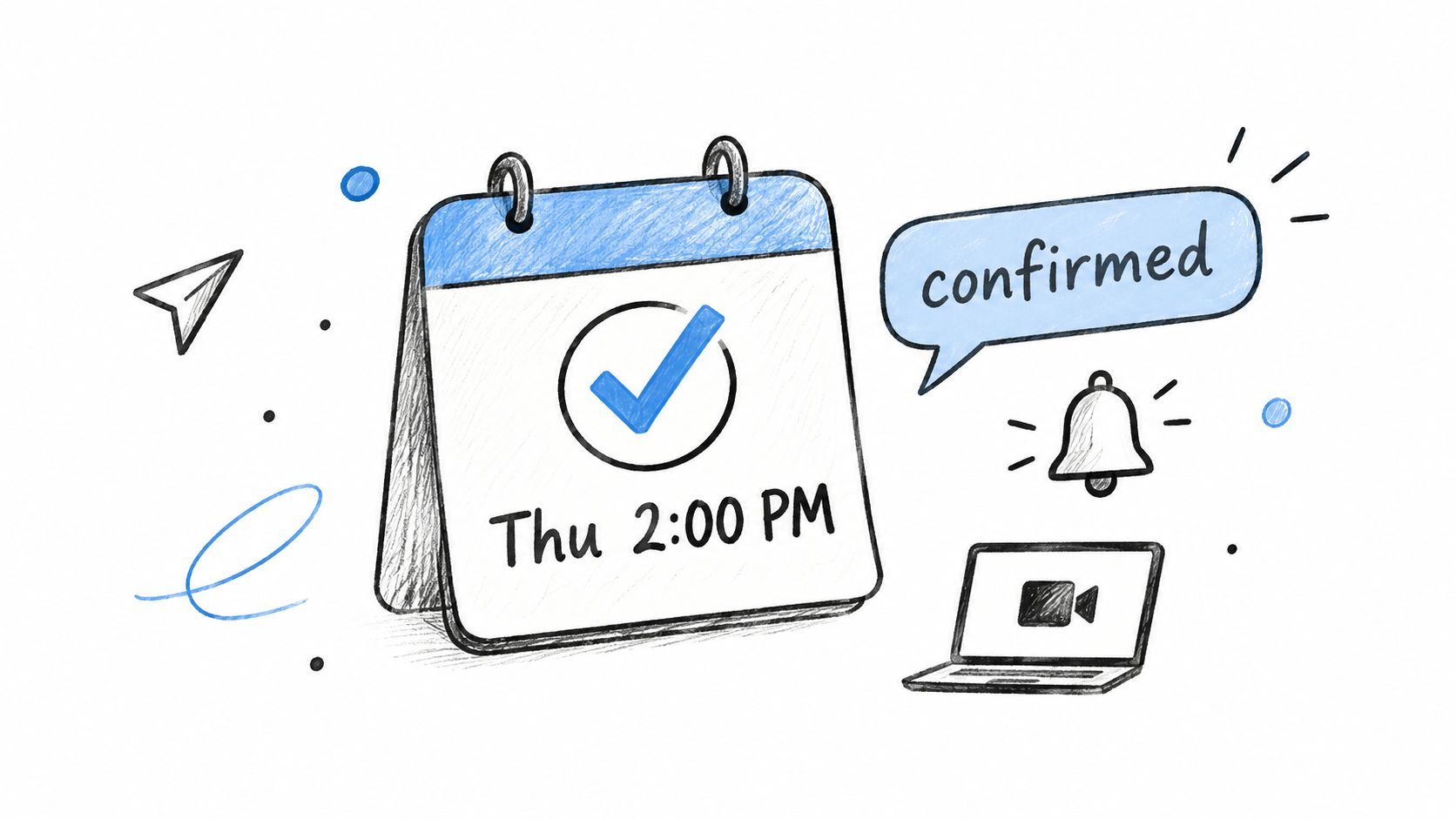
Appointment setting moves the conversation from interest to a specific event. The intake specialist should confirm the date, time, format, attorney or team member, location or video link, and anything the prospect should prepare. A confirmation that includes one relevant detail, such as “bring your accident report if you have one,” feels like a real appointment rather than a calendar placeholder.
Protect the appointment after booking
Consider a prospect who qualifies on Tuesday afternoon. The team books a Thursday consultation during the initial call, sends a confirmation by text and email, then sends reminders on Wednesday evening and Thursday morning. If the prospect misses the appointment, the rescheduling message goes out within the hour, while the original context is still available.
That process is simple, but simplicity is not the same as automatic success. Track the ratio of booked consultations to completed consultations. If many appointments are booked but few happen, the problem may be reminder timing, unclear instructions, poor qualification, or a consultation that feels too difficult to attend.
Use reminders to reduce friction, not to bombard the prospect. The right message answers the practical questions before the prospect has to ask them:
- Where is the meeting: Include the address, video link, or phone number.
- What should they bring: Request only documents that are genuinely useful.
- What happens next: Explain whether the meeting is with an attorney, intake professional, or case team member.
- What if they need to reschedule: Give one clear route instead of making them search the website.
6. Warm Transfers and Structured Attorney Handoffs
The first ring may go well, yet the conversation can stall at the attorney handoff. A prospect answers detailed intake questions, reaches the lawyer, and hears, “So, what happened?” Repeating the story makes the firm look disconnected, even when the intake work was solid.
A warm transfer keeps the thread intact. Before connecting the call, the intake specialist gives the attorney a concise summary covering the incident date, injuries, treatment status, insurer, and the prospect's preferred callback window. The attorney can then confirm the facts, address the legal issue, and decide the next step without restarting intake.
Set the handoff rules before calls begin. A live transfer may suit an urgent matter. A scheduled callback may be appropriate when the attorney is in court or handling an emergency. Both work when the prospect receives a clear owner, timing, and expectation.
Use a record that answers five practical questions:
- Matter basics: Practice area, incident date, location, and jurisdiction.
- Current condition: Injuries, treatment status, custody status, or another factor affecting urgency.
- Other parties: Insurer, opposing party, prior counsel, or referral source.
- Client preference: Best contact method and a realistic callback window.
- Next action: Live transfer, scheduled attorney call, document request, or disqualification review.

The operational rule is simple: if the attorney cannot accept the call, the prospect should know who will call, when that call will happen, and what information the firm already captured. A vague promise sends the conversation back into the queue.
Review a sample of handoffs each month with the attorneys receiving them. Ask which fields supported a decision, which were missing, and which questions created noise. Then remove low-value fields and tighten the summary. A short record that gets read beats a perfect template buried in the file.
7. Proactive Client Status Updates During the Case
The conversation doesn't end when the firm signs the client. In many practices, the most damaging silence begins after the retainer, when the client expects progress and the case enters a long period of records requests, negotiations, discovery, or waiting.
Clients often don't need dramatic news every time. They need to know where the matter stands, what the team is doing, and when they'll hear from someone again. Research from the Legal Services Consumer Panel found that clients wanted one clearly identified contact, regular updates even when nothing had changed, and explanations without legal jargon. Its legal services delivery research also describes how proactive communication can make delays more tolerable because it signals respect and control.
Make “no change” a real update
A case manager might send a monthly message with three parts: where the medical-record request stands, whether the insurer has responded, and what the client should do before the next update. That message gives the client a status, an owner, and a next action without predicting an outcome.
A reliable cadence is better than an ambitious promise that disappears once the team gets busy. The person responsible for the update should be named internally, and the communication should be recorded so the next staff member doesn't restart the conversation from zero.
The Model Rules of Professional Conduct include Rule 1.4 on communication, while specific obligations vary by jurisdiction. Firms should have counsel confirm their duties and review confidentiality safeguards for email and text communications. This is an operational framework, not legal advice.
A quiet case still needs an owner, a next-update date, and a plain-language explanation of what is happening.
Attorney Assistant's case-calling support is designed around proactive status updates and follow-up calls. Whether a firm handles that work internally or uses dedicated support, the standard is consistent communication that helps the client understand the matter without requiring an attorney to personally write every routine update.
8. Retainer-Stage Onboarding and Document Collection Check-Ins
A signed retainer can create false relief. The client may still need to sign authorizations, identify treating providers, provide insurance information, and send an accident report. Until those pieces arrive, the file remains only partly usable, and the client may wonder whether work has begun.
This is the first handoff after conversion, so assign it an owner before the signature is complete. Send a welcome message with a focused checklist and begin with the four items that allow the team to open the file properly:
- Signed authorization forms
- A list of treating providers
- Insurance information
- The accident report, if available
Use a short follow-up runway. Have the support team check in on day two, day five, and day ten, recording each response in the case system. If the required materials arrive early, move the file into case management. Requests that are less urgent can follow later. Asking for every possible document in the first message turns a straightforward onboarding step into a small document-production project, which is how clients start avoiding the inbox.
Give the client one named contact and one phone number for questions. A client unsure whether to call the attorney, intake specialist, case manager, or receptionist will often call nobody. One clear route preserves the conversation and gives staff a consistent place to record answers.
Measure the time from retainer to complete file. A growing interval points to a collection bottleneck that may deserve attention before attorney review. Staffline provides dedicated, full-time legal support professionals who can work inside the firm's systems on file opening, records, calendar and inbox management, CRM hygiene, and other case-support functions.
A named owner for the workflow matters more than another shared inbox.
8-Point Conversation Continuity Comparison
| Strategy | 🔄 Implementation Complexity | ⚡ Resource Requirements | ⭐ Expected Outcomes | 📊 Ideal Use Cases | 💡 Key Tip |
|---|---|---|---|---|---|
| Speed-to-Lead First Response | Low–Medium: automation + defined SLA | ⚡ Moderate: alerts, rapid staffing or vendor | ⭐ Very high: preserves prospect momentum and initial contact | 📊 Emergency/injury, high-intent inbound leads | 💡 Write and measure a 1–5 minute first-contact standard |
| Structured Multi-Attempt Follow‑Up Cadence | Medium: sequence design + CRM workflows | ⚡ Low–Medium: CRM, templates, compliance review | ⭐ High: increases contact rates across multiple attempts | 📊 Cold/no-answer leads; non-urgent inquiries | 💡 Limit attempts, vary message content, verify consent |
| Lead Recovery for Stalled & Aged Prospects | Medium: list cleanup, segmentation rules | ⚡ Low–Medium: periodic project work, minimal steady headcount | ⭐ Medium: recovers opportunities from existing spend | 📊 Backlog of unretained or neglected leads | 💡 Clean and validate lists; reference original inquiry |
| After‑Hours Coverage & Missed‑Call Callback Protocol | Medium–High: staffing, escalation, SLAs | ⚡ High: live coverage or vendor contracts, training | ⭐ High for time‑sensitive matters; neutral otherwise | 📊 Night/weekend emergencies, criminal/PI intake | 💡 Require a next action and due time for every after‑hours message |
| Appointment Setting with Confirmations & Reminders | Low–Medium: booking flow + reminders | ⚡ Low: calendar integration and automated messages | ⭐ High: reduces no‑shows and preserves scheduled consults | 📊 Consult-driven practices needing predictable calendars | 💡 Book during first call and include one specific item to bring |
| Warm Transfers & Structured Attorney Handoffs | Medium: intake summary standards + transfer rules | ⚡ Low–Medium: training, short standardized summaries | ⭐ High: preserves momentum and increases retention likelihood | 📊 High‑value matters needing attorney review immediately | 💡 Standardize a 5–7 field intake summary for quick scans |
| Proactive Client Status Updates During the Case | Medium: cadence, templates, owner assignment | ⚡ Low–Medium: case manager time, logging systems | ⭐ High: reduces complaints and improves client trust | 📊 Long‑running matters with multiple milestones | 💡 Promise only a cadence you can reliably keep |
| Retainer‑Stage Onboarding & Document Collection Check‑Ins | Medium: checklist, check‑in schedule, handoff rules | ⚡ Low–Medium: support staff and document tracking tools | ⭐ High: shortens time‑to‑file and reduces downstream delays | 📊 Newly retained clients needing records and authorizations | 💡 Limit initial checklist to 4–5 priority items and name a contact |
Where Your Firm Should Start Tomorrow Morning
Pick the stage where your firm loses the most prospects and audit it this month. For many firms, that will be first response. For others, it will be the gap between consultation and retainer, where a qualified prospect receives a pleasant conversation and then an impressive amount of silence.
Start with one stage, not the entire operating universe. Write the standard, assign one owner, and measure response time and contact attempts each week. If the issue is appointment attendance, measure booked consultations against completed consultations. If the issue is a stalled file, measure the time from retainer to complete documents. A metric should help someone decide what to do next, not merely decorate a dashboard.
Clio reports that 64% of prospective clients did not receive a response from the lawyers they contacted, a finding discussed in its research on faster law-firm responses. That is a process warning, not an invitation to send more generic messages. The firm needs a defined owner, a documented cadence, and a stopping rule when a prospect declines or becomes clearly disqualified.
If the audit shows that the gap is capacity rather than process, adding another instruction to an already overloaded team won't solve it. Attorney Assistant's Frontline team provides 24/7 live intake, qualification, follow-up, appointment setting, warm transfers, and retainer signing, including nights, weekends, English, and Español coverage. Staffline provides dedicated legal support professionals who work with one firm inside its systems, supporting intake, case management, records, file opening, CRM hygiene, and administrative work.
The broader staffing question deserves an honest answer. Firms sometimes consider LATAM legal virtual assistants or other staffing models, but the important issue is not the label. It is whether the person or team owns the workflow, understands legal support fundamentals, documents the work, and maintains continuity when the attorney is unavailable.
Frontline signs the case. Staffline carries it. Together, those roles address the operational reality behind many intake problems. More marketing cannot compensate for missed calls, incomplete follow-up, or a case file that nobody has time to open.
Audit one stalled stage tomorrow morning. Put a name beside it, define the next action, and review the result at the end of the week. Your attorneys went to law school to practice law. Ideally, they should occasionally get to do that.
Attorney Assistant provides Frontline 24/7 live intake and structured lead follow-up, plus Staffline dedicated legal support professionals for intake, records, case administration, CRM hygiene, and document work. If your conversations are stalling because coverage and capacity are missing, visit Attorney Assistant to review an operating model built for law firms.
Related Articles
Preferred Method of Contact for Law Firm Intake
Discover how to capture and use the preferred method of contact in legal intake to improve conversions, ensure compliance, and streamline law firm operations.

1st Dollar Coverage in Law Firm Retainers: A Practical Guide
Understand 1st dollar coverage in legal and insurance contexts. Learn how it shapes intake, retainer strategy, firm revenue, and risk.
24 7 Phone Answering Service: Law Firm Guide
Discover how a 24 7 phone answering service can help your law firm capture every lead and provide round-the-clock client support. Learn best practices here.