Fast Lead Response: Advantages Every Law Firm Needs

Responding to a new lead within five minutes can make your firm 21 times more likely to convert that prospect than waiting 30 minutes. That single operational fact explains why fast lead response is the highest-leverage variable most law firms are ignoring.
Here is what firms that fix their response time actually see:
- Higher contact rate: Prospects reached while still actively searching are far more likely to pick up.
- Conversion lift: Improving response time from two hours to 15 minutes can significantly increase conversion rates in urgent practice areas.
- Lower cost per signed case: Same marketing spend, more signed cases.
- Recovered revenue: Cases that were leaking out of your intake funnel start closing.
- Better client experience: Prospects who feel heard immediately are more likely to stay, refer, and review positively.
Benchmark: Leads contacted quickly convert at significantly higher rates than those reached after a longer delay. That gap is not a marketing problem. It is an intake problem.
This week: run a secret-shopper test: submit a form on your own website at 7 PM and see what happens. The result will tell you more about your intake than any marketing report.
Table of Contents
- Why fast lead response matters more for law firms than most industries
- What are the concrete advantages of faster lead response?
- What does “fast” actually mean by channel?
- What operational changes actually deliver fast response?
- How do you measure the ROI of faster intake?
- What intake failures are costing you cases right now?
- How Attorney Assistant helps your firm respond faster
- Key Takeaways
- The intake problem most firms refuse to see
- FAQ
Why fast lead response matters more for law firms than most industries
Law firm prospects are not casual browsers. Someone submitting a personal injury intake form at 9:47 PM is in a high-stress moment, often contacting multiple firms simultaneously. The first firm to respond with a real human voice wins the case. The rest get voicemail.
Many law firms take more than two hours to respond or do not respond at all, while a smaller share respond within five minutes. That means three out of four firms are handing cases to competitors every single day.
The financial math is brutal for contingency practices. A personal injury firm with a typical case value losing a couple of cases per month to slow intake could lose a substantial amount annually. No PPC campaign recovers that. The importance of responding to leads fast is not a soft metric. It is a revenue line.
What are the concrete advantages of faster lead response?
- Higher contact rate. Prospects who submitted a form five minutes ago are still at their phone. Those you call two hours later have moved on or signed elsewhere.
- Conversion lift of 2x–4x. Improving response time from two hours to 15 minutes can more than double conversion in urgent practice areas. Some intake data shows a 21x lift for sub-five-minute contact versus 30-plus minutes.
- Lower cost per signed case. If your firm spends $5,000 per month on leads and converts 10%, you are paying $500 per signed case. Move conversion to 20% and that drops to $250, with zero additional ad spend.
- Fewer no-shows. Prospects who feel engaged from the first contact show up to consultations. Cold leads ghost.
- Competitive differentiation. Most of your competitors are slow. Being fast is a real advantage, not a marketing claim.
- Better reviews and referrals. Clients who felt heard immediately tend to leave stronger reviews and refer more readily.
- Reduced after-hours lead dropout. After-hours protocols that respond within one minute reduce lead dropout by roughly 50%.
Pro Tip: When a prospect calls or submits a form, your goal is not to give legal advice. It is to acknowledge, schedule, and collect minimal qualifying information. Capture name, contact number, and the nature of the matter. That is enough to prioritize the lead and protect your firm from UPL exposure.
What does “fast” actually mean by channel?

Response windows differ by channel and practice area. Here is a practical baseline:
| Channel | Target response window | First action |
|---|---|---|
| Inbound phone call | Answer live or call back within 5 minutes | Live conversation or voicemail with callback time |
| Web form (urgent practice) | Automated acknowledgment within 60 seconds; live call within 5–15 minutes | SMS + email confirmation, then human callback |
| Web form (family/employment) | Acknowledgment within 60 seconds; live contact within 30–60 minutes | Email confirmation, scheduled callback |
| Live chat | Respond within 30 seconds | Qualify and route to intake specialist |
| SMS inquiry | Reply within 2 minutes | Confirm receipt, offer callback or scheduling link |
For criminal defense and DUI, the best-practice benchmark is a live call within five to ten minutes during business hours and an automated response within two to three minutes outside of business hours.
Sample SMS acknowledgment: “Hi [Name], we received your message and a member of our team will call you within the next 10 minutes. If you need to reach us sooner, call [number].”
Sample automated email: “Thank you for contacting [Firm Name]. We have received your inquiry and will follow up by phone within [timeframe]. In the meantime, you can reach us at [number].”
Pro Tip: In the first 30–90 seconds of a live call, collect name, callback number, and a one-sentence description of the matter. Do not give legal advice. Your goal is to qualify and schedule, then hand off to an attorney.
What operational changes actually deliver fast response?
Speed-to-lead is a systems problem. Motivated staff alone will not solve it. The firms hitting five-minute benchmarks have built infrastructure, not just good intentions.
The right model is automated acknowledgment plus trained human follow-up. Attorneys should not be doing initial triage. That is a costly misuse of billable time and a common reason intake slows down.
Concrete operational moves:
- 24/7 coverage plan. A substantial share of prospects contact firms outside business hours. Without after-hours coverage, those leads are gone. Use an AI-plus-human hybrid or an outsourced intake team to cover nights and weekends.
- Dedicated intake specialist. A trained intake specialist handles first contact, qualification, and scheduling. Attorneys stay focused on billable work.
- Automated acknowledgments. Set up immediate SMS and email confirmations the moment a form is submitted. This buys time and signals responsiveness.
- Callback SLAs. Define and enforce a maximum callback window (five minutes for urgent matters). Assign ownership so no lead sits in a queue with no one responsible.
- CRM hygiene. Every lead gets a timestamp. Every contact attempt is logged. No lead disappears into a spreadsheet.
- Escalation rules. If a lead has not been contacted within the SLA window, an alert fires to a supervisor.
For law firm follow-up process design, the sequence is: automated acknowledgment within 60 seconds, live callback within five minutes, and a follow-up sequence over 24–48 hours if the first call goes unanswered.
Pro Tip: Design automation to acknowledge and schedule only. Automation that gives legal guidance or solicits consent for messaging without proper opt-in creates UPL and TCPA exposure. Keep it simple: confirm receipt, set expectations, offer a callback.
How do you measure the ROI of faster intake?
Track these five KPIs:
| KPI | What it tells you |
|---|---|
| Average response time | Baseline for improvement and SLA compliance |
| Contact rate | % of leads you actually reach |
| Consult show rate | % of scheduled consults that attend |
| Conversion to signed case | % of contacts that become clients |
| Cost per signed case | Total marketing spend divided by signed cases |
Example calculation: A firm spends $8,000/month on leads and signs 10 cases at a 10% conversion rate. Cost per signed case: $800. After improving response time, conversion moves to 20%. Now 20 cases signed. Cost per signed case: $400. Revenue recovered without spending a dollar more on marketing.
Improving intake delivers ROI almost immediately, unlike SEO, which builds over months. For most personal injury and criminal defense firms, recovering even one additional signed case per month from faster intake more than offsets the cost of any intake infrastructure investment.
What intake failures are costing you cases right now?
Most slow intake comes from three root causes: no one owns the lead, tooling is missing, and after-hours coverage does not exist.
Diagnostic checklist:
- Submit a form on your own website after 6 PM. Time the response.
- Call your own firm’s main number on a Saturday. What happens?
- Pull your CRM. How many leads have no contact attempt logged?
- Check your missed call rate for the last 30 days.
Quick fixes, in priority order:
- Set up automated acknowledgments today. This is a one-hour project that immediately reduces lead dropout.
- Assign a named owner to every incoming lead. No owner means no accountability.
- Outsource after-hours coverage. Even a basic answering service beats silence.
- Review response-time data weekly. What gets measured gets managed.
For a deeper look at common intake failures and how to fix them, the pattern is consistent: firms that audit first, then fix, see faster gains than those that buy tools without diagnosing the actual gap.
How Attorney Assistant helps your firm respond faster
Attorney Assistant provides the operational infrastructure that produces measurable intake gains without adding headcount or pulling attorneys into triage.
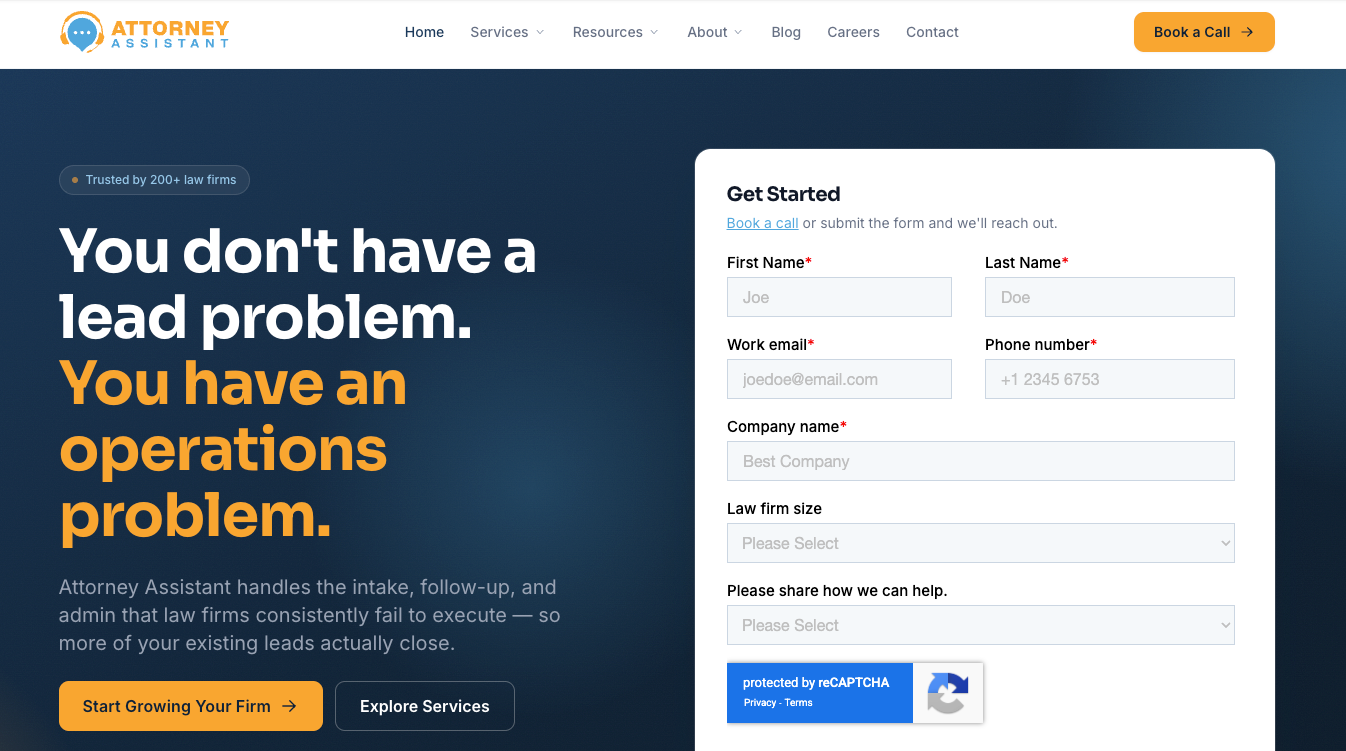
The core offering covers 24/7 intake coverage, trained intake specialists, automated acknowledgments, CRM hygiene, and conversion reporting. Firms that implement this model stop losing cases to slow follow-up and start converting the leads they are already paying for. The lead follow-up service is built specifically for small and mid-sized law firms that need reliable intake without building an internal team from scratch.
If you want to see exactly where your intake is leaking, Attorney Assistant offers a free secret-shopper audit. Book a short call and get a clear picture of your current response-time performance and what it is costing you.
Key Takeaways
Firms that fix intake speed convert more of the leads they already pay for, without increasing marketing spend.
| Point | Details |
|---|---|
| Five-minute benchmark | Leads contacted within five minutes are 21 times more likely to convert than those reached after 30 minutes. |
| Conversion lift | Improving response time from two hours to fifteen minutes can move conversion rates from around 10% to 25% or higher in urgent practice areas. |
| After-hours coverage | After-hours protocols that respond within one minute reduce lead dropout by roughly 50%. |
| Measure five KPIs | Track response time, contact rate, consult show rate, conversion to signed case, and cost per signed case. |
| Attorney Assistant | Provides 24/7 intake coverage and a free secret-shopper audit to identify and fix response-time gaps. |
The intake problem most firms refuse to see
Most managing partners I talk to are convinced they have a marketing problem. They want more leads. More ad spend. A better agency. What they actually have is a bucket with holes in it.
The data is consistent: 39% of firms take more than two hours to respond or do not respond at all. That is not a marketing failure. That is an operational failure. And it is fixable without a single additional dollar in ad spend.
The firms that scale past $2M do not just generate more leads. They build systems that capture a higher percentage of the leads they already have. Speed-to-lead is where that work starts. The firms that treat intake as an afterthought will keep paying for leads they cannot convert.
If you want to know where your firm stands, book a call. The audit is free and the answer is usually uncomfortable in the best possible way.
FAQ
How fast should a law firm respond to a new lead?
For urgent practice areas like personal injury and criminal defense, the target is a live call within five minutes during business hours and an automated acknowledgment within 60 seconds for web form submissions. After-hours, an automated response within two to three minutes is the minimum standard.
What is the biggest advantage of fast lead response for law firms?
The primary advantage is conversion lift. Improving response time from two hours to 15 minutes can more than double conversion rates in urgent practice areas, which directly lowers cost per signed case without increasing marketing spend.
How does Attorney Assistant help with speed-to-lead?
Attorney Assistant provides 24/7 intake coverage, trained intake specialists, automated acknowledgments, and CRM hygiene so firms hit five-minute response benchmarks consistently. A free secret-shopper audit identifies exactly where the current intake process is losing cases.
What KPIs should a law firm track to measure intake performance?
Track average response time, contact rate, consult show rate, conversion to signed case, and cost per signed case. These five metrics give a complete picture of intake health and make ROI from faster response visible.
Can automation help with fast lead response without creating legal compliance issues?
Yes, when designed correctly. Automation should acknowledge receipt and offer scheduling only. It should not give legal guidance or solicit messaging consent without proper opt-in, which avoids both UPL and TCPA exposure while still delivering immediate responsiveness.
This article is general operational information, not legal or professional advice. Confirm compliance requirements with a qualified attorney for your specific jurisdiction and practice area.
Recommended
Related Articles

Call Flow Customer Service for Law Firms: A Practical Guide
Design a call flow customer service system for your law firm that captures leads, qualifies matters, and signs cases. Practical guide

Fear of Talking on Phone: 7 Practical Confidence Tips
Overcome fear of talking on phone with practical scripts, role-play, exposure exercises, and intake tools built for legal teams.

Appointment Setting Online: A Law Firm Guide
Master appointment setting online for law firms with proven strategies that turn leads into booked consultations and grow your practice.