Law Firm Structures: Choosing the Right Entity and Governance

Solo practitioners typically do best as a PLLC or single-member LLC. Small and midsize firms generally need an LLP, LLC, or PC with a real operating agreement. Larger firms tend to run as LLPs or PCs with formal governance, an executive committee, and tiered partnership. That’s the practical shortlist. The right pick depends on three things: how much personal liability exposure you can tolerate, how you want profits taxed, and how fast you need decisions made as you grow.
Before you file anything, weigh these drivers:
- Liability and tax exposure. Entity choice determines who’s on the hook for business debts, and how much of your income gets taxed twice.
- Operational capacity. Your governance model decides who approves spending, who owns the intake process, and how fast your firm reacts when a new lead calls.
One more thing before you pick a structure: check your state bar rules, keep malpractice insurance regardless of entity, and fix your intake process before you scale. A better legal structure won’t save a firm that loses leads at the phone.
Key Takeaways
The right law firm structure balances liability protection, tax treatment, and governance speed, but no entity fixes a broken intake process.
| Point | Details |
|---|---|
| Match entity to firm size | Solo firms fit sole prop/PLLC; small-to-mid firms fit LLP or LLC; larger firms fit LLP or PC with formal governance. |
| No entity blocks malpractice liability | Every structure still requires malpractice insurance, since personal liability for your own conduct can’t be shielded. |
| S-election has real limits | Under 100 shareholders, U.S. individuals only, and a single stock class are required to keep S-corp tax treatment. |
| Governance speed matters as much as tax | Full-partnership voting slows decisions; a managing partner or small committee model moves faster as you scale. |
| Fix intake before you restructure | Attorney Assistant helps firms enforce fast lead response and follow-up so a new entity doesn’t sit on top of the same revenue leak. |
This article is general information, not a substitute for advice from a qualified lawyer. Consult a qualified legal professional about your own circumstances before acting on anything here.
Table of Contents
- Why Law Firm Structures Actually Change Your Outcomes
- What Are the Main Law Firm Entity Types?
- How Should Partners and Roles Be Structured?
- What Are the Real Tax Trade-offs Between Structures?
- Does Your Entity Structure Protect You From Malpractice?
- How Do You Decide Which Structure Fits Your Firm?
- What’s the Formation Checklist for a New Structure?
- How Does Structure Affect Your Intake and Follow-up?
- What Happens to Ownership When a Partner Leaves?
- Can Your Firm’s Structure Affect Financing and Capital?
- Sources
- FAQ
Why Law Firm Structures Actually Change Your Outcomes
Your entity choice isn’t paperwork. It determines who’s personally on the hook when a vendor doesn’t get paid, how your profits get taxed, and how fast your firm can act on a new client call.
A general partnership makes every partner liable for the firm’s debts, even ones another partner signed off on. An LLC or PC generally limits that exposure to business obligations, not malpractice. Tax treatment shifts with entity too: pass-through structures tax profits once, on your personal return; C-corp treatment can tax them twice.
Governance matters just as much. A single managing partner can approve a new hire in a day. A five-partner voting structure can take three weeks to approve the same thing, including approving a new intake process.
Pro Tip: Don’t chase growth or a new entity structure until you’ve fixed speed-to-lead. A firm converting to an LLP with a broken follow-up process just built a nicer house on a cracked foundation.
What Are the Main Law Firm Entity Types?
Every practical entity choice for a law practice falls into six buckets, and each one trades off liability, tax treatment, and paperwork differently. Here’s what each one actually does.
Sole proprietorship is the default if you hang a shingle and file nothing else. There’s no legal separation between you and the business: every dollar of business debt and every judgment against the firm reaches your personal assets. Taxes pass straight through to your personal return, which keeps bookkeeping simple, but the liability picture is the worst of any option on this list. It fits a solo attorney testing a niche practice with minimal overhead and no employees.
General partnership is two or more lawyers practicing together without a formal entity filing. It’s easy to form (some states don’t even require a filing) but every partner carries unlimited personal liability for the firm’s debts and, in many states, for the negligence of other partners committed within the scope of the partnership. Profits pass through to each partner’s return. This structure made sense decades ago; today it rarely does, given how cheap an LLP filing is by comparison.
Limited partnership (LP) separates general partners, who run the firm and carry full liability, from limited partners, who invest but don’t manage and enjoy liability limited to their investment. Law firms rarely use this structure for the core practice since bar rules in most states require active lawyers to have management rights, which conflicts with the limited partner’s passive role. It shows up more often in ancillary business ventures a firm runs alongside the practice.
Limited liability partnership (LLP) is the workhorse for multi-partner firms. Each partner is shielded from the malpractice and misconduct of other partners, though not from their own. Business debts are generally partnership obligations rather than personal ones. Taxation stays pass-through. Most states require an LLP designation in the firm name and an annual filing to keep the status active, according to state-bar formation guidance. This is the default choice for firms with three or more equity partners.
LLC or PLLC works for smaller firms wanting liability separation without the corporate formalities of a PC. Many states require law firms specifically to form as a PLLC (professional LLC) rather than a standard LLC, and the rules on availability vary widely by jurisdiction — see this Professional Limited Liability Company guide for Non-U.S. for details. As one detailed breakdown of state rules notes, an LLC’s liability protection for law firms is narrower than in other industries. It shields business debt but does nothing for a lawyer’s own malpractice. Taxation is pass-through by default, with an S-election option available. This fits solo practitioners and small partnerships wanting simple governance.
Professional corporation (PC) brings the most liability separation but also the most formality: a board, officers, bylaws, and recorded meeting minutes. A PC defaults to C-corporation double taxation unless it elects S-corp status, which caps ownership at 100 shareholders, all of whom must be individuals (in most cases, licensed professionals) and requires a single class of stock. The American Bar Association’s guide to entity choice confirms that PCs still don’t eliminate professional malpractice exposure. This structure suits larger firms with formal ownership tiers and a need for stock-based succession planning.
| Entity | Liability protection | Tax treatment | Ownership restrictions | Formality burden | Best fit by size |
|---|---|---|---|---|---|
| Sole proprietorship | None (personal assets exposed) | Pass-through | Single owner only | Minimal | Solo, early stage |
| General partnership | Unlimited, joint and several | Pass-through | Licensed attorneys, state-dependent | Low | Rarely recommended today |
| Limited partnership | Full for GPs, limited for LPs | Pass-through | Active lawyers can’t be passive LPs | Moderate | Ancillary ventures, not core practice |
| LLP | Shields partners from co-partner malpractice | Pass-through | Licensed attorneys, varies by state | Moderate (annual filing) | 3+ partner firms |
| LLC / PLLC | Business debt only, not personal malpractice | Pass-through (S-election optional) | Often licensed-professional-only | Moderate | Solo to mid-size |
| PC (S or C) | Business debt only, not personal malpractice | C-corp double tax unless S-elected | S-election caps at 100 shareholders, one stock class | High (board, bylaws, minutes) | Mid-size to large |
A quick gut check on the tax side: pass-through entities (sole prop, partnerships, LLPs, most LLCs, and S-elected PCs) tax profits once, on the owners’ personal returns. A C-corp PC taxes profits at the corporate level, then again when distributed as dividends, unless the S-election is in place.
Naming and formation rules genuinely trip up new firms. Many states require the professional designator, PC, PLLC, or LLP, appear in the firm’s legal name, and some restrict who can hold an ownership interest to licensed attorneys only. If your firm operates in more than one state, you’ll likely need to foreign qualify in each additional jurisdiction, which means a second filing and, often, a second registered agent.
How Should Partners and Roles Be Structured?
Three governance models cover most firms. A single managing partner model puts one person in charge of hiring, vendor decisions, and intake protocol ownership. Decisions move fast, but the firm’s capacity is bottlenecked by one person’s bandwidth.
A small executive or management committee, typically three to five partners, splits authority across practice areas or functions. It scales better than a solo decision-maker but requires clear escalation paths, or committee meetings become the new bottleneck.
Full-partnership voting gives every equity partner a say on major decisions. It works for firms under ten partners with aligned priorities. Past that, it tends to slow everything down, including decisions as basic as approving a new intake coordinator.
Layered onto governance is partner structure itself. Most firms with formal tiers, described in detail by U.S. News’s overview of law firm hierarchies, run something like this:
| Role | Typical authority | Compensation basis |
|---|---|---|
| Managing partner / executive committee | Firm-wide strategy, budget, hiring | Equity share plus management stipend |
| Equity partner | Practice group decisions, client relationships | Share of firm profits |
| Nonequity partner | Client management, limited firm decisions | Salary plus bonus |
| Of counsel | Advisory, specialized matters | Salary or fee-sharing |
| Associate | Casework under partner supervision | Salary |
A two-tier partnership, equity and nonequity, lets a firm bring in strong performers without diluting ownership immediately. “Of counsel” arrangements bring in specialized expertise or semi-retired partners without full governance rights. Neither model is right or wrong; both need to match your firm’s actual decision-making needs, not just tradition.
What Are the Real Tax Trade-offs Between Structures?
Pass-through taxation means the firm itself pays no federal income tax. Profits flow to owners’ personal returns and get taxed once, at individual rates. This is the default for sole proprietorships, partnerships, LLPs, and most LLCs.
A C-corporation, the default for a PC that hasn’t elected S status, pays corporate tax on its profits, and then shareholders pay tax again on dividends. That’s double taxation, and it’s the main reason most law firm PCs elect S-corp status instead.
The S-election avoids that double hit, but it comes with strings: shareholders must be U.S. individuals (with narrow trust exceptions), the count can’t exceed 100, and the corporation can only issue one class of stock. It also changes how owners get paid. Owners must take a “reasonable” salary subject to payroll tax, with remaining profit distributed and generally exempt from self-employment tax, a distinction that shapes real take-home pay for equity partners.
Talk to a tax advisor, not just a formation attorney, before you commit. That conversation matters most when:
- You’re planning to sell the practice or bring on outside investors within the next few years.
- The firm is retaining significant earnings rather than distributing them annually.
- You practice across multiple states with different tax treatment for pass-through entities.
Does Your Entity Structure Protect You From Malpractice?
No entity eliminates a lawyer’s personal liability for their own malpractice. That’s the single most misunderstood point in this whole topic. A PC, LLC, or LLP shields you from the firm’s general business debts and, in most states, from a co-partner’s negligence. It does nothing to shield you from a claim arising out of your own conduct with your own client, as the ABA’s guide to entity choice makes clear.
Where an LLP genuinely helps is co-partner exposure. If your partner mishandles a case and gets sued, an LLP structure generally keeps that liability off your personal balance sheet, though the exact protection is state-dependent and worth confirming with your state bar before you rely on it.
Practical risk controls that matter regardless of entity:
- Carry adequate malpractice insurance, sized to your practice area and caseload.
- Run conflict checks on every new matter before intake, not after.
- Use engagement letters on every case, no exceptions.
- Keep trust accounts separate and reconciled monthly.
Pro Tip: Keep your corporate formalities current, separate bank accounts, documented meeting minutes, a real operating agreement, because sloppy formalities are exactly what lets a court “pierce the veil” and hold owners personally liable anyway.
How Do You Decide Which Structure Fits Your Firm?
Work through this in order, not all at once:
- Define your ownership and exit goals. Are you building something to sell in ten years, or a lifestyle practice you’ll wind down solo?
- Map your liability appetite. A solo practitioner with minimal overhead tolerates more personal exposure than a firm carrying six-figure vendor contracts.
- Model the tax and cash flow impact. Run the numbers on pass-through versus S-election with an actual accountant, not a rule of thumb.
- Evaluate your management needs. Can you live with corporate formalities (board minutes, bylaws) or do you need something leaner?
- Test transferability and sale mechanics. Stock-based PCs sell more cleanly than partnership interests in most cases.
- Confirm your state bar rules. Ownership restrictions, naming rules, and permitted entity types vary enough that a structure legal in one state can be noncompliant in another.
A few questions worth asking before you file anything: Do you need outside capital or financing, and does your entity choice affect access to it? Will ownership change hands in the next five years, through a buy-in, buyout, or merger? Do you practice in more than one state, and will that trigger foreign qualification?
Operations should weigh into this decision more than most guides admit. A firm with fast, documented intake procedures and clear delegated authority can run a leaner governance model than a firm where every decision still routes through one partner’s inbox. If your operations aren’t documented, fix that before you pick a structure to build around them.
Most firms convert as they grow: solo practitioners move from sole proprietorship to PLLC once they hire their first employee. Partnerships convert to LLP or PC once they cross three or four equity partners and the liability math on a general partnership stops making sense.
What’s the Formation Checklist for a New Structure?
Once you’ve picked an entity, the actual filing work runs in a predictable order:
- Pick your entity type and confirm the name is available, including any required professional designator (PC, PLLC, LLP).
- Check your state bar’s rules on ownership, management, and permitted entity types for law practices.
- File your formation documents with the secretary of state.
- Obtain an EIN from the IRS.
- Open a separate business bank account, never commingle firm and personal funds.
- Draft an operating agreement or partnership agreement that spells out ownership, profit splits, and exit terms.
- Buy malpractice insurance sized to your practice.
- Register for state and local tax obligations.
- File for foreign qualification in any additional state where you practice.
Most states require an annual report and, for PCs, recorded meeting minutes to keep the entity in good standing. Skipping these is one of the most common ways firms accidentally lose the liability protection they filed for in the first place. If you’re building the full formation checklist from scratch, budget several weeks for filing and licensing before you open your doors, longer if you need foreign qualification in a second state.
How Does Structure Affect Your Intake and Follow-up?
Governance model and intake speed are more connected than most firm owners realize. A partner-led approval model, where every process change needs sign-off from three people, is exactly the kind of friction that turns a five-minute lead-response goal into a two-day delay. That delay is where leads disappear.
Growth tends to expose this fast. Firms that hit roughly $1M to $2M in revenue usually find partners buried in approvals and firefighting instead of billing. The fix isn’t a new entity structure. It’s operational sequencing.
Here’s the order that actually works, drawn from a practical framework for law firm growth strategies: audit your current intake process first. Fix response time so leads get a callback in minutes, not hours. Document the follow-up cadence so it doesn’t live in one paralegal’s head. Only then expand marketing spend or bring on lateral hires.
As you scale, the roles you need tend to show up in this order:
- Intake coordinator — owns the first response to every lead.
- Director of operations or practice manager — owns SOPs, vendor relationships, and CRM hygiene across the firm.
- Practice group leads — own case quality and staffing within a specific area of law.
Pro Tip: Enforce a hard intake SLA, five minutes or less to first response, and keep your CRM clean regardless of what entity or governance model you run. A perfect legal structure can’t fix a lead sitting unanswered in a shared inbox.
What Happens to Ownership When a Partner Leaves?
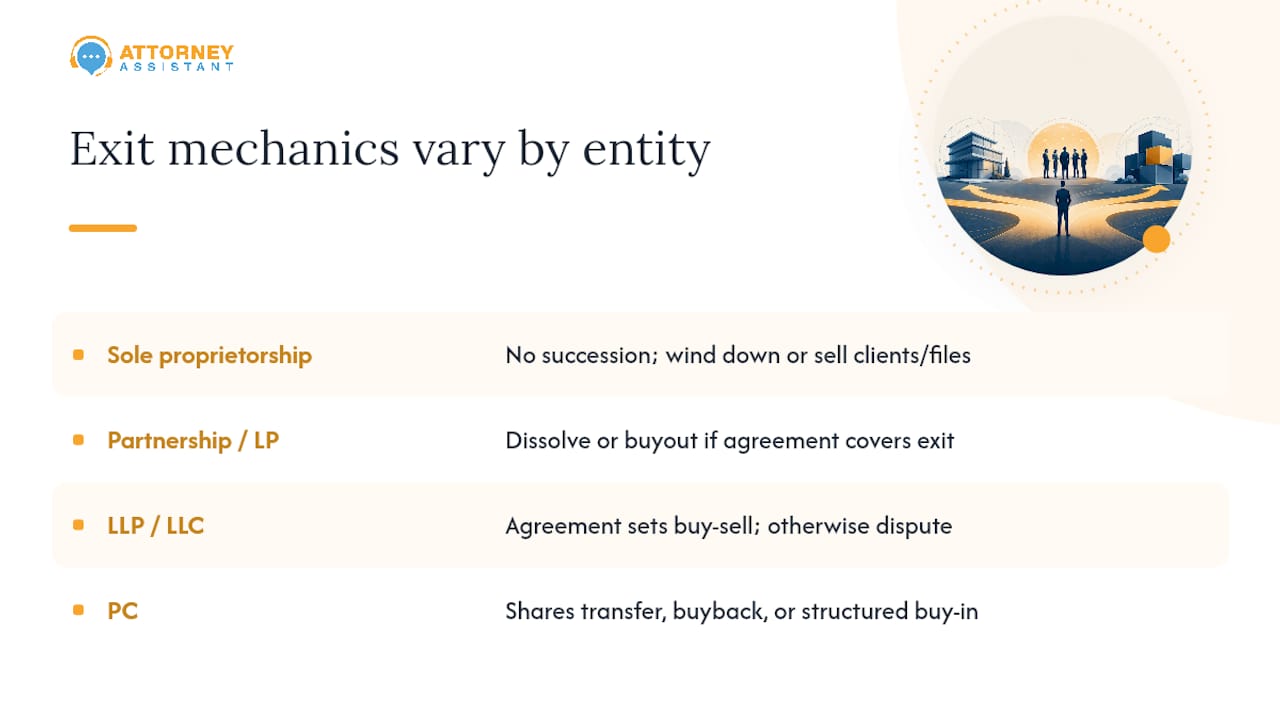
Every entity type needs an exit plan, and the plan looks different depending on the structure. In a sole proprietorship, there’s no real succession mechanism: the practice typically winds down or sells its client list and files, since the business and the owner are legally the same thing.
General partnerships and LPs usually dissolve or trigger a buyout under the partnership agreement when a partner leaves, assuming that agreement actually addresses it. Too many partnerships form on a handshake and only discover the gap when someone wants out.
LLPs and LLCs handle this more cleanly if the operating agreement spells out a buy-sell mechanism, typically a formula for valuing the departing partner’s stake and a payout timeline. Without that language in writing, a partner’s exit can turn into a drawn-out negotiation or, worse, litigation.
PCs offer the cleanest mechanics for succession because ownership is represented by shares. Shares can transfer to a new partner, get bought back by the corporation, or pass through a structured buy-in program for associates working toward partnership. That’s part of why larger firms planning for multi-generational succession often lean toward a PC.
Whatever structure you choose, the exit terms belong in your founding documents from day one, not drafted under pressure when a partner announces they’re leaving. Revisit the agreement every few years as ownership and firm value change. A structure that fit two founding partners rarely still fits after you’ve added six more.
Can Your Firm’s Structure Affect Financing and Capital?
Entity choice shapes how a firm raises money more than most owners expect going in. A sole proprietorship or general partnership typically relies on personal credit, since lenders see no separation between the owner and the business. That limits the loan size and the terms.
LLCs, LLPs, and PCs generally build a credit history under the business’s own EIN, which opens the door to firm-specific lines of credit and equipment financing once the entity has a track record. Banks and lenders also tend to feel more comfortable extending credit to an entity with documented governance, an operating agreement, meeting minutes, a clear ownership structure, than to a loosely organized partnership.
Most states restrict non-lawyer ownership of law firms, which rules out traditional equity investment as a financing option for the core practice. This is a meaningful constraint compared to other professional services businesses, and it’s one reason firms lean on lines of credit, partner capital contributions, or revenue-based financing instead of outside equity.
A PC’s stock structure can matter here too. It makes partner buy-ins more straightforward to finance, since incoming partners are purchasing defined shares rather than negotiating an undefined partnership stake. If your growth plans include bringing on partners who need to finance their buy-in, that’s worth weighing when you pick between an LLP and a PC.
A Note on Structure From the Operations Side
Picking the right entity and governance model gives a firm clarity: who decides what, who’s exposed to what risk, and how profit gets split. What it doesn’t fix is what happens after a new client calls.
I’ve seen firms with textbook-perfect PC structures still lose a quarter of their leads to slow callbacks. The entity on paper and the operation on the ground are two different problems, and only one of them shows up in your formation documents.
Once your structure is settled, Attorney Assistant helps firms build the intake and follow-up systems that keep the leads you’re already generating from walking out the door.
Fixed Your Structure? Now Fix What’s Leaking Revenue
A clean entity and a solid partnership agreement won’t stop a lead from going cold because nobody called back within the hour. That’s a separate problem, and it’s the one Attorney Assistant solves. We handle intake, follow-up, and the administrative workflow around it, so calls get answered, leads get worked, and retainers get signed while the client’s still on the phone, not three days later.

This isn’t staffing. It’s fixing the specific point where firms lose cases they already paid to generate: missed calls, slow follow-up, and no coverage outside business hours. If you’ve just restructured, or you’re scaling past the point where partners can personally track every lead, that’s exactly when intake gaps start costing real money. If you’d rather see how it works before committing to anything, join a session on our virtual webinar and walk through what co-managed intake actually looks like day to day.
Sources
- American Bar Association — Law firm choice of entity
- Are law firms LLCs? State rules and structures - LegalClarity
- DC Bar presentation — Business entity formation (Batzel, Oct 2017)
- Understanding law firm MSOs — Hunton Andrews Kurth
FAQ
What are the different positions in a law firm?
Most firms run a hierarchy from managing partner or executive committee down through equity partners, nonequity partners, of counsel, associates, and support staff, with each tier carrying different decision-making authority and compensation structure.
Do lawyers make $500,000 a year?
Some equity partners at large or highly profitable firms earn that much or more, but it’s far from typical; most attorneys, including many partners at small and midsize firms, earn well below that figure.
What is the 80/20 rule for lawyers?
It generally refers to the idea that roughly 80% of a firm’s revenue comes from about 20% of its clients or matters, which is why intake quality and follow-up on high-value leads matter more than raw lead volume.
What are the “Big Five” in law?
There’s no single agreed-upon “Big Five” of law firms; the term is used inconsistently across markets and usually refers informally to a handful of the largest, most prestigious firms in a given region or specialty rather than a fixed list.
Can a non-lawyer own part of a law firm?
In most states, no. Bar rules typically restrict ownership and management of a law practice to licensed attorneys, which is why traditional outside equity financing isn’t an option for most firms regardless of entity type.
Does forming an LLC protect me from malpractice claims?
No. An LLC or PLLC limits your exposure to general business debts, not to claims arising from your own professional conduct, which is why malpractice insurance remains necessary no matter which entity you choose.
Recommended
Related Articles

Fear of Talking on Phone: 7 Practical Confidence Tips
Overcome fear of talking on phone with practical scripts, role-play, exposure exercises, and intake tools built for legal teams.

Appointment Setting Online: A Law Firm Guide
Master appointment setting online for law firms with proven strategies that turn leads into booked consultations and grow your practice.

Medical Records Request: A Practical Guide for Law Firms
Run a clean medical records request with HIPAA-compliant steps, sample language, timelines, fees, and follow-up tactics built for law firm operations.