Litigation Support Ediscovery: How Cases Get Organized
The production deadline is approaching, the shared drive contains several folders called Final, and someone has just asked whether the former employee's phone was preserved. Nobody knows. The firm has discovery software. What it doesn't have is a reliable answer.
Litigation support ediscovery is the operational work of finding, preserving, collecting, processing, reviewing, and producing electronically stored information for litigation. Attorneys set the legal boundaries. Support staff, IT personnel, and vendors turn those boundaries into completed tasks with records someone can explain. Defensibility comes from that documented routine, not from owning the most expensive tool in the room.
Table of Contents
- The Six Stages Every Ediscovery Project Passes Through
- Who Does What Across the Discovery Team
- Where the Discovery Budget Actually Goes
- How to Build a Legal Hold That Holds Up
- Deciding What to Collect Without Overcollecting
- Proving Evidence Stayed Intact Through Every Transfer
- Auditing AI-Assisted Review Before Someone Asks
- Map Your Discovery Workflow Before the Next Case
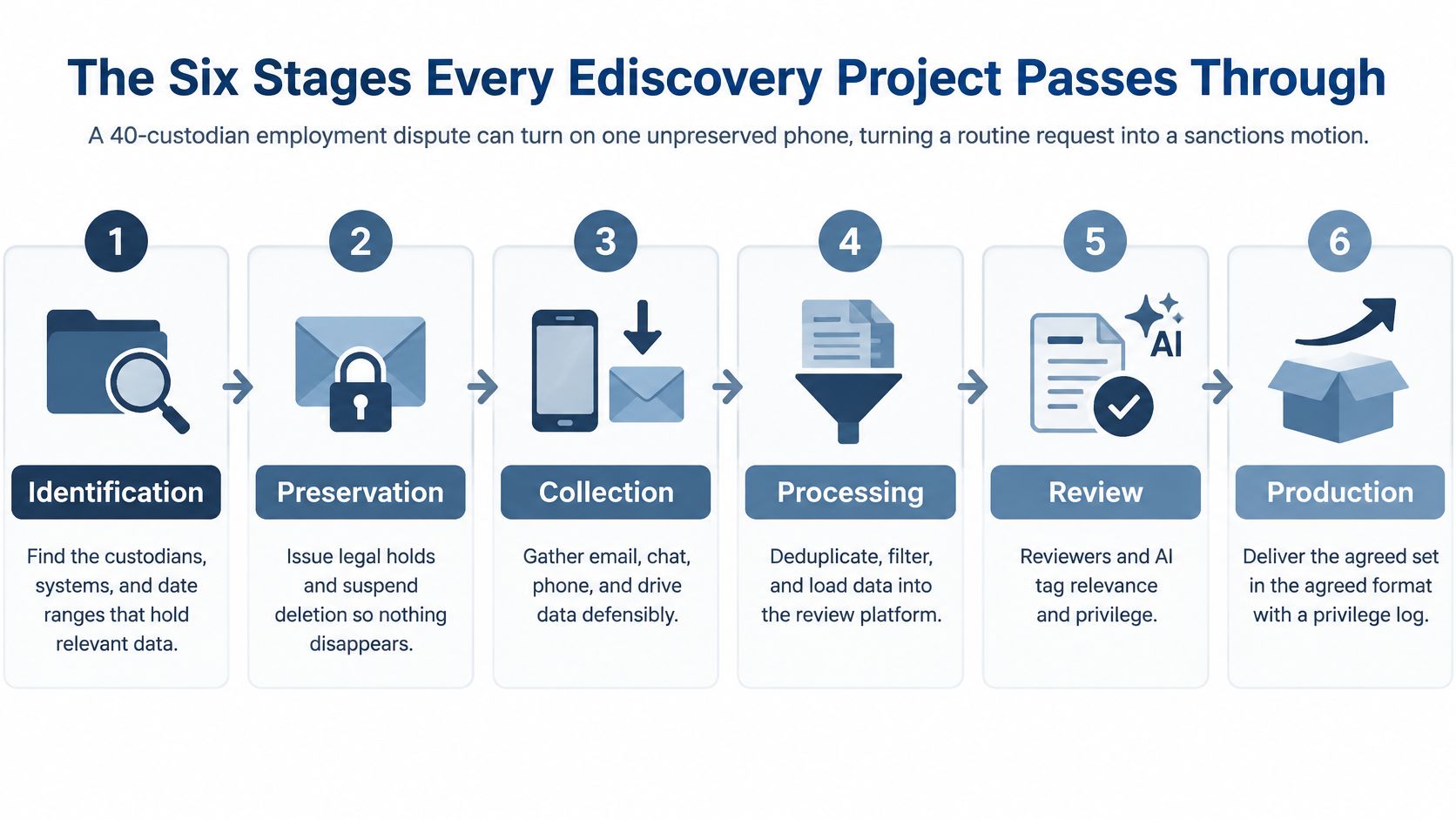
The Six Stages Every Ediscovery Project Passes Through
Say an employment dispute involves 40 custodians, and a former supervisor's unpreserved phone becomes the subject of a sanctions motion. That's a hypothetical, but it illustrates the problem: a routine discovery request can become an argument about what disappeared before anyone began reviewing documents.
Electronically stored information, or ESI, includes email, messages, spreadsheets, cloud files, and other digital records. Treating those records as paper documents with better search functions misses the preservation and metadata work that makes them usable.
Turn Each Stage Into a Deliverable
Identify custodians and sources. Start with the people involved in the disputed events, then identify where they communicated and stored work. Ask about Microsoft Teams, Slack, personal phones, and shared drives, not merely their work inboxes. The deliverable is a source map with relevant date ranges.
Preserve potentially relevant information. Counsel defines the hold's scope; support staff coordinate notices, acknowledgments, and technical preservation actions. A hold notice isn't proof that IT stopped deletion. Record both the instruction and its implementation.
Collect from the source. Use defensible system exports or forensic collection where the circumstances warrant it. Preserve metadata and document the method. Asking a custodian to forward selected emails may omit attachments, context, or records they didn't recognize as relevant.
Process the collection. Deduplicate, index, extract text, and normalize review formats while preserving source relationships. Check that email attachments remain connected to their parent messages. Record unreadable, encrypted, or failed files instead of letting them disappear.
Review for legal significance. Attorneys establish relevance, responsiveness, and privilege standards. Reviewers apply the approved protocol, while support staff organize batches and route questions. Changing a coding rule without documenting the change is an efficient way to purchase the same review twice.
Produce the approved set. Apply Bates identifiers where appropriate, export in the agreed format, validate redactions and load files, and retain a production log and cover letter. Prepare any required privilege log under attorney supervision.
Assign Ownership Before Work Starts
These stages overlap. The Federal Judicial Center's explanation of the preservation rule places the preservation obligation in the context of reasonably anticipated litigation, not merely receipt of a discovery request.
Use this ownership table when opening the matter. A task assigned to everyone has an impressive ability to remain unfinished.
Ediscovery stages, tasks and typical owners
| Stage | Core task | Typical owner | Common failure |
|---|---|---|---|
| Identification | Find custodians and the data sources they use | Attorney with litigation support | Missed phones, chat apps or personal cloud drives |
| Preservation | Issue legal hold and suspend auto-delete | Litigation support, signed off by attorney | Hold sent late or never logged |
| Collection | Gather files forensically or from systems | Litigation support or vendor | Metadata altered during copying |
| Processing | Deduplicate, index and normalize formats | Vendor or support team | Attachments separated from parent emails |
| Review | Code for relevance, responsiveness and privilege | Attorneys, supported by staff | Inconsistent coding across reviewers |
| Production | Apply Bates numbers, export and log | Litigation support | Privileged documents released by mistake |
Who Does What Across the Discovery Team
Attorneys own legal judgment. Litigation support owns the mechanics that let attorneys exercise it efficiently. That distinction should appear in task assignments, access permissions, and escalation procedures, not just in the job description nobody has opened since hiring.
Consider a hypothetical ten-attorney firm with a litigation support specialist. The specialist maintains the custodian tracker, coordinates collection appointments, prepares review batches, checks document-family relationships, and updates the production tracker. Each matter still has a responsible attorney who answers substantive questions and authorizes release.
Separate Decisions From Administration
The specialist can flag inconsistent coding without deciding which legal interpretation is correct. They can identify a missing attachment without deciding whether the email is responsive. They can assemble proposed privilege-log fields without making the privilege determination.
That division matters financially. RAND's large-volume case studies found that outside counsel represented approximately 70% of e-discovery production costs, as reported in CloudNine's account of the RAND findings. Those matters aren't a pricing formula for a smaller firm, but they make attorney labor a sensible place to examine avoidable administrative work.
Give the specialist a defined escalation route: matter attorney, backup attorney, and a recorded response deadline. Otherwise, the review queue fills with unresolved questions while everyone assumes someone else is handling them.
Delegation test: Can the task be completed correctly by following an approved procedure without making a new legal judgment? If yes, it's a candidate for support staff.
Our dedicated assistants are legal operations specialists who go through rigorous vetting and integrate directly into the firm's workflows. Attorney Assistant trains them on legal support fundamentals; the firm teaches its particular systems, procedures, and preferences, with shared performance oversight. Familiarity with the actual workflow is more useful than a general claim of being good with documents.
A written litigation support services responsibility map helps separate operational ownership from attorney approval. It should also identify work requiring specialist vendors, such as complex mobile-device extraction, rather than assuming every support professional is a forensic examiner.
Make the Handoff Explicit
Delegate these tasks under approved procedures
- Custodian administration: Maintain contact details, source inventories, and collection status.
- Collection records: Update transfer logs and chase missing documentation.
- Review coordination: Assign batches and track unresolved questions.
- File checks: Check parent-child relationships, naming, and export completeness.
- Production administration: Maintain Bates ranges, delivery records, and receipt confirmations.
Keep these decisions with attorneys
- Privilege: Determine assertions, exceptions, and waiver implications.
- Responsiveness: Resolve substantive judgments and approve the governing standard.
- Strategy: Set scope positions, objections, negotiations, and production approval.
Where the Discovery Budget Actually Goes
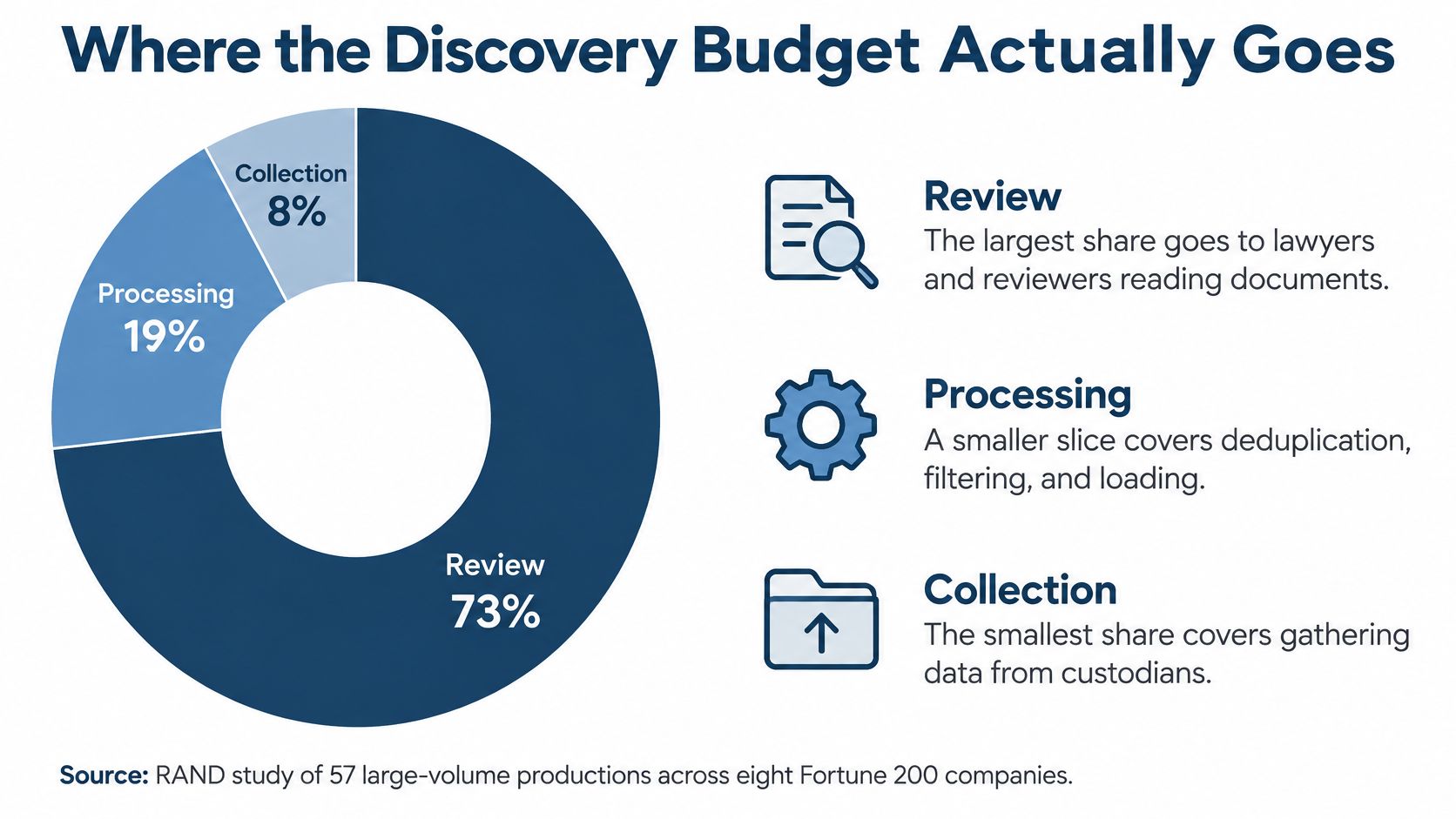
Review accounted for approximately 73% of production costs, processing about 19%, and collection about 8% in RAND's study of 57 large-volume productions involving eight Fortune 200 companies. The matters included civil litigation and regulatory investigations.
That breakdown doesn't mean collection deserves little attention. It means mistakes made early can create expensive work later, when attorneys and reviewers must make sense of what arrived.
Control the Work Around the Documents
At collection, use a clean custodian list. Record aliases, relevant employment dates, system accounts, and the reason each person is in scope. Otherwise, teams can collect an abandoned mailbox while missing the account the custodian used.
At processing, demand intact document families and a visible exception list. An encrypted spreadsheet needs an owner and a next action. Marking the processing job complete doesn't make the spreadsheet readable.
At review, give reviewers manageable batches, a written coding protocol, and a single route for substantive questions. Grouping comparable materials helps reviewers apply the same standard. Letting every reviewer privately interpret an ambiguous instruction produces different answers, all entered with confidence.
RAND cost share by e-discovery stage
| Stage | Share of production cost | Practical lever |
|---|---|---|
| Review | about 73% | Written coding protocol, sized batches and a single escalation path |
| Processing | about 19% | Intact document families and a logged exception list |
| Collection | about 8% | A clean, documented custodian list |
Cost shares are from the RAND study identified above.
Catch Ambiguity Before It Becomes Rework
Consider a hypothetical review of 300,000 documents. On day two, reviewers discover that the protocol doesn't explain whether internal complaints unrelated to the named plaintiff count as responsive. By then, 40,000 documents need recoding.
A hypothetical thirty-minute protocol review using representative documents could have exposed that ambiguity before full review began. The useful intervention isn't a motivational email asking reviewers to be more consistent. It's a resolved rule, documented examples, and confirmation that reviewers understand the change.
Track open questions separately from completed review. Record the attorney's answer, effective date, and affected batches so the support lead can identify what needs rechecking.
A faster reviewer applying an unclear rule produces a larger correction queue.
These cost shares come from large matters. Smaller cases may place more weight on collection, particularly when difficult devices or legacy systems require specialist work. Use review as the first budget hypothesis to test, not as an excuse to ignore the actual matter's cost profile.
How to Build a Legal Hold That Holds Up
A legal hold needs an operational record, not merely a sent email. The responsible attorney should be able to establish what the firm identified, what it instructed people to preserve, and what happened afterward.
Under Federal Rule of Civil Procedure 37(e), the loss framework applies when ESI that should have been preserved is lost because reasonable steps weren't taken and cannot be restored or replaced through additional discovery; prejudice permits measures no greater than necessary to cure it, while severe remedies require intent to deprive another party of the information's use. A missing file doesn't automatically establish grounds for the harshest sanction.
Build a Record Someone Else Can Follow
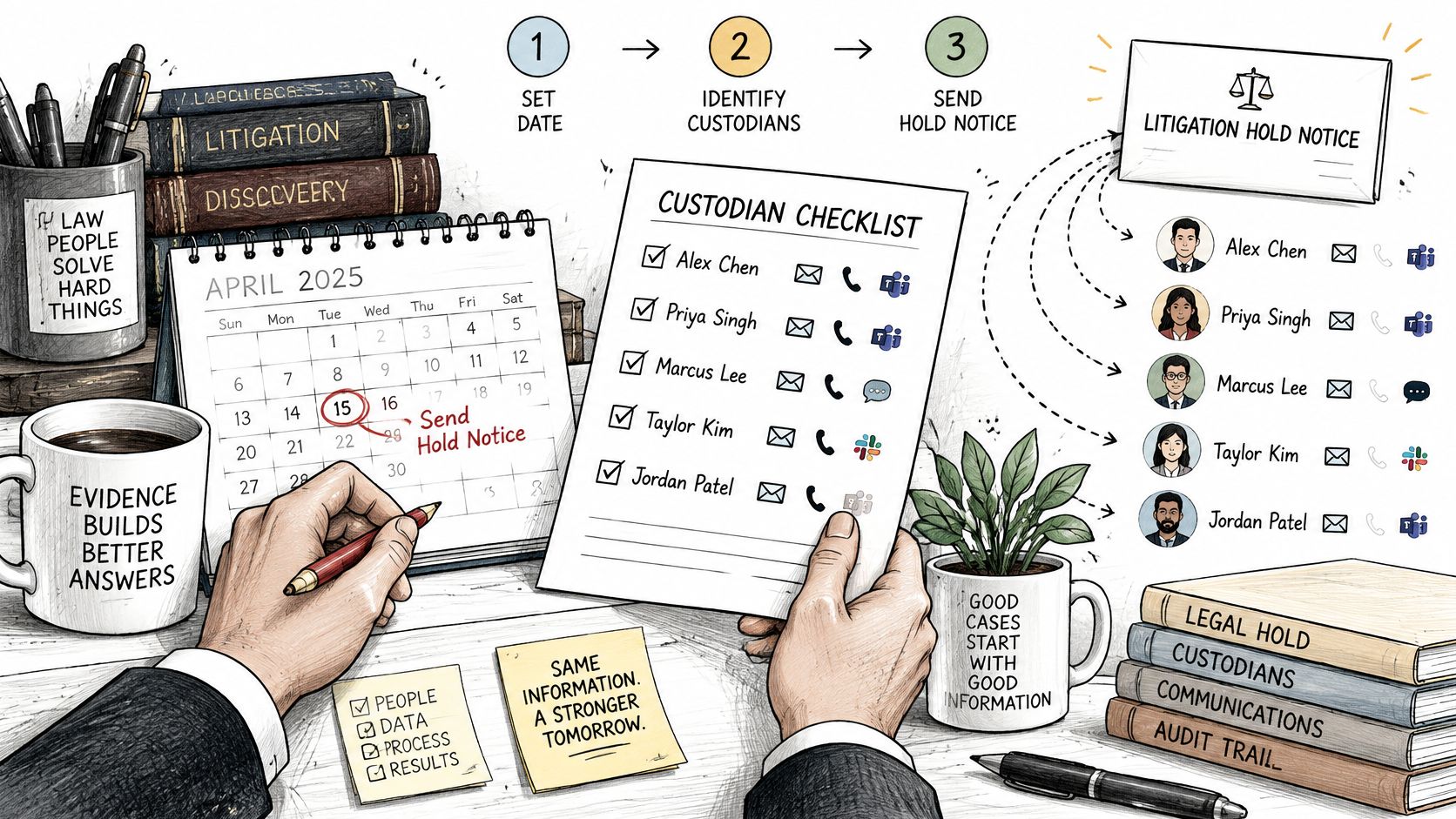
Record the trigger. Have counsel document when litigation was reasonably anticipated and why. Preserve the underlying notice, complaint, correspondence, or other material supporting that conclusion.
Inventory people and systems. Include phones, chat applications, cloud drives, and AI tools used for relevant work. Identify who controls each source and whether the firm can preserve it directly.
Send understandable written notices. Name the matter, describe the information to retain, explain the duty to preserve, and provide a contact for questions. Avoid instructions so broad that custodians cannot translate them into action.
Confirm technical changes. Coordinate applicable auto-delete suspensions across email, messaging, and backup rotation. Ask IT to record what changed and identify technical limits. Don't indiscriminately freeze unrelated systems without counsel assessing scope and burden.
Log exceptions. Record unavailable devices, inaccessible accounts, failed exports, and preservation limitations. Include the reason, proposed alternative, attorney decision, and follow-up owner.
Obtain acknowledgments and monitor compliance. Keep signed or electronically confirmed acknowledgments. As an internal operating recommendation, schedule quarterly checks and additional checks when employees leave or systems change; that cadence isn't a universal legal requirement.
Set an escalation deadline. Urgent deletion risks need immediate attorney attention. For other gaps, establish a written response window and a backup contact so an absent matter attorney doesn't become the preservation procedure.
Connect the Hold to Employee Departures
Say a departing employee's laptop is wiped because HR never received the hold restriction. The support team had sent the notice, but nobody connected it to offboarding. The useful control is a departure checklist requiring a hold-status check before equipment is reset.
Locating a former custodian may require separate work. Where counsel needs lawful assistance finding someone in London, Sentry Private Investigators Ltd.’s tracing agents London resource can be a starting point for that task, not a substitute for preservation or authority to access their records.
Maintain a master hold record linking notices, acknowledgments, IT confirmations, exceptions, and release approvals. An acknowledgment proves receipt or confirmation, not that every relevant system was preserved.
Could you hand a judge one document that shows every step and points to its supporting record?
Deciding What to Collect Without Overcollecting
Collect everything isn't a substitute for a scope decision. It can create unnecessary sensitive copies and leave reviewers sorting through material that has little connection to the dispute.
Federal Rule 26(b)(1), discussed in the ABA's guidance on AI and e-discovery, requires relevance and proportionality, considering the issues' importance, amount in controversy, access to information, resources, discovery's importance, and burden compared with likely benefit.
Use a Small Triage Sheet
Start with the claims and defenses in the pleadings. Have counsel approve a sheet with these fields:
| Source and custodian | Unique relevant information | Effort and sensitivity | Decision | Reason and approval |
|---|---|---|---|---|
| Supervisor's Teams messages | Discussions absent from email | Export coordination; employee information | Preserve and collect | Direct connection to disputed decision |
| Duplicate shared-drive folder | Apparently duplicates collected files | Additional sensitive copies | Preserve only pending verification | Confirm duplication before excluding collection |
Include email, phones, shared drives, personal cloud accounts used for work, chat, and relevant AI logs. Assess deletion risk as well as likely evidentiary value.
For sensitive archives, the SourceX guide to sensitive archive handling is a supplementary resource to consider when planning copy controls; it doesn't determine discovery obligations.
Excluding a source from collection doesn't automatically release it from preservation.
Revisit decisions when pleadings or requests change, new sources emerge, or custodians depart. Preserve potentially relevant material pending counsel's scope determination, and document collection and preservation decisions separately.
Proving Evidence Stayed Intact Through Every Transfer
If an attorney relies on a file's metadata, the team needs a record of what happened to that file. An unexplained modification date is easier to investigate during processing than during a deposition.
NIST's digital-evidence guidance recommends hashing evidence objects with an approved algorithm as close to collection as possible and storing the resulting hash separately in a secure location. A hash is a cryptographic digest used to compare the byte-level consistency of an object and subsequent copies.
Verify Copies Without Overclaiming
Generate the collection hash, retain it in access-controlled evidence records, and compare hashes after transfers. For unchanged native objects, recheck through processing and production. Investigate mismatches before relying on the affected file.
A converted PDF won't necessarily match its native source's hash. That's not automatically evidence of misconduct. It means the team needs to distinguish an expected transformation from an unexplained alteration and retain records connecting the versions.
Integrity controls and their limits
| Control | What it proves | What it does not prove |
|---|---|---|
| Hash value at collection | With a matching later hash, the object is unchanged since collection | The collection was complete or relevant |
| Chain-of-custody log | Who handled the file and when, as recorded | The collection was lawfully authorized |
| Time zone normalization record | Timestamps are read consistently across sources | Timestamps were accurate at the source |
| Tool and version record | Which software processed the data | The processing choices were correct |
| Exception log | Which files failed and why, as recorded | No relevant files were missed |
A hash alone proves very little without a comparison. Likewise, a custody log is only as useful as the accuracy and completeness of its entries.
Connect Technical Records to the Production
Pair integrity checks with source identification, collection timestamps, custodian authorization, tool versions, time zone treatment, and exception records. Document format conversions and load-file creation so someone can reconstruct how source records became reviewable and producible files.
Paradigm International's evidence handling guidance offers a supplementary reference for formalizing handling procedures. Translate any adopted procedure into named responsibilities and required log fields rather than leaving it as background reading.
Keep the evidence repository distinct from ordinary working folders, with access appropriate to each role. A practical legal documents management workflow should connect matter organization with controlled evidence records without treating every working copy as an original.
Every production should be explainable from source to Bates number using the logs alone. Test that proposition by selecting a produced file and tracing it backward through its exports, processing record, and collection source.
Ask: What changed? Who touched it? Where is that recorded?
Auditing AI-Assisted Review Before Someone Asks
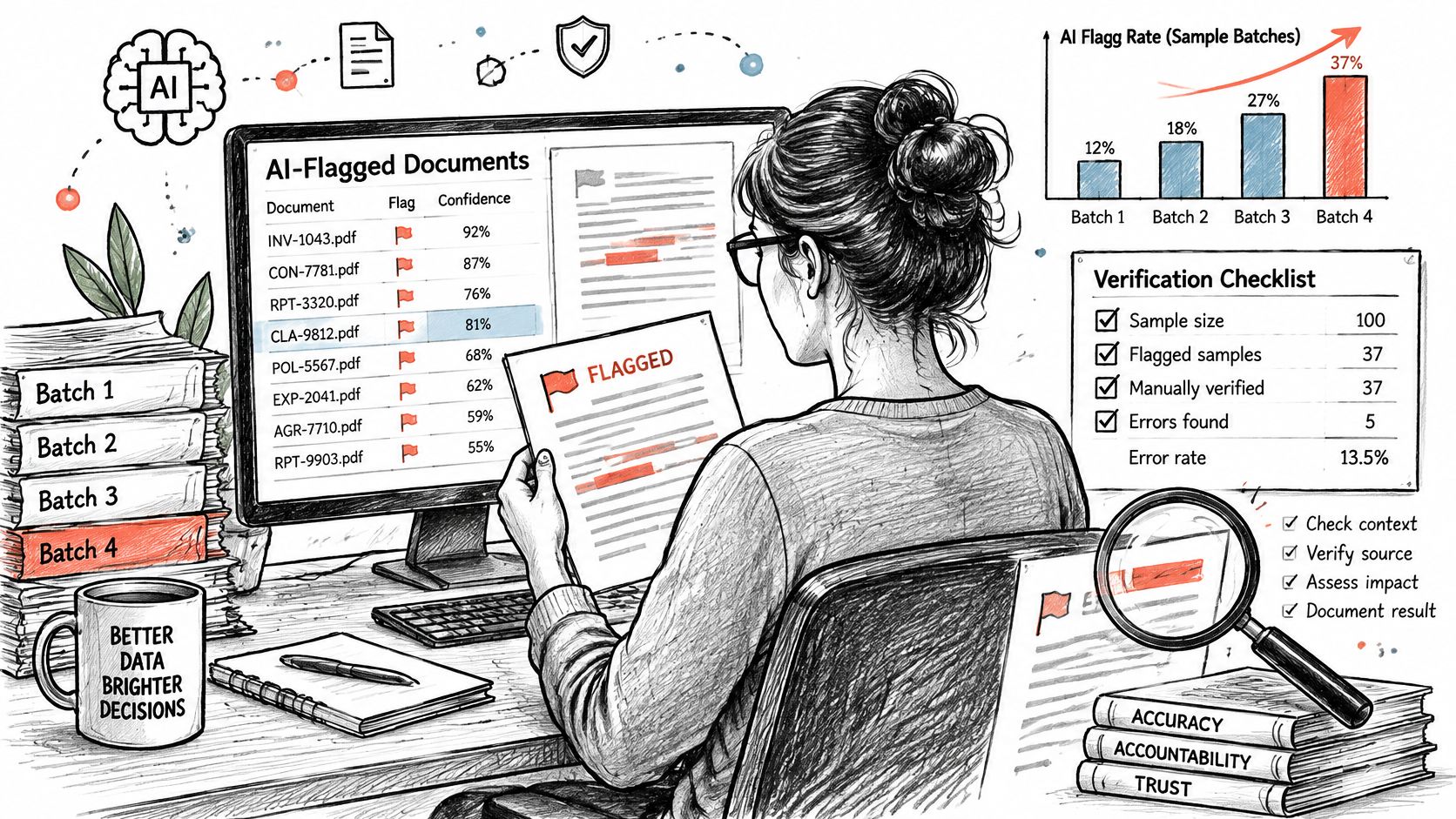
In 2025, 37% of surveyed legal professionals reported actively using generative AI in e-discovery, up from 12% two years earlier, according to the Everlaw survey published with ACEDS and ILTA, based on 299 respondents, as reported by LawNext.
Adoption doesn't answer the operational question: can the firm reconstruct how a document received its final classification? A useful result without a reproducible decision record is an awkward thing to explain months later.
Keep the Decision Record
Before review starts, identify what the platform records automatically and what the firm must retain separately. The minimum operational record should include:
- Prompts and instructions: Retain the actual instructions used, including revisions and their effective points.
- Model and version: Record the available model identifier, platform configuration, and relevant settings.
- Retained outputs: Connect classifications, summaries, and explanations to stable document identifiers.
- Reviewer decisions: Preserve attorney overrides and their reasons in the appropriate controlled record.
- Validation results: Document sampling methods, human findings, disagreements, and corrective action.
- Protocol language: Describe the AI's role, human supervision, escalation rules, and approval process accurately.
Don't promise a level of reproducibility the tool cannot provide. If the vendor doesn't expose a model version, record that limitation and the available release information instead of filling the field with a guess.
Validate the Calls That Matter
Say an AI privilege tool marks a memo as non-privileged. An attorney reads it, identifies a request for legal advice, and overrides the classification. Record the document identifier, original classification, attorney disposition, and rationale with appropriate access controls.
The override isn't merely a correction to that memo. It should prompt a check for comparable documents and consideration of whether the instructions or validation plan need adjustment.
Validation requires a sampled human check with documented results, not a general impression that the summaries sound convincing. Include material the tool excluded, not just documents it flagged, and have counsel decide how identified errors affect further review.
Prompts, conversations, logs, and outputs may raise discoverability questions depending on jurisdiction and protocol, an issue identified in Nextpoint's discussion of generative-AI discovery governance. Counsel should establish retention, confidentiality, and access rules before the first AI-assisted production.
The goal isn't to retain everything indefinitely or delete inconvenient records. It's to follow a deliberate policy consistent with preservation obligations and the matter's governing requirements.
Map Your Discovery Workflow Before the Next Case
Defensibility comes out of documented routine work, not the size of the tool budget. Firms that struggle in a discovery dispute usually have the software. What they lack is a written answer to who did what, when, and under which procedure.
Take a common failure: a preservation notice goes out, three custodians acknowledge it, and six months later opposing counsel asks who confirmed the hold on a departed employee's mailbox. Nobody can say. The workflow existed only as habit.
Map the firm's current litigation support ediscovery process against identification, preservation, collection, processing, review, and production. Write an actual person's name beside each stage, plus a backup. If nobody owns a stage, record it as unowned instead of disguising the gap as shared responsibility.
Run a Practical Self-Audit
- Ownership: Every stage needs a named owner, a backup, and a written procedure that survives a departure.
- Holds: Check trigger dates, custodian coverage, acknowledgments, and technical confirmations for each active matter.
- AI controls: Confirm that instructions, outputs, overrides, validation results, and retention rules are recorded.
- Scope: Make sure active matters carry documented collection, preservation, and exclusion decisions, including what was deliberately left out.
Tie the findings to the firm's trial preparation checklist so missing records surface before deposition or exhibit preparation.
Most fixes will be an owner, a procedure, a training session, or a capacity decision rather than another license. A discovery plan shouldn't live inside a paralegal's memory, however impressive that memory happens to be.
At Attorney Assistant, every engagement starts by diagnosing where the firm is losing revenue, then mapping intake, follow-up gaps, and administrative workflows. Staffline scoping happens on a discovery call with the Attorney Assistant team, and a hire works inside the firm's case management system, including Filevine, Litify, Clio, MyCase, and SmartAdvocate.
Dedicated operational capacity is one path; the mapping work starts regardless. Assign the missing owners and document the unresolved decisions this week.
Attorney Assistant provides trained legal support staff to help firms build capacity without turning attorneys into full-time administrators. Visit Attorney Assistant to discuss where discovery logistics are consuming attorney time and whether dedicated case-support capacity fits your workflow.
Related Articles
Monitoring Phone Calls Without Breaking the Law
Learn how monitoring phone calls works, which methods need consent, how all-party states differ, and how to use call data without legal trouble.
Medical Records Request Law: Rules, Deadlines and Fees
Learn how medical records request law works: HIPAA deadlines, fee limits, authorization rules and state differences, with steps to get complete files.

Client Experience Coordinator for Law Firms
See what a client experience coordinator owns in a law firm, from intake and status updates to the skills that keep matters moving.