Live Virtual Receptionists for Law Firms: A Practical Guide

In 2024, only 40% of law firms answered the phone live, and just 25% of firms that missed a call called back, according to Clio's secret-shopper study summary. That means six in ten firms failed to create immediate human contact, while three out of four missed-call opportunities received no callback.
That isn't a receptionist inconvenience. It's a lead-latency problem. A paid inquiry arrives, waits in voicemail, sits behind a hearing, or lands in an inbox nobody owns, and the firm loses control of the next step. Live virtual receptionists can fix that, but only when they operate as an intake system rather than a voice that politely writes down a name and number.
Table of Contents
- Why Live Answering Has Become a Legal Intake Problem
- What Live Virtual Receptionists Actually Do
- How Receptionists Handle Intake, Routing, and Follow-Up
- Choosing Between Dedicated, Pooled, and AI Models
- The ROI and Productivity Math for Law Firms
- Integrating Reception Into Firm Workflows and CRM
- Selecting a Live Reception Partner That Fits Your Firm
Why Live Answering Has Become a Legal Intake Problem
A benchmark cited by Panzidigital's law-firm intake analysis reports that leads contacted within 5 minutes are 100 times more likely to convert than leads contacted after 30 minutes. The same source says conversion probability falls sharply after 15 minutes. Response time therefore functions as a revenue-control measure. Every unanswered ring, delayed callback, and unattended form gives a paid lead time to choose another firm.
A basic answering service may answer the phone, record a message, and send an email. That helps with call coverage, but legal intake requires a defined next step. Message-taking captures contact details; intake qualifies, routes, and books the next step.
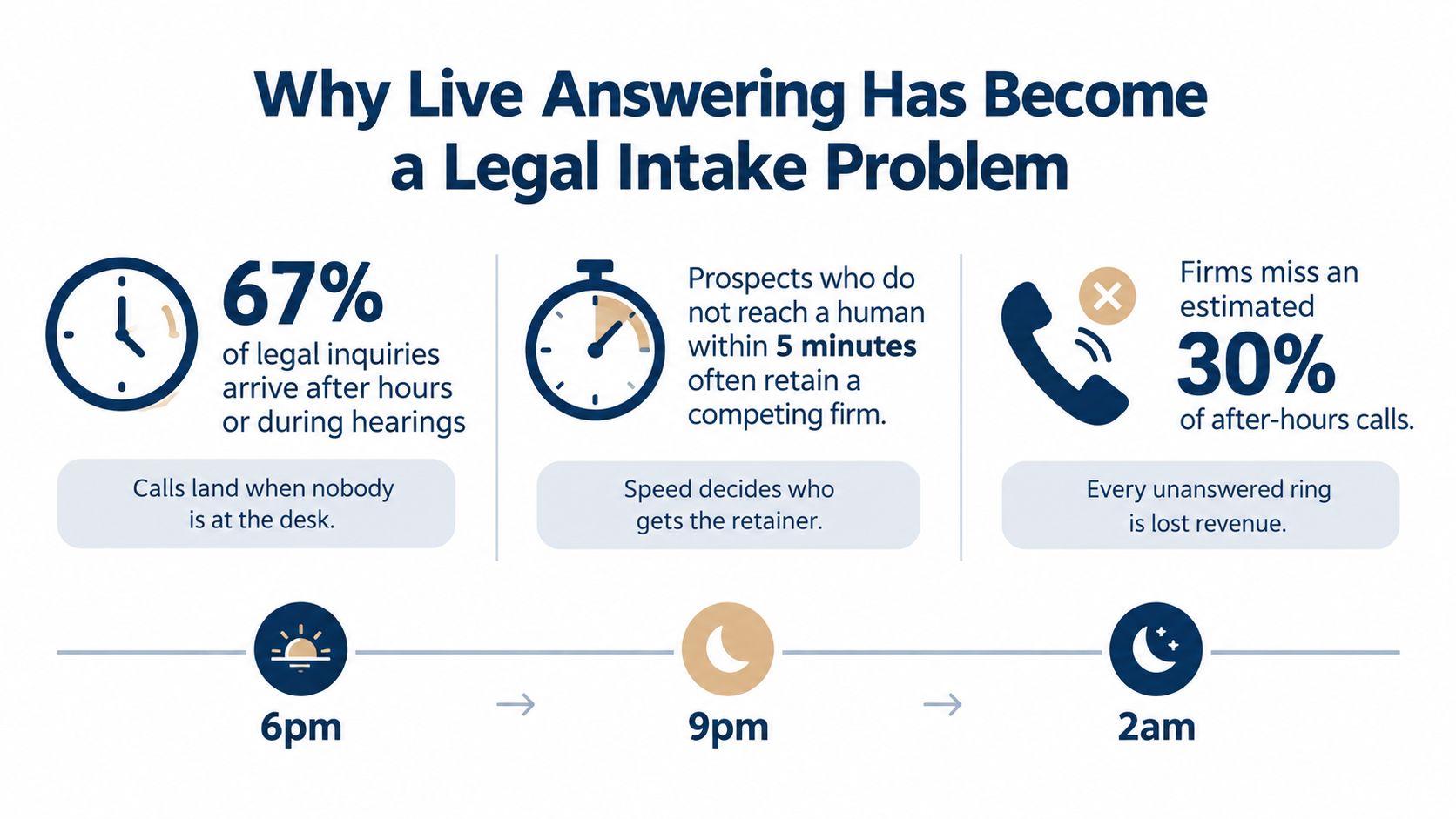
The operational bottleneck
Historical figures in the Clio study summary show live answering declining from 56% in 2019 to 40% in 2024, a 16-percentage-point drop. Callback recovery also fell from 38% to 25%, a 13-percentage-point decline. Those results point to a capacity and ownership problem, not merely a staffing preference.
After-hours coverage makes the gap visible. A 2026 study that placed 1,000 calls to personal injury firms after 5 p.m. across 25 cities and 17 states found that 40.9% received no live answer, according to Legal Intake Lab. Among firms advertising 24-hour availability, 29.2% still failed to answer. Earlier research on law-firm intake failures reaches the same practical conclusion: advertised availability has little value when no person owns the conversation.
The recurring breakdowns are predictable:
- After-hours gaps: Calls arrive after staff leaves while the website continues promising availability.
- Voicemail backlogs: A paralegal returns calls between deadlines, hearings, and client emergencies.
- Weekend leakage: A web lead received Saturday may be cold by Monday.
- Unprocessed forms: A completed intake form waits in an inbox without an owner.
A live virtual receptionist closes those latency gaps by answering in the firm's name, qualifying the matter, capturing essential facts, routing the caller, scheduling the next step, and recording the interaction. Firms evaluating an AI answering service for lawyers should judge the system by one outcome: whether it preserves lead value from the first ring through signed representation.
What Live Virtual Receptionists Actually Do
A live virtual receptionist is a trained remote professional who handles the first human interaction with a caller and follows the firm's documented process. The role can include greeting, screening, intake, calendar booking, routing, bilingual support, and structured follow-up. The receptionist works from firm-approved scripts and escalation rules, not from improvisation or legal judgment.
That distinction separates the service from several neighboring tools. A generic answering service usually records a message. An AI bot handles predictable questions and routing. A virtual assistant may manage administrative work but have no responsibility for front-line lead conversations. The role matters because a prospect asking a sensitive question doesn't always fit a neat menu option. For readers comparing software categories, what an AI customer service agent does provides useful background, but legal intake still requires a clear boundary between automation and human judgment.
The job description that matters
A competent receptionist should be able to:
- Open the conversation professionally: Use the firm's approved greeting and identify whether the caller is a new prospect, existing client, referral, opposing party, vendor, or something else.
- Capture structured facts: Record contact details, matter type, location, urgency, and the facts the firm needs before deciding on a consultation.
- Apply routing rules: Send personal injury inquiries, family law consultations, criminal emergencies, or mass-tort leads to the correct workflow.
- Book the next action: Use the firm's calendar rules rather than promising that someone will call whenever they get a chance.
- Close the loop: Send confirmations, create a CRM record, trigger follow-up, and flag urgent matters for immediate review.
| Capability | Live Virtual Receptionist | Generic Answering Service | AI Bot | Virtual Assistant |
|---|---|---|---|---|
| Human conversation | Yes | Yes | No | Sometimes |
| Legal intake script | Yes | Limited | Configured rules | If assigned |
| Matter qualification | Yes | Usually limited | Narrow or rule-based | Possible |
| Appointment scheduling | Yes | Sometimes | Yes, for defined flows | Yes |
| Judgment in sensitive calls | Escalates to firm rules | Usually takes a message | Limited | Depends on training |
| Administrative support | Intake-focused | Message delivery | Automated actions | Broad support |
| Legal advice | No | No | No | No |
Live virtual receptionists shouldn't give legal advice, promise outcomes, or draft documents. Their job is to create a reliable handoff. The firm still decides whether a matter fits, whether a conflict exists, and what legal guidance the caller receives. Firms that want the broader operating model should also review Attorney Assistant's guide to 24/7 virtual receptionists, especially when reception needs to connect with follow-up and case support.
How Receptionists Handle Intake, Routing, and Follow-Up
Good intake feels calm to the caller because the process is doing the work in the background. Consider a personal injury inquiry at 9 p.m. on a Saturday. The receptionist answers in the firm's voice, confirms the caller's location and contact details, asks what happened and when, identifies immediate medical or safety concerns, records the relevant parties, and checks whether an on-call attorney should receive a warm transfer.
The receptionist doesn't make a liability assessment or offer legal advice. They classify urgency, capture enough information for the next decision, and route the matter according to the firm's rules. If no attorney is available, the caller gets a defined next step, not a vague promise.
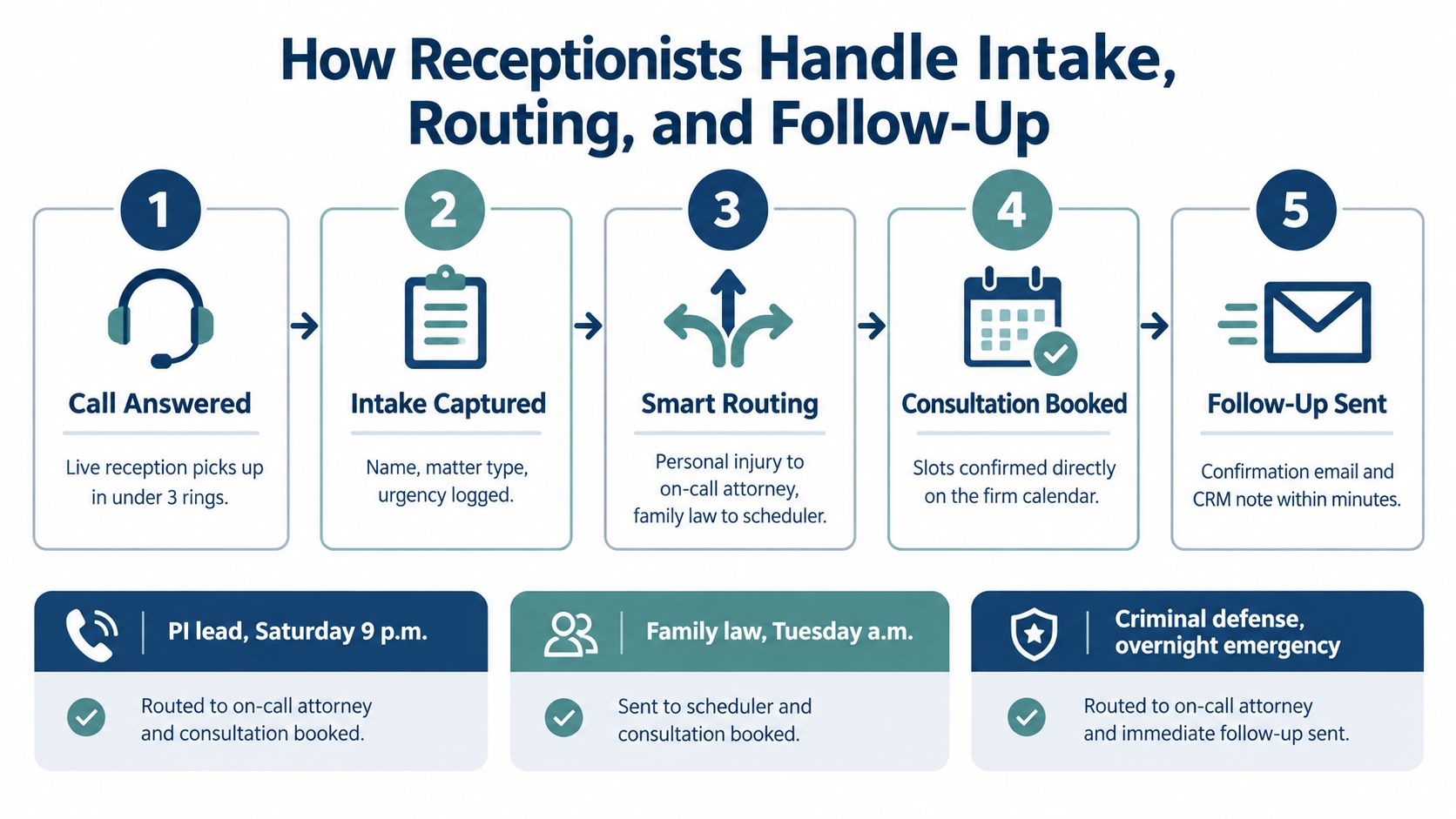
Three calls, three workflows
A family law prospect calling Tuesday morning needs a different path. The receptionist can identify the requested service, jurisdiction, immediate safety concerns, prior representation, and preferred consultation time, then book directly into the appropriate calendar. The attorney receives a structured summary instead of beginning the consultation with, “So, what brings you in?”
A mass-tort inquiry creates another requirement. The team should capture the product, event, exposure, location, relevant dates, and known parties before routing the lead for conflict screening. A receptionist shouldn't treat every inquiry as a generic callback because a conflict-sensitive matter requires controlled information handling.
The workflow should also define what happens after the call:
- Confirmation: Send the appointment details and any approved preparation instructions.
- Documentation: Create or update the contact and matter record in the CRM or case-management platform.
- Escalation: Notify the responsible attorney or intake lead when the matter meets urgent criteria.
- Recovery: Re-engage no-shows, incomplete forms, and callers who couldn't be transferred.
- Review: Record the disposition so managers can see whether the lead was qualified, booked, rejected, or left unresolved.
A cold intake ends with a form. A warm intake ends with a controlled next action. That difference is where many firms lose revenue.
Choosing Between Dedicated, Pooled, and AI Models
The architecture matters more than the label. A managing partner choosing among dedicated agents, pooled teams, and AI-first reception should ask how each model behaves when the caller is emotional, the facts are incomplete, and the correct route isn't obvious.
| Criterion | Dedicated Agents | Pooled Team | AI-First |
|---|---|---|---|
| Firm familiarity | Deep, develops over time | Variable across agents | Based on configured data |
| Practice-area nuance | Strong after training | Depends on shared scripts | Strong only within defined flows |
| After-hours routing | Can follow firm-specific rules | May create handoff drift | Fast, but escalation must be engineered |
| Bilingual coverage | Can be assigned deliberately | Often broader but less consistent | Depends on language capability |
| Sensitive conversations | Human judgment and empathy | Human, with variable context | Escalates when rules are triggered |
| Best fit | Complex, relationship-driven intake | Volume and broad coverage | Predictable questions and triage |
| Main risk | Capacity depends on team design | Inconsistent context | Missed nuance and weak escalation |
Dedicated agents are the strongest choice when the firm has complex practice areas, strict routing, recurring referral sources, or callers who need context rather than a script recital. They learn terminology, attorney preferences, calendar rules, and the difference between an urgent matter and a merely enthusiastic caller.
Pooled teams can work for straightforward qualification and overflow. Their weakness is handoff drift. One person captures the call, another sees the record, and a third handles the callback. Unless the system preserves every detail, the caller repeats the story and the firm looks less organized than it is.
AI-first systems excel at predictable routing, basic FAQs, and immediate response. They struggle when conflict screening, emotional de-escalation, or incomplete facts require judgment. AI can support a legal intake operation. It shouldn't become the entire operation because the monthly software bill looks tidy.
Decision rule: Use AI for repeatable triage, pooled coverage for structured volume, and dedicated human coverage when context, sensitivity, and conversion matter.
Cost should also be evaluated by pricing model, not headline rate. Per-minute pricing, per-call pricing, and per-qualified-lead pricing each shift risk between the vendor and the firm. Review virtual receptionist pricing models alongside your actual call outcomes, staffing gaps, and required follow-up. The cheapest unit can become expensive when it produces incomplete records.
The ROI and Productivity Math for Law Firms
A missed call is a measurable revenue risk:
Potential revenue leakage = average case value × missed-call rate × monthly call volume.
Start with the firm's own records, not a vendor's conversion promise. Review inbound call volume, unanswered calls, qualified matters, consultations booked, retainers signed, and average case value. If the firm cannot produce its missed-call rate, that gap is an intake-control problem that should be fixed before approving new coverage.
Speed-to-lead should be modeled as a latency problem. Apply the five-minute conversion window established earlier to the firm's call volume, then estimate how many qualified matters could be recovered when a live receptionist answers immediately, captures usable facts, and routes the caller correctly. The objective is not to repeat a benchmark. It is to connect minutes saved with matters recovered.
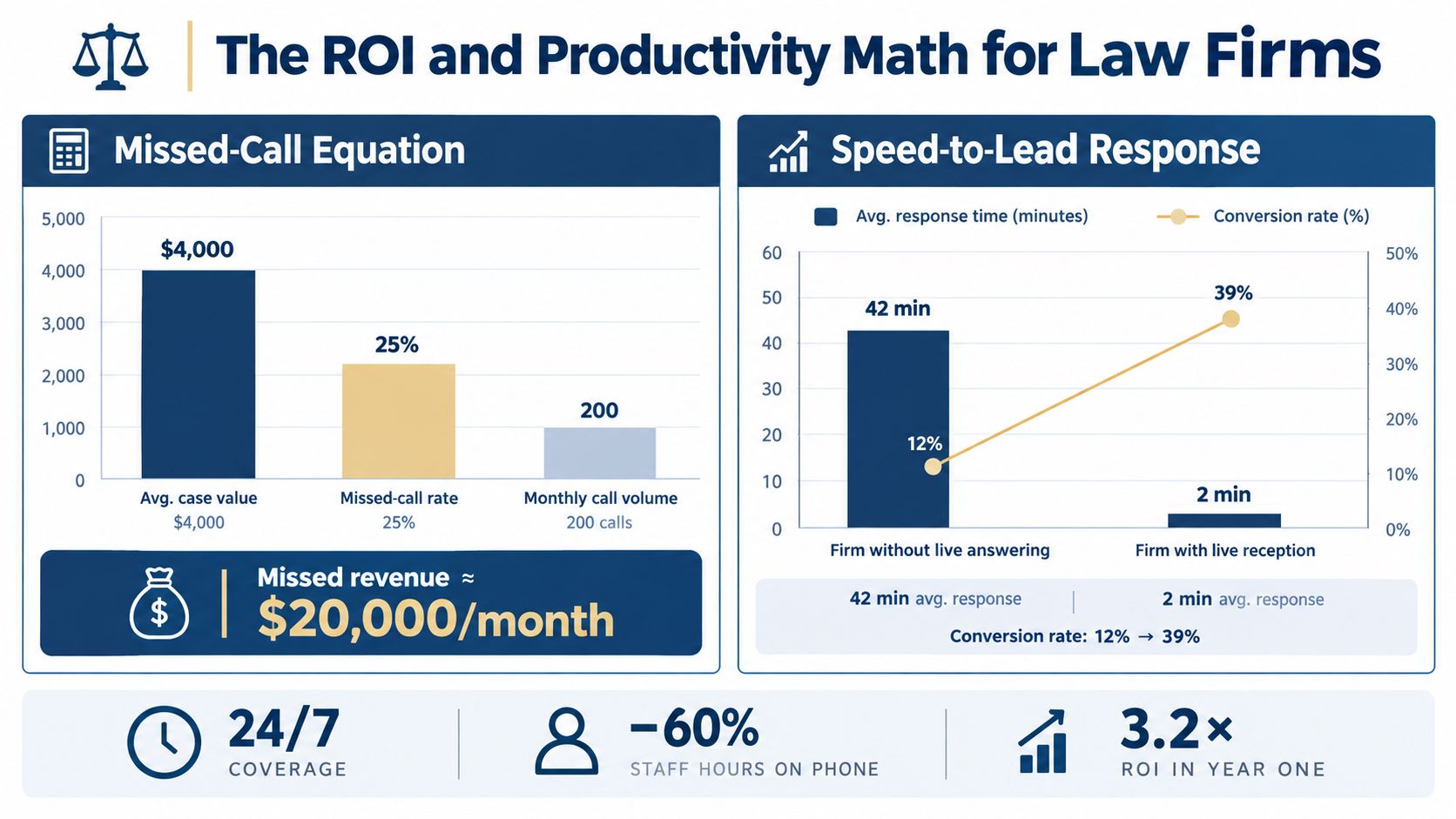
Two practical models
For a solo personal injury firm, calculate the value of calls answered by a human, the share meeting qualification criteria, and the number advancing to consultation or retainer. Subtract coverage costs and attorney time spent managing scripts, screening calls, returning messages, and repairing incomplete records. Live coverage earns its place only when it protects qualified opportunities or returns meaningful attorney capacity.
A mid-size family law practice needs a broader operating view. Measure consultation bookings, show rates, lead-source quality, routing accuracy, and staff time spent scheduling and following up. A receptionist can fill the calendar with poor-fit inquiries while making the firm less productive. Qualified, documented, properly routed matters are the target.
Practical rule: Calculate payback from recovered qualified matters and recovered staff capacity, not answered-call volume.
The model can produce a negative return. Common causes include limited inbound demand, weak qualification criteria, no calendar availability, slow attorney follow-up, or call logs that never become actionable records. Management attention also carries a cost. Scripts require testing, routing rules need revision, and one person must own quality assurance.
Use this formula:
Payback period = implementation and monthly service cost ÷ monthly gross contribution from recovered matters and capacity.
Track outcomes by call disposition. A firm that cannot separate spam, unqualified inquiries, qualified consultations, and signed matters cannot measure intake ROI. A CRM cannot follow up with a lead that no one records. The receptionist is a latency-control system, so measure the full chain from answer to signed case, not the first event alone.
Integrating Reception Into Firm Workflows and CRM
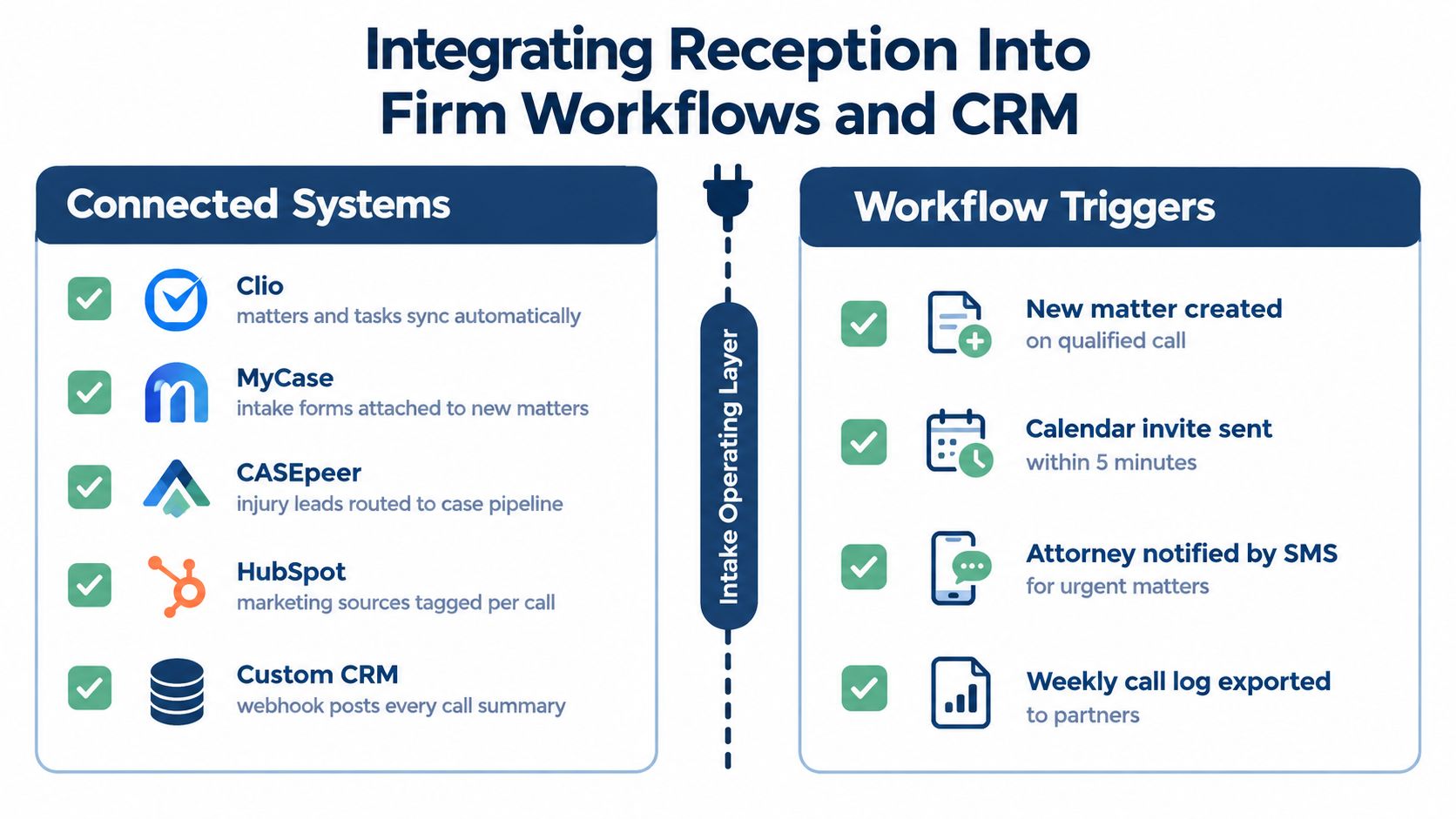
Reception becomes an operating layer when it writes to the systems the firm already trusts. A call summary trapped in an email inbox is better than a lost call, but it still leaves staff to copy facts, create a contact, schedule the consultation, and notify the right person. Every manual handoff creates another place for the process to fail.
The integration points worth requiring
For Clio, MyCase, CASEpeer, HubSpot, or a custom CRM, ask for specific behavior rather than a vague promise of integration:
- Lead creation: A qualified call creates a contact or lead record with source, matter type, urgency, and assigned owner.
- Calendar sync: The receptionist sees approved availability and books the correct consultation type.
- Conflict workflow: The system triggers the firm's conflict-check process before a callback or substantive discussion.
- Attorney alerts: Urgent matters reach the responsible attorney through the firm's approved notification channel.
- Disposition reporting: Managers can see answered, qualified, booked, transferred, followed-up, and unresolved calls.
A co-managed model adds operational ownership. The partner helping with reception should participate in script design, routing rules, quality assurance, and performance review. That arrangement is different from buying minutes from a call center and hoping the firm discovers problems through angry callers.
A serious setup should answer these questions:
- Where does each call record live?
- Who owns a lead after the receptionist finishes?
- What happens when the calendar is full?
- How does the firm detect a dropped handoff?
- Who reviews incomplete or misrouted records?
- How quickly can the team change a script?
Watch the explanation of intelligent communication hub setup for a broader view of how voice, CRM, and workflow events can connect. Then ask the vendor to demonstrate the actual handoff in your own environment.
The proof isn't a slide titled “integrations.” It's a test call that creates the right record, books the right calendar, sends the right alert, and leaves a usable summary without someone retyping it.
Selecting a Live Reception Partner That Fits Your Firm
Treat vendor selection as diligence, not a price comparison. The firm isn't buying a voice. It's choosing who controls the first operational moment after a prospective client calls.
Ask where receptionists are located, how shifts cover nights and weekends, and whether the team can support English and Español when the firm needs it. Ask whether scripts are built for personal injury, family law, criminal defense, immigration, or mass torts, or whether every client receives the same cheerful template.
Questions that expose the real capability
- Training: How does the team learn legal terminology, confidentiality procedures, conflict-screening boundaries, and the firm's escalation rules?
- Customization: Can the firm change qualification questions, routing logic, calendars, and emergency instructions without a long service ticket?
- Handoffs: Does a qualified caller receive a warm transfer, a booked consultation, or a documented next step?
- Measurement: Can the vendor show call recordings, quality reviews, response speed, disposition data, and follow-up completion?
- Escalation: What happens when a high-value prospect calls after hours, becomes upset, or reports an urgent situation?
- Accountability: Who reviews performance with the firm, and who fixes a failing script?
A provider that handles law firms alongside plumbers and dentists may still answer competently. That doesn't prove it understands conflicts, jurisdiction, intake boundaries, referral ownership, or the cost of sending an incomplete matter to an attorney. Review the firm's actual requirements before accepting generic “professional answering” language. Call handling services for law firms should be evaluated by what happens after the call, not just whether someone picked up.
The market itself is no longer a small niche. One virtual receptionist service market estimate projects the global category at USD 4.64 billion in 2026 and USD 10.85 billion by 2035, while another estimate cited in the same market coverage projects USD 2.58 billion in 2025 and USD 4.22 billion by 2034. The figures differ by methodology, but the commercial point is consistent: firms have many options, and they need decision criteria more useful than a feature list.
The right question isn't, “Should we hire a receptionist?” It's, “What is our 24/7 intake operating model, and who is responsible for making it work?” Attorney Assistant offers Frontline, a 24/7 live intake team for answering, qualifying, routing, following up, and signing appropriate cases, alongside Staffline dedicated full-time legal support professionals who can carry broader work such as case management, records, lien reduction, file opening, CRM hygiene, and administrative support.
If missed calls, slow follow-up, or incomplete intake are costing your firm opportunities, visit Attorney Assistant to review how Frontline and dedicated Staffline support can fit into your existing workflows. Start by mapping one intake path, one staffing gap, and one handoff that currently depends on somebody remembering to do it.
Related Articles

Appointment Setting Online: A Law Firm Guide
Master appointment setting online for law firms with proven strategies that turn leads into booked consultations and grow your practice.

Medical Records Request: A Practical Guide for Law Firms
Run a clean medical records request with HIPAA-compliant steps, sample language, timelines, fees, and follow-up tactics built for law firm operations.

Litigation Support Services: What Law Firms Need to Know
Discover how litigation support services streamline discovery, reduce costs, and improve case outcomes. Learn what to look for in a provider.