Medical Billing Itemization: A PI Firm Playbook
An itemized medical billing record for personal-injury use is a line-by-line invoice that must include dates of service, provider identity and NPI, CPT and ICD codes, line-item charges, modifiers, and all payments and adjustments. Summary totals are not enough. An adjuster or auditor cannot evaluate damages from a balance statement, and a lien you cannot verify is a lien you cannot negotiate.
Your intake team’s single next step: send a signed HIPAA authorization and a written request for an itemized billing statement to every provider the client visited, then log each request in a tracking sheet the same day.
Three things to confirm before you send anything:
- The authorization names the specific provider, date range, and record types (itemized bills plus EOBs)
- The request explicitly asks for CPT/ICD codes, modifiers, insurance payments, and contractual adjustments
- Every request is logged with a follow-up date 30 days out
Key Takeaways
Itemized medical billing records with CPT/ICD codes, modifiers, and payment adjustments are required for every PI case before you can calculate damages or verify lien exposure.
| Point | Details |
|---|---|
| Required fields | Every bill must include CPT/ICD codes, modifiers, NPI, line-item charges, insurer payments, and adjustments. |
| Request timing | Send HIPAA authorization and itemized billing requests within 48 hours of intake. |
| Provider scope | Request bills from every treating provider: ER, ambulance, specialists, imaging, labs, PT, chiro, and DME. |
| Verification step | Match each bill line to clinical notes, check for duplicates, and compare to Medicare benchmarks before calculating damages. |
| Attorney Assistant | Handles HIPAA retrieval, itemization, reconciliation, and lien verification as a discrete service for PI firms. |
Table of Contents
- What does a complete medical billing itemization actually include?
- Which providers do you need itemized bills from?
- How to request itemized billing statements step by step
- How do you verify and reconcile itemized bills against EOBs?
- What are the most common billing problems and how do you fix them?
- How should you organize and store itemized bills for audits?
- When should you outsource itemization and retrieval?
- What intake failures actually cost firms at settlement
- Attorney Assistant handles the billing work your team keeps deferring
- Sources
- FAQ
What does a complete medical billing itemization actually include?
Itemized billing statements must include CPT and ICD codes, patient and insurer payments, and all adjustments. A summary bill or a single-line “balance due” statement is insufficient for an adjuster to evaluate damages. The following is every field an auditor will look for:
- Patient name and date of birth
- Date of service (each line, not a range)
- Place of service code (e.g., 21 for inpatient hospital, 11 for office)
- CPT code (procedure performed)
- ICD-10 diagnosis code(s) (linked to each service line)
- Modifier(s) (e.g., 25, 59, LT/RT) — critical for catching unbundling and upcoding
- Units billed
- Provider name, NPI, and Tax ID
- Facility billing ID (for UB-04 claims) or rendering provider ID (for HCFA 1500 claims)
- Line-item charge
- Insurer payment
- Patient payment or co-pay
- Contractual adjustment or write-off
- Outstanding balance
- Date billed and date posted
The CPT and ICD codes do the heaviest lifting. They let you cross-reference the bill against clinical notes, confirm the procedure actually happened, and catch modifiers that change reimbursement. The UB-04 form covers facility billing (hospitals, outpatient centers); the HCFA 1500 covers professional billing (physicians, therapists, labs). Both formats must carry the same core fields above.
Annotated billing example:
Which providers do you need itemized bills from?
Every provider who treated your client can hold a lien or generate a conditional payment obligation. Start lien identification at intake, not at settlement. Missing one provider at disbursement can delay or unwind a settlement.
Request itemized bills from all of the following:
- Emergency department (facility bill, UB-04)
- ER physicians (separate professional bill, HCFA 1500)
- Ambulance service
- Urgent care
- Primary care physician
- Specialists: orthopedics, neurology, pain management, neurosurgery
- Imaging centers (X-ray, MRI, CT)
- Laboratories
- Physical therapy and occupational therapy
- Chiropractic
- Durable medical equipment (DME) suppliers
- Hospitals (inpatient and outpatient)
- Health insurers (EOBs and conditional payment notices)
- Medicare and Medicaid (conditional payment letters)
- Workers’ comp carriers where applicable
Provider tracking template (one row per provider):
For personal injury case intake, build this tracker the day the client signs. Every row without a “Y” in the Received column is a potential gap at settlement.
How to request itemized billing statements step by step
Step 1: Secure a signed HIPAA authorization. A HIPAA-compliant authorization must include the patient’s name and date of birth, the specific provider, the date range of treatment, the exact record types requested (itemized bills and EOBs), the recipient (your firm), the purpose (personal-injury claim), and the patient’s signature. Providers generally have 30 days to respond. Get the authorization signed at intake, not after.
Step 2: Send a written Request for Itemized Billing Statement. Do not request “all records.” Requesting specific record types and exact date ranges reduces ambiguity and prevents providers from returning incomplete or summary records. Your request letter should explicitly name CPT codes, ICD codes, modifiers, insurance payments, and adjustments as required fields.
Step 3: Attach a cover sheet. State the legal purpose, identify the case as a personal-injury claim, and request expedited handling if a lien or pending settlement is involved.
Step 4: Choose the right delivery channel. Electronic delivery typically reduces fees and speeds turnaround. Providers may charge reasonable, cost-based fees for copies; request a fee waiver when the client is represented and the request is for litigation purposes.
Timelines to plan around:
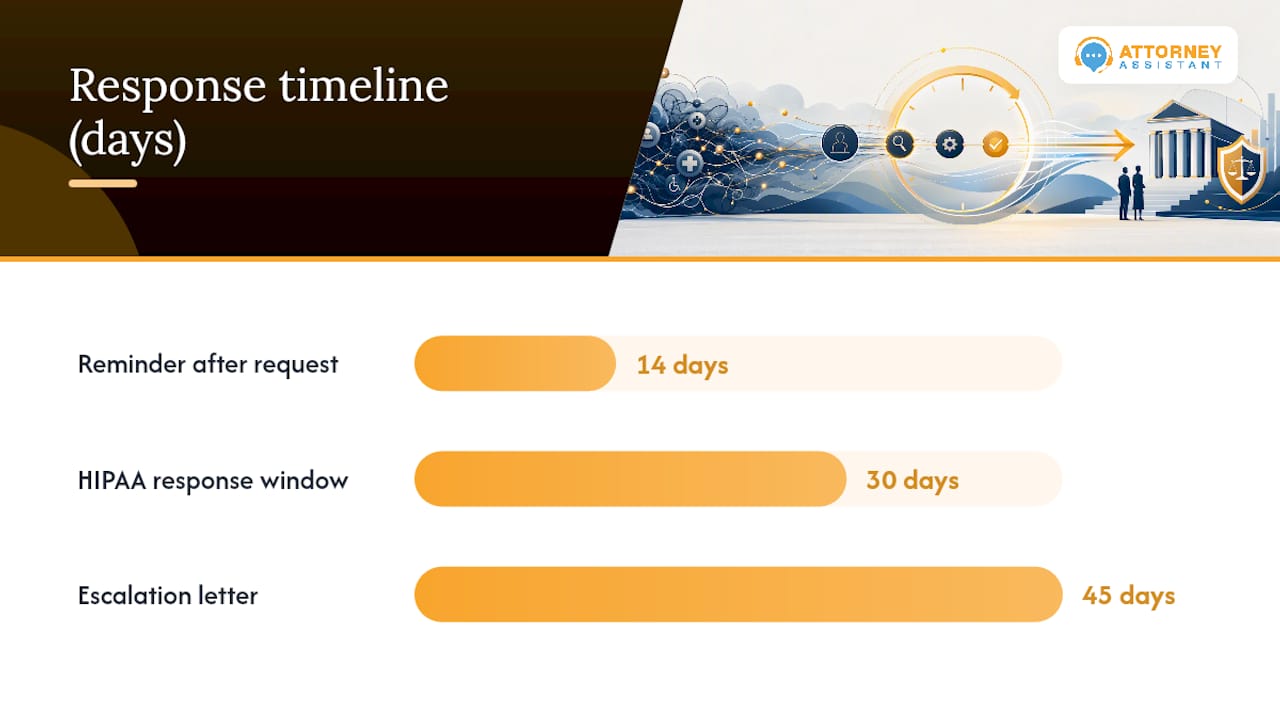
- Allow 30 days for the standard HIPAA response window
- Set a reminder two weeks after the request if nothing is received
- Follow up by phone at day 30 if no records arrive
- Send a formal escalation letter at day 45
- Issue a subpoena if litigation has started and the provider is unresponsive
Sample request language (itemized billing):
For a full HIPAA-compliant retrieval workflow, including form templates, see Attorney Assistant’s records retrieval guide.
How do you verify and reconcile itemized bills against EOBs?
A defensible bill-review workflow matches each billed line to clinical documentation, checks for duplicates, verifies CPT/ICD accuracy, and compares billed amounts to Medicare or regional usual-and-customary benchmarks. Run this process for every provider before you calculate damages.
Reconciliation checklist:
- Match each bill line to a corresponding clinical note or operative report
- Flag any CPT code without supporting documentation
- Check for duplicate dates of service across providers
- Verify modifiers match the documented clinical scenario
- Compare billed amounts to the Medicare fee schedule for the same CPT code and region
- Record insurer payment, contractual adjustment, and outstanding balance per line
- Identify any charges that appear upcoded or unbundled
Example reconciliation row:
Pro Tip: Maintain a running damages worksheet with four columns: Billed, Paid by Insurer, Contractual Write-Off, and Outstanding Balance. Total each column across all providers. That Outstanding Balance column is your lien exposure figure going into settlement.

What are the most common billing problems and how do you fix them?
Common problems:
- Provider sends a summary bill instead of an itemized statement
- CPT or ICD codes are missing entirely
- Charges appear without matching clinical documentation
- Signs of upcoding (higher-complexity E&M than notes support) or unbundling (separate billing for bundled procedures)
- Provider refuses or delays the request
- Unexpected fees that exceed reasonable copy costs
Fixes and escalation steps:
- If you receive a summary bill, respond in writing citing the original request and attach the HIPAA authorization again. Ask specifically for the itemized version with CPT/ICD codes.
- If codes are missing, call the billing department directly and request a corrected statement. Document the call.
- If the provider refuses, escalate to the records supervisor or compliance officer.
- If the provider is still unresponsive after 45 days, send a formal demand letter on firm letterhead.
- If litigation has started, issue a subpoena for the billing records.
Requesting specific record types by name rather than asking for “all records” prevents most ambiguity problems before they start.
How should you organize and store itemized bills for audits?
Consistent naming and a single master index are the difference between a five-minute production and a two-hour search during a deposition.
File naming convention: ClientLast_First_DOS_Provider_Type_v1.pdf
Example: Johnson_Maria_20250314_MemorialER_Bill_v1.pdf
Storage and chain-of-custody practices:
- Store all bills, EOBs, and correspondence in a secure, encrypted folder or case management portal with access logging
- Maintain a master index that links each bill to its corresponding clinical record, EOB, and any lien correspondence
- Version every document when a corrected or amended bill arrives (v2, v3)
- Record the date received, method of receipt, and who processed each document
- Keep a production-ready export folder with final, certified copies for settlement or trial
- Retain records per your state’s statute of limitations plus a reasonable buffer; for CMS conditional payment purposes, retain through final resolution
Master index fields:
When should you outsource itemization and retrieval?
Outsourcing makes sense when your team has a backlog of unretrieved bills, when liens are being missed at settlement, when post-settlement disputes are recurring, or when no one internally owns the reconciliation step. Consolidating retrieval, itemization, and reconciliation into a single vendor workflow cuts audit time and reduces post-settlement clawback risk.
Checklist for evaluating a vendor:
- HIPAA-authorized retrieval process with documented chain of custody
- Itemization that produces CPT/ICD-coded, line-item statements
- Bill-to-record cross-reference capability
- Damages worksheet and lien verification deliverables
- Defined turnaround SLAs
- Secure data handling with access controls
- Integration or compatibility with your case management system
- Sample deliverables available before you commit
Attorney Assistant handles medical records retrieval, itemization, and lien verification for PI firms, producing annotated billing statements, reconciliation spreadsheets, and payoff letters as discrete deliverables.
What intake failures actually cost firms at settlement
The most common pattern: a client signs a retainer, the HIPAA authorization gets collected two weeks later, and the records request goes out a month after that. By the time the firm is preparing a demand, three providers have never been contacted and two liens are unknown. That is not a documentation problem. It is a process problem.
The fixes are not complicated. Require HIPAA authorization at the same appointment the retainer is signed. Send records and billing requests within 48 hours of intake, as early retrieval workflows dramatically reduce missing-provider risk. Assign one person to own every open request and review the tracker weekly. When a provider hits 30 days with no response, escalate the same day, not the next week.
The firms that recover the most damages are not the ones with the best negotiators. They are the ones whose intake teams never let a bill go missing. See intake process best practices for a full operational checklist.
Attorney Assistant handles the billing work your team keeps deferring
Attorney Assistant’s medical records and billing service covers the full retrieval-to-verification cycle: HIPAA-compliant requests, itemized billing statements with CPT/ICD codes, bill-to-record cross-reference, damages worksheets, lien verification, and payoff coordination. Your team gets annotated billing statements, a reconciliation spreadsheet, and a chronology, not a pile of raw PDFs to sort through.
For firms carrying a backlog or preparing for a high-volume settlement push, this is the fastest way to close the gap without hiring. Book a call to see how the workflow fits your current caseload.
Sources
- Document Review for Personal Injury Attorneys: Medical Records & Bills
- Medical Liens in PI Settlements: A Complete Guide | Disbo
- Requesting Medical Bills - Wallace Pierce | Injury Lawyers North Carolina
- How Do You Request Medical Records For An Injury Claim? » Personal Injury Case Consultants
- How to Request Medical Records for Your Personal Injury Claim – Lawyer in Martin County – Juan Cordero Lawyers
This article is general information, not a substitute for advice from a qualified lawyer. Consult a qualified legal professional about your own circumstances before acting on anything here.
FAQ
What fields must an itemized medical bill include for a PI case?
Every line must show the date of service, CPT procedure code, ICD-10 diagnosis code, modifiers, units, provider NPI, billed amount, insurer payment, contractual adjustment, and outstanding balance. Summary bills are insufficient for damages calculation or lien verification.
How long does a provider have to respond to a billing records request?
Under HIPAA, providers generally have 30 days to respond to a records request. Set a 14-day reminder and follow up by phone at day 30 if nothing arrives.
What is the difference between a UB-04 and a HCFA 1500 for PI billing?
The UB-04 is the facility billing form used by hospitals and outpatient centers; the HCFA 1500 is the professional billing form used by physicians, therapists, and labs. Both must carry CPT/ICD codes and line-item charges for PI use.
When should a PI firm outsource medical billing itemization?
Outsource when your team has a backlog of unretrieved bills, when liens are being missed at settlement, or when no one internally owns the reconciliation step. Attorney Assistant handles retrieval, itemization, and lien verification as a discrete service.
How do you calculate lien exposure from an itemized bill?
Add the outstanding patient balance across all providers after subtracting insurer payments and contractual write-offs. That total is your lien exposure figure for settlement planning.
Recommended
Related Articles

1st Dollar Coverage in Law Firm Retainers: A Practical Guide
Understand 1st dollar coverage in legal and insurance contexts. Learn how it shapes intake, retainer strategy, firm revenue, and risk.

24 7 Phone Answering Service: Law Firm Guide
Discover how a 24 7 phone answering service can help your law firm capture every lead and provide round-the-clock client support. Learn best practices here.

White Glove Support for Law Firms
Discover how white glove support transforms law firm intake and operations. Learn the metrics, staffing models, and workflows that actually sign cases.