How to organize your law firm intake team for peak efficiency

TL;DR:
- Improving intake processes involves identifying gaps, standardizing data capture, and ensuring fast follow-up.
- Investing in integrated legal CRM, AI tools, and automated workflows enhances lead conversion and client experience.
- Leadership engagement and ongoing training are crucial for sustaining intake performance and continuous improvement.
Every missed call is a missed case. For personal injury firms running on contingency, that missed case could represent thousands of dollars in lost revenue. The real problem is not that your firm lacks leads. It is that the process for handling those leads is leaking money at every stage. Disorganized intake teams, slow follow-up, and inconsistent data capture send potential clients straight to your competitors. This guide walks you through a practical, step-by-step approach to building an intake team that converts more leads, delivers a better client experience, and runs without the internal chaos that quietly kills profitability.
Table of Contents
- Assess your current intake process and identify gaps
- Build your tech foundation: Essential tools and automation
- Design team roles and workflows for accountability
- Onboard, train, and continuously improve your intake team
- Monitor, measure, and optimize intake performance
- Why most intake re-orgs fail — and what really works
- Ready to supercharge your intake team?
- Frequently asked questions
Key Takeaways
| Point | Details |
|---|---|
| Intake gaps matter | Mapping and analyzing your current intake process reveals where leads and revenue are slipping through the cracks. |
| Right tech accelerates results | A dedicated CRM, automation, and AI tools make intake fast, accurate, and scalable. |
| Clear roles drive accountability | Assigning specific responsibilities and standardized workflows ensures no opportunities fall through the cracks. |
| Continuous improvement is critical | Ongoing team training, KPI tracking, and feedback loops turn your intake operation into a high-performance engine. |
Assess your current intake process and identify gaps
Before you can fix anything, you need to understand exactly what is broken. Most PI firm owners have a general sense that intake is “not working,” but they haven’t mapped the full workflow from first contact to signed retainer. That mapping exercise is where real improvement begins.
A typical PI intake process looks like this: a potential client calls, fills out a web form, or sends a message through social media. Someone at the firm picks up (or doesn’t). Basic information is collected (or partially collected). A follow-up may or may not happen within a reasonable timeframe. Eventually, someone decides whether the case is worth pursuing, and the lead either converts or disappears. The problem is the phrase “may or may not.” In a well-organized intake team, every step is defined, assigned, and tracked.
Common intake gaps that cost firms signed cases:
- Inconsistent data capture — different team members asking different questions, leaving critical case details out of the record
- Slow follow-up — potential clients contacting multiple firms simultaneously, signing with whoever responds first
- Unclear team roles — everyone thinks someone else is responsible for following up
- No after-hours coverage — leads that come in on evenings or weekends go cold by Monday morning
- Missing documentation standards — retainers not sent promptly, e-signatures not tracked
| Intake element | Current state (typical) | Ideal state |
|---|---|---|
| Lead response time | 4 to 24 hours | Under 5 minutes |
| Data capture consistency | Varies by staff member | Standardized intake form, every time |
| After-hours coverage | None or voicemail | AI pre-qualification or live service |
| Follow-up tracking | Informal or memory-based | CRM-automated reminders |
| Retainer delivery | Manual, delayed | E-signature sent same day |
| Team role clarity | Blurred responsibilities | Defined by job description |
A legal intake tips review reveals that many small PI firms do not have a documented intake process at all. That is actually good news. It means there is significant room to improve without overhauling your entire practice.
Pro Tip: Before buying new software or hiring more staff, sit down with your current intake team and ask them directly where the friction is. They will tell you exactly where leads are slipping through the cracks, and you will save months of trial and error.
The goal of this gap analysis is simple: create a written map of what happens right now, then compare it against what should happen ideally. Every gap between those two states is a revenue opportunity waiting to be recovered.
Build your tech foundation: Essential tools and automation
With a clear view of your intake gaps, the next pivotal step is investing in technology that supports and scales your team’s workflow. The right tech stack does not just save time. It enforces consistency, captures data accurately, and ensures no lead slips through because of a busy afternoon or a forgotten callback.
A law firm CRM tools analysis shows that law-specific platforms like Clio and MyCase offer integrations purpose-built for legal intake, including AI in law firm intake tools that pre-qualify leads and handle after-hours contact automatically. The right tech stack for a PI firm includes a law-specific CRM, a VoIP system with call recording, a unified intake platform for forms, retainers, and payments, and AI tools for pre-qualification and after-hours coverage.
| Tool category | Example platforms | Core function | Key benefit |
|---|---|---|---|
| Legal CRM | Clio, MyCase | Case and contact management | Centralizes lead tracking |
| VoIP with recording | RingCentral, Dialpad | Call handling and documentation | Quality control and compliance |
| Intake platform | Lawmatics, Intaker | Forms, retainers, e-signature | Faster, paperless onboarding |
| AI pre-qualification | Intaker AI, Gideon | After-hours lead screening | No lead goes unanswered |
| E-signature | DocuSign, PandaDoc | Remote retainer signing | Reduces time to signed case |
| Online payment | LawPay, Clio Payments | Fee collection | Streamlines client onboarding |
Must-have integrations for small and mid-sized PI firms:
- CRM to intake form (auto-populate lead data, eliminate double entry)
- VoIP to CRM (log every call automatically with timestamp and recording)
- E-signature to CRM (trigger retainer delivery on case qualification)
- AI chatbot to CRM (capture web leads and after-hours inquiries in real time)
- Calendar integration (auto-schedule consultations without back-and-forth emails)
Automating legal intake tasks like follow-up reminders, document requests, and retainer delivery dramatically reduces the manual workload on your team. It also eliminates the human error factor that causes delays and data gaps.
Pro Tip: Choose systems that integrate with each other natively rather than relying on third-party connectors. Every extra step in an integration chain is a potential failure point. When evaluating platforms, ask vendors specifically about after-hours lead capture and how quickly new leads are routed to staff.
Design team roles and workflows for accountability
Once your tools are in place, it is crucial to ensure your human resources are aligned. This means organizing both team roles and workflow protocols so that every lead has a clear owner and every handoff is documented.
The three core roles in a PI intake team are the Intake Specialist, the Reviewer, and the Case Manager. Understanding what each person owns is the foundation of a conversion-focused operation. Detailed guidance on intake specialist best practices makes clear that blurred job boundaries are one of the top reasons leads fall through the cracks.

Responsibilities by role:
Intake Specialist: First point of contact, answers all inbound calls and web inquiries, completes the standardized intake form, assesses basic case eligibility, and delivers the retainer for qualified leads.
Reviewer (senior intake or attorney): Reviews completed intake forms for quality and case merit, makes the go or no-go decision, flags potential issues, and provides feedback to the intake specialist.
Case Manager: Accepts the warm handoff from intake, manages the new client relationship, coordinates document collection, and ensures the onboarding process is completed without gaps.
Steps to structure your intake workflow from initial contact to handoff:
- Lead arrives via phone, web form, chat, or referral. CRM logs the contact automatically.
- Intake Specialist responds within five minutes using a scripted greeting and qualification checklist.
- All case details are entered into the CRM intake form during or immediately after the call.
- Qualified leads receive an e-signature retainer within the same business hour.
- Reviewer checks the intake record for completeness and case viability within 24 hours.
- Approved cases are assigned to a Case Manager with a documented handoff note in the CRM.
- Case Manager confirms receipt, introduces themselves to the client, and begins onboarding.
To master intake for PI cases, firms need this workflow written down, trained to every team member, and enforced consistently. A checklist posted at every workstation sounds simple, but it is one of the most effective tools for maintaining intake standards across a growing team.
Pro Tip: Script the first 60 seconds of every intake call. It sounds restrictive, but a scripted opener ensures your specialist asks the right questions in the right order, captures accurate data, and communicates professionalism from the first moment. Pair it with a role-play practice session every quarter.
Legal assistants who are embedded in the intake workflow need clear boundaries so they can act quickly without waiting for attorney approval on routine steps. That speed is often the difference between a signed retainer and a lost lead.
Onboard, train, and continuously improve your intake team
With defined roles, take your team to the next level by investing in effective onboarding and ongoing improvement. Even the best workflow on paper collapses when new hires are dropped into it without proper training.
Onboarding a new intake hire should follow a structured path. In the first week, they shadow experienced staff on live calls. In weeks two and three, they handle calls independently with a supervisor reviewing recordings daily. By week four, they operate autonomously with weekly call audits and a performance review at the 30-day mark. This graduated approach lets new hires build confidence while giving managers early visibility into any knowledge gaps.
Key training elements and ongoing development practices:
- Intake script mastery and role-play practice before any live calls
- CRM navigation and data entry standards, tested with mock scenarios
- Objection handling for common PI caller concerns (cost, timeline, case strength)
- Empathy and tone coaching, especially for distressed or injured callers
- Monthly call reviews where the team listens and discusses real intake calls together
- Mystery shopping: have someone call your firm as a potential client and report on the experience
- Quarterly refreshers on updated firm intake criteria and case acceptance guidelines
“The best intake teams treat every call like it could be the firm’s most valuable case of the year. That standard is not built through one training session. It is built through consistent review, honest feedback, and leadership that participates in the process, not just monitors it.”
Firms that invest in improving legal intake through structured training see measurable improvements in conversion rates within the first 60 to 90 days. The key is treating intake training as an ongoing practice rather than a one-time onboarding task.
Modern incident response procedures in high-stakes environments demonstrate a principle that applies directly to legal intake: teams that rehearse their processes regularly perform significantly better under pressure than those who rely only on written documentation.
Feedback loops are what separate high-performing intake teams from mediocre ones. When a lead does not convert, someone should ask why. Was it a qualification issue? A slow response? A poor call interaction? Documenting those answers and bringing them back to the team creates a continuous improvement cycle that compounds over time.
Monitor, measure, and optimize intake performance
Finally, to keep your new intake structure running at peak performance, it is essential to measure what matters and optimize accordingly. A well-designed process without measurement is just guesswork.
Core KPIs every PI intake team should track:
- Lead-to-client conversion rate (the percentage of new inquiries that become signed clients)
- Average response time (from first contact to first meaningful human interaction)
- Missed and dropped call rate (how often leads are not reached on the first attempt)
- Retainer turnaround time (from qualification to signed retainer)
- Follow-up attempts per unconverted lead (are you following up enough before closing a lead?)
- After-hours lead capture rate (what percentage of off-hours inquiries are being handled)
Automated intake processes can reduce lead response times dramatically, and faster response is directly correlated with higher conversion rates in competitive PI markets. Set a benchmark for each KPI, then review it weekly for the first 90 days of your new system, then monthly once performance stabilizes.
Monitoring legal intake efficiency through a simple dashboard inside your CRM gives you real-time visibility into where leads are moving through the pipeline and where they are stalling. Most legal CRM platforms offer built-in reporting. Use it. A 15-minute weekly review of your key intake metrics will do more for your conversion rate than a full day of ad-hoc troubleshooting.
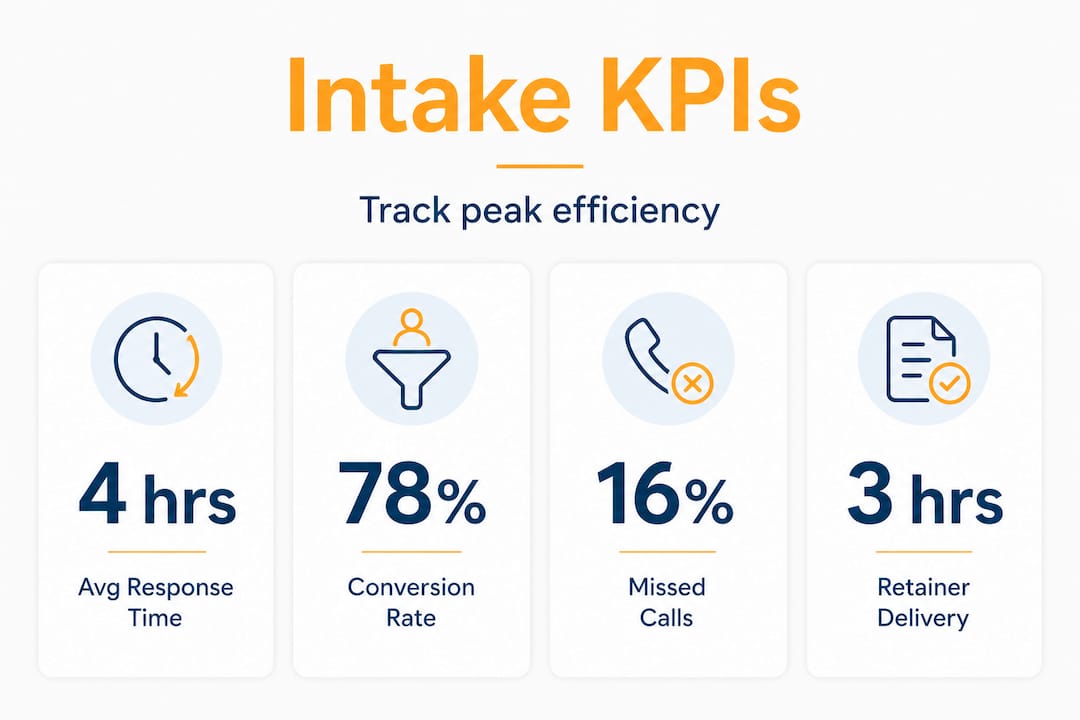
Data-driven adjustments also make it easier to justify investments in technology or staffing. When you can show that response time improved by 30% after implementing automated follow-up, it becomes straightforward to expand those investments with confidence.
Why most intake re-orgs fail — and what really works
Here is the uncomfortable reality: most law firm intake improvement projects fail not because of a lack of tools, but because of a lack of commitment to process change. Firms invest in a new CRM, hire an intake specialist, and expect results. But without redefining how decisions are made, how feedback is delivered, and how leadership engages with intake performance, the new tools just automate the old dysfunction.
Technology does not fix culture. If your team has a habit of skipping follow-up steps because “we already know this client won’t qualify,” no software in the world will stop that from happening. What changes behavior is accountability, and accountability requires leadership visibility.
The firms that see real results from real-world intake improvements share a common trait: the managing partner or firm owner is actively engaged in intake performance. They review call recordings. They sit in on team meetings. They ask about conversion rates by name, not just revenue totals. That involvement signals to the team that intake is a priority, not just an administrative function.
“Your process is only as strong as your weakest link — the follow-up.”
Hiring alone does not fix conversion. Firms often assume that adding another intake specialist will solve the problem. It can help, but if the underlying workflow is broken, you are just adding more people to a broken system. Fix the process first. Then scale it.
Schedule regular call audits where the whole intake team listens to real calls together. The best lessons come from hearing what actually happens on live calls, not what everyone assumes is happening. This kind of transparent, team-based review builds both skill and accountability faster than any training manual can.
Ready to supercharge your intake team?
Building a high-performing intake team is a process, and you do not have to figure it out alone. The steps in this guide give you a solid foundation, but the fastest path to results is combining that structure with expert support and purpose-built tools.
Attorney Assistant specializes in helping PI firms stop leaking revenue through missed calls, slow follow-up, and inconsistent intake. Whether you need a fully managed intake solution or a dedicated lead follow-up service to make sure no inquiry goes unanswered, the tools and team are ready to plug into your operation. You can also join our upcoming intake webinar for a live walkthrough of the strategies that are working right now for firms like yours. If you are ready to start converting more of the leads you already have, reach out today and let’s build a system that works.
Frequently asked questions
What are the key roles in an effective legal intake team?
Key roles include intake specialists, reviewers, and case managers, each with specific responsibilities for ensuring leads are captured, qualified, and promptly followed up, as outlined in best practices for intake staffing.
How can automation improve intake efficiency?
Automation speeds up lead capture, follow-up, and documentation across every stage of the intake process, which directly increases conversion rates and client satisfaction without adding headcount.
What metrics should I track to gauge intake team success?
Track lead response time, lead-to-client conversion rate, missed call rate, and retainer turnaround time to identify bottlenecks and measure the real impact of your intake improvements.
Do I need different intake strategies for after-hours leads?
Yes. Using AI for pre-qualification and unified intake platforms allows your firm to capture, screen, and respond to leads even outside regular business hours, ensuring no inquiry goes cold overnight.
Recommended
Related Articles

Medical Records Coordinator: What the Role Actually Does
A medical records coordinator manages records retrieval, summaries, billing, and liens for law firms. Learn duties, KPIs, and when to outsource vs hire.

Macs for Lawyers: The Hardware and Compatibility Guide
A practical guide to Macs for lawyers covering hardware choices, software compatibility, security tradeoffs, and recommendations by firm size and workflow.

Business Telephone Answering Service for Law Firms
How a business telephone answering service works for law firms, including 24/7 intake, qualification, warm transfers, pricing models, and what