Best PATLive Alternatives for Business Owners in 2026

The strongest PATLive alternatives fall into three categories: hybrid AI-plus-human services built for speed and scale, legal-specialist intake partners that handle retainer signing and conflict checks, and flat-rate providers that eliminate per-minute billing surprises. If you are running a law firm and losing leads to missed calls or slow follow-up, the category you pick matters more than any individual feature list.
Here is the shortlist:
- Attorney Assistant — Legal-specialist intake, 24/7 coverage, retainer signing, CRM integration, and follow-up automation built specifically for law firms
- Smith.ai — Hybrid AI-plus-human with strong CRM integrations and legal intake workflows; per-call pricing
- AIRA — AI-native receptionist with human escalation; well-suited for high-volume, structured intake
- Ruby Receptionists — Brand-focused live answering with warm, personalized service; best for small professional firms
- AnswerConnect — 24/7 live agents with broad industry coverage and flat-rate plans
- Nexa — High-volume live and hybrid answering with legal and medical specialization
- Moneypenny — Dedicated receptionist model with strong brand consistency; UK-origin but US-available
- SureCall Experts — Flexible live answering with customizable scripts and competitive pricing
- Posh Receptionists — App-driven live answering with real-time call management for small businesses
One pricing note worth flagging early: per-minute billing can hide overages, holiday premiums, and after-hours surcharges that multiply costs unpredictably during peak intake periods. Flat-rate or hybrid pricing gives you a predictable monthly number. That tradeoff is the first thing to resolve before you evaluate any vendor on features.
Statistic: Practitioners estimate the true cost of a missed intake call is 4–5x the immediate case value when you factor in lost marketing spend, future referrals, and CRM momentum — for solo personal-injury attorneys, that can mean hundreds of thousands of dollars lost annually at a 35% missed-call rate.
Table of Contents
- How do these PATLive alternatives compare at a glance?
- Detailed profiles: which alternative fits your operation?
- Why do businesses leave PATLive?
- How do you choose the right PATLive alternative?
- How do you switch from PATLive without dropping calls?
- Why do legal firms perform best with hybrid AI-plus-human intake?
- Key Takeaways
- What law firms should fix before they switch answering services
- Attorney Assistant handles the intake work your firm is leaking revenue on
- Sources and further reading
- FAQ
How do these PATLive alternatives compare at a glance?
| Provider | Pricing model | Best for | Coverage | Approach | Legal specialist services | Contract / minimums | Onboarding time | CRM integrations | Bilingual support |
|---|---|---|---|---|---|---|---|---|---|
| Attorney Assistant | Monthly subscription | Legal intake, PI firms | 24/7 | AI + human hybrid | Retainer signing, conflict checks, follow-up, CRM hygiene | Monthly, no long-term lock-in | 1–2 weeks | Clio, MyCase, Lawmatics, others | Yes |
| Smith.ai | Per-call / per-chat | Legal, SMB, e-commerce | 24/7 | AI + human hybrid | Intake forms, appointment booking, lead follow-up | Monthly minimums apply | 3–5 days | Clio, Salesforce, HubSpot | Yes |
| AIRA | Per-minute / flat | High-volume, structured intake | 24/7 | AI-native with human escalation | Scheduling, structured capture | Varies | 1–3 days | Varies by plan | Limited |
| Ruby Receptionists | Per-minute | Small professional firms | Business hours + after-hours | Live human | Appointment booking, message taking | Monthly minimums | 1–2 days | Limited native integrations | Yes |
| AnswerConnect | Flat monthly | SMB, multi-industry | 24/7 | Live human | Appointment booking, lead capture | Month-to-month available | 1–3 days | Salesforce, Zoho, others | Yes |
| Nexa | Per-minute / flat hybrid | Legal, medical, high-volume | 24/7 | Live + AI hybrid | Legal intake, appointment scheduling | Monthly minimums | 3–5 days | Clio, Salesforce | Yes |
| Moneypenny | Monthly flat | Brand-focused, professional services | Business hours + overflow | Dedicated live human | Message taking, appointment booking | Monthly | 3–7 days | Limited | Limited |
| SureCall Experts | Per-minute / flat | SMB, customizable scripts | 24/7 | Live human | Custom scripts, appointment booking | Flexible | 2–5 days | Basic integrations | Yes |
| Posh Receptionists | Per-minute | Small business, app-driven management | Business hours + after-hours | Live human | Message taking, call routing | Monthly minimums | 1–2 days | Limited | Yes |
Pricing reference points (based on published ranges for legal answering services):
- Per-minute plans typically start around $150–$300/month at low volume
- Flat monthly plans start near $199/month and scale to $300–$2,200/month depending on included minutes and integrations
- Legal-specialist services with retainer signing and CRM integration sit toward the higher end of that range, but the operational ROI is proportionally larger
Detailed profiles: which alternative fits your operation?
Attorney Assistant
Attorney Assistant is built for law firms that are losing revenue at the intake stage, not for general business call answering. The core offering covers 24/7 phone and reception coverage, legal intake, retainer agreement signing, CRM hygiene, lead follow-up, and back-office workflows like medical record retrieval and lien verification. It operates on a subscription model with no long-term contract lock-in.
Strengths:
- Handles the full intake-to-signed-retainer workflow, not just message taking
- Native integration with Clio, MyCase, Lawmatics, and other legal CRMs
- AI-plus-human hybrid model with documented escalation rules
- Dedicated legal assistant staffing available for small to mid-sized PI firms
- Automated follow-up and speed-to-lead enforcement built into the workflow
Limitations:
- Designed specifically for law firms; not a fit for general business call answering
- Pricing is subscription-based; not structured for very low call volumes
Best for: Personal injury and contingency-fee law firms with consistent lead volume that need intake, follow-up, and CRM integration handled as a single operational system.
Onboarding: Typically 1–2 weeks, with CRM field mapping and script validation included.
Pro Tip: Ask any intake vendor to walk you through what happens after the call ends. If the answer is “we send you a message,” that is a message-taking service, not an intake partner. The difference shows up in your conversion rate within 30 days.
Smith.ai
Smith.ai uses a hybrid model where AI handles initial screening and humans take over for complex or sensitive calls. It covers legal intake, appointment booking, lead follow-up, and live chat alongside phone answering. Pricing is per-call or per-chat, which keeps costs predictable at moderate volume but can climb at high volume.
Strengths:
- Strong CRM integrations (Clio, Salesforce, HubSpot, and others)
- Legal intake workflows with conflict-check support
- 24/7 coverage with bilingual agents
- Transparent per-call pricing
Limitations:
- Per-call pricing can become expensive for high-volume firms
- Less depth on back-office legal tasks (record retrieval, lien verification) compared with legal-specialist partners
Best for: Small to mid-sized law firms and professional services businesses that want a proven hybrid model with solid CRM integration.
AIRA
AIRA leads with AI-native call handling and routes to human agents when the AI reaches its confidence threshold. The model works well for structured, high-volume intake where the call script is predictable. It is less suited to emotionally complex legal calls where a human needs to be present from the first sentence.
Strengths:
- Fast AI-first response; minimal hold time
- Handles structured data capture and scheduling at scale
- Cost-efficient at high volume
Limitations:
- Human escalation is reactive, not proactive; some sensitive calls may not trigger escalation early enough
- Limited legal-specialist workflow depth (retainer signing, conflict checks)
Best for: High-volume businesses with predictable call scripts and lower emotional complexity per call.
Ruby Receptionists
Ruby is the brand-experience play in this category. Live agents answer in the firm’s name, follow custom scripts, and prioritize warmth and consistency. The service runs on per-minute billing, which works well at low to moderate volume but punishes firms with unpredictable call spikes.
Strengths:
- Consistently high agent quality and brand voice alignment
- Bilingual support included
- Strong reputation for caller experience
Limitations:
- Per-minute billing with monthly minimums; costs spike during busy periods
- Limited legal-specific workflow capability (no retainer signing, limited CRM integration)
- Not built for high-volume or complex intake
Best for: Small professional firms, solo practitioners, or boutique practices where caller experience and brand voice matter more than intake depth.
AnswerConnect
AnswerConnect offers 24/7 live agent coverage with flat monthly pricing, which removes the per-minute billing anxiety. It covers a broad range of industries and provides appointment booking, lead capture, and basic CRM integrations. The trade-off is that it is a generalist service without legal-specific workflow depth.
Strengths:
- Flat monthly pricing; predictable costs
- 24/7 live coverage with bilingual support
- Month-to-month contracts available
- Integrates with Salesforce, Zoho, and other mainstream CRMs
Limitations:
- No retainer signing, conflict checks, or legal-specific intake workflows
- Agent training is generalist; legal nuance requires additional scripting work from the firm
Best for: Small businesses and multi-industry operations that want predictable flat-rate pricing and 24/7 coverage without legal-specialist requirements.
Nexa
Nexa operates at the intersection of live answering and AI-assisted intake, with specific experience in legal and medical verticals. It offers per-minute and flat hybrid pricing, 24/7 coverage, and integrations with Clio and Salesforce. Monthly minimums apply, so it fits firms with consistent call volume better than sporadic-call operations.
Strengths:
- Legal and medical vertical experience
- 24/7 coverage with bilingual agents
- Clio integration for legal firms
- AI-assisted intake with human oversight
Limitations:
- Monthly minimums can make it expensive for lower-volume firms
- Onboarding takes 3–5 days; not the fastest to deploy
Best for: Mid-sized legal and medical practices with consistent call volume that want a hybrid model with vertical-specific experience.
Moneypenny
Moneypenny assigns a dedicated receptionist (or small team) to each client, which produces strong brand consistency and caller familiarity. It originated in the UK but operates in the US market. Coverage is primarily business hours with overflow options, and pricing is flat monthly. CRM integration depth is limited compared with legal-specialist services.
Strengths:
- Dedicated receptionist model; callers reach the same person repeatedly
- Strong brand consistency and professional tone
- Flat monthly pricing
Limitations:
- Limited 24/7 coverage; primarily business hours with overflow
- Minimal legal-specific workflow capability
- CRM integration options are narrower than legal-focused competitors
Best for: Professional services firms where caller relationship continuity and brand voice are the primary concerns.
SureCall Experts
SureCall Experts offers flexible live answering with customizable scripts and competitive pricing across per-minute and flat-rate structures. It covers 24/7 and provides bilingual support. The service is a solid generalist option for small businesses that need custom call handling without paying for legal-specialist depth they do not need.
Strengths:
- Flexible pricing structures
- Customizable scripts and call flows
- 24/7 coverage with bilingual agents
- Fast onboarding (2–5 days)
Limitations:
- Generalist service; limited legal intake workflow capability
- Basic CRM integrations; not suitable for firms requiring native Clio or MyCase logging
Best for: Small businesses with custom scripting needs and moderate call volume that do not require legal-specific intake workflows.
Posh Receptionists
Posh differentiates on its mobile app, which lets business owners manage calls, set availability, and review messages in real time. Live agents handle calls during business hours and after-hours overflow. Per-minute billing applies, and CRM integration is limited. It is a strong fit for solo operators or very small teams that want hands-on call management visibility.
Strengths:
- Real-time call management via mobile app
- Live human agents with bilingual support
- Fast onboarding (1–2 days)
Limitations:
- Per-minute billing; costs scale with volume
- Limited CRM integration
- Not suited for legal intake complexity
Best for: Solo practitioners or very small businesses that want live answering with real-time visibility and control via a mobile interface.
Why do businesses leave PATLive?
The most common reason firms switch is billing unpredictability. Per-minute billing hides holiday premiums, after-hours surcharges, and rounding rules that only surface on the invoice. A firm that budgets $500/month can easily see $900 in a peak intake month without changing call behavior.
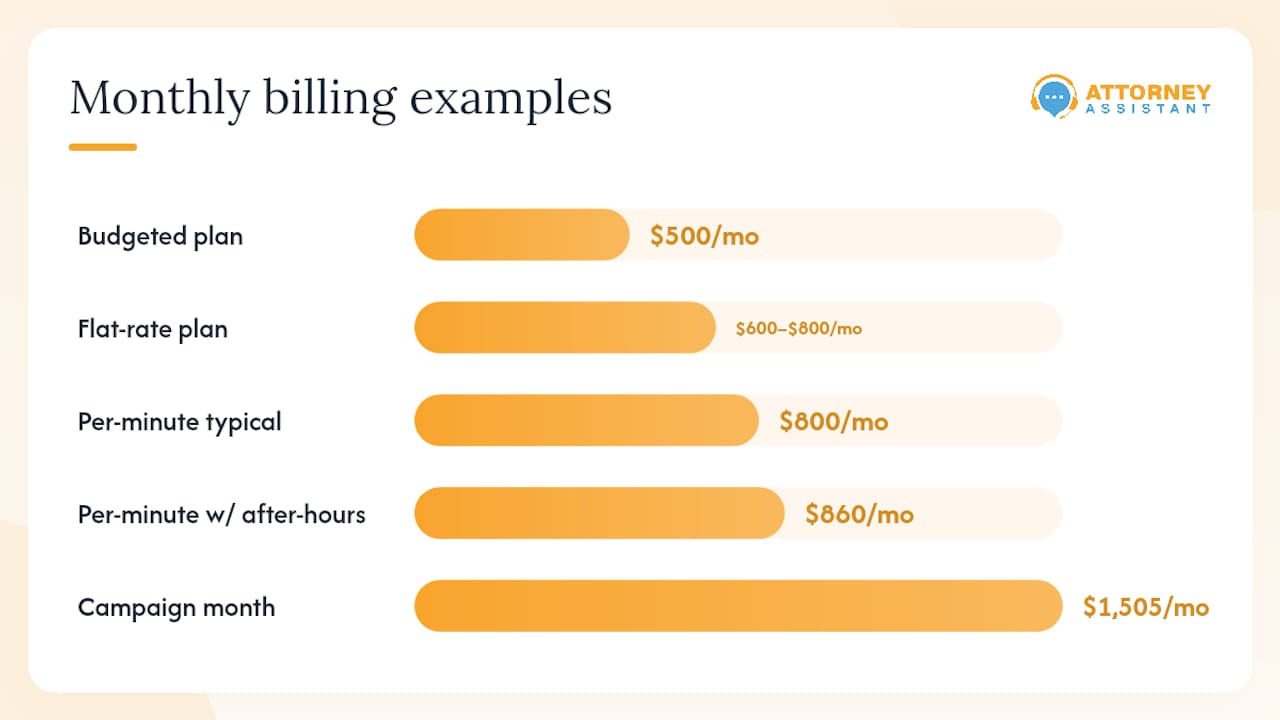
Here is a simple illustration: at $1.25 per minute, a firm averaging 8-minute calls at 80 calls per month pays $800. Add a 20% after-hours surcharge on 30% of those calls and the bill climbs to $860. During a campaign month with 140 calls, the same math produces $1,505 before any holiday premiums. Flat-rate plans at $600–$800/month would have been cheaper in both scenarios.
Beyond billing, the other common pain points are:
- Inconsistent agent quality. Generic answering services rotate agents with no legal training. Callers describing a car accident or a workplace injury need a consistent, empathetic script, not a message pad.
- Weak CRM integration. If the vendor sends a text or email summary instead of logging directly into Clio or MyCase, the firm still faces manual data entry and loses speed-to-lead. Automated missed-call follow-up under 60 seconds requires a coordination layer connecting VoIP, SMS, and CRM APIs — a text summary does not come close.
- No legal intake depth. Generic answering services act as message-takers; legal-focused partners handle intake workflows end-to-end, including retainer signing and conflict checks.
- Slow follow-up. A vendor that batches messages or sends end-of-day summaries is not enforcing speed-to-lead. The first firm to call back wins the case.
- Monthly minimums with no flexibility. Paying for 200 minutes when you used 120 is a recurring tax on low-volume months.
Statistic: Practitioners estimate the true cost of a missed intake call is 4–5x the immediate case value when lost marketing spend, future referrals, and CRM momentum are included. For a personal injury firm, that math adds up fast.
Reputation signals to check before switching:
- G2 and Trustpilot reviews specifically mentioning billing disputes or surprise charges
- Response time to your own test calls (call as a prospect before signing)
- Whether the vendor publishes SLA metrics (answer rate, average speed to answer)
- Trial period availability and data export terms
How do you choose the right PATLive alternative?
Start with pricing shape, not features. If your call volume is consistent and predictable, flat-rate wins. If volume swings month to month, a hybrid pricing model with a flat base and per-call overage is safer than pure per-minute. Model your peak month before you sign anything.
Then match intake complexity to the human-versus-AI decision. A firm handling personal injury intake needs a human on the line for sensitive conversations. AI can handle structured data capture, scheduling, and initial qualification, but AI must not give legal advice and should escalate conflict-risk or emotional calls to humans. A vendor that cannot explain its escalation rules in writing is not ready for legal intake.
Prioritized demo questions:
- Show me a live intake call from first ring to CRM entry. How long does it take?
- Which CRMs do you integrate with natively, and what data fields do you create automatically?
- How do you handle conflict-check requests during intake?
- What is your documented answer rate and average speed to answer?
- Can you show me a sample intake script for a personal injury call?
- What is your onboarding timeline, and what does the firm need to provide?
- How do you handle after-hours calls differently from business-hours calls?
- What are your cancellation terms and data export SLA?
Red flags during evaluation:
- Vague minute-counting rules (“we round to the nearest minute” with no definition of when timing starts)
- No named CRM integrations; “we can integrate with most systems” is not an integration
- No trial or demo environment; vendors confident in their product offer both
- Poor data export terms; you should own your call logs and contact records
Pro Tip: Before signing, run a billing simulation. Give the vendor your last three months of call data and ask them to calculate what your bill would have been under their pricing model. If they refuse or cannot do it, that tells you everything about how transparent the billing will be.
A free intake audit tool can help you baseline your current call volume and missed-call rate before you start vendor conversations.
How do you switch from PATLive without dropping calls?
The risk in any service switch is a coverage gap during the transition. A 30/60/90-day migration plan eliminates that risk.
Phase 1: Preparation (Days 1–30)
- Export all call logs, contact records, and phone number porting documentation from PATLive before you give notice.
- Map your CRM fields to the new vendor’s intake form. Confirm which fields the new vendor creates automatically via API.
- Set up a test forwarding number with the new vendor and run live test calls through the full intake workflow.
- Validate the conflict-check process, retainer signing flow, and bilingual script with the new vendor.
- Confirm SMS and callback automation rules are active and tested.
- Review your PATLive contract for cancellation windows and minimum notice periods.
Phase 2: Parallel run (Days 31–60)
- Forward a portion of calls to the new vendor while keeping PATLive active. Compare call recordings, CRM entries, and follow-up speed between the two.
- Identify any script gaps or escalation failures in the new vendor’s handling.
- Confirm that CRM entries are creating contacts correctly and triggering automated follow-up within your target window.
- Adjust scripts and escalation rules based on real call data.
Phase 3: Cutover and review (Days 61–90)
- Port your main business number to the new vendor once parallel testing confirms quality.
- Cancel PATLive in writing, confirming the final billing date and data export deadline.
- Run a 30-day post-cutover review: answer rate, speed-to-lead, CRM entry accuracy, and conversion rate versus the prior period.
- Set escalation rules and SLA review cadence with the new vendor for ongoing quality management.
Porting note: Number porting typically takes 7–14 business days. Never cancel your current service before porting is confirmed complete. Overlap billing for 2–4 weeks is cheaper than a coverage gap.
For a detailed look at common intake challenges that cost firms clients during transitions, that resource maps the failure points most firms miss.
Why do legal firms perform best with hybrid AI-plus-human intake?
The answer is operational, not philosophical. Hybrid models handle routine intake via AI while humans address exceptions and sensitive conversations. For a personal injury firm, that split looks like this: AI captures name, contact, incident date, and injury type; a human takes over the moment the caller becomes distressed, describes a complex liability situation, or triggers a conflict-check flag.
Pure human services scale poorly. Adding call volume means adding headcount, which adds cost and inconsistency. Pure AI lacks the empathetic nuance that closes a distressed caller on a retainer conversation. AI intake recovers staff hours and improves qualification consistency, but human handoffs remain necessary for high-value or emotional calls. The hybrid model captures both advantages without the ceiling of either.
What to require from a hybrid vendor:
- Native CRM integration that creates contacts automatically, not via email summary
- Documented escalation rules: which call types trigger human handoff and within what timeframe
- Automated conflict-check workflow that flags potential conflicts before the intake conversation ends
- Retainer-signing capability within the intake flow, not as a separate manual step
- Bilingual scripts validated by a native speaker, not machine-translated
“Legal-operations experts say the top mistake when switching services is picking a vendor that lacks legal-specific workflows. A vendor that can sign retainers, fetch records, and run conflict checks acts like an operational extension rather than a message-taker.” — AI voice agent vs live answering service (small business)
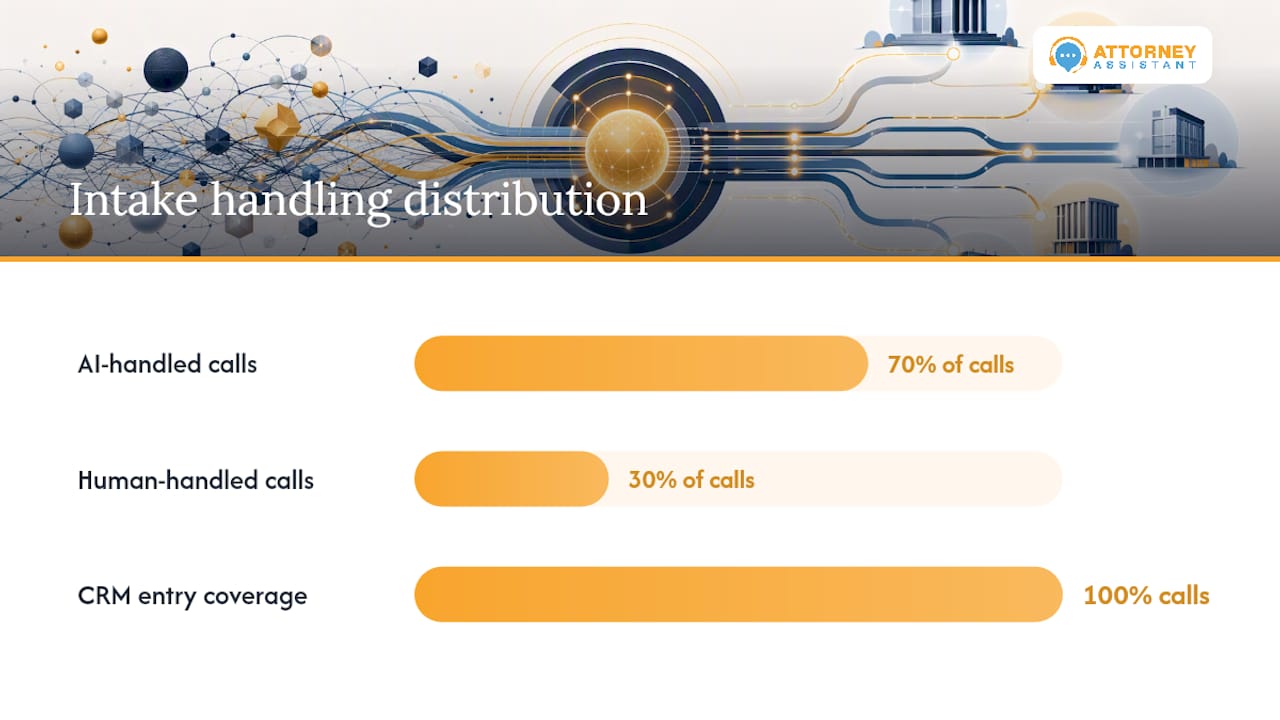
Process-focused example: A PI firm running 150 intake calls per month implemented a hybrid model where AI handled initial data capture and scheduling for 70% of calls. Human agents handled the remaining 30%, which included all calls flagged for emotional distress, complex liability, or potential conflicts. The result was consistent CRM entry on 100% of calls and faster speed-to-lead on the AI-handled volume, while human agents focused their time on the calls that actually required empathy and judgment.
Pro Tip: When piloting a hybrid model, run it for 30 days on a single practice area before rolling it out firm-wide. You will catch script gaps and escalation failures on a contained volume before they affect your highest-value intake pipeline.
For more on AI-driven intake conversion rates in legal contexts, that resource covers the operational mechanics in detail.
Key Takeaways
The strongest PATLive alternatives for law firms combine hybrid AI-plus-human intake, native CRM integration, and flat-rate or subscription pricing that eliminates per-minute billing surprises.
| Point | Details |
|---|---|
| Pricing model first | Model your peak call month before signing; flat-rate plans typically outperform per-minute billing for firms with consistent or growing volume. |
| Legal intake requires specialists | Generic answering services take messages; legal-specialist partners handle retainer signing, conflict checks, and CRM logging as part of the intake workflow. |
| Hybrid AI-plus-human wins | AI handles structured capture and scheduling; humans handle distressed callers, conflict flags, and retainer conversations — the split improves both speed and conversion. |
| Migration needs a parallel run | Run new and old vendors simultaneously for 30–60 days before porting your main number; this prevents coverage gaps and validates CRM entry quality. |
| Attorney Assistant for PI firms | Attorney Assistant covers the full intake-to-signed-retainer workflow with 24/7 coverage, CRM integration, and follow-up automation built for personal injury and contingency-fee firms. |
What law firms should fix before they switch answering services
Most firms shopping for a PATLive replacement are solving the wrong problem. They focus on which vendor answers calls. The real question is what happens in the 10 minutes after the call ends.
If a caller reaches a live agent but the intake data sits in an email summary for two hours before anyone logs it into the CRM, the firm has not fixed its speed-to-lead problem. It has just moved the bottleneck. The vendor is not the failure point. The workflow is.
The firms that see the biggest conversion improvement after switching are the ones that fix three things simultaneously: they enforce speed-to-lead (the CRM entry and follow-up trigger within minutes, not hours), they embed intake into the CRM so there is no manual data-entry step, and they stop paying for per-minute billing that punishes growth.
Per-minute billing is a structural problem, not a vendor-quality problem. A service that charges by the minute has no incentive to keep calls short or efficient. A subscription or flat-rate model aligns the vendor’s incentives with the firm’s: more qualified leads converted, not more minutes billed.
The other thing firms underestimate is follow-up frequency. A single callback attempt is not follow-up. High-frequency, multi-touch follow-up over the first 48 hours after an inquiry is what converts a warm lead into a signed case. Most generic answering services do not touch this at all.
If you want to see what intake looks like when it is working, the place to start is a call with someone who has fixed it for firms like yours.
Attorney Assistant handles the intake work your firm is leaking revenue on
Law firms switching from PATLive typically have one of two problems: unpredictable billing that spikes every busy month, or a vendor that takes messages instead of closing intake. Attorney Assistant solves both.
Attorney Assistant provides 24/7 intake coverage, retainer agreement signing, automated lead follow-up, and native CRM integration for personal injury and contingency-fee law firms. The model is subscription-based with no per-minute billing surprises. Every call that comes in gets logged, followed up, and tracked through to a signed retainer or a qualified disqualification, not dropped into an email summary.
What a pilot includes: CRM field mapping, intake script validation, conflict-check workflow setup, bilingual script review, and a 30-day conversion baseline so you can measure the difference against your current numbers.
The firms that benefit most are small to mid-sized PI firms that are spending on marketing but not converting the leads they already have. If that describes your operation, book a call to see the intake workflow in action, or register for the next live webinar to see how other firms have fixed the same problem.
Sources and further reading
The research and resources below support the pricing figures, hybrid model evidence, missed-call cost analysis, and CRM integration guidance in this article.
- 24/7 Legal Answering Service: AI vs Human vs Hybrid — Covers how hybrid models split AI and human responsibilities in legal intake and why escalation rules matter.
- AI voice agent vs live answering service (small business) — Explains why generic answering services fail legal intake and what legal-specific workflows require.
- Live-call answering services (blog) — OnDial — Details per-minute billing risks, hidden surcharges, and the case for fixed-rate pricing.
- What Missed Calls Actually Cost Your Law Firm (With Real Numbers) — Quantifies the 4–5x multiplier on missed intake call cost including referral and CRM momentum loss.
- Law Firm Missed Call Follow-Up Automation 2026 — US Tech Automations — Benchmarks for automated follow-up speed and CRM API integration requirements.
- Legal Answering Service: 2026 Buyer’s Guide — ServiceAgent — Pricing ranges ($150–$2,200/month), buyer questions, and vendor evaluation criteria.
- AI intake vs human intake: What the data says — Kerri James — Practitioner analysis of recovered staff hours and the limits of pure AI intake for emotional calls.
- Top 10 PATLive Alternatives and Competitors in 2026 — G2 — User reviews and competitive positioning data for PATLive and its alternatives.
- Common Intake Challenges That Cost Law Firms Clients — Attorney Assistant — Maps the operational failure points most firms miss during service transitions.
- AI in law firm intake: 35% higher conversion rates — Attorney Assistant — Data and case examples on AI-driven intake conversion improvements for legal firms.
- Attorney Assistant lead follow-up services — Primary conversion page for firms ready to fix intake and follow-up gaps.
FAQ
What is the main difference between PATLive and its alternatives?
PATLive uses live human agents on a per-minute billing model. The strongest alternatives offer flat-rate or subscription pricing, hybrid AI-plus-human models, and legal-specific workflows like retainer signing and CRM integration that PATLive does not provide natively.
Which PATLive alternative is best for law firms?
Attorney Assistant is built specifically for law firms, covering 24/7 intake, retainer signing, conflict-check workflows, and native CRM integration with Clio, MyCase, and Lawmatics. Smith.ai and Nexa are also strong options for legal firms that want a hybrid model with CRM integrations.
How much do PATLive alternatives typically cost?
Legal answering services range from roughly $150–$300/month for entry-level per-minute plans to $300–$2,200/month for flat-rate or hybrid plans with legal-specific integrations, based on published pricing ranges for the category.
How long does it take to switch from PATLive to a new service?
A safe migration runs 60–90 days: 30 days of preparation and testing, 30 days of parallel operation, then cutover once quality is confirmed. Number porting alone takes 7–14 business days, so plan accordingly before canceling your current service.
What should I ask a vendor before signing a contract?
Ask for a live demo of the full intake-to-CRM-entry workflow, named integration documentation, your cancellation terms, data export SLA, and a billing simulation using your actual call volume from the past three months.
Recommended
Related Articles

Best AnsweringLegal.com Alternatives for Law Firms 2026
Discover the best answeringlegal.com alternatives for law firms. Explore options like Attorney Assistant and optimize your client intake process.

Case Management Notes: A Law Firm's How-To Guide
Learn how to write case management notes that hold up, with a defensible structure, privilege safeguards, handoff tips, and a smarter way to staff the work.

Medical Records Coordinator: What the Role Actually Does
A medical records coordinator manages records retrieval, summaries, billing, and liens for law firms. Learn duties, KPIs, and when to outsource vs hire.