
The most popular advice in personal injury lead generation is to shop harder: find a cheaper vendor, negotiate the per-lead price, add a second supplier, turn up the ad budget. I'd push back on all of it. The sharper question is what your firm does in the first hour after someone calls, submits a form, or emails, because that hour decides whether the lead you paid for becomes a signed case or a row in a spreadsheet nobody opens. A Harvard Business Review study of 1.25 million leads across 42 companies, summarized by Voiso, found that organizations attempting contact within one hour were nearly seven times more likely to qualify a lead than those waiting one more hour, and more than 60 times more likely than those waiting at least 24 hours.
So every option below gets judged on the work it drops on your intake desk: how much screening you have to redo, how fast the first response has to be, how many follow-up attempts the lead will need, and what a signed case costs once you count all of it. Cheap leads that need six callbacks and a full re-interview aren't cheap. If you'd rather build demand than buy it, SEO tactics for personal injury firms cover the acquisition side. This list covers what happens next.
Table of Contents
- 1. Attorney Assistant
- 2. Lead Search Pros
- 3. PinPoint Legal Marketing
- 4. First Intent Leads
- 5. Premier Kingdom Leads
- 6. Scorpion
- 7. Hennessey Digital
- How the Seven Options Differ on Model, Published Pricing, and Best Fit
- Where Signed Cases Actually Come From
1. Attorney Assistant
Most firms shopping for lead sources don't have a lead problem. They have an operations problem wearing a lead problem's clothing. Attorney Assistant is built around that observation, and it's the reason it sits first here: it's the only option on this list that adds the people who answer, qualify, follow up, and then carry the file.
Intake that signs, not intake that takes messages
Frontline is our 24/7 live intake team, and it's built to answer and sign cases rather than promise a callback. Outbound follow-up runs up to five attempts per lead, covering forwarded lead emails, website form submissions from sources like Facebook and Google, and CRM status changes. Lead recovery is built in and priced by completed action, so you pay for work performed rather than someone sitting near a phone. In lead recovery, every call, form, and chat inquiry is captured in real time, screened against your criteria, and delivered to your team with full context attached.
That distinction matters more than any vendor's price sheet. Consumer research cited in Hennessey Digital's ranking of the fastest-responding personal injury firms found that 72% of prospective legal clients move on if they don't hear back within 24 hours.
Taking a message is not intake. Intake ends with a qualified prospect, a scheduled consultation, or a signed retainer.
The part after the signature
Staffline provides dedicated full-time legal support professionals who work with one firm, 40 hours a week, inside your systems. Once a lead signs, that assistant takes over records, liens, drafting, and administration, which is where most growing firms stall. The results are specific: one Staffline assistant signed 109 cases in 30 days for a high-volume personal injury firm, and at an $8,000 average personal injury case value, a single Staffline seat generated $872,000 in pipeline revenue.
The trade-off is honest work on your side. We co-manage performance, but your firm still has to define case-fit criteria, jurisdiction limits, and what "qualified" means, then train the team on your workflows. Frontline signs the case. Staffline carries it. If your criteria live in a partner's head, fix that before you buy anything from anyone on this list.
2. Lead Search Pros
Say a vendor sells you an exclusive motor-vehicle-accident inquiry for a few hundred dollars. Exclusivity is worth something, because you're not racing four other firms to the same phone number. It just doesn't buy you a client.
Lead Search Pros' personal injury lead program offers exclusive inquiries across motor-vehicle accidents, premises liability, medical malpractice, and wrongful death, delivered in real time to an intake team, CRM, or call center. The company describes screening for incident date, injury and treatment status, location, contactability, and consent, and publishes typical pricing of $150 to $450 per exclusive lead depending on market, case type, and volume.
Run that against signed-case economics before you commit. A 2026 personal injury marketing benchmark from Pioneerly reports an average cost per lead of $337 and an average cost per signed case of $3,123, with top-quartile operators at $1,693. Those are directional industry estimates, not audited market statistics, so validate them against your own jurisdiction and matter mix.
What your team must do next:
- Re-verify the screening: Ask which fields the vendor confirms by phone versus which the consumer typed into a form, then have intake re-confirm incident date, treatment status, and prior representation on the first call.
- Get the replacement terms in writing: Invalid lead, duplicate, unreachable, already represented, and out-of-state each need a defined outcome and a deadline.
- Track signed cases by supplier: Tag every inquiry at the source in your CRM and judge the vendor on retained matters, not delivered volume. Our guide to law firm lead generation walks through the funnel math.
Exclusive leads punish slow intake less than shared leads do, but they still punish it.
3. PinPoint Legal Marketing
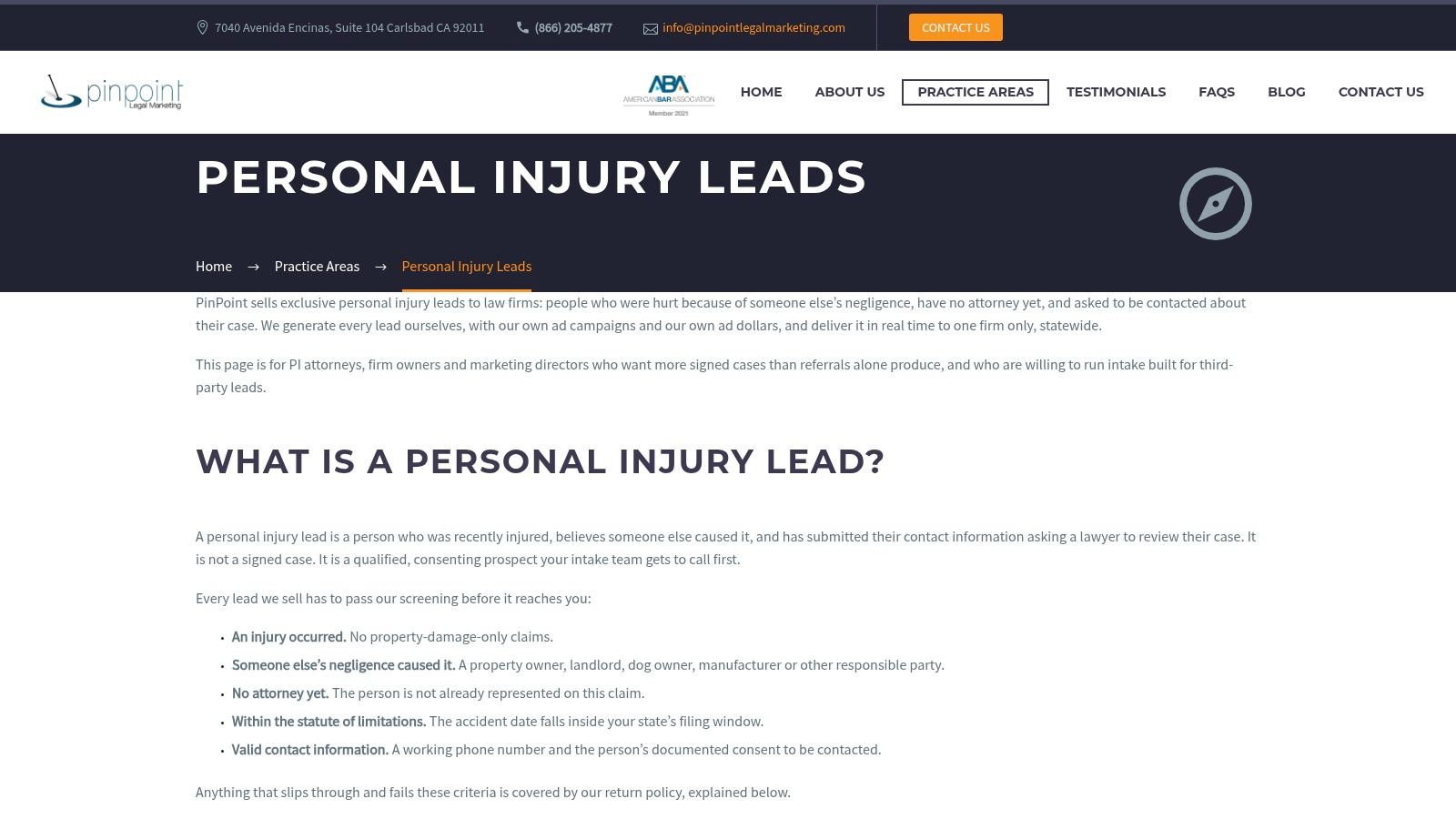
Case mix is the thing firms skip and then complain about. PinPoint Legal Marketing's personal injury lead page says it generates leads through its own campaigns rather than reselling another vendor's inventory, delivers to one firm, and describes screening for injury, alleged negligence, existing representation, filing-window timing, contact details, and consent. Its general personal injury product leans toward premises-liability matters, with car-accident and workers' compensation leads sold as separate products. Pricing is by quote.
That's a feature if you want slip-and-fall work and a problem if your docket is built on rear-end collisions. Premises cases carry a different evidentiary burden, so your intake script needs notice, incident reports, property ownership, and surveillance-preservation questions ready on the first call.
The bigger gap is what happens after the screen. In Clio's 2024 Legal Trends research, 84% of firms that responded to emails did so within eight hours, but only 18% supplied clear next steps or cost information. Answering fast and then leaving the prospect guessing is a half-finished job.
Practical rule: every first contact ends with a named next step, a time, and a person responsible for it.
Your team's work here is to write the case-type-specific qualification questions before the leads arrive, decide who owns the consult booking, and confirm the return policy against the case types you accept. Buying premises leads and then screening them with a car-accident script is how firms end up paying twice. These strategies for generating higher-quality legal marketing leads are worth reading before you sign a quote-based agreement.
4. First Intent Leads
Format changes the workload more than price does. A form lead needs an outbound call. An inbound call needs someone live. A warm transfer needs someone live right now, with no second chance.
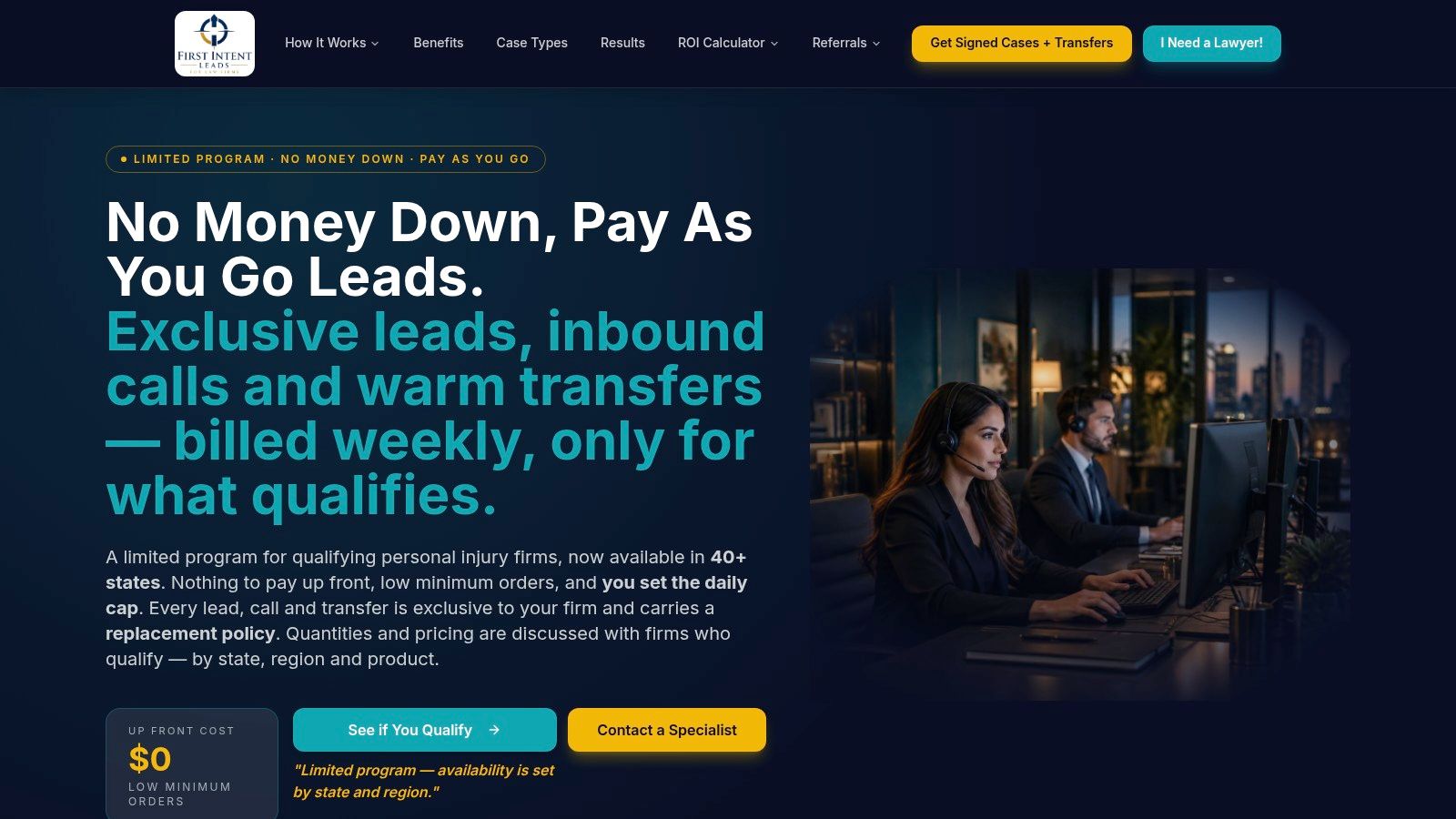
First Intent Leads' pay-as-you-go program offers exclusive motor-vehicle-accident form leads, consumer-initiated inbound calls, and warm transfers, with no upfront payment for qualifying firms, low minimum orders, weekly billing, a replacement policy, and stated coverage in more than 40 states. Pricing is market-specific and requires a quote.
Low commitment makes this a reasonable testing ground, and testing three formats side by side tells you more than any sales deck. Just staff the test properly. A 2024 mystery-shopper benchmark of nearly 1,400 law firms covered by Hennessey Digital found a median online-lead response time of 13 minutes, with only 25.5% of firms responding within five minutes and 55.1% within one hour.
If your firm sits at the median, warm transfers will ring out and form leads will get one attempt. What to do next: set a sub-five-minute acknowledgment target with automated escalation for anything unanswered, confirm in writing which replacement exclusions apply to transfers versus forms, and log contact rate separately for each format. Then compare them on signed cases, which is the only comparison that settles the argument. Our breakdown of converting more leads into signed cases for injury firms covers the follow-up cadence in detail.
5. Premier Kingdom Leads
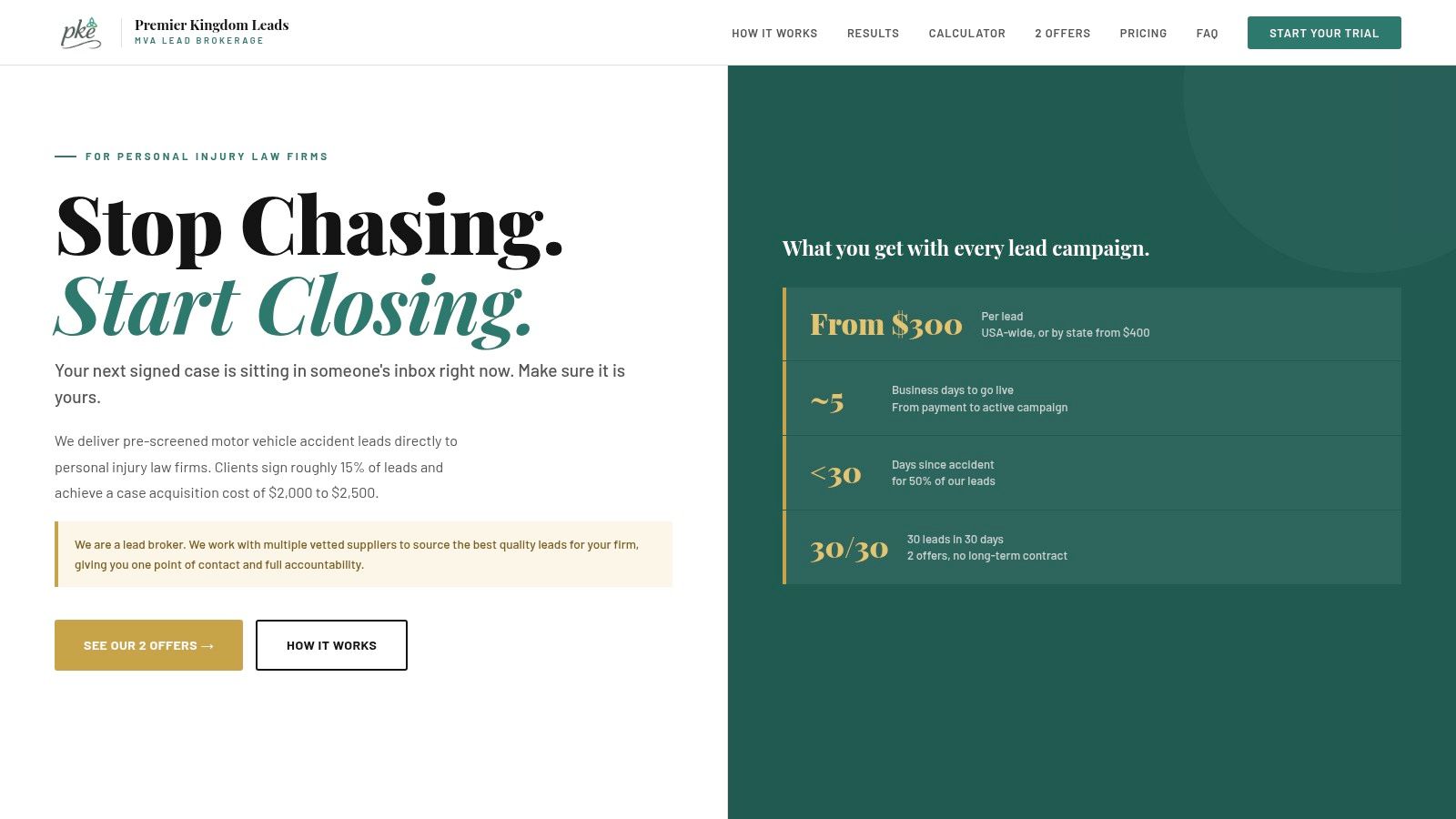
Brokered supply needs a different kind of diligence. Premier Kingdom Leads focuses on pre-screened motor-vehicle-accident leads and identifies itself as a broker working with multiple suppliers. It advertises opt-in leads, injury confirmation during intake, real-time email delivery, trial offers, and coverage across 48 states, with a nationwide offer listed at $300 per lead and state-targeted leads from $400. The nationwide offer doesn't allow state selection, per the site.
When a vendor aggregates from several upstream sources, consent provenance becomes your problem, not theirs. Scorpion's 2025 Legal Consumer Insights report describes the FCC's one-to-one consent rule scheduled to take effect January 27, 2025, changing how lead generators obtain permission for automated calls and texts, and notes that injury inquiries can contain sensitive personal information while some states require both parties to consent to call recording.
Before a trial order, your team should:
- Demand the consent artifact: the actual form text, the named attorney or firm the consumer consented to contact, the timestamp, and the source URL, stored where you can retrieve it.
- Confirm lead origin per batch: which supplier produced it, how recently the consumer submitted it, and whether it was routed to anyone else.
- Check your recording notice: if intake calls are recorded, the disclosure has to match the strictest state you call into.
A trial is a fine way to test contactability. It's a poor way to discover that your tracking can't prove consent. Unusable or unlawfully contacted leads aren't inexpensive leads, they're liabilities with a discount.
6. Scorpion
Agency relationships get judged on the wrong number. Clicks and form fills are easy to report and easy to celebrate, and neither pays a paralegal.
Scorpion's personal injury marketing offering combines SEO, paid advertising, local search, video, and social with case-specific landing pages, intake features including AI chat and lead scoring, and reporting the company says can track signed cases, case value by channel, and cost per signed client. That reporting orientation is the right one. Pricing is quote-based, and some SEO and marketing technology services typically run on 12-month terms, so confirm fees, ad spend, deliverables, and who owns the data before signing.
Here's the arithmetic that keeps everyone honest. In a study reported by Pareto Legal's legal client intake statistics, personal-injury pay-per-click leads converted to signed cases at 6.7% in 2026. At that rate, a channel producing plenty of inquiries can still produce very few retainers, and no dashboard fixes that on its own.
An agency can deliver the inquiry. It cannot make your intake team pick up the phone at 9:40 on a Saturday.
What your team must do next: insist on signed-case and case-value reporting by channel rather than lead totals, define "qualified" once and apply it identically across every source, and feed qualified and signed outcomes back into the ad platforms so they optimize toward clients instead of form fillers. Then check whether your intake capacity can absorb the volume the agency is about to generate. Adding traffic to a bottleneck just makes a longer queue.
7. Hennessey Digital
Buying leads means renting someone else's pipeline. Building your own channels costs more patience upfront and pays back in compounding volume. Hennessey Digital's law firm marketing services cover SEO, paid media, content, social, and website work for personal injury, car-accident, and medical-malpractice practices, and the agency audits existing marketing before proposing a strategy. A free digital marketing audit is the entry point. Hennessey Digital does not publish pricing, so expect a custom quote after the audit.

The trade-offs are familiar to anyone who's waited on rankings. SEO takes time and depends on competition, budget, and market, while paid search delivers inquiries immediately at a price that reflects how competitive injury keywords are. Neither comes with a fixed per-lead price tag, and neither includes the people who answer. That last part is your payroll, not theirs.
Hennessey also publishes the research that makes this point better than I can. Its 2023 law firm lead form response time study submitted test inquiries through the online forms of 1,300 U.S. law firms and found that 73% replied in 2023, up from 59% in 2021, with median response time falling to 20 minutes. Improvement, and still a lot of unanswered forms.
Firm-owned leads arrive with your name already attached, which is a real advantage. It evaporates if the first reply is a form email. Before you fund a build, assign an owner for after-hours coverage, write the multi-attempt follow-up cadence, and decide who signs off on qualification standards. Otherwise you're paying an agency to introduce prospects to your voicemail.
How the Seven Options Differ on Model, Published Pricing, and Best Fit
Price is the laziest way to compare these seven. A $300 lead that reaches a voicemail is more expensive than a $450 lead that reaches a trained intake specialist in five minutes. Read the table below with one question in mind: what does your intake and follow-up have to absorb after the lead arrives?
| Item | Model | Published pricing | Best fit |
|---|---|---|---|
| Attorney Assistant | Co-managed legal operations and virtual staffing | Transparent month-to-month pricing with no setup fees; Frontline is priced per completed action, with 75 credits included monthly and overage billed per credit | Firms seeking intake coverage and legal operations support without hiring in-house |
| Lead Search Pros | Exclusive pay-per-lead provider | $150–$450 per exclusive lead | Firms seeking screened personal injury leads and able to measure cost per signed case |
| PinPoint Legal Marketing | Vendor-run lead generation | Quote-based | Firms seeking screened leads, especially premises-liability prospects |
| First Intent Leads | Pay-as-you-go leads, calls, and warm transfers | Market-specific pricing by quote | Qualifying firms testing lead formats with lower upfront commitment |
| Premier Kingdom Leads | Brokered, pre-screened auto-accident leads | Nationwide offer at $300 per lead; state-targeted leads from $400 | Firms seeking motor-vehicle-accident leads with trial options |
| Scorpion | Full-service legal marketing and technology agency | Quote-based | Firms seeking an integrated marketing, intake, and reporting partner |
| Hennessey Digital | Legal digital marketing agency | Not publicly available | Personal injury firms building their own paid and organic lead channels |
Three distinct purchases hide inside that table. The per-lead vendors sell you a name and a phone number, and your team owns everything after that: first-hour response, multi-attempt follow-up, screening against your criteria, signing. The agencies sell you a channel that generates inquiries over time, which means your team owns the same list plus a retainer. Attorney Assistant is the odd one out because it sells the response itself rather than the lead, which only makes sense if you already have lead flow worth answering.
Quote-based pricing is not a red flag by itself. It is a homework assignment. Before signing with any vendor in that column, get the qualifying criteria in writing, ask what happens to leads that fail screening, and calculate your cost per signed case rather than cost per lead. The firms that skip this step fund a lot of vendor growth.
One practical note on the per-lead options. Warm transfers and exclusive leads cost more because the vendor does part of the contact work for you. If your intake already answers fast and follows up persistently, raw form leads convert fine and the premium buys you little. If your intake is a shared inbox checked twice a day, the premium is the least of your problems.
Where Signed Cases Actually Come From
Signed cases come from a process, not a supplier. The audit takes an afternoon and costs nothing but honesty. List every inbound channel: purchased leads by vendor, paid search, organic, referrals, chat, after-hours calls. For each one, time the first response, count the follow-up attempts made (not the ones in the policy document), and mark the stage where prospects stall. Contact, qualification, consultation, retainer. Most firms find the leak sits between two of those stages, not at the top of the funnel.
Then look at what your attorneys are doing with the hours you're paying for. A national LexisNexis survey of nearly 500 attorneys reported by Legal News found that 50% ranked administrative or practice-management activities as the first- or second-largest source of nonbillable work hours, with lawyers spending roughly one-third of their working time on nonbillable business activities. Your attorneys went to law school to practice law. Ideally they should occasionally get to do that.
Three things to fix before you add a single new lead source:
- Name an owner for every hour: nights, weekends, and overflow included, with escalation when nobody answers.
- Write the qualification standard down: case type, jurisdiction, incident date, liability, treatment, conflicts, and limitations concerns, applied identically to every source.
- Set an exit rule per channel: the cost per signed case a source must hit, over a defined period, to keep its budget.
Every engagement we start begins with diagnosing where the firm is losing revenue, then mapping the intake process, follow-up gaps, and admin workflows. If you want an outside view of yours, request the free intake audit and a team member will reach out after you submit the form. Firms that already know where the gap is can look at Frontline for 24/7 intake and structured follow-up, or Staffline for dedicated support across records, liens, and case work.
A lead is only as valuable as the process that answers it. Buy the process first. The leads get better on their own after that.
Attorney Assistant provides 24/7 live intake that answers, qualifies, follows up, and signs cases, plus dedicated full-time legal support staff who handle the records, liens, and administration after the retainer is signed. If your lead spend is fine and your first-hour response isn't, start with the free intake audit at Attorney Assistant and find out exactly where inquiries are stalling. We'll map the gap before anyone talks about buying more leads.
Related Articles

CRM for Law Firms: Intake, Follow-Up and Client Care
A plain-English guide to CRM for law firms: what to track from first call to signed client, the features that matter, and how to choose one.

Monitoring Phone Calls Without Breaking the Law
Learn how monitoring phone calls works, which methods need consent, how all-party states differ, and how to use call data without legal trouble.

Client Experience Coordinator for Law Firms
See what a client experience coordinator owns in a law firm, from intake and status updates to the skills that keep matters moving.