Pipeline management for law firms: boost intake and conversions

TL;DR:
- Most law firms lose clients due to poor follow-up rather than lack of leads.
- A legal pipeline provides visibility into client journey stages to prevent leads from slipping through.
- Regular management and clear ownership of pipeline stages improve client intake and case conversion.
Most personal injury law firms are not losing money because they lack leads. They are losing money because the leads they already have fall through the cracks. A missed callback, a slow follow-up, a lead that never got a consultation scheduled — these are not random bad days. They are the symptoms of a broken process. Pipeline management fixes that process, but not in the way most attorneys think. It is not a sales script or a pressure tactic. It is a visibility system, and pipeline should serve as a visibility tool, not a source of sales pressure.
Table of Contents
- What is pipeline management for law firms?
- Key stages in a law firm intake pipeline
- Building and managing your legal pipeline: best practices
- Common pitfalls and how to avoid them
- Our perspective: what most law firms miss about pipeline management
- Take your intake pipeline further with Attorney Assistant
- Frequently asked questions
Key Takeaways
| Point | Details |
|---|---|
| Pipeline = clarity | Treating your pipeline as a visibility tool eliminates guesswork and reveals bottlenecks. |
| Maturity over pressure | Focus on guiding cases through stages and decisions, not forcing every inquiry to close. |
| Review for results | Monthly pipeline reviews uncover growth opportunities and stop leaks in intake. |
| Assign ownership | Clear stage ownership prevents lost leads and ensures next steps are always defined. |
What is pipeline management for law firms?
Let’s clear something up right away. When attorneys hear the word “pipeline,” many picture a pushy sales funnel borrowed from corporate software companies. That instinct makes sense. But pipeline management in a law firm context is something entirely different, and far more useful.
At its core, a legal pipeline is a structured system for tracking prospective clients from their very first contact with your firm all the way through to becoming an active, signed client. It maps out every step of the client journey so that nothing gets lost, no one slips through the cracks, and every inquiry gets the attention it deserves.
Here is why this matters specifically for personal injury firms. You are dealing with injured people who are often scared, in pain, and comparing multiple attorneys at once. The window to earn their trust is narrow. Without a clear system to track where each prospect stands, you are essentially flying blind. You don’t know which leads were never followed up on. You don’t know where your consultation-to-retainer rate breaks down. You don’t know which referral sources are producing the best cases.
A legal pipeline gives you that visibility. It answers the questions:
- How many new inquiries came in this week?
- Which leads have been contacted and which have not?
- How many prospects are waiting on a consultation?
- How many retainers were sent but not yet signed?
- Which cases were lost, and at what stage?
This is not about chasing every lead aggressively. It is about having a clear picture of your firm’s opportunity flow so that you can make smarter decisions.
“A law firm pipeline is not a sales tool. It is a decision tool. It gives you the information you need to improve your process, serve your clients better, and grow your revenue without guessing.”
Pro Tip: When you improve your client intake communication strategies, your pipeline data becomes significantly more valuable. Better conversations at the front end produce cleaner data throughout.
The biggest practical difference between a law firm pipeline and a traditional sales funnel is the mindset. Sales funnels focus on conversion rates and closing percentages. Legal pipelines focus on process maturity and decision quality. The goal is not to convert 100% of inquiries. The goal is to make sure every inquiry gets a fair, timely, well-organized response so that the right cases move forward.
Key stages in a law firm intake pipeline
Understanding what a pipeline is will only take you so far. What really drives results is knowing how to structure it. A well-defined pipeline breaks the intake journey into specific stages so your team always knows what comes next.
Here are the seven core stages most personal injury firms should use:
- New inquiry — A potential client has made first contact through a web form, phone call, referral, or ad.
- Initial contact — Your team has reached out (or attempted to reach out) to acknowledge the inquiry.
- Qualification — Your intake team has gathered enough information to assess whether this is a viable case.
- Consultation scheduled — A formal intake consultation has been set with an attorney or senior intake specialist.
- Retainer sent — The firm has decided to take the case and sent a retainer agreement for signature.
- Engagement — The client has signed and the case is officially active.
- Closed or lost — The lead did not convert, either because it was not a good fit or the prospect chose another firm.
Each stage serves a specific function. It tells your team exactly what has happened and, more importantly, what needs to happen next. This kind of clarity is worth more than most firms realize.
One concept worth understanding here is maturity levels. Rather than measuring success purely by conversion rates, maturity levels describe how far along a prospect is in their decision process. A prospect in the “retainer sent” stage is more mature than one in “qualification,” but neither should be rushed or pressured. As pipeline reduces uncertainty through maturity levels rather than 100% conversion pressure, the focus stays on conversation quality and good decisions.
Here is a quick comparison of two approaches:
| Approach | Focus | Risk |
|---|---|---|
| Pressure-based sales funnel | Conversion rate at all costs | Clients feel rushed, poor case fit |
| Maturity-based legal pipeline | Quality of decisions and conversations | Requires consistent team discipline |
| No system at all | Reactive, ad hoc handling | High lead leakage, zero visibility |
The maturity-based pipeline wins every time, especially in personal injury law where trust is the deciding factor for most prospects. Your client communication guide matters at every stage, and quality conversations are what move prospects forward naturally.
Pro Tip: Train your intake team to view each stage as a conversation goal, not a checkbox. The question at every stage should be, “What does this person need to feel heard and confident in moving forward?” Combine this mindset with your client intake best practices and you will see your retainer rates rise without any added pressure.
Building and managing your legal pipeline: best practices
Defining your pipeline stages is only half the work. The real value comes from how you operate and maintain that pipeline day to day. Most firms that build a pipeline and then let it sit idle quickly discover it becomes useless within weeks.
Here is how to build a pipeline that actually works.
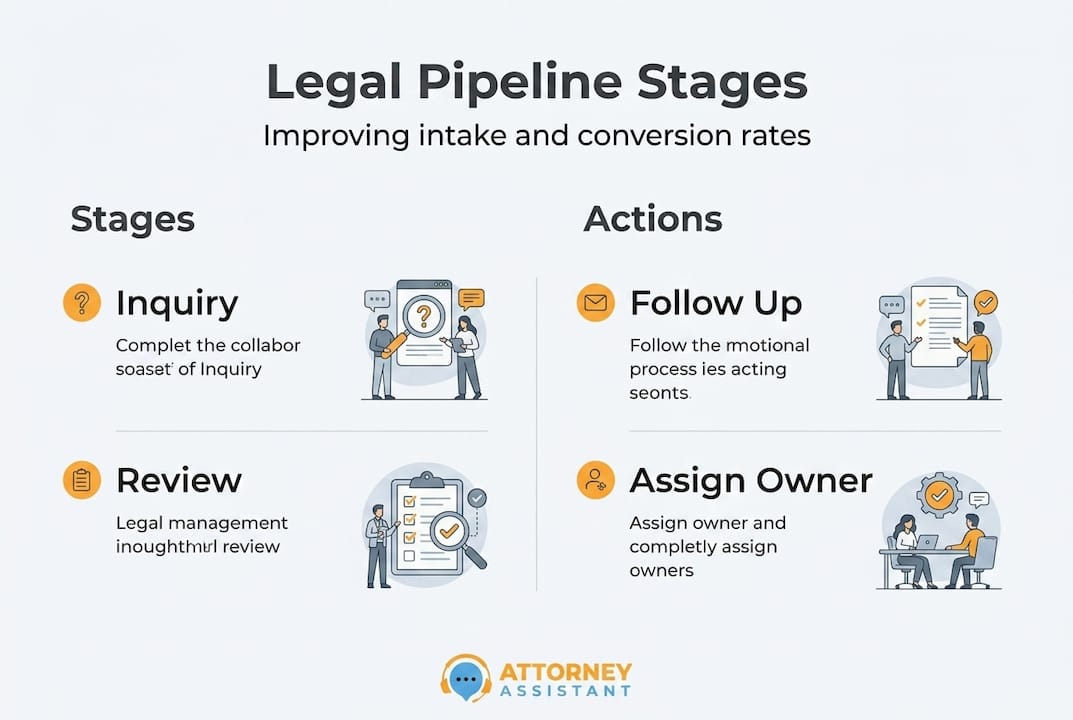
Assign a clear owner to every stage and every opportunity. This is the single most important rule. When everyone is responsible, no one is responsible. Every lead in your pipeline should have a specific person accountable for moving it forward. As assigning owners and next steps per opportunity and reviewing monthly for patterns is a core RevOps best practice, this principle applies directly to law firm intake. That person should know the next action required and the deadline for it.
Hold monthly pipeline reviews. Schedule a recurring meeting, even if it is just 30 minutes, to review every stage of your pipeline. Look for patterns. Are leads consistently stalling at the consultation stage? That might mean your scheduling process is too slow. Are retainers being sent but not signed? That might point to a gap in your follow-up. Monthly reviews turn your pipeline from a passive log into an active management tool.

Integrate your pipeline with your revenue operations. RevOps (revenue operations) is the practice of aligning your intake, case management, and financial reporting into a unified system. When your pipeline integrates with your case management software and billing systems, you can track the full journey from first contact to case resolution and see exactly where your revenue is being generated or lost.
Here is a practical breakdown of what each stage should include:
| Pipeline stage | Owner | Next action | Target timeline |
|---|---|---|---|
| New inquiry | Intake coordinator | Make first contact | Within 5 minutes |
| Initial contact | Intake coordinator | Gather case details | Same day |
| Qualification | Senior intake specialist | Assess case viability | Within 24 hours |
| Consultation scheduled | Attorney or intake manager | Send confirmation and prep materials | Immediately |
| Retainer sent | Case manager | Follow up if unsigned | Within 48 hours |
| Engagement | Assigned attorney | Open file and assign tasks | Within 24 hours |
| Closed or lost | Intake manager | Log reason and trigger survey | Within 48 hours |
Pro Tip: Use free intake tools to automate status reminders and reduce the manual work of tracking. Automation will not replace human judgment, but it will prevent the small oversights that cost you signed cases. Pair automation with your intake tips for case conversions to build a system that runs smoothly even on your busiest days.
The goal is not perfection. The goal is consistency. A pipeline that is reviewed regularly and owned clearly will outperform a “perfect” system that no one actually uses.
Common pitfalls and how to avoid them
Even firms that build a solid pipeline structure can undermine their own results with predictable, avoidable mistakes. Knowing what to watch for is just as important as knowing what to build.
Here are the most common pipeline pitfalls in personal injury law firms and how to fix them:
-
Over-pushing leads. Treating every inquiry like a must-convert sale damages your reputation and pushes good prospects away. Injured people are not buying software. They are making one of the most important decisions of their lives. Pressure backfires. The pipeline should guide, not coerce.
-
No clear ownership. When a lead is not assigned to a specific person, it waits. And while it waits, the prospect calls a competitor who picks up on the first ring. Every inquiry needs a name attached to it and a deadline on the next action.
-
Skipping analytics. Your pipeline is also a data source. Firms that ignore the numbers lose the ability to learn from their own patterns. Which marketing channels produce the best cases? Which intake messages generate the most consultations? Your pipeline can answer both, if you track it.
-
Setting it and forgetting it. A pipeline is not a one-time setup. Your firm changes. Your caseload changes. Your team changes. The pipeline should evolve with you. Rigid systems that are never updated become obstacles rather than assets.
-
Treating the pipeline as a rigid script. The stages and owners are a framework, not a rulebook. Empower your intake team with clarity and autonomy. They should know the process well enough to make judgment calls when the situation calls for it.
“Expert nuance: treat the pipeline as a visibility tool rather than sales pressure, assign owners and next steps per opportunity, and review monthly to identify patterns before they become problems.”
One of the best investments you can make is in your intake team’s skill and confidence. When you consider using intake specialists, you are not just adding a role. You are adding a layer of accountability and expertise that makes every stage of the pipeline more effective.
The firms that avoid these pitfalls are not the ones with the biggest marketing budgets. They are the ones with the most disciplined, thoughtful intake process.
Our perspective: what most law firms miss about pipeline management
Here is the uncomfortable truth that most pipeline conversations skip entirely. Firms obsess over conversion rates. They want to know what percentage of inquiries became signed clients. That number matters, but chasing it blindly misses the bigger picture.
The real value of a pipeline is pattern recognition. It is not just about plugging leaks. It is about learning which cases, which channels, and which conversations produce the best outcomes over time. When you study your boosting client intake data carefully, you start to see that certain referral sources consistently produce cases that close faster. Certain intake messages generate more consultation bookings. Certain case types convert at a much higher rate than others.
That knowledge is worth far more than a few extra conversions in a given month. It reshapes how you allocate your marketing budget, how you train your team, and which types of cases you actively pursue.
The firms winning in personal injury right now are not the ones trying to convert every lead. They are the ones using their pipeline data to get smarter with every passing quarter. Attrition is not failure. It is information. The question is whether you are reading it.
Take your intake pipeline further with Attorney Assistant
Building a pipeline strategy is one thing. Executing it consistently, especially when your team is stretched thin, is another challenge entirely. That is where Attorney Assistant comes in.
We work with personal injury firms to handle the intake workflows, follow-up sequences, and administrative processes that keep your pipeline moving even when your team cannot. From automated lead follow-up that responds within minutes to free law firm tools that track every stage of your pipeline, our solutions are built specifically for firms that want to convert more of the leads they already have. You can also join our virtual webinar for law firms to see exactly how a well-built intake pipeline works in practice. If you are serious about building a system that works as hard as you do, we are ready to help.
Frequently asked questions
How is pipeline management different from traditional sales funnels in law firms?
Pipeline management in law firms focuses on process visibility and maturity levels rather than aggressive sales tactics. As pipeline reduces uncertainty through maturity levels rather than 100% conversion pressure, the goal is quality conversations and sound decisions, not closing every lead.
What are the main benefits of using a pipeline for client intake?
A pipeline helps you track every inquiry, assign clear next steps, identify bottlenecks, and improve overall conversion rates. By assigning owners and next steps per opportunity and reviewing monthly for patterns, your firm gains the visibility needed to improve continuously.
How often should a law firm review its pipeline process?
Best practice is to review monthly for patterns and address breakdowns before they compound. Monthly reviews help you spot slow stages, reassign ownership gaps, and make data-driven improvements to your intake process.
Should every stage of the pipeline have an assigned owner?
Yes, absolutely. Assigning owners per opportunity ensures accountability at every stage and prevents leads from stalling due to unclear responsibility. When someone owns a stage, things get done.
Recommended
Related Articles

10 Business Finance Course Options for Law Firms
Compare 10 business finance course options by level, format, workload, and law-firm relevance, then choose the right fit for your role and goals.

10 Good VoIP App Options for Law Firms in 2026
Compare 10 good VoIP app options for small and mid-sized law firms, including security, integrations, pricing, mobile use, and desk-phone readiness.

10 Insurance Software Companies Worth Comparing
Compare 10 insurance software companies by features, use cases, trade-offs, and implementation fit for carriers, MGAs, brokers, and agencies.