A prospective client calls your firm after seeing an advertisement. Intake answers, qualifies the matter, and calls back from the firm's main number. The prospect ignores it because the screen says Spam Likely. Later, they call reception and ask why the firm was trying to scam them. Nothing in the file explains the warning, although the warning has already done its job.
That's the operational reality behind removing number from spam. A legitimate law firm number can be labeled by a carrier or caller-ID analytics provider, and fixing it usually requires more than deleting a blocked contact from one phone. The FCC says call-blocking and labeling services may rely on call patterns, consumer complaints, and other methods. It also warns that a number being labeled as potential spam may have been spoofed, which means the right response depends on what happened. The FCC's consumer guidance on unwanted robocalls is clear about the distinction.
The pressure is understandable. The FCC reported illegal and unwanted calls as its top consumer-complaint category, with about 150,000 complaints in 2016, 185,000 in 2017, 232,000 in 2018, 193,000 in 2019, and 157,000 in 2020. A Congressional Research Service brief later estimated that U.S. individuals collectively received 4.2 billion robocalls in April 2026, about 13 calls per person. The FCC material containing those complaint figures helps explain why carriers are aggressive. Unfortunately, aggressive systems sometimes treat legitimate providers like the problem.
For a law firm, a spam label isn't a cosmetic nuisance. It affects whether an intake specialist reaches a lead, whether a current client answers a case-related call, and whether follow-up happens before another firm gets there. A practical guide to how phone answering boosts client acquisition matters only if prospective clients trust the number enough to answer.
This guide treats the problem correctly. You'll identify where the label appears, submit remediation requests through the relevant carrier and analytics channels, verify the number across ecosystems, diagnose the behavior that caused the problem, and build an intake process that doesn't let a clean number ring unattended.
Table of Contents
- Introduction Why Your Legitimate Number Shows as Spam
- How Spam Labeling Actually Works Across Carriers and Apps
- How to Remove Your Number From Spam Lists and Verify It
- Why Legitimate Law Firm Numbers Get Flagged in the First Place
- Prevent Future Spam Flags and Keep Answer Rates High
- Building Reliable Intake So Good Calls Get Answered
Introduction Why Your Legitimate Number Shows as Spam
A prospective client fills out an intake form. Your team calls back promptly, yet the phone displays “Spam.” The lead ignores it, the intake specialist records another missed connection, and a competitor may get the conversation instead. Law firms can inherit this problem without fraud or bad intent.
A recycled number may carry old history. A new number may receive cautious treatment. A legitimate intake campaign can create calling patterns that resemble unwanted outreach. Carriers and analytics providers evaluate behavior and complaint signals, not the firm's carefully written mission statement.
That makes removing number from spam a reputation fix across several ecosystems, not a single-button repair. A label may originate with a carrier's analytics partner, a caller-ID application, or another reputation database. The number can appear clean on one network and suspicious on another. “It depends” is a poor operating procedure, especially when intake staff are already sorting urgency from chaos.
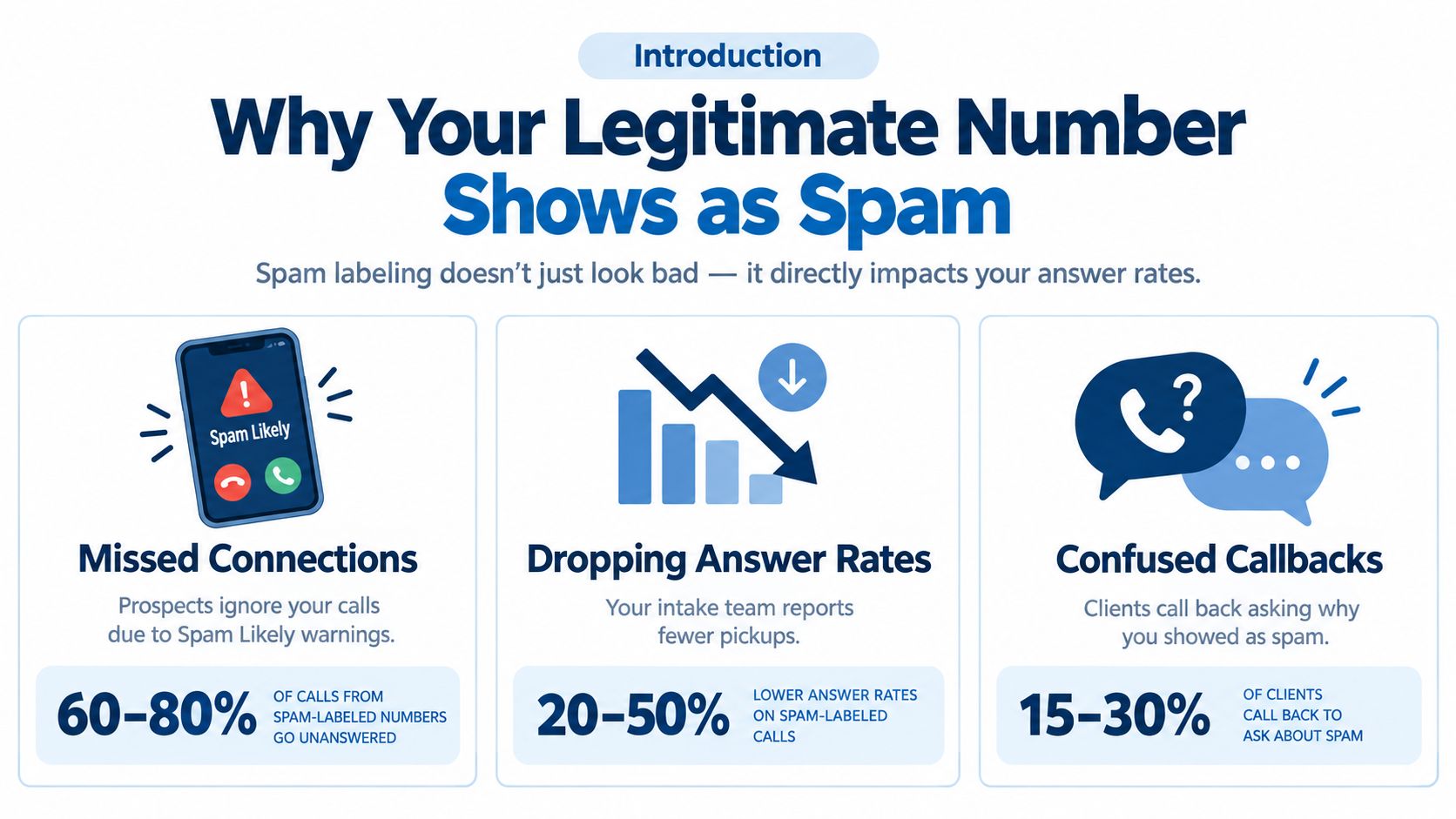
The answer-rate consequence is severe. Consumers answer only 9% of calls marked as spam, according to FCC material cited in this carrier remediation guidance. Fast callbacks cannot overcome a warning that makes the caller look unsafe. A quick intake workflow still fails if nobody answers.
The law firm version of the problem
The warning usually appears through operational symptoms:
- Prospects stop answering: A lead submits a form, then ignores the callback because the firm's number looks risky.
- Intake reports fewer pickups: The team sees fewer connections but does not check caller-ID treatment by carrier or app.
- Clients call back confused: A person recognizes the firm yet asks why a legitimate call displayed as spam.
The usual fixes miss the source. Someone blocks and unblocks the number on a personal phone. Someone deletes a caller-ID app. Someone proposes buying a new number. Those actions do not necessarily change carrier-level reputation, complaint records, or analytics data.
Operational rule: Treat a spam label as a reputation incident, not a blocked-contact problem.
Start with evidence. Record the exact warning, receiving network or app, date observed, and number used. Submit remediation requests through the systems that can change the classification, then test the result across the ecosystems that affect clients and prospects. A clean result on one network does not clear a flag elsewhere. Reliable phone answering that supports client acquisition depends on both reputation repair and an intake team ready to answer.
How Spam Labeling Actually Works Across Carriers and Apps
The common assumption is that every spam label comes from one master list. It doesn't. Carrier databases, third-party caller-ID applications, and analytics engines can evaluate the same number independently. A firm can therefore have a number that looks legitimate to one recipient and suspicious to another, with both phones behaving exactly as designed.
The FCC explains that call-blocking and labeling services may use call patterns, consumer complaints, or other methods. Those systems can also react to spoofing or historical activity. A number may remain mislabeled after the problematic behavior stops because the underlying data doesn't update in one universal place.
Blocking is not the same as labeling
A consumer blocking your number on an iPhone is a local action. It changes that person's phone behavior. It doesn't necessarily remove a carrier warning, correct a caller-ID application, or update a registry.
A network-level label is broader. The carrier or analytics provider decides how the call should be displayed or treated for its users. Removing the number from one person's blocked list won't resolve that classification. It's like removing one file from a receptionist's desk and assuming the entire document-management system has been corrected.
The practical split looks like this:
| Problem | Where it exists | Correct response |
|---|---|---|
| A person blocked the firm | One device or contact list | The recipient must unblock it |
| A carrier displays “Potential Spam” | Carrier analytics ecosystem | Submit a carrier or analytics dispute |
| A caller-ID app displays a warning | Third-party application database | File a separate app-level correction |
| The number may be spoofed | Caller identity and complaint systems | Investigate spoofing and route the complaint correctly |
That distinction should also shape your outbound communication. Words associated with urgency, prizes, threats, or suspicious offers can make a message look untrustworthy when paired with a call. A practical spam trigger words reference can help your marketing and intake teams review language before it gets reused in texts, emails, or scripts. It won't repair a carrier label, but it can reduce avoidable signals across the broader communication process.
For law firms, the key point is simple. You're not “getting off a list.” You're correcting a reputation record across systems that don't share one universal removal process.
How to Remove Your Number From Spam Lists and Verify It
Start with diagnosis, not repeated calling. Calling the same lead again and again from a flagged number may produce more ignored calls and more complaints, while giving the carrier additional behavior to evaluate. A structured remediation path is more sensible.
Step one identify every place the label appears
Call the firm's number from trusted devices connected to different major networks, and check the exact wording displayed. Ask intake staff to record whether the call shows as clean, “Spam Likely,” “Scam Risk,” or another warning. Check caller-ID applications used by your clients or team members as well.
Keep a small incident record:
- Number tested: Record the full business number and any alternate numbers.
- Network or app: Note the carrier, device, and caller-ID application.
- Exact label: Preserve the wording rather than summarizing it as “spam.”
- Date and time: Record when the test occurred.
- Use case: Explain whether the number handles intake, follow-up, client communication, or another legitimate function.
This record gives each provider something concrete to review. “Our calls aren't working” is a complaint. “This number displays Potential Spam on this network while representing a law firm's intake line” is a remediation request.
Step two submit through the relevant channels
Use carrier feedback forms and registry systems designed to review legitimate business numbers. The major endpoints commonly involved include AT&T and Hiya, Verizon and TNS, T-Mobile and First Orion, and Free Caller Registry. The exact submission requirements vary, so provide consistent firm information across every request.
Include the business name, number, contact details, the label shown, and a short description of the firm's lawful calling purpose. Don't write a novel. The reviewer needs identity, context, and evidence that the number is being used for a legitimate business function.
Registration and remediation are related but different. A registry can establish that a number belongs to a real firm. It doesn't necessarily remove an active label by itself. Active labels usually require a dispute or review through the ecosystem that produced them.
Step three verify the result everywhere
A confirmation from one provider is not a complete resolution. Retest the number across the networks and applications where the warning appeared. Keep the original evidence beside the new test results so your team can tell whether the label disappeared, changed wording, or moved to another ecosystem.
Practical rule: Never close the incident because one phone displayed a clean caller ID.
Structured remediation can work. Numeracle reports that across 434,459 vetted and registered numbers in 2022, 61,111 labeling incidents were remediated at a 97% average success rate, with an average resolution time of 1.4 days. Numeracle's remediation record supports the operational lesson, although the result depends on complete verification and appropriate channel submissions.
A compact remediation checklist
- Capture the label: Save the exact display and test context.
- Separate device blocking from network labeling: Don't send the wrong request to the wrong party.
- Register the firm and number: Use relevant verification and registry systems.
- File each necessary dispute: A single submission won't necessarily reach every carrier or app.
- Adjust the calling pattern: Fix the behavior that may have produced complaints or suspicious signals.
- Retest across ecosystems: Confirm that the number is recognized as legitimate where clients receive calls.
- Monitor after clearance: A temporary improvement isn't the same as durable reputation.
Call tracking can make this easier to investigate because it connects source numbers, call outcomes, and intake activity. Firms evaluating call tracking for law firms should make sure the setup supports reputation monitoring rather than adding a pile of numbers nobody owns operationally.
Why Legitimate Law Firm Numbers Get Flagged in the First Place
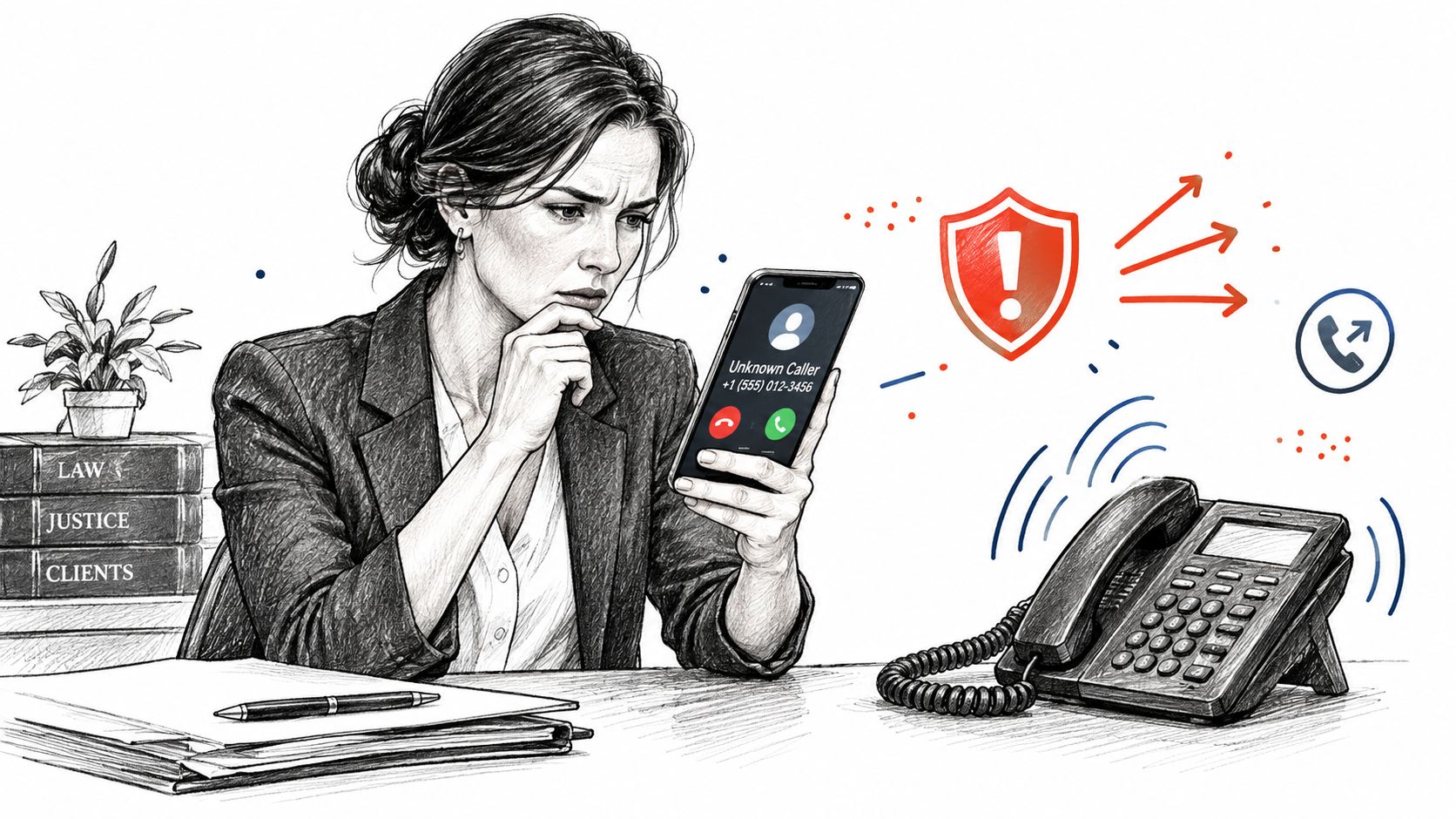
Carriers don't understand your intake sprint. They see a number making many outbound attempts, reaching people who don't answer, generating short calls, or receiving complaints. Those patterns can resemble nuisance calling even when the firm is following up with people who requested information.
Number history creates another problem. A firm may acquire a new line that previously belonged to a different business or individual. The firm sees a fresh number. The analytics system may see inherited history. The number didn't get a clean slate because your phone vendor did.
The FCC's 2025 congressional report explicitly says legitimate providers that begin using new numbers can be labeled as spam. The wider environment is noisy: the FTC logged over 2.6 million Do Not Call complaints in fiscal 2025, the registry held more than 258 million active registrations, and spam robocalls averaged about 2.56 billion per month in 2025, according to the FCC's 2025 congressional report. Filters have strong reasons to be cautious, even when they occasionally mistake a legitimate firm for the nuisance.
Common flag triggers and what they signal to carriers
| Calling Pattern | How Analytics Interprets It | Prevention Tip |
|---|---|---|
| Sudden outbound volume | A burst may resemble automated calling | Spread legitimate work across a planned cadence and avoid chaotic dialing spikes |
| Repeated unanswered calls | Recipients may be screening or rejecting the number | Clean the contact list and stop pursuing unsuitable or unresponsive records indefinitely |
| Very short conversations | The pattern can look like abandoned or unwanted calls | Review scripts, caller identification, and whether the recipient expected contact |
| Frequent redials | Repeated attempts may resemble aggressive behavior | Use structured follow-up intervals instead of reflexive redialing |
| A recycled number | The number may carry prior reputation history | Test and register the number before making it a primary intake line |
| Complaint-driven labeling | Recipients may have reported or marked calls | Honor opt-outs, improve caller context, and review the lead source |
A firm's legitimate purpose doesn't cancel out the signal. If an intake team launches a high-volume follow-up push from one number, the carrier doesn't know that the list came from a lawful consultation form. It sees the pattern. That's why remediation must be paired with process changes, or the label can return after the paperwork is complete.
Prevent Future Spam Flags and Keep Answer Rates High
A caller-ID cleanup fails if the firm returns to the same dialing habits. Give each number a defined role, keep the firm identity consistent, and tell intake, client service, and follow-up teams which line to use. Removing a number from spam is a reputation fix across carriers, analytics systems, and complaint channels, not a single unblock button.
Start with list hygiene. Remove invalid records, honor suppression lists, and document opt-out requests. Continuing to call people who have clearly rejected contact does more than waste staff time. It creates the complaint signals that can bring the label back.
Build a calmer outbound rhythm
Use a measured cadence instead of a burst of calls followed by silence. After a lead submits an inquiry, contact the person promptly, identify the firm, explain the reason for the call, and offer a clear next step. If there is no answer, follow a defined sequence across appropriate channels. Do not let every staff member improvise a new pursuit plan, because intake chaos is not a calling strategy.
Keep caller ID recognizable. Casual number rotation makes the firm harder to identify and spreads reputation history across multiple lines. A consistent business identity gives recipients a clearer reason to answer and gives carrier systems a cleaner record to assess.
Speed still affects intake results. Calling a lead within 5 minutes instead of 30 minutes made the odds of qualifying that lead 21 times higher and the odds of contacting the lead 100 times higher. Fast follow-up only produces value when the displayed number reaches a person who recognizes and trusts the call.
Put reputation inside intake management
Track more than attempted calls. Review answer patterns by number, carrier, time of day, lead source, and staff workflow. A drop in connections may indicate a spam label, but it may also expose a weak script, poor timing, inaccurate data, or inconsistent caller identity.
Set a practical operating standard:
- One owner for phone reputation: Assign someone to monitor labels, submit disputes, and retain confirmations.
- Consistent caller identity: Keep the firm name and call purpose clear across phone systems.
- Structured follow-up: Make attempts predictable and respectful, with defined stopping points.
- Fast human response: Route new inquiries to trained intake coverage, including nights and weekends when firm staff are unavailable.
- Quality review: Listen to calls and check whether staff explain who they are and why they are calling.
Review these controls regularly. Carrier analytics, recipient complaints, and intake performance describe the same reputation from different angles. A change in one can explain a change in the others.
Your CRM cannot follow up with a lead who never enters the system. It also cannot repair a phone reputation problem without an assigned owner. Assign both responsibilities before the next campaign, not after another round of missed calls.
Building Reliable Intake So Good Calls Get Answered
Removing number from spam should end with a firm-level decision, not a congratulatory screenshot from one phone. If the number is clean but calls still go unanswered, the firm has an intake capacity problem. If the number is flagged, the firm has a reputation problem. Many firms have both, which is how a perfectly good marketing budget becomes a collection of missed calls.
The response depends on where the work breaks:
- Technical ownership: Assign someone to test numbers, file remediation requests, and verify results across carriers and apps.
- Intake coverage: Provide live answering and qualification when attorneys and staff are unavailable.
- Follow-up discipline: Use a documented process for missed, stalled, and aged leads.
- Case-support capacity: Move records, file opening, CRM hygiene, and administrative work away from attorneys where appropriate.
The staffing pressure is real. The ABA reported that more than 40% of timekeepers spent more than 35% of their time on nonbillable work, amounting to at least 700 hours per year. Earlier Legal Trends reporting found that 48% of lawyers' nonbillable time was spent on administrative tasks and 33% on business development, as documented in the ABA's report on legal-industry automation adoption.
A firm can handle occasional remediation internally. It shouldn't pretend that intake, follow-up, records, and phone-reputation monitoring will remain reliable inside someone's memory. Live answering services for law firms can provide coverage, but taking a message isn't intake. The team needs to qualify the opportunity, follow up consistently, and move appropriate matters toward signing.
That's the capacity model: Frontline signs the case. Staffline carries it. A 24/7 live intake team can answer, qualify, follow up, and sign appropriate cases, while dedicated Staffline professionals can support case management, records, file opening, CRM hygiene, calendars, inboxes, and other legal operations work. The point isn't to add more activity to an already crowded firm. It's to make sure legitimate calls reach a trained person and the resulting work has somewhere to go.
Attorney Assistant provides 24/7 live intake through Frontline and dedicated full-time legal support through Staffline, including structured follow-up, case support, records, and administration. Visit Attorney Assistant to assess where spam labels, missed calls, and overloaded staff are costing your firm opportunities.
Related Articles
Case Management App for Law Firms in 2026: How to Choose
Compare case management app options for law firms on intake, documents, calendaring, security and pricing, with a checklist to pick the right fit.
Business Telephone Answering Service for Law Firms
How a business telephone answering service works for law firms, including 24/7 intake, qualification, warm transfers, pricing models, and what
Call Flow Customer Service for Law Firms: A Practical Guide
Design a call flow customer service system for your law firm that captures leads, qualifies matters, and signs cases. Practical guide