The Role of Follow-Up Emails in PI Firm Conversions
TL;DR:
- Follow-up emails that are automated and timely help personal-injury firms convert more inquiries into consultations. Implementing a structured sequence with five touches over about a week significantly increases case retention and revenue. Clear ownership, personalization, and compliance are essential to maximize follow-up effectiveness and avoid lost leads.
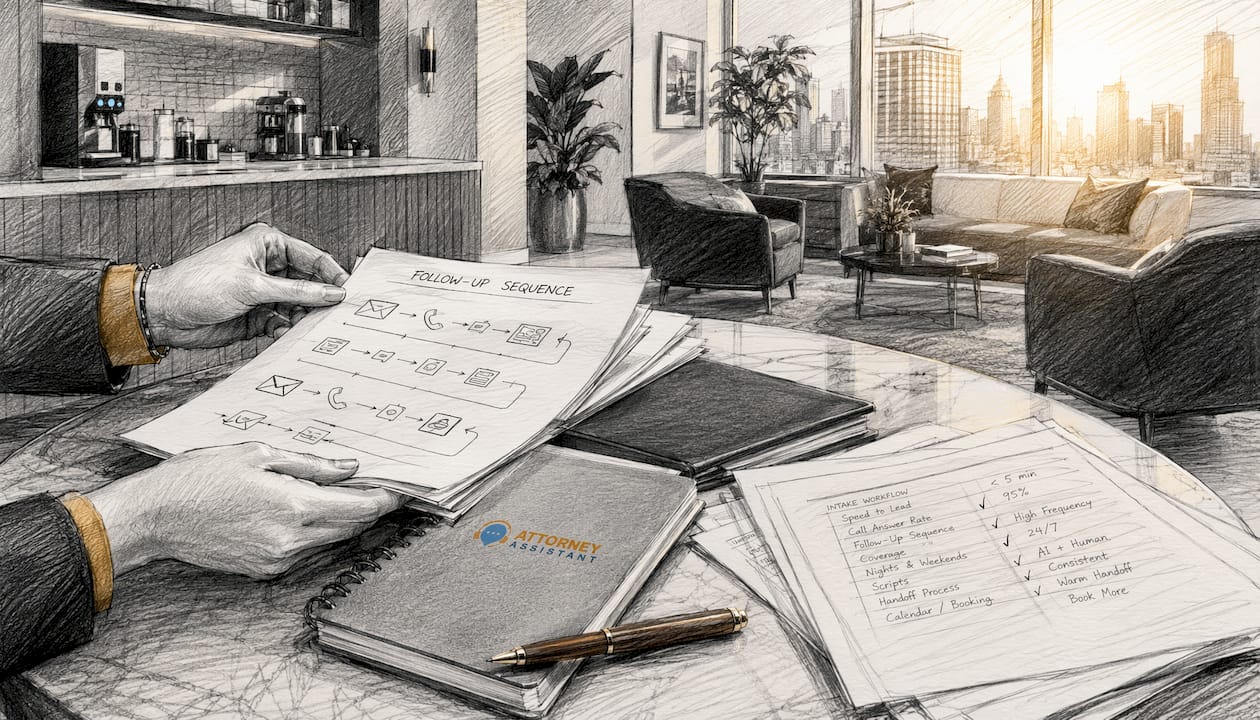
Follow-up emails keep personal-injury prospects in your decision window and convert inquiries into consultations by enforcing speed-to-lead and delivering a clear next step at every touch. The single fastest change you can make: fire an automated Day-0 acknowledgment (email plus SMS) within minutes of a form submission, then queue a Day-1 email with a one-click scheduling link.
TL;DR: Most PI firms lose leads between contact and consultation, not because of bad marketing, but because follow-up is slow, inconsistent, or missing entirely. A structured multi-touch sequence over about a week to a week and a half fixes that.
Immediate action checklist:
- Set up an automated acknowledgment email and SMS to fire within minutes of every form submission
- Add a scheduling link (Calendly, Acuity, or your CRM’s booking tool) to every Day-1 email
- Assign one person to own follow-up and define exactly when automation hands off to a human
Table of Contents
- Why follow-up emails convert leads for personal-injury firms
- What is the right timing and cadence for follow-up?
- What every follow-up message must include
- Ready-to-use follow-up templates for each touchpoint
- Who owns follow-up, and how do you stop leads from slipping?
- Which KPIs tell you if your follow-up is working?
- What compliance rules apply to follow-up emails and texts?
- Your 30-day implementation checklist
- Key Takeaways
- The part most firms skip
- How Attorney Assistant closes the follow-up gap for PI firms
- Useful sources
- FAQ
Why follow-up emails convert leads for personal-injury firms
Personal-injury prospects rarely hire the first firm they contact. They shop. Legal prospects often shop multiple firms over several days after first contact, and whoever reaches them with the clearest value proposition during that period usually wins the case.
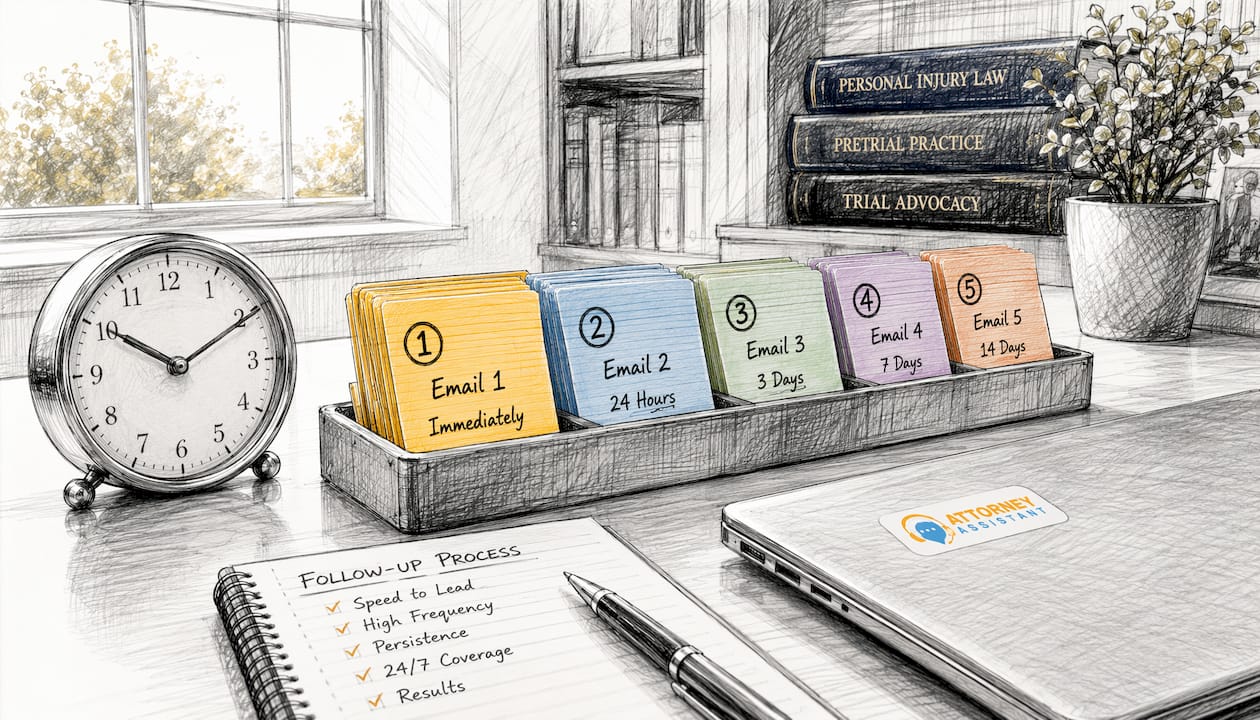
Follow-up emails do three things during that window. They keep your firm visible while the prospect weighs options. They deliver social proof, fee clarity, and objection answers before a competitor does. And they create a low-friction path to booking a consultation without requiring the prospect to pick up the phone.
The business case is concrete. One case example: a 6-attorney firm using a structured 5-touch follow-up sequence increased their consultation conversion rate from 31% to 54% and their retainer rate from 19% to 27%, resulting in approximately $28,200/month additional revenue on the same 84 leads per month at a $4,200 average retainer. More leads are not the answer when you are already leaking the ones you have.
What is the right timing and cadence for follow-up?
Speed matters more than most firms realize. Contacting a lead within one hour is dramatically more likely to result in a meaningful conversation than waiting two hours or more. The goal is an automated response within minutes, not a manual one within the day.
A multi-touch sequence over about a week to a week and a half is the practical standard for personal-injury intake. After five attempts with no response, move the lead to a long-term nurture list rather than continuing aggressive contact.
| Touch | Timing | Channel | Content Focus |
|---|---|---|---|
| 1 | Day 0 (immediate) | Email + SMS | Acknowledge inquiry; confirm receipt; set contact timeline |
| 2 | Day 1 | Phone + Email | Intake call attempt; introduce attorney; single scheduling CTA |
| 3 | Day 3 | Objection handler: cost, timeline, “do I have a case?” | |
| 4 | Day 6 | Email + SMS | Value-add: FAQ or rights summary; social proof |
| 5 | Day 10 | Break-up message: file closure language, final CTA |
Once a prospect replies or books, automation stops immediately and a human takes over. Leads who complete all five touches without responding move to a passive nurture list with a “we’ll keep your inquiry on file” message. Continuing to contact them past that point wastes staff time and risks complaints.
Pro Tip: Compress the sequence to 3 touches over 48 hours for leads with urgency signals, such as a recent accident or a statute of limitations concern. Speed matters more than volume in those cases.
What every follow-up message must include
Every message in the sequence needs four things: a single clear next step, a short empathetic opening, one social proof element, and a brief fee explanation when appropriate. That is it. Anything beyond that adds friction.
Avoid generic “just checking in” emails. They signal low effort and produce low response rates. A message that names the prospect’s situation (“We understand auto accident cases are stressful”) outperforms a generic “Thank you for contacting our firm” every time.
Message-level rules:
- Emails: under 200 words, one CTA, human voice
- SMS: under 160 characters, no case-sensitive details, informational tone only
- Voicemail: under 30 seconds, name the attorney, give one callback number
Personalization keys that move the needle: injury type, the name of the attorney handling the case type, and a no-pressure opt-out line. Prospects who feel pushed tend to disappear. Prospects who feel informed tend to book.
Ready-to-use follow-up templates for each touchpoint
These are starting points. Edit the bracketed fields for your firm and practice area.
Day 0: Automated acknowledgment
Subject: We received your inquiry, [First Name]
“Hi [First Name], we received your message about your [injury type] case. Someone from [Firm Name] will call you within [X] hours. If you’d like to schedule a consultation now, use this link: [scheduling link]. We’re here to help.”
SMS (Day 0): “Hi [First Name], [Firm Name] received your inquiry. We’ll call within [X] hours. Questions? Reply here.”
Day 1: Post-call follow-up email
Subject: Next steps for your [injury type] case
“Hi [First Name], thank you for speaking with us today. Attorney [Name] handles [case type] cases and would like to meet with you. Here’s what to expect at your consultation: [2–3 bullet points]. Book your time here: [scheduling link]. There’s no fee unless we win.”
Day 3: Objection handler
Subject: Common questions about [injury type] cases
“Hi [First Name], many people in your situation wonder whether they have a case, how long it takes, and what it costs. Here are quick answers: [3 Q&As]. Ready to talk? [scheduling link].”
Day 6: Value-add + social proof
Subject: What happens after you hire a PI attorney
“Hi [First Name], here’s a short guide on [evidence preservation / what to expect in a PI case]. [Link to resource.] Clients like [First Name from review] say [brief quote]. We’d love to help. [scheduling link].”
For car accident cases specifically, sharing evidence preservation guidance in this email gives the prospect something genuinely useful and positions your firm as a resource before they’ve signed.
Day 10: Break-up email
Subject: Closing your file, [First Name]
“Hi [First Name], we haven’t heard back, so we’ll close your inquiry file for now. If your situation changes, we’re here. [scheduling link]. No pressure, no obligation.”
Break-up messages consistently generate replies from prospects who were silent through the entire sequence. The file-closure language creates urgency without pressure.
Who owns follow-up, and how do you stop leads from slipping?
Unclear ownership is the most common reason follow-up fails. Every lead needs one named person responsible for each stage.
Role assignments:
- Intake coordinator: owns the first human touch, confirms the Day-0 automation fired, and makes the Day-1 call attempt
- Automation owner: monitors sequence triggers, checks for stuck leads, and confirms handoffs fire correctly in the CRM
- Escalation owner: handles fee disputes, conflict checks, and any lead that requires attorney involvement before booking
Handoff rules:
- Automation stops the moment a lead replies or books a consultation
- A staff notification fires immediately on any reply; do not let automation override a live conversation
- Qualified leads (replied, booked, or expressed urgency) move to the intake pipeline; unqualified leads move to the nurture list after Touch 5
Failure safeguards:
- Missed-call alert: if a Day-1 call attempt goes unanswered, trigger an SMS within 15 minutes
- No-show recovery: if a consultation start time passes with no check-in, send a reschedule SMS within 30 minutes
- CRM hygiene: tag every lead with a status (active, nurture, disqualified) so the pipeline stays clean
A law firm follow-up workflow that defines these triggers in writing takes about two hours to build and saves dozens of hours of chasing lost leads each month.
Pro Tip: Automate follow-up for the first five touches, but never automate the response to a live reply. A prospect who writes back deserves a human within minutes, not another drip email.
Which KPIs tell you if your follow-up is working?
Track several key performance indicators. Everything else is noise.
| KPI | Definition | Target |
|---|---|---|
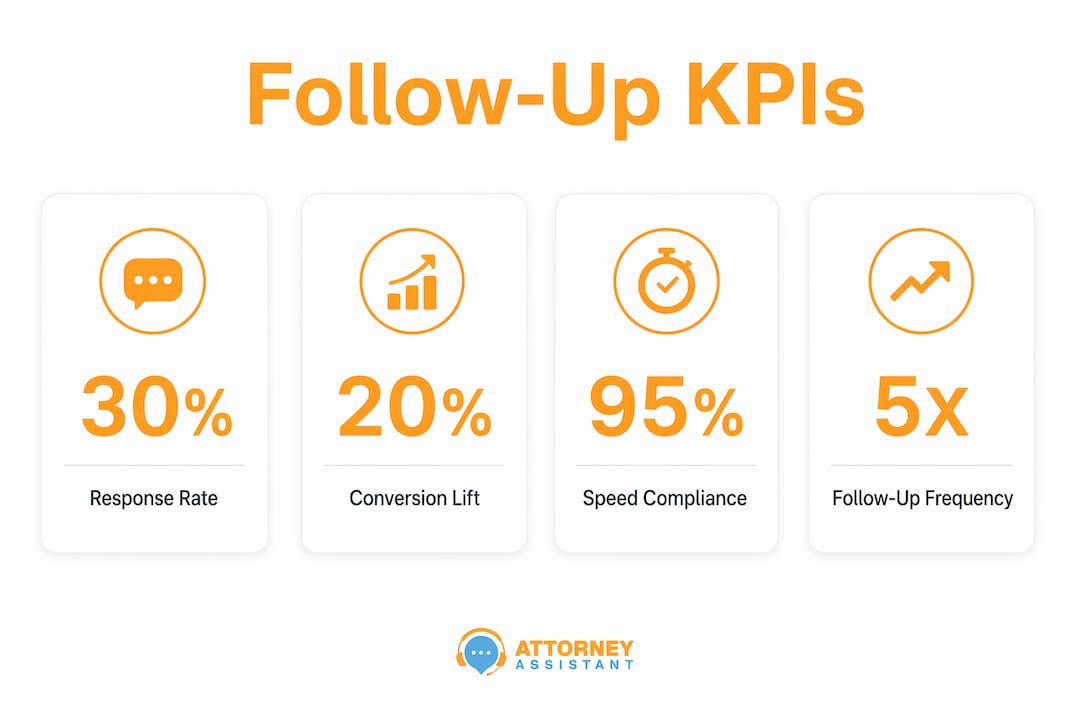
| Speed-to-first-contact | Time from form submission to first human or automated touch | Under 5 minutes |
| Contact rate | Conversations / inbound inquiries | — |
| Reply rate | Replies to email sequence / emails sent | 15% |
| Consultation booking rate | Consultations booked / contacts made | — |
| Signed-retainer rate | Signed cases / consultations held | — |
| No-show rate | Missed consultations / booked consultations | Under 15% |
Three low-cost tests worth running:
- Subject line A/B: practice-area-specific subject lines (“Your auto accident case: next steps”) versus generic ones. Practice-area-specific subject lines achieve 35–45% open rates; generic subject lines average 18–22%.
- CTA format: calendar link versus “reply to this email” as the next step. Test which drives more consultations, not just more clicks.
- Day-1 message length: under 100 words versus 150–200 words. Shorter often wins for mobile readers.
A conversion optimization approach that connects email engagement to intake outcomes, rather than treating email as a separate marketing silo, is what separates firms that grow from firms that plateau.
What compliance rules apply to follow-up emails and texts?
Three areas require attention before you deploy any automated sequence.
State Bar solicitation rules: Keep acknowledgment emails factual and non-promissory. Do not create an implied attorney-client relationship through automated messages. Avoid language that guarantees outcomes or implies representation before a retainer is signed.
TCPA and SMS consent: Confirm that the prospect opted in to receive texts before sending any SMS. Keep texts informational and low-frequency during intake. Honor SMS stop commands immediately and build an unsubscribe link into every email.
Confidentiality and HIPAA caution: Never include sensitive medical details in standard email or SMS. Move detailed case discussions to a secure intake channel. Standard email is not HIPAA-compliant; treat it accordingly.
Pro Tip: Have ethics counsel review your sequence templates once before launch. A 30-minute review is far cheaper than a bar complaint.
This article is general information, not legal or ethics advice. Confirm current solicitation and TCPA rules with your state bar and qualified counsel for your specific situation.
Your 30-day implementation checklist
Week 1
- Map every lead source and confirm each triggers a CRM record
- Write and activate the Day-0 acknowledgment email and SMS
- Build the Day-1 email with a scheduling link and assign the intake coordinator role
- Test the full Day-0 trigger with a live form submission
Week 2
- Build automation for Day-3 and Day-6 messages
- Set disqualification rules (case type, geography, statute of limitations)
- Train intake staff on handoff triggers: when automation stops, when humans take over
- Confirm no-show recovery SMS fires within 30 minutes of a missed consultation
Weeks 3–4
- Launch subject-line A/B test on Day-1 email
- Set up KPI dashboard: speed-to-contact, contact rate, booking rate, retainer rate
- Add long-term nurture list and confirm Touch-5 break-up email moves non-responders there
- Review first two weeks of data; adjust Day-3 content based on reply rate
For a detailed client follow-up workflow with timing diagrams and trigger maps, Attorney Assistant’s 2026 guide covers each step in depth.
Key Takeaways
Structured follow-up emails convert more personal-injury leads into signed cases by enforcing speed-to-lead, maintaining presence during the 3–14 day decision window, and delivering a clear next step at every touch.
| Point | Details |
|---|---|
| Speed-to-lead is the priority | Contact leads within 5 minutes of inquiry; automated acknowledgment buys time until a human calls. |
| Five touches, then nurture | Run a 5-touch sequence over 7–10 days; move non-responders to a passive list after Touch 5. |
| Every message needs one CTA | A single scheduling link or reply option outperforms multiple options in every touch. |
| Track six KPIs | Monitor speed-to-contact, contact rate, reply rate, booking rate, retainer rate, and no-show rate. |
| Attorney Assistant | Delivers 24/7 intake coverage, follow-up automation, and CRM handoffs so no lead slips through. |
The part most firms skip
Most firms that implement a follow-up sequence get the tools right and the ownership wrong. They set up automation, write decent templates, and then leave the handoff undefined. A lead replies on Day 3, nobody sees it for six hours, and the prospect has already signed with another firm.
The sequence is not the hard part. The hard part is deciding, in writing, who owns each stage and what happens when a lead does something unexpected. A no-show, a reply at 9 PM, a prospect who says “call me next week.” Those moments are where cases are won or lost, and no automation handles them without a human decision behind it.
Firms that close the gap between a structured sequence and consistent human follow-through tend to see the conversion lifts that make the whole system worth building. The ones that treat it as a set-it-and-forget-it automation project usually end up back where they started, wondering why the leads are not converting.
How Attorney Assistant closes the follow-up gap for PI firms
Firms that build this sequence internally often hit the same wall: the system works until someone is out sick, a call goes unanswered after hours, or the CRM falls behind. Attorney Assistant handles intake enforcement, 24/7 phone and follow-up coverage, and CRM handoffs so the sequence runs without depending on any single staff member.
The operational model is straightforward: Attorney Assistant embeds into your daily workflow, covers the touches your team cannot, and escalates qualified leads to your attorneys with context already in the file. No staffing headaches, no dropped leads at 7 PM on a Friday.
If you want a second set of eyes on your current intake sequence, book a call and Attorney Assistant will walk through your process and deliver a 30-day implementation plan. You can also review the case management services that support the downstream workflow once leads convert to signed cases.
Useful sources
- Law Firm Lead Conversion Benchmarks | LEXGRO
- Optimal Legal Lead Follow-Up Time | Attorney-Leads.com
- Stop Leads Going Cold at Your Law Firm in 2026 | US Tech Automations
- Capture Lost Intake Leads: Follow-Up Sequences for 2026 | US Tech Automations
- 5-Step Legal Lead Nurturing Automation Recipe for 2026 | US Tech Automations
- The Follow-Up Email Template That Wins Clients | Kerri James
- The 7-Email Sequence That Turns PI Leads into Signed Cases | Cato Marketing
- Speed-to-Lead Benchmarks for Law Firm Attorneys | YMM Digital
- Email Marketing for Law Firms: Follow-Up Templates | Scale and Prosper
- Why Hire a Car Accident Attorney After a Crash — useful for understanding common client objections and timelines that shape follow-up message framing
- Client Follow-Up Strategy for Law Firms: 2026 Guide | Attorney Assistant
FAQ
How quickly should a PI firm send the first follow-up email?
Within minutes of a form submission. Automated acknowledgment emails and SMS should fire immediately; a human call attempt should follow within one hour during business hours.
How many follow-up emails should a personal-injury firm send?
Five touches over 7–10 days is the practical standard. After five unanswered attempts, move the lead to a long-term nurture list rather than continuing active outreach.
What should every follow-up email include?
A single clear next step (scheduling link or reply option), a short empathetic opening, one social proof element, and a brief fee explanation when relevant. Keep emails under 200 words.
Does automated follow-up violate attorney solicitation rules?
Automated responses to inbound inquiries are generally not subject to outbound solicitation rules, but rules vary by state bar. Have ethics counsel review your templates and trigger conditions before launch.
What is the most important KPI for follow-up email performance?
Consultation booking rate, defined as consultations booked divided by contacts made. It connects email activity directly to revenue and is the clearest signal that your sequence is working.
Recommended
- The Role of Follow-Up in Client Conversion: 2026 Guide | Attorney Assistant
- Streamline your law firm follow-up process: convert more leads | Attorney Assistant
- Intake follow-up steps that boost law firm conversions | Attorney Assistant
- Why Prompt Follow-Up Boosts Cases for Injury Firms | Attorney Assistant
Related Articles
Request for Discovery Template: A Practical Guide
Use our request for discovery template with annotated fields, jurisdictional notes, and filing instructions. Customize it for federal or state court cases.
Litigation Support Services: What Law Firms Need to Know
Discover how litigation support services streamline discovery, reduce costs, and improve case outcomes. Learn what to look for in a provider.
Keep the Conversation Going: 8 Intake Follow-Up Tactics
Learn how to keep the conversation going with law prospects using eight practical intake and follow-up tactics, from speed-to-lead to attorney handoffs.