Telephone Answering Service Jobs That Fix Law Firm Intake
TL;DR:
- Telephone answering services for law firms focus on capturing leads through 24/7 live answering and structured legal intake. They prevent missed calls, qualifying cases early and rediscovering lost revenue through automated follow-up and real-time booking. Implementing these systems significantly improves lead conversion and reduces revenue loss without high staffing costs.
What telephone answering service jobs actually do for law firms
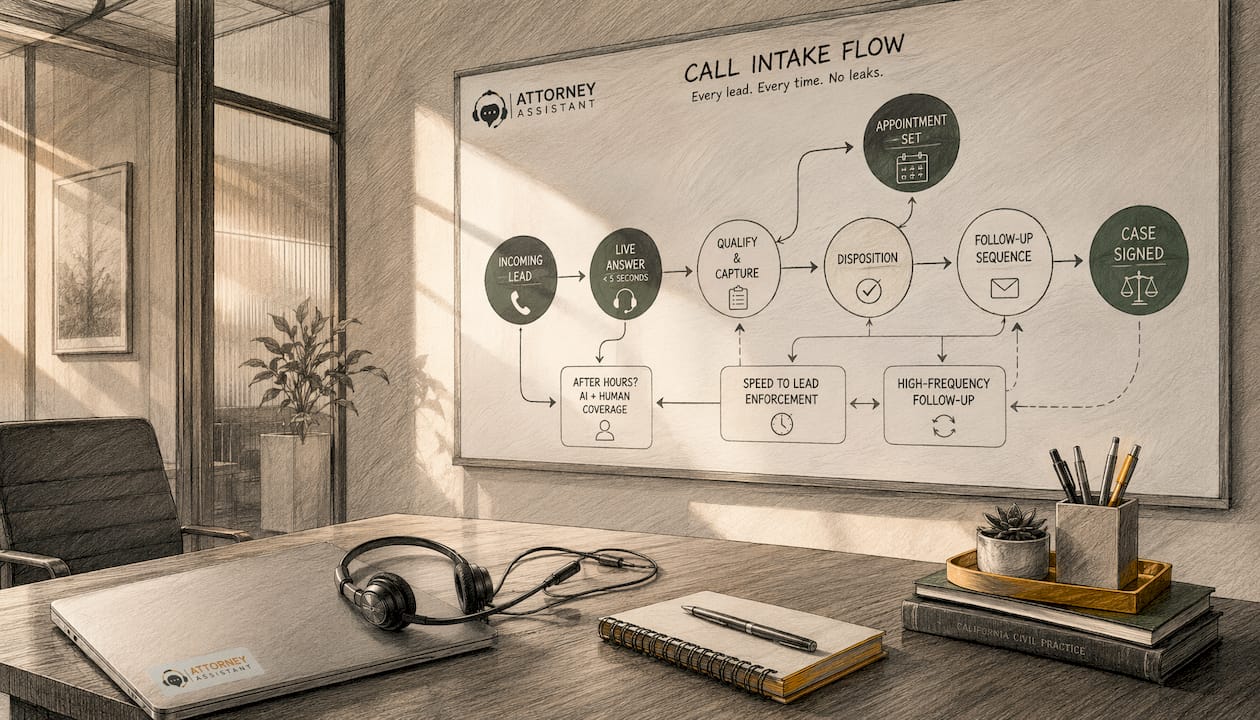
Telephone answering service jobs in a legal context are not general customer service roles; they often involve strategies like those detailed in Google Ads for Lawyers to complement intake improvements with answering services dedicated to law firms. They are specialized positions built around one goal: making sure every potential client who calls your firm reaches a live, trained person who can capture their information, qualify their case, and book a consultation before they dial the next attorney on their list.
The core functions of these roles include:
- Live call answering, 24/7 — covering nights, weekends, and holidays when most firms go dark
- Structured legal intake — collecting caller name, contact details, case type, incident facts, and urgency level using a consistent script
- Case qualification — filtering calls by practice area fit and case merit so attorneys only spend time on viable leads
- Consultation scheduling — booking directly into attorney calendars in real time, not creating a callback queue
- CRM data entry — logging every call and intake summary so nothing falls through the cracks
- Outbound follow-up — re-engaging leads who left voicemails or submitted forms but were never reached
Staff in these roles require training in legal confidentiality, compliance with attorney-client privilege norms, and the ability to handle distressed callers with empathy. This is not a job for a general call center operator reading from a generic script.
Table of Contents
- Why law firms keep missing calls and losing follow-up
- What intake failures actually cost your firm
- How to close intake gaps and stop the revenue leak
- Why Attorney Assistant is built specifically for this problem
- Stop losing cases you already paid to generate
- FAQ
- Key Takeaways
Why law firms keep missing calls and losing follow-up
The problem is structural, not personal. Most firms are set up in a way that makes missed calls almost inevitable.
- Limited office hours — the majority of firms answer phones from 9 AM to 5 PM, Monday through Friday. A large portion of legal calls come in after business hours, which means many inbound leads hit voicemail by default.
- Single-line overflow — when a receptionist is already on a call, the next caller either waits or goes to voicemail. There is no overflow system.
- Undertrained staff — human receptionists at most firms multitask, lack legal intake training, and cannot assess case merit or book consultations on the spot.
- Voicemail dependence — callers who reach voicemail rarely call back. Most are simultaneously contacting two or three other firms, and the first one to answer wins.
- No follow-up system — firms that do capture a voicemail often have no structured process to call back within the window that actually converts leads.
The result is a firm that spends money on marketing, generates inbound calls, and then loses a significant portion of those leads before a single attorney ever speaks to them.
What intake failures actually cost your firm
The revenue loss from missed calls is not abstract. Losing just a few calls per month can lead to significant annual revenue loss, depending on average case value. That range reflects how quickly the math compounds when you factor in case fees, referral potential, and the marketing cost already spent to generate each lead.
Speed compounds the problem. Firms that answer leads quickly are far more likely to connect than firms that respond with delay. Most firms are not responding promptly. They are responding the next morning, if at all.
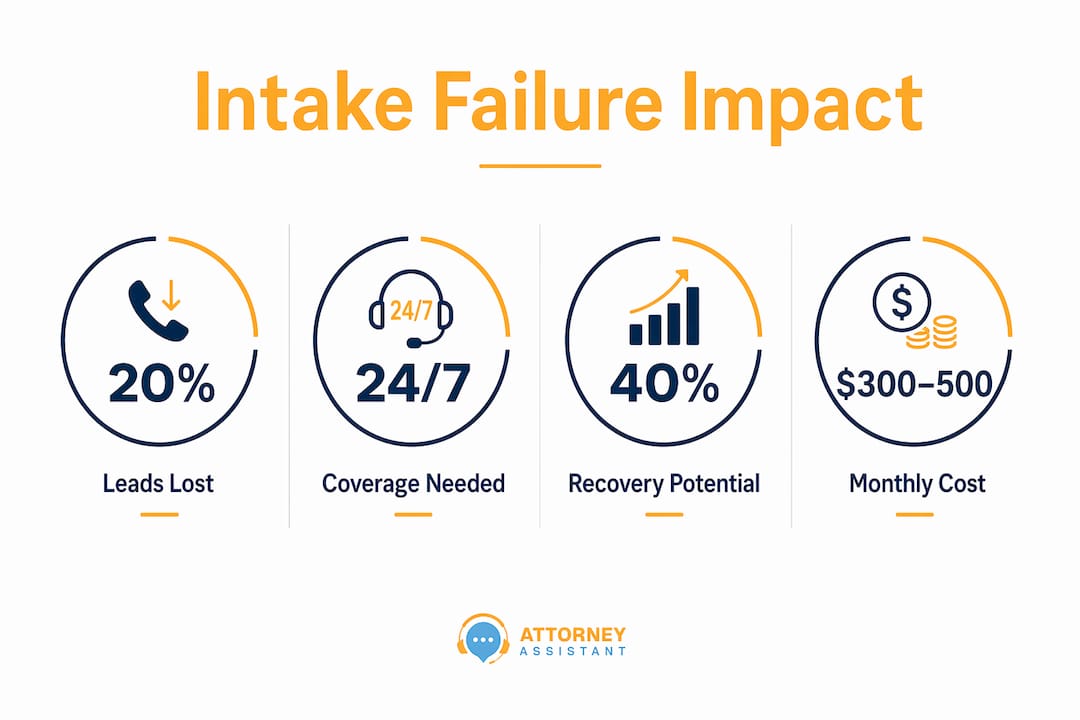
The voicemail backlog is not a dead end. Structured follow-up can recover 20–40% of leads lost to voicemail or missed calls without additional marketing spend. That is revenue already sitting in your existing lead pool, waiting for a system to extract it. Firms that implement 24/7 virtual reception, CRM integration, and automated follow-up have seen substantial improvements in lead-to-client conversion rates and significant additional revenue within months.
How to close intake gaps and stop the revenue leak
Fixing intake does not require hiring a full office of receptionists. It requires the right systems and the right people in the right roles.
- Deploy 24/7 live answering — cover every hour, including weekends and holidays. A legal answering service typically costs $300–$500 per month, far less than a full-time receptionist at $35,000–$55,000 per year in salary and benefits.
- Use structured intake scripts — every call should follow the same qualification criteria: case type, incident date, injuries or damages, contact information, and urgency. Consistency produces better data and faster attorney follow-up.
- Integrate with your CRM and calendar — intake summaries should land in your practice management system automatically, and consultations should be booked in real time, not added to a callback list.
- Add AI-assisted capacity — AI phone answering handles unlimited concurrent calls with consistent quality, eliminating the overflow problem entirely and covering every after-hours inquiry.
- Build outbound follow-up into the workflow — every voicemail and missed call should trigger a structured callback sequence, not a sticky note on someone’s desk.
- Train for confidentiality and compliance — staff handling legal intake must understand attorney-client privilege basics, data handling protocols, and how to manage distressed callers without overpromising outcomes.
Pro Tip: Audit your intake metrics monthly. Track call answer rate, response time, consultation booking rate, and lead-to-signed-case conversion. If you do not know these numbers, you cannot fix what is broken.
Firms that treat phone answering as a client acquisition function rather than a clerical task consistently outperform those that do not. The difference shows up in signed cases, not just call logs.

Why Attorney Assistant is built specifically for this problem
Attorney Assistant is not a staffing vendor. It is a law firm operations company that closes the intake gaps costing firms cases and revenue every month.
- Near-zero missed calls — 24/7 answering coverage with an AI-plus-human hybrid model means every call gets answered, including concurrent calls during peak hours and inquiries at 2 AM on a Sunday.
- Legal-specific intake protocols — every call follows structured scripts built for legal practice, capturing complete case information and qualifying leads against your criteria before an attorney ever picks up the phone.
- Real-time consultation booking — consultations are booked directly into attorney calendars during the call, not queued for a paralegal to schedule the next morning.
- CRM and workflow integration — intake summaries go directly into your practice management system, eliminating manual data entry and the errors that come with it.
- Systematic lead follow-up — Attorney Assistant’s lead follow-up service re-engages voicemail leads and cold contacts through structured outbound sequences, recovering cases that would otherwise be permanently lost.
- Co-management model — Attorney Assistant embeds in your daily operations and monitors performance continuously, not a set-it-and-forget-it arrangement.
The firms that work with Attorney Assistant stop losing cases to missed calls and start converting the leads their marketing already paid for.
Stop losing cases you already paid to generate
Most law firms do not have a lead problem. They have an intake problem. The leads are coming in. The calls are being missed, the voicemails are going unanswered, and the revenue is walking out the door to the firm that picked up the phone.
Attorney Assistant fixes that. The intake solution covers 24/7 live and AI-assisted answering, structured legal intake, real-time consultation booking, CRM integration, and systematic follow-up for every lead your firm generates. You get faster response times, higher conversion rates, and attorneys freed from non-billable intake chaos. If your firm is ready to stop leaking revenue from leads you already have, book a consultation with the Attorney Assistant team and find out exactly where your intake is breaking down.
FAQ
What qualifications do telephone answering service staff need for law firms?
Staff handling legal intake need training in confidentiality protocols, structured case qualification, empathetic caller management, and CRM data entry. Legal intake is distinct from general reception work and requires practice-area-specific knowledge.
How much does a legal answering service cost compared to a receptionist?
A professional legal answering service typically costs $300–$500 per month. A full-time receptionist costs $35,000–$55,000 per year in salary and benefits, covers one shift, and cannot handle concurrent calls or after-hours inquiries.
How quickly should a law firm respond to a new lead?
Firms that respond within 5 minutes are 100 times more likely to connect with a lead than those that wait 30 minutes. Speed-to-lead is one of the highest-impact variables in legal intake conversion.
Can missed voicemails actually be recovered?
Yes. Structured follow-up workflows recover 20–40% of leads lost to voicemail without additional marketing spend. The key is a systematic outbound sequence, not a manual callback attempt.
How does Attorney Assistant handle after-hours calls?
Attorney Assistant uses a hybrid AI-plus-human model to answer every call around the clock, conduct structured legal intake, and book consultations in real time, including nights, weekends, and holidays.
Key Takeaways
Law firms lose 20–40% of recoverable leads to voicemail and missed calls, and structured intake systems are the most direct fix available without increasing marketing spend.
| Point | Details |
|---|---|
| After-hours gap is the biggest leak | 64% of legal calls come in after business hours, when most firms send callers to voicemail. |
| Speed-to-lead determines conversion | Responding within 5 minutes makes a firm 100 times more likely to connect than waiting 30 minutes. |
| Voicemail leads are recoverable | Structured follow-up recovers 20–40% of leads lost to missed calls without new marketing spend. |
| Answering services cost far less than staff | Legal answering services run $300–$500 per month versus $35,000–$55,000 per year for a full-time receptionist. |
| Attorney Assistant closes the intake gap | Attorney Assistant’s 24/7 AI-plus-human model handles intake, follow-up, and CRM integration to stop revenue leakage. |
Recommended
Related Articles

1st Dollar Coverage in Law Firm Retainers: A Practical Guide
Understand 1st dollar coverage in legal and insurance contexts. Learn how it shapes intake, retainer strategy, firm revenue, and risk.
24 7 Phone Answering Service: Law Firm Guide
Discover how a 24 7 phone answering service can help your law firm capture every lead and provide round-the-clock client support. Learn best practices here.

White Glove Support for Law Firms
Discover how white glove support transforms law firm intake and operations. Learn the metrics, staffing models, and workflows that actually sign cases.