
It's Monday. A client wants a treatment update, a medical-record request has gone unanswered, and the attorney drafting a demand is the person who notices both. Everyone has touched the file. Nobody quite owns what happens next.
A virtual case manager is a dedicated legal-support professional who manages case administration remotely, inside your firm's own case management system. The useful distinction isn't where the person sits. It's whether someone owns the follow-through without taking over the attorney's legal judgment.
Table of Contents
- What a Virtual Case Manager Owns Day to Day
- Why Attorney Time Disappears Into Admin
- The Line Between Process and Legal Judgment
- Records Liens Discovery and File Movement
- Metrics That Prove the Caseload Is Moving
- How Co-Managed Onboarding and Scaling Work
- When to Hire Virtual Instead of In-House
What a Virtual Case Manager Owns Day to Day
Who owns each case-support task
| Workstream | Case manager executes | Attorney keeps |
|---|---|---|
| Medical records and bills | Request, follow up, log receipt, and prepare a factual summary | Medical conclusions and how the record is used |
| Pleadings support | Assemble exhibits, track deadlines, and format drafts from attorney direction | Legal theory, signature, and filing approval |
| Discovery administration | Organize productions, log deficiencies, and chase outstanding items | Scope, objections, and privilege calls |
| Lien management | Gather lien letters, balances, and reduction materials | Settlement authority and final numbers |
| Case administration | Client status updates, treatment tracking, scheduling, and system notes | Advice, matter acceptance, and strategy |
The case manager owns the administrative sequence, not merely the next task someone emails over. Requesting records includes confirming delivery, setting a follow-up date, checking what arrived, and identifying what's still missing. Sending the request isn't completion. It's sending the request.
That separates the role from a receptionist handling incoming communications, a shared assistant working through miscellaneous assignments, or a paralegal dividing attention among several firms. A title alone doesn't establish ownership. A defined workflow, assigned files, and an observable completion standard do.
Location matters less than workflow
Approximately 75% of attorneys used cloud computing for work-related tasks in the American Bar Association's 2024 Legal Technology Survey. That makes remote execution practical, but a cloud subscription doesn't tell anyone whose turn it is to chase the hospital.
For structured information collection, tools such as Kiwiform's online forms with business tool integrations offer an option to evaluate. Before connecting any form to a matter, check security, field mapping, and routing. A treatment update should reach the correct file and owner, not become another inbox attachment awaiting interpretation.
On that familiar Monday, the ownership failure becomes obvious: treatment status exists in someone's memory, an old request has no follow-up date, and the attorney discovers the gap while doing legal work.
Use a simple delegation test: Is the task repeatable, documented, and executable without legal advice? Assign administrative execution to the case manager, subject to attorney-approved procedures. If completing it requires interpretation, authority, or judgment, assign a review point rather than hoping the job title answers the question.
Why Attorney Time Disappears Into Admin
Attorneys spent 58% of their time practicing law, 14% meeting or speaking with clients, 13% managing the firm, 10% handling administrative tasks, and 5% on marketing and firm growth, according to the time-allocation figures cited by Thomson Reuters, which also reported that 74% of surveyed firms considered excessive administrative time at least a moderate challenge.
Management, administration, and marketing together accounted for 28% in that breakdown. Those activities aren't interchangeable, and not all should be delegated. But they explain why a full calendar doesn't necessarily mean a full day of legal work.
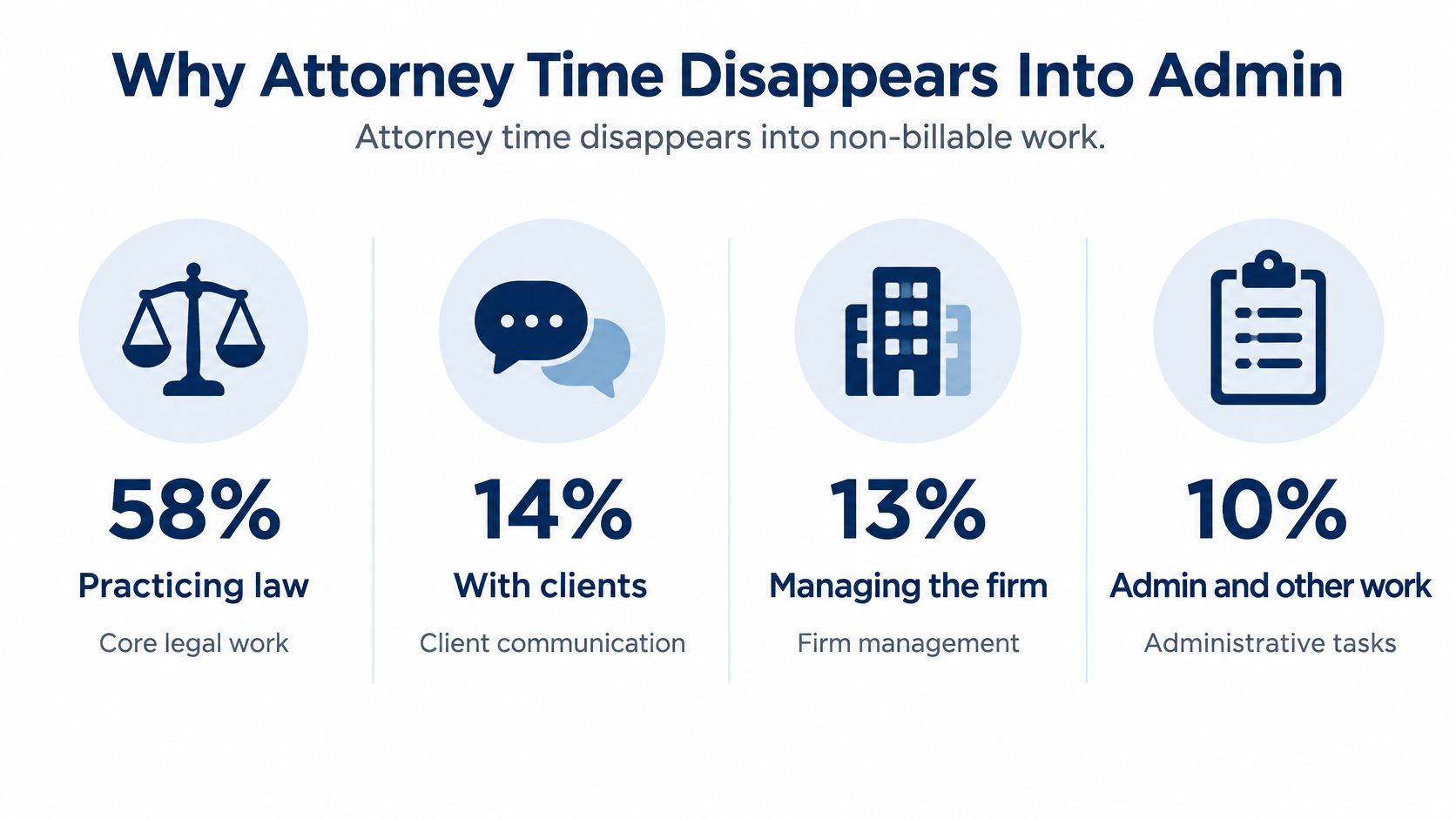
The graphic highlights selected categories; marketing and firm growth make up the remaining category in the cited breakdown.
Small chores arrive with switching costs
In a personal-injury practice, the individual requests sound harmless. Confirm the provider received the authorization. Find the missing bill. Tell the client whether records arrived. Check which version of the chronology is current.
None requires a lengthy meeting. Together, they keep pulling the attorney away from the demand, deposition outline, or negotiation that does require an attorney.
The 2018 Legal Trends Report found that 25% of legal professionals were interrupted more than 10 times daily, another 30% between six and 10 times, and reported an average 23 minutes to refocus after an interruption; 78% were often interrupted by existing clients. Those historical findings provide context for coordination costs, not a stopwatch prediction for your firm.
Clients shouldn't have to interrupt legal work to discover whether anyone is working on their file.
The answer isn't to make attorneys inaccessible. Give routine status inquiries an owner, provide approved answers, and reserve attorney interruptions for facts requiring legal attention. A client reporting a changed condition needs a different route from a client asking whether the imaging records arrived.
Run an attorney-capacity check
Review recurring work rather than asking whether everyone feels busy. Busy is already well documented.
- List the actual chores. Include provider emails, document searches, scheduling, data entry, routine updates, and internal status requests.
- Estimate the time involved. Use calendars and task history rather than a general impression of the week.
- Mark checklist-ready work. Identify tasks another trained person could complete using an existing procedure.
- Name the missing instruction. If delegation would require repeated attorney explanations, write that decision rule first.
The capacity opportunity is the work that can leave the attorney's desk without returning for routine clarification.
The Line Between Process and Legal Judgment
Telling someone not to give legal advice isn't a supervision plan. It's a warning label.
Ambiguous delegation is the central operational risk, whether the worker sits overseas, across town, or outside the partner's door. Remote work makes unclear instructions harder to overlook, but it doesn't create the underlying problem.
The ABA's discussion of legal ethics and virtual lawyering explains that virtual practice doesn't remove lawyers' duties concerning competence, confidentiality, communication, and supervision. Lawyers must also consider applicable jurisdictional rules, including where the lawyer and client are located; the worker's location belongs in the firm's compliance review too.
Put the boundary into task instructions
A useful delegation standard states what the case manager may do, what stops the task, and who receives the escalation.
- Intake qualification. Capture facts, dates, urgency, and potential conflicts. Route acceptance decisions to the authorized attorney rather than treating a completed questionnaire as approval.
- Deadline tracking. Enter and verify attorney-approved dates. Escalate conflicting dates, uncertainty about a triggering event, or any concern about a missed limitation period.
- Medical summaries. List providers, treatment dates, documented findings, and missing records. Don't infer causation or diagnose the claim.
- Lien communications. Request balances and assemble reduction materials. Don't concede settlement value or commit the firm to a final figure.
- Client updates. Report completed work and the next scheduled step. Escalate requests for advice, outcome predictions, or a change in strategy.
Pleadings support needs the same separation. AIDictation's guide to persuasive legal briefs can serve as a drafting-process resource, but formatting a brief and choosing its argument are different assignments. The attorney supplies the legal position and approves the final document.
Write the escalation rule before the urgent call
A missed-statute concern, a new injury, or a client asking what they should do shouldn't sit in an ordinary task queue. Specify the primary attorney, backup contact, escalation channel, and acknowledgment requirement. The case manager should record the client's words accurately, avoid interpreting them, and continue escalating until an authorized person accepts responsibility.
Supervision test: Could another attorney reconstruct who made the decision, what information they reviewed, and what the support professional was authorized to communicate?
At Attorney Assistant, every case manager signs a strict confidentiality agreement, and conflict checks run on every new matter before work begins. Those controls support supervision; they don't replace access restrictions, written instructions, or attorney review.
Audit a recent sample of client updates. Can you identify the sender, the approved communication standard, and any question referred to counsel? If not, improve the decision trail before expanding the role.
Records Liens Discovery and File Movement
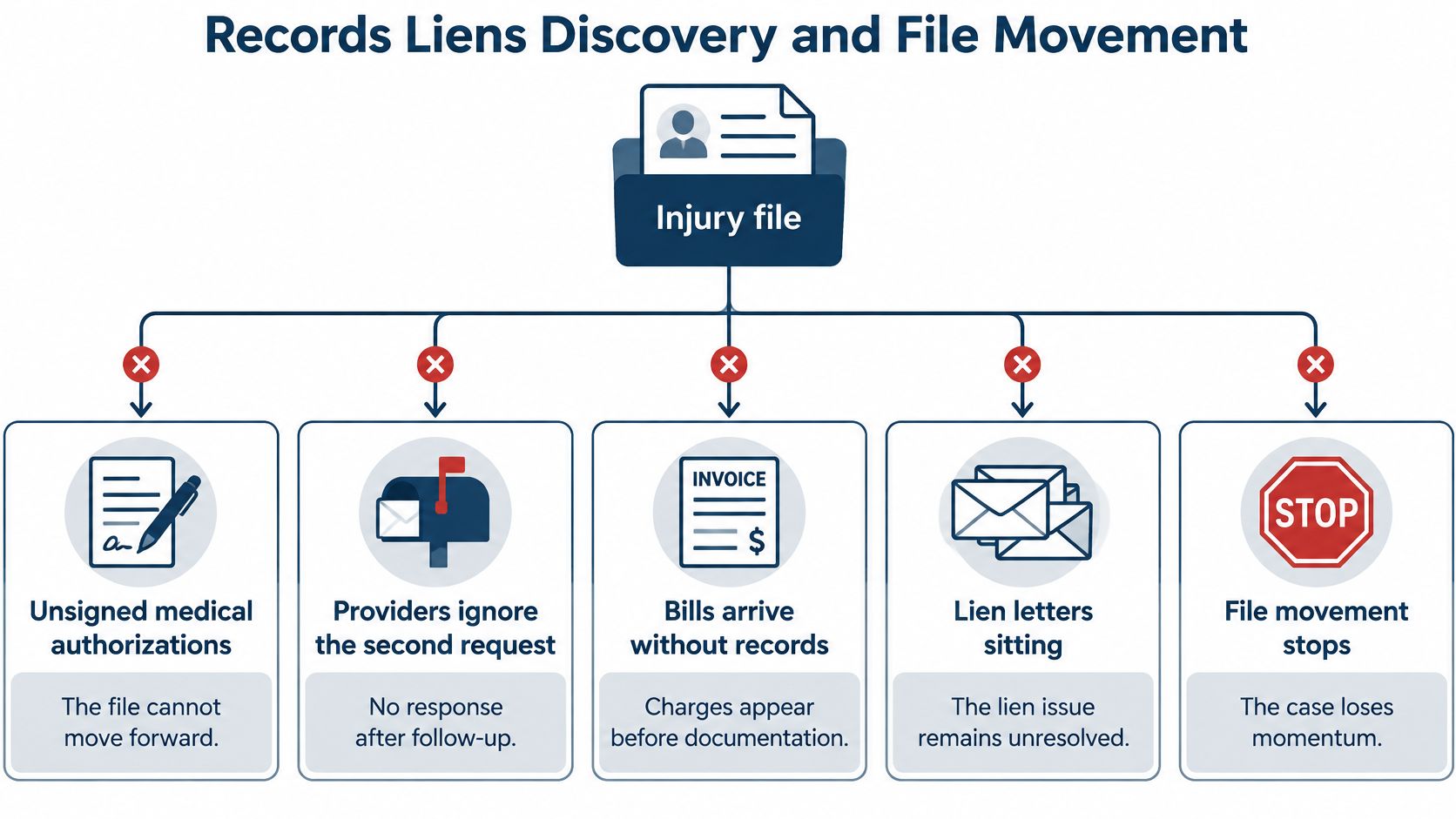
Say an injury file is ready for records collection, except the medical authorization hasn't been signed. The case manager sends the approved request, confirms the client received it, and records the outstanding signature as the next action. The file isn't labeled “waiting,” which is less a status than an invitation to forget.
Once authorization arrives, the provider request goes out through the approved channel. The case manager logs the destination, requested date range, delivery confirmation, and follow-up date in the matter.
Follow the file through the quiet handoffs
The provider doesn't respond after follow-up. Rather than sending the same email indefinitely, the case manager checks whether the request reached the correct department, whether the authorization was accepted, and whether a fee or additional form is holding it up.
Then bills arrive without records. The case manager marks the bill received but leaves the record request open, checks the service dates against the requested range, and asks for the missing documentation. A populated document folder is not proof of a complete response.
Next, a lien letter lands in an attorney's inbox. The case manager files it, records the stated balance and date, gathers supporting material, and flags any dispute or proposed resolution for attorney direction. The administrative task is assembling an accurate packet, not deciding what the client should accept.
Discovery needs an equally visible handoff. Track requested items, custodians, received materials, deficiencies, and follow-up dates in the case system rather than an isolated spreadsheet. Give the attorney a concise exception list when an objection, privilege question, or scope decision blocks completion.
For a deeper division of retrieval responsibilities, our guide to the medical records coordinator role helps distinguish acquisition work from broader matter administration.
Keep volume visible and access narrow
In mass tort work, apply consistent fields and checklists across claimants while preserving matter-specific facts. A manager should be able to filter for missing authorizations, incomplete treatment histories, and outstanding provider responses without asking who remembers the last call.
Document tools can assist with review, but they need their own controls. If evaluating LegesGPT's AI document review, check confidentiality terms, permitted data use, and verification procedures before uploading client material. Require a human to compare extracted facts with the underlying documents.
The NIST Cybersecurity Framework 2.0 calls for least-privilege access and protection of data confidentiality, integrity, and availability. Apply that operationally:
- Limit permissions. Intake staff see relevant contact fields; records specialists see authorized requests; privileged strategy remains restricted to attorneys or designated managers.
- Protect access and transfer. Use unique accounts, authentication, and approved encrypted storage and transmission.
- Preserve the trail. Log the user, timestamp, matter, action, outcome, and source system, with restricted administration and protection against alteration.
Finish the backlog review by aging open requests and assigning owners. Separate waiting on provider from nobody asked again. They require different fixes.
Metrics That Prove the Caseload Is Moving
Case-support scorecard and what bad numbers mean
| Metric | Healthy signal | Bad number usually means |
|---|---|---|
| Open record requests past chase interval | Few, each with a named owner | The cadence isn't running, or the provider has stalled |
| Median days from authorization to complete records | Falling month over month | Handoffs between request and receipt are stalling |
| Matters with a next task and date | All open matters | Files are managed from memory, not the system |
| Client updates sent on promised cadence | On schedule | The role hasn't taken the file, or updates depend on the lawyer |
| Lien letters requested versus balances in hand | Gap narrowing | Lien follow-up isn't closing |
| Discovery items past follow-up date | Short, named list | Outstanding items aren't being chased |
| Tasks reassigned back to attorneys | Declining | Scope is too narrow or the checklist is missing |
These are management signals, not universal benchmarks. Case complexity, provider behavior, and the mix of newly opened matters affect results. Investigate the cause before treating a worsening number as an employee-performance verdict.
Hours logged answer whether capacity was available. They don't answer whether anyone obtained the missing records or closed the lien follow-up.
Review exceptions, not the entire docket
Establish a baseline before the handoff, then compare the same definitions after the new owner takes responsibility. Our guide to case management goals can help connect task-level measures to broader operational priorities.
Keep the recurring review short and exception-led:
- Overdue work. Identify the blockage and the next action, not just the age.
- Attorney decisions. Present the specific question and supporting material together.
- Repeated returns. Examine administrative tasks repeatedly handed back to lawyers.
- Data gaps. Investigate missing dates, owners, or completion evidence before trusting the dashboard.
A suspiciously clean task list deserves attention too. If overdue work disappears because employees close tasks without recording the next step, you've improved the dashboard rather than the operation.
A completed follow-up task should leave either a result or another accountable next action.
Keep this scorecard separate from intake reporting. Answered calls and signed retainers measure opportunity capture; completed record sets and resolved administrative exceptions measure whether the firm can carry the resulting workload.
The most useful review ends with decisions: change a procedure, escalate a provider issue, approve an attorney response, or rebalance assignments. A recital of matter names isn't management. It's the docket read aloud.
How Co-Managed Onboarding and Scaling Work
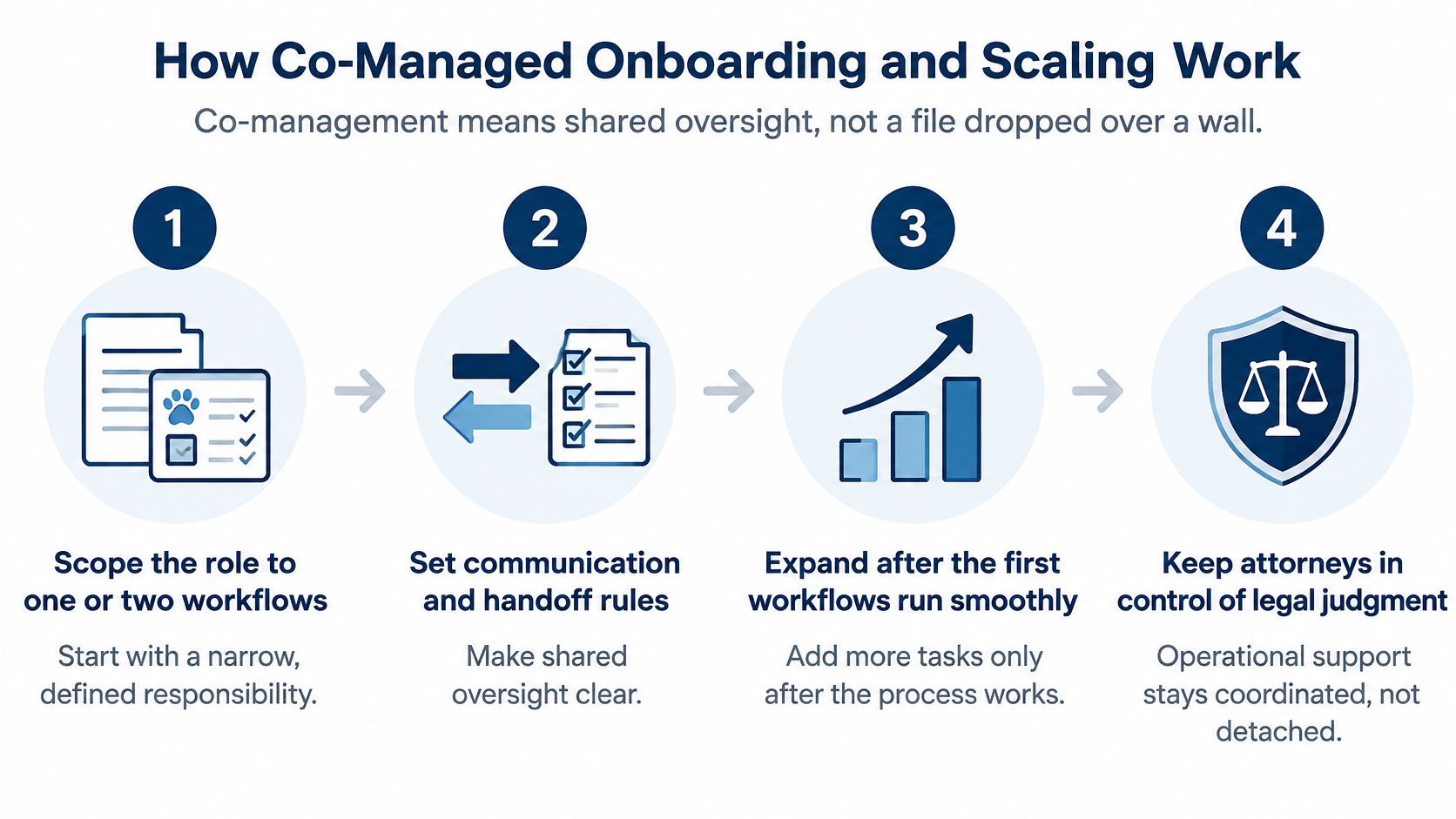
Co-management means shared oversight, not a file dropped over a wall. Attorney Assistant prepares legal-support personnel and helps manage performance; the firm supplies its specific procedures, legal direction, and approval standards.
Our process follows role scoping, matching and onboarding, system integration, and ongoing quality review and coaching. The firm doesn't need a parallel chain of command for every email, but it does need a clear division between operational coaching and attorney authority.
Make the handoff deliberately small
Scope a narrow responsibility. Start with records follow-up and treatment tracking, for example, rather than “help with cases.” Define the starting trigger, required fields, completion evidence, and escalation conditions. A broad job description is useful for recruiting; it isn't an operating procedure.
Match the person and teach the firm's method. A dedicated case manager works only the firm's files and learns its system, checklists, and client-communication standards. We source, vet, and train staff in legal-support fundamentals. The firm teaches its particular workflows, preferences, and procedures, including examples of acceptable work.
Integrate before increasing volume. Case manager onboarding starts with system access, followed by an active-file review and a follow-up cadence for every handed-off matter. Check permissions, document locations, task naming, notification settings, and escalation routes before assigning additional files. Otherwise, the first assignment becomes a scavenger hunt with confidentiality implications.
Keep quality review beside attorney direction. Our team reviews quality and coaches performance while the attorney directs legal work. Agree who corrects a missed procedural step, who approves a revised template, and who answers a substantive question. Don't make the case manager choose between conflicting instructions.
Broader virtual staffing arrangements work best when the firm treats integration as part of the job, not an inconvenience before the job starts.
Cap the opening caseload
The initial handoff should be a closed, named list, not access to the entire docket accompanied by encouragement. Start with selected aging record requests and deadline-sensitive matters that have attorney-approved priorities. Don't add files until the assigned workflow has held through a complete review cycle.
Review early output closely enough to catch misunderstandings while they're still inexpensive to fix. Check whether notes explain what happened, follow-ups have meaningful dates, and escalations contain enough context for the attorney to decide.
Expand only when the scorecard shows a dependable cadence and a specific remaining bottleneck. A growing lien queue may justify additional specialization; a mass-tort records backlog may justify more retrieval capacity. An unpleasant inbox, by itself, doesn't identify either.
Reduce scope just as deliberately when a practice area slows. The firm still owns its templates, tone, priorities, and rules for which communications require a lawyer. Co-management adds execution and oversight capacity. It doesn't outsource the firm's preferences.
When to Hire Virtual Instead of In-House
The decision turns on where the leak sits: repeatable process inside your case system, or work only a local employee can physically do.
Dedicated virtual case manager versus an in-house hire
| Factor | Dedicated virtual case manager | In-house hire |
|---|---|---|
| Assignment | One firm only, full time, not shared | One firm, onsite or hybrid |
| Where the work lives | The firm's own case management system | The firm's own case management system |
| Starting point | Pre-trained on legal-support fundamentals, then trained on the firm's system, checklists, and client-communication standards | Recruiting plus firm-specific training |
| Handoff | System access, active-file review, cadence on every matter | Recruiting, offer, any notice period, then training |
| Oversight | Attorney direction plus co-managed quality review | Firm manages directly |
| Change in capacity | Scope roles up or down as volume changes | Requires hiring or employment changes |
| Cost shape | Attorney Assistant case manager support from $2,500 per month | Salary, applicable benefits, payroll taxes, and recruiting |
Choose dedicated virtual support when the bottleneck is repeatable case administration, your team already uses a case management system, and the work can be documented and reviewed remotely. Keep the split explicit: attorneys own strategy, legal judgment, and substantive client answers; the case manager owns execution inside the file.
Choose an in-house hire when duties require physical presence, local provider relationships, or onsite coordination that can't reasonably be reassigned. Reluctance to document procedures isn't a strong reason to hire onsite. It usually means the firm will train the next employee through interruptions.
Match the hire to the actual leak
Attorney Assistant's Staffline provides a dedicated, full-time professional for one firm only, working 40 hours per week, never shared. Case managers work directly in systems such as Filevine, Litify, Clio, CASEpeak, or SmartAdvocate, keeping documents filed, notes logged, and tasks updated under attorney direction. If the problem is unanswered prospective-client calls instead, Frontline provides 24/7 live intake, qualification, structured follow-up, and signing of appropriate matters under firm-approved processes, rather than message-taking.
That distinction matters: a 2024 secret-shopper study cited by the American Bar Association found that only 40% of firms answered incoming calls, down from 56% in 2019. A case-support hire and live intake coverage address different failures.
Before choosing, list the recurring administrative tasks attorneys still perform. If the list is long, checklist-shaped, and concentrated around open files, scope a virtual case manager role. If the work requires physical presence or substantive legal decisions, hire for that requirement directly.
The right hire fits the bottleneck. The wrong hire gets a full inbox and responsibility for work nobody has routed.
Attorney Assistant provides dedicated legal support through Staffline and 24/7 live intake through Frontline. Bring your recurring attorney-admin tasks and oldest case-support backlog to Attorney Assistant to discuss a virtual case manager scope with clear ownership, review points, and measurable file movement.
Related Articles

Call Answering Service for Law Firms: What Actually Works
A call answering service for law firms should sign cases, not take messages. Learn pricing models, vendor criteria, and 24/7 intake that converts.
Case Management Aide: A Law Firm Setup Guide
Learn the key roles, setup steps, and workflow tips for a case management aide in your law firm. Boost efficiency and organize cases in 2026.

Virtual Staffing Solutions for Law Firms
Discover how virtual staffing solutions build real operational capacity for law firms. Learn about co-managed models, dedicated legal support, and 24/7 intake.