
A medical lien is a legal claim against a personal injury settlement or judgment, not against the patient generally, and it gets paid from the recovery before the client receives a net share. In the United States, hospital and medical lien laws go back to the 1930s, with a cited milestone in 1936 in New York and another in 1951 in Florida, so this is old legal plumbing, not a trendy billing invention.
If you're running a PI practice, you've probably got at least one file right now where everyone is talking about the settlement amount and almost nobody is talking about the pile of reimbursement rights waiting behind it. Then the check arrives, the math gets ugly, and suddenly everyone discovers that enthusiasm is not a disbursement strategy.
For case managers, liens are where legal theory turns into operational drag. For firm owners, they're one of the quietest ways profit, client satisfaction, and staff time disappear at the same time. A file can look healthy right up until the lien letters show up and start eating the settlement with the calm efficiency of termites.
Table of Contents
- What a Medical Lien Actually Is
- How a Medical Lien Gets Created
- Who Files Liens and Why They Care
- Statutory Versus Contractual Liens
- How Liens Change Settlement Math
- Reducing Liens Before the Check Cuts
- Lien Work as an Operations Problem
What a Medical Lien Actually Is
A rear-end crash client goes to the ER, gets imaging, follows up with an ortho, then does six weeks of physical therapy. All of that happens before any settlement exists. The providers still expect to be paid, and a medical lien is one way they protect that right if the injury claim later produces money.
The simplest answer to what is a medical lien is this: it is a secured claim against the proceeds of a personal injury settlement or judgment. It is not a grab at the client's general assets. The lien attaches to the recovery fund itself, which is why it matters most in cases with liability coverage, a viable defendant, and an actual path to money. That structure is described clearly in this explanation of how medical liens attach to settlement proceeds.
Billing is not the same thing as a lien
A bill says, "You owe us for treatment."
A lien says, "If this injury case pays out, we want to be paid from that money."
Those are related, but they aren't the same. A provider can send ordinary bills without ever asserting a lien. A lien is the extra legal mechanism that waits for settlement funds and claims a place in line when the money arrives.
Why this distinction matters in practice
Once a lien is in play, the settlement doesn't pass from insurer to firm to client. It passes through a filter. The lienholder may need to be verified, negotiated with, paid, or formally resolved before the client gets a net disbursement.
Practical rule: Never treat a lien as a bookkeeping nuisance. It changes settlement value, case strategy, and disbursement timing.
That is why lien handling belongs near the center of case management, not buried at the end of the file like a surprise chore someone remembers after drafting the settlement statement.
A second point matters just as much. In practical use, liens often exist so injured people can receive treatment immediately and pay later if the case resolves by settlement, judgment, or arbitration award. That is one reason they show up so often in accident cases, as noted in this overview of medical liens in injury matters.
How a Medical Lien Gets Created
Take a routine car crash file. The client is hurt, misses work, and doesn't want to hear the phrase "high deductible" one more time. Treatment starts anyway.
At intake with a provider, the patient may sign paperwork allowing treatment on a lien basis or assigning reimbursement rights if the case later pays. That usually happens because the client lacks health insurance, has coverage the provider doesn't want to bill, or is being treated under a process that expects repayment from the injury case.
The timeline usually looks like this
- Treatment starts first. The provider renders care before any settlement exists.
- Charges accumulate. Bills, records, and coding build in the provider's system.
- The claim becomes known. The provider learns there is a PI claim or attorney involved.
- A demand or lien notice goes out. The provider, insurer, or another payer asserts a right to be paid from any recovery.
- The firm has to track it to the end. If nobody logs it, nobody resolves it. That is how "minor" liens become end-of-case disasters.
Some liens are more formal than others. A statutory hospital lien may arise because state law allows it if the provider follows the required process. A contractual lien may arise because the patient signed something during intake that created reimbursement rights.
Timing isn't uniform across lien types
New case managers get tripped up. They expect every lien to arrive as a neat letter with a round number and a footer that says "please remit." That would be nice. It would also be unusual.
Hospitals, insurers, and government payers all move on different clocks. Some rights arise by statute. Some get triggered when the payer learns there's a third-party claim. Some sit until settlement is imminent, then appear with remarkable confidence and very little concern for your calendar.
The lien file starts on the first treatment date, not when someone emails "final demand" three days before disbursement.
Historically, this payment structure exists for a reason. Hospital and medical lien laws emerged in the 1930s as a response to indigent care and weak payment protection for providers. A cited milestone is 1936, when New York's lien law section 189 gave certain hospitals lien rights for care provided to people injured by a third party's negligence, and Florida followed with a major milestone in 1951 through a general hospital lien law for large counties, as summarized in this historical review of hospital lien law development.
Who Files Liens and Why They Care
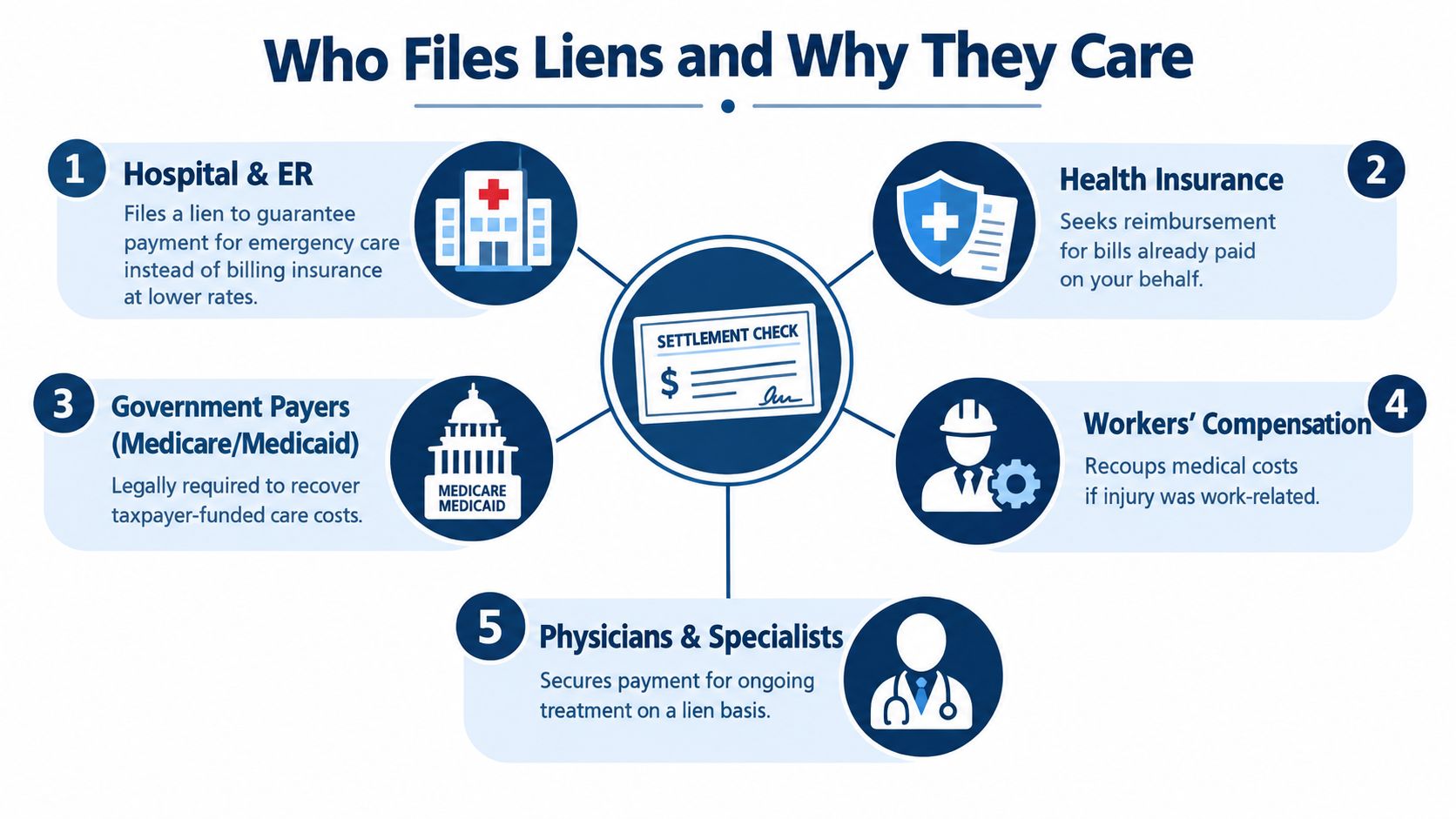
Not every lienholder wants the same thing, and that matters because they won't respond to the same reduction argument. If your team treats all lien claims as one generic bucket, you're volunteering for avoidable delay.
The usual lien players
- Hospitals and treating providers: These are the ER, hospital system, surgery center, imaging facility, chiropractor, pain clinic, or specialist who wants direct payment from the settlement instead of chasing patient balances later.
- Private health insurers and managed care plans: They may assert reimbursement or subrogation rights because they already paid for injury-related care.
- Government programs: Medicare and Medicaid have their own recovery systems and documentation habits, which is a polite way of saying your staff should calendar everything twice.
- Workers' compensation carriers: If the injury overlaps with work-related facts and a third party is involved, they may seek reimbursement too.
- Physician groups billing separately from the facility: The hospital may have one claim and the physicians another. Because one invoice would be too simple.
Why each category cares
Providers care because treatment on accident cases can otherwise drift into bad debt or delayed collections. Insurers care because they don't want the claimant recovering the same medical expense twice. Government programs often have recovery obligations built into their reimbursement systems, and those rights can be less casual than the average provider demand.
Medical lien recovery is generally limited to the amount of the treatment or service provided, which is one reason many authorities describe liens as a mechanism to prevent double recovery for the same medical expense. That framework is summarized in this legal definition of medical lien recovery limits.
The operational point owners should notice
A serious lien inventory is not optional. Every category produces a different mailing address, payoff process, supporting-document request, and reduction posture.
That matters even before settlement. If your firm is also working to increase inbound case volume through channels like local SEO for lawyers, better marketing only helps if your operations can carry the file from intake through disbursement. Frontline signs the case. Staffline carries it. Liens are part of the carrying.
Statutory Versus Contractual Liens
The label "medical lien" sounds singular. It isn't. The source of the right controls the strength of the claim, the required notice, and how much room you have to negotiate.
The two engines behind most lien claims
| Dimension | Statutory Lien | Contractual Lien |
|---|---|---|
| Source of right | Created by state or federal law | Created by signed agreement or plan terms |
| Common examples | Hospital lien statutes, some government recovery rights | Provider lien forms, assignments, plan reimbursement clauses |
| What you review first | Notice requirements, filing steps, scope allowed by law | Contract language, authorization, plan documents |
| Main vulnerability | Defective filing, late notice, charges outside statutory scope | Weak contract language, missing signatures, limited applicability |
| Negotiation posture | Often framed around statutory caps and compliance defects | Often framed around contract terms, equity, hardship, and case limits |
A statutory lien exists because a law says it can. A historical example appears in New York's 1936 hospital lien law. Another useful historical point comes from Missouri. A Missouri law review article noted that by 1998 the state's framework still consisted only of a hospital lien statute, so physicians and other providers lacked direct statutory recovery tools there until later reforms, as discussed in this law review analysis of medical lien development and related reimbursement systems.
A contractual lien exists because someone signed something. That could be a provider intake agreement, an assignment of benefits, a health plan reimbursement clause, or a repayment document tied to treatment.
Why the distinction changes negotiation
If the claim is statutory, your first questions are procedural.
- Was notice proper
- Was the right party identified
- Were only permitted charges included
If the claim is contractual, the questions shift.
- What exactly did the patient sign
- Does the contract cover this recovery
- Is the payer relying on plan language that supports the demand
Recent reporting also shows why this isn't just academic. An Arizona statute still gives licensed providers a lien on liability recoveries while excluding health insurance and med-pay coverage, while a reported 2025 Georgia Supreme Court ruling limited some contractual medical liens when the patient has health insurance, according to this discussion of changing lien rules and tort reform implications.
A lien amount is never self-proving just because it arrived on letterhead.
Diagnostic questions for case managers
Before anyone accepts a lien number at face value, run this checklist:
- Identify the source: Is this right based on a statute, a signed contract, or a government reimbursement rule?
- Match it to the treatment: Does the charge relate to the accident care at issue?
- Check the scope: Are they claiming only recoverable items, or did someone throw in unrelated balances and hope nobody notices?
- Verify enforceability: State, payer type, and document language all matter.
How Liens Change Settlement Math
Settlement math looks impressive until the deductions line up in single file. Then everyone remembers that a gross number and a net number are not close relatives.
From a case-administration perspective, liens can materially reduce the client's recovery and create a priority waterfall that must be cleared before funds are released. They also require verification of the amount, treatment nexus, and any statutory or contractual limits, as explained in this discussion of liens and settlement administration.
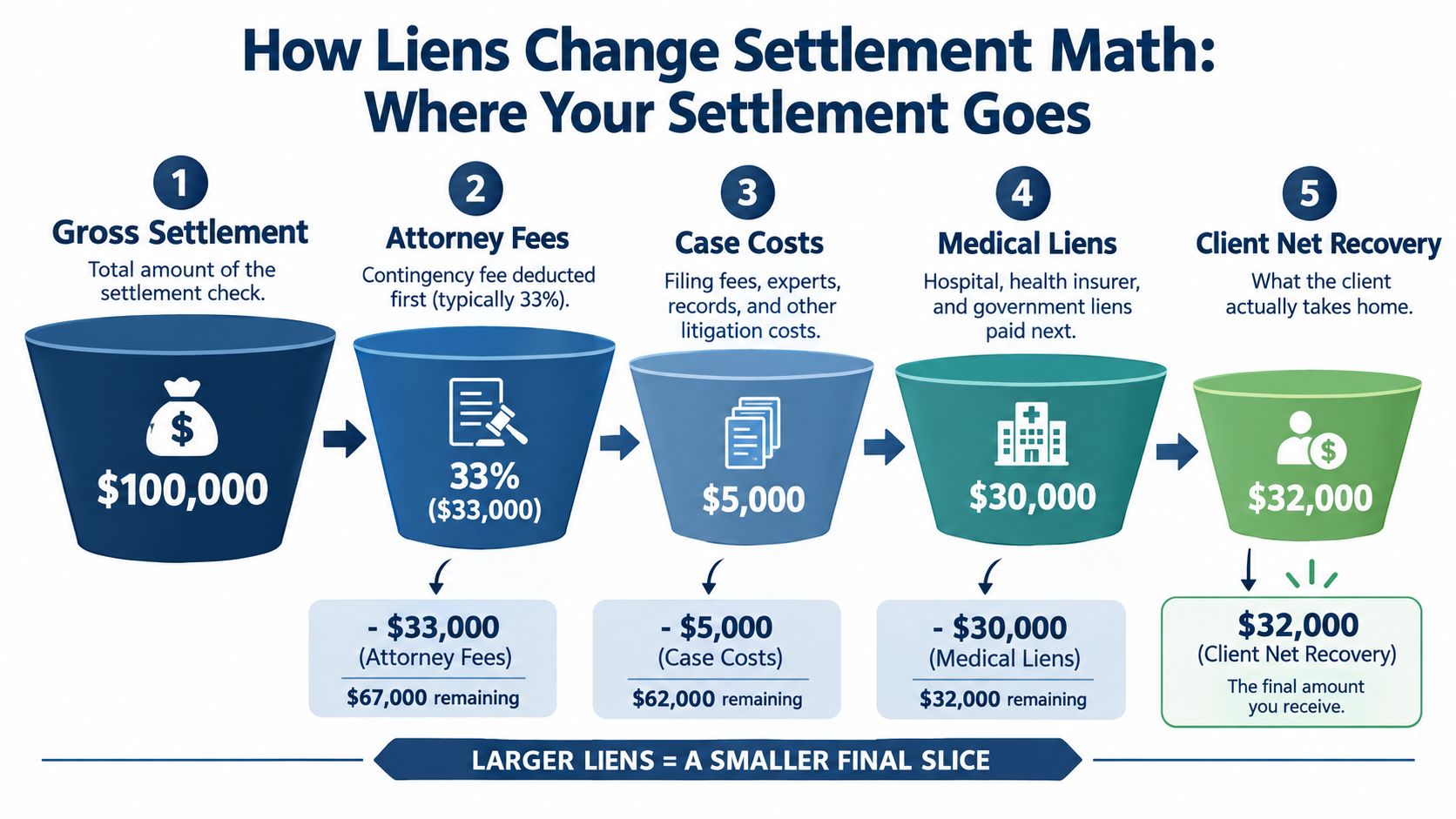
A representative settlement breakdown
Use this as a working example:
- Gross settlement: $100,000
- Attorney fee at 33%: $33,000
- Case costs: $5,000
- Medical liens before reduction: $45,000
If no lien reduction happens, the rough waterfall looks like this:
| Item | Amount |
|---|---|
| Gross settlement | $100,000 |
| Attorney fee | $33,000 |
| Case costs | $5,000 |
| Medical liens | $45,000 |
| Estimated client net | $17,000 |
That is the moment clients stop caring how good the gross number sounded in the demand package.
Why reduction work matters before disbursement
If lien review cuts the payable medical lien stack down to the lower figure shown in the infographic, the client's net changes materially. The principle is simple even when the paperwork isn't. Every dollar that remains valid and unpaid in the lien stack comes out of somebody's portion of the settlement, and that "somebody" is usually the client first, then sometimes the fee in practical negotiations.
For firms trying to understand the provider side of the equation, this overview of Happy Billing revenue recovery is useful context. Medical providers don't see these balances as abstract legal doctrine. They see accounts receivable.
Why owners should care about the net, not the headline number
A case can "settle well" and still end badly from the client's perspective. That is where complaints start. The client remembers the settlement amount they heard in the conference room, not the lien file no one explained clearly three months earlier.
This is also why itemization matters. If your staff isn't reviewing medical charges line by line, you are trusting the final math to whoever generated the bill. That's optimistic. A practical place to tighten that process is this guide to medical billing itemization, because a clean lien negotiation usually starts with a clean bill review.
Reducing Liens Before the Check Cuts
Lien reduction is not a ceremonial email you send the day the release goes out. It is a workflow. The good news is that it is a repeatable workflow, which means your team can get better at it instead of re-learning it in every file under mild panic.
Attorneys are commonly advised to identify lienholders early, request itemized statements, audit the charges against the injury date, and then make a specific reduction demand. Many reductions take multiple rounds before a written satisfaction or reduction agreement is finalized, as outlined in this medical lien reduction negotiation playbook.
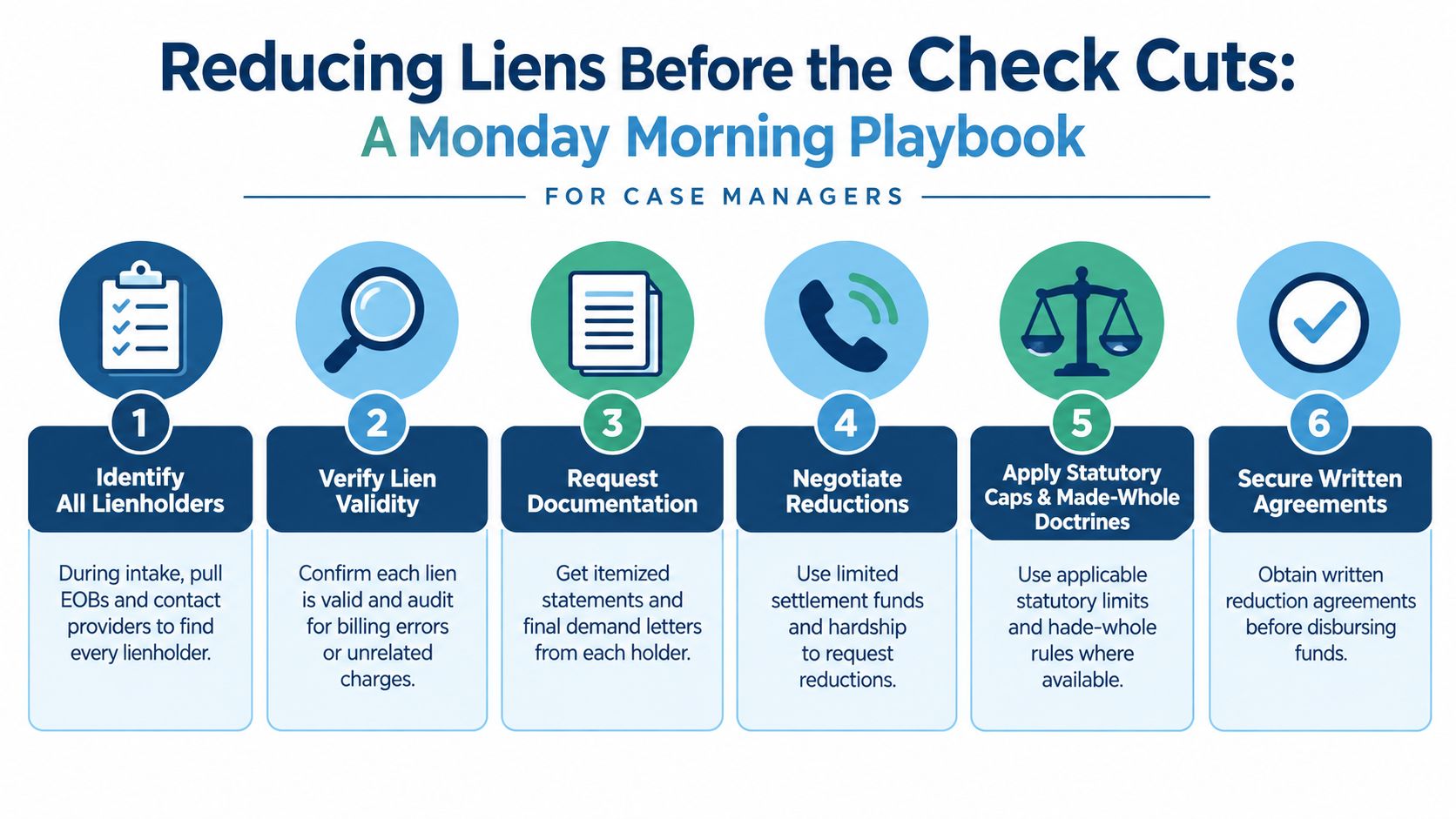
The Monday morning version of the playbook
- Start at intake: Ask about every insurance card, every treating provider, and every place the client received care. Pull EOBs early when available.
- Get demands in writing: Request an itemized ledger, not just a balance due. You want dates of service, charge descriptions, and enough detail to tell whether the bill belongs in the file.
- Audit before negotiating: Compare treatment dates to the accident timeline. Watch for unrelated care, duplicate entries, or charges that don't match the claimed injury path.
- Negotiate with facts: Limited policy, limited recovery, disputed liability, treatment gaps, hardship, and common-fund style arguments all matter more when attached to documents.
- Close the loop in writing: Don't rely on a phone call that ended with "we should be able to do something." Get the reduction and payoff terms confirmed before disbursement.
What usually gets missed
Many public explanations stop at "liens can be negotiated." True, but not very helpful.
What moves the file is support. Settlement sheet. policy information if relevant. attorney fee structure. cost ledger. proof of hardship when appropriate. explanation of contested liability when applicable. If your reduction request is three vague sentences and a signature block, you're mostly testing the lienholder's generosity.
California-related coverage in 2025–2026 also highlighted expanding price-transparency requirements for outpatient surgery and imaging facilities used in injury cases, suggesting more room to dispute billed amounts before lien resolution. The same coverage noted a medical-ethics review finding that lien use is permitted by statute in Missouri, but experts said the practice is not extremely common, which shows the gap between legal availability and real-world usage, as summarized in this fifty-state hospital lien chart and related commentary.
Send the first reduction demand early enough that "follow-up" means negotiation, not begging for a payoff two hours before accounting wants to cut checks.
For firms building a tighter process around this work, medical lien management is a useful framework because reduction only works consistently when the file is organized before settlement lands.
Lien Work as an Operations Problem
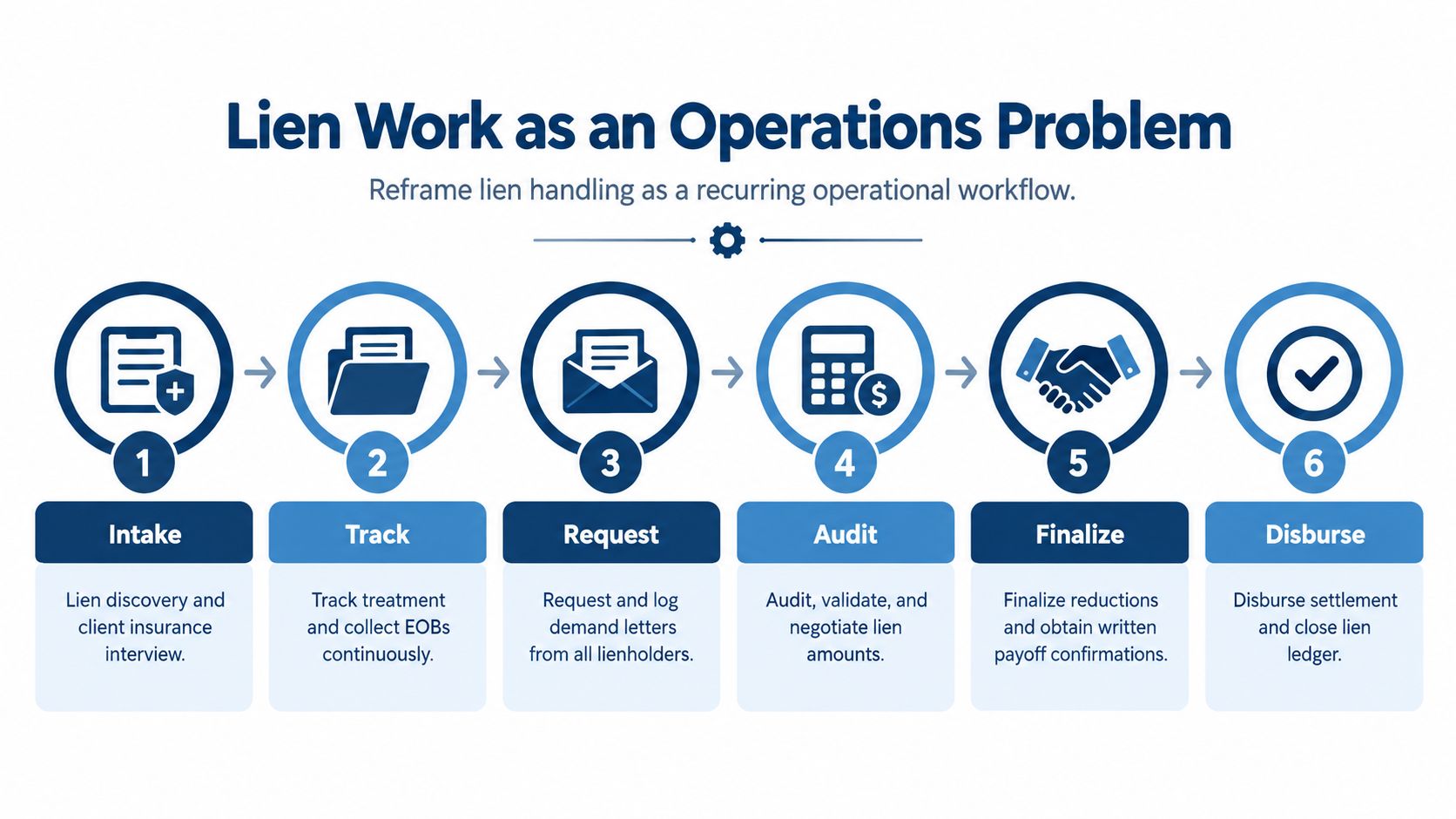
Most firms talk about liens like they are occasional legal side quests. They are not. In a PI practice, lien work is recurring operational labor that repeats across files with annoying consistency.
A typical file demands intake questioning, insurance verification, treatment tracking, statement requests, ledger review, follow-up, negotiation, final payoff coordination, and reconciliation before disbursement. None of that disappears because the attorney is busy, and none of it gets easier because someone writes "lien TBD" in the notes field and hopes for character development.
Where firms usually lose control
- Discovery is inconsistent: The intake team misses a coverage source or treatment provider.
- Tracking is passive: Nobody updates the lien log while treatment is ongoing.
- Demands arrive into chaos: Letters hit shared inboxes, get saved nowhere useful, and then become "accounting's problem" at settlement.
- Negotiation has no owner: Everyone assumes someone else is handling reductions.
- Payoff confirmation is late: The file closes slowly because final numbers were never nailed down.
That is not a legal knowledge problem alone. It is a staffing and systems problem.
What a workable structure looks like
Mature firms treat liens as a defined workflow with ownership. They use standardized intake questions, a lien tracker, document naming rules, follow-up intervals, and a clear handoff to whoever handles final accounting.
Some firms build that capacity with internal staff. Some use software plus dedicated support. Some add specialized outside help for complex reductions. One option in that mix is Attorney Assistant's lien management support, which handles bill and lien checks, reduction work, and related case-support tasks as part of broader legal operations staffing.
Why this matters to owners, not just case managers
When lien work is understaffed, the effects show up everywhere else.
- Client satisfaction drops: The client thought they were waiting on the insurer. They were waiting on your unresolved payoff stack.
- Attorney time gets wasted: Lawyers end up chasing statements and explaining net sheets instead of practicing law.
- Cash flow slows down: Settlement funds sit while someone reconstructs the file at the last possible moment.
- Staff burnout rises: Case managers inherit a cleanup project that should have been a process.
Liens don't just reduce settlements. Poor lien handling reduces capacity.
That is the broader lesson. Many firms think they have a growth problem or a lead problem. Often they have a carry problem. Frontline signs the case. Staffline carries it. If the carry breaks at billing, records, or lien resolution, more marketing just creates a larger pile of half-managed opportunity.
If lien work keeps showing up late, slowing disbursements, and pulling attorneys into admin cleanup, that's a capacity issue, not bad luck. Attorney Assistant provides dedicated legal support staff and 24/7 intake for law firms, including help with records, billing support, and lien management workflows, so your team can stop treating settlement math like an end-of-case surprise.
Related Articles
5 Case for Support Examples for Law Firms
Review five case for support examples for law firms, with strategic breakdowns, reusable templates, and practical tactics for staffing, intake, and growth.

Call Screen Service Options for Law Firms Compared
Compare call screen service options for law firms. Evaluate in-house staff, auto-attendants, and 24/7 legal intake teams to stop losing cases to missed calls.

Live Virtual Receptionists for Law Firms: A Practical Guide
Learn how live virtual receptionists help law firms capture more leads, qualify intake, and operate 24/7 without adding attorney workload.