What Is Client Qualification for Law Firms: 2026 Guide

TL;DR:
- Client qualification involves systematically assessing potential clients to ensure they align with your firm’s criteria and profitability. Implementing frameworks like BANT and MEDDIC, along with a clear ideal client profile, helps filter leads early and prevent wasted attorney time. Building a team-wide qualification culture promotes consistency, improves conversion rates, and protects firm profitability by prioritizing high-value, well-fit cases.
Client qualification is the process of systematically evaluating potential clients against defined criteria to determine whether they are worth your firm’s time, resources, and legal expertise. In sales methodology, this is often called lead qualification, but in legal practice it carries higher stakes. A poor fit client does not just waste a few hours. It drains attorney time, creates scope creep, and erodes profitability. Legal firms using standardized qualification rubrics report 20% higher project profitability by filtering leads early. Frameworks like BANT (Budget, Authority, Need, Timeline) and MEDDIC give legal professionals a repeatable structure to make that filtering objective, not instinctive.
What is client qualification and why does it matter for law firms?
Client qualification is defined as the structured assessment of whether a prospective client meets the criteria that make engagement viable and profitable. The term “lead qualification” is the recognized industry standard across sales and professional services, but in legal intake, the concept applies directly to every inbound call, web form submission, or referral your firm receives.
The importance of client qualification goes beyond saving time. Without a defined process, intake coordinators make judgment calls based on gut feel. Those calls are inconsistent. One coordinator might advance a case with no clear budget or timeline. Another might turn away a strong lead because the initial call felt awkward. Neither outcome serves the firm.
The client assessment process also protects attorneys from burnout. Every hour spent on a client who was never a good fit is an hour not spent on a case that could win, settle well, and generate referrals. Qualification is the filter that keeps your caseload aligned with your firm’s actual strengths and capacity.
What are the core criteria and frameworks used in client qualification?
Two frameworks dominate how legal and professional services firms qualify clients: BANT and MEDDIC. Both provide structured criteria to assess whether a prospect is worth advancing through intake.
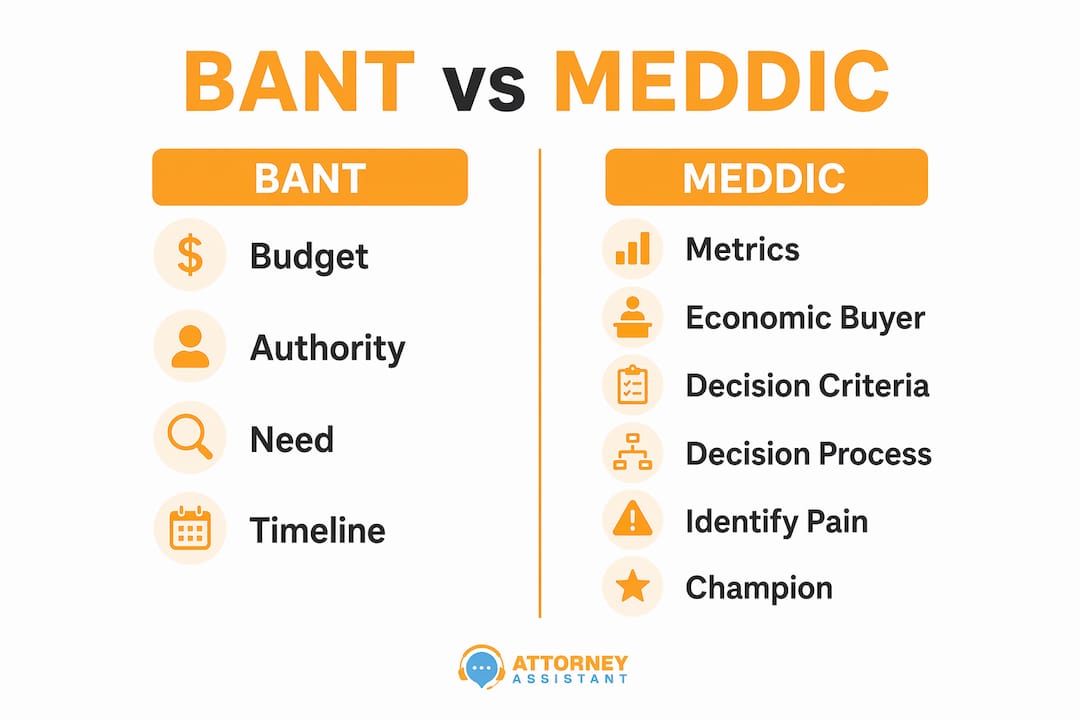
BANT: the standard starting point
BANT remains the primary framework for most qualification processes, with MEDDIC reserved for more complex, multi-stakeholder decisions. BANT stands for Budget, Authority, Need, and Timeline. In a legal context, Budget means whether the prospect can fund the representation. Authority means whether you are speaking to the actual decision-maker. Need means whether the legal issue falls within your practice area. Timeline means whether the matter has urgency that justifies immediate engagement.
MEDDIC: for complex or high-value cases
MEDDIC adds depth for cases involving business clients, large settlements, or multiple decision-makers. The acronym covers Metrics, Economic Buyer, Decision Criteria, Decision Process, Identify Pain, and Champion. A corporate litigation matter, for example, may require you to identify the economic buyer (the CFO, not the in-house counsel) and understand the internal decision process before committing firm resources.
BANT vs. MEDDIC: a direct comparison
| Framework | Best for | Key criteria | Legal application example |
|---|---|---|---|
| BANT | Standard intake, personal injury, family law | Budget, Authority, Need, Timeline | Confirming a PI client has a viable claim and can retain within 30 days |
| MEDDIC | Business litigation, high-value cases, corporate clients | Metrics, Economic Buyer, Decision Criteria, Decision Process, Identify Pain, Champion | Mapping who approves outside counsel spend in a commercial dispute |
Both frameworks connect directly to your Ideal Client Profile (ICP). Without a defined ICP, qualification becomes subjective and unreliable. Your ICP should be built from your most successful past clients, not from who you wish you could serve.
How does the client qualification process work step by step?
A practical client qualification process for legal intake follows seven stages. Each stage filters the lead pool further and routes prospects to the right next action.
- Define your ICP. Document the firmographic and case-type criteria that describe your best past clients. Include practice area, case value range, geographic location, and urgency level.
- Capture the lead. Every inbound inquiry, whether by phone, web form, or referral, enters a single tracking system. No lead should exist only in someone’s memory or email inbox.
- Respond within 5 minutes. Initial response under 5 minutes is the standard for effective qualification. Speed signals professionalism and catches prospects before they call the next firm on their list.
- Ask 3–5 targeted qualifying questions. Cover need, timeline, authority, and basic case fit. Limiting intake questions to 5–7 focused items balances the insight you need with the completion rates you require.
- Score the lead. Assign a Hot, Warm, or Cold designation based on the answers. Leads with a confirmed fit and a timeline within 90 days route as Hot. Vague timelines or unclear need route as Warm or Cold.
- Route and follow up. Hot leads go directly to an attorney or senior intake coordinator. Warm leads enter a structured follow-up cadence. Cold leads enter a 14-day nurture sequence or receive a polite decline.
- Hand off with context. When a qualified lead moves to the attorney, the handoff includes the qualification notes, not just a name and phone number. This prevents the attorney from re-asking questions the prospect already answered.
Pro Tip: Keep your intake form to five questions maximum. Every additional question you add drops completion rates and forces prospects to self-qualify out before you have a chance to assess them properly.
This lead qualification process is not a one-time screen. It is a multi-touch loop. A prospect who is Cold today may become Hot in 30 days if their situation changes. Your nurture sequence keeps the firm present until that moment arrives.

What are the common mistakes in client qualification and how do you avoid them?
Most qualification failures in law firms fall into a small number of repeatable patterns. Recognizing them early prevents wasted intake hours and misaligned cases.
- Treating the discovery call as a sales pitch. Discovery calls should function as an audit, not a pitch. Your goal is to uncover red flags and confirm fit, not to convince the prospect to hire you. Firms that shift to an audit mindset see less scope creep and better long-term client relationships.
- Asking cold budget questions. Asking “What’s your budget?” directly puts prospects on the defensive and produces unreliable answers. Use price anchoring instead. State a typical fee range for similar matters, then ask whether that aligns with their expectations. This approach surfaces honest budget information without creating friction.
- Accepting vague timelines. The best leads share trigger events linked to concrete recent needs. A prospect who says “sometime this year” is not qualified. A prospect who says “I need to file before the statute runs in 60 days” is. Vague timeline answers are a signal to probe further or route to nurture.
- Ignoring objections. Objections during qualification are signals of true decision criteria, not dead-ends. When a prospect pushes back on fees or process, they are telling you what matters to them. Map that information. It either confirms fit or reveals a misalignment worth addressing now rather than after engagement.
- Skipping the authority check. Intake coordinators often speak to a spouse, adult child, or business partner rather than the actual decision-maker. Advancing a lead without confirming authority wastes everyone’s time.
Pro Tip: Set up automated intake filtering so that prospects who do not meet your minimum criteria receive a polite, immediate response directing them elsewhere. This self-selecting prospect approach reduces burnout and keeps your team focused on cases that fit.
How to build a client qualification culture in your law firm
A single intake coordinator following a checklist is not a qualification culture. A qualification culture means every person who touches a lead, from the receptionist to the senior partner, applies the same criteria consistently.
- Build a qualification scorecard. Document your ICP criteria as a scored checklist. Assign point values to each criterion. A case that scores above a threshold advances. One that falls below routes to nurture or decline. This removes subjectivity from the process.
- Define firmographic and behavioral criteria. Firmographic criteria include case type, jurisdiction, and case value. Behavioral criteria include how quickly the prospect responded to your outreach, whether they came through a referral, and whether they have a concrete trigger event driving their inquiry.
- Train the whole team. Qualification consistency breaks down when only one person knows the criteria. Every team member who handles intake should be able to explain what a qualified lead looks like and why.
- Measure conversion at each stage. Track how many raw leads become qualified prospects, how many qualified prospects become signed clients, and how long each stage takes. These metrics tell you where the process is leaking.
| Metric | What it measures | Target benchmark |
|---|---|---|
| Lead-to-qualified rate | Percentage of raw leads that pass initial screening | Firm-specific; track trend over time |
| Qualified-to-signed rate | Percentage of qualified prospects who retain | Improvement from baseline |
| Time to first response | Speed of initial contact after inquiry | Under 5 minutes |
| Nurture conversion rate | Percentage of Warm/Cold leads that eventually sign | Track monthly |
Integrating your qualification scorecard with your intake system closes the loop. Leads that are not tracked are leads that disappear. Converting more leads into cases requires knowing exactly where each prospect stands at every point in the process.
Key takeaways
Client qualification is the single most effective way to protect firm profitability, because it filters misaligned cases before they consume attorney time and firm resources.
| Point | Details |
|---|---|
| Define your ICP first | Build qualification criteria from your best past clients to make the process objective and repeatable. |
| Use BANT for standard intake | Apply Budget, Authority, Need, and Timeline criteria to every inbound lead before advancing them. |
| Respond within 5 minutes | Speed to first contact is a core qualification variable, not just a courtesy. |
| Score leads as Hot, Warm, or Cold | Route each tier to the right next action rather than treating all leads the same. |
| Treat discovery as an audit | Shift from pitching to assessing fit, and you will reduce scope creep and improve client quality. |
Why most firms qualify too late, and what I have learned from it
After working with legal intake operations across dozens of firms, the pattern I see most often is not a broken process. It is a delayed one. Firms do qualify clients. They just do it three weeks into the engagement, when the attorney has already spent five hours on a matter that was never a good fit.
The mindset shift that changes everything is treating the first call as a filter, not a first impression. You are not trying to win the client over in that conversation. You are trying to determine whether this person belongs in your firm’s caseload at all. That is a fundamentally different posture, and it produces fundamentally different outcomes.
I have also seen firms overcorrect. They build qualification processes so rigid that good leads fall through because they did not answer a question the “right” way. The best qualification systems are structured but not mechanical. They leave room for intake coordinators to use judgment within a defined framework, not instead of one.
The firms that get this right share one trait: they know exactly what their best clients look like, and they have written it down. They do not rely on institutional memory or the instincts of whoever answers the phone. They have a scorecard, they use it, and they update it when the data tells them to.
If your firm is still qualifying by feel, you are not making bad decisions on purpose. You just have not built the system yet. That is fixable.
— Nicole
How Attorneyassistant helps firms qualify and convert more leads
Most firms do not have a lead volume problem. They have a follow-up and intake consistency problem. Leads come in, responses are slow, and qualification never happens because the team is already stretched.
Attorneyassistant handles intake, follow-up, and administrative workflows so your firm responds faster and qualifies leads before they go cold. From the first call to the signed retainer, the process runs consistently, whether your team is in the office or not. Firms that fix their intake operations stop losing cases they already paid to generate. Join one of Attorneyassistant’s free intake webinars to see how the system works in practice, or explore the lead follow-up service to close the gap between inquiry and signed case.
FAQ
What is client qualification in a law firm context?
Client qualification is the process of evaluating whether a prospective client meets defined criteria, including case type, budget, authority, and timeline, before committing firm resources to their matter.
What is the BANT framework and how does it apply to legal intake?
BANT stands for Budget, Authority, Need, and Timeline. In legal intake, it helps coordinators confirm that a prospect can fund representation, is the actual decision-maker, has a valid legal need, and has a concrete timeline for moving forward.
How quickly should a law firm respond to a new inquiry?
Initial response should happen within 5 minutes of the inquiry. Faster response rates significantly improve the likelihood that the prospect is still available and has not contacted a competing firm.
What happens to leads that do not qualify immediately?
Leads that do not meet Hot criteria enter a structured nurture sequence, typically 14 days, with follow-up touchpoints designed to re-engage them when their situation changes or their timeline becomes concrete.
How does a client qualification checklist improve conversion?
A checklist removes subjectivity from intake decisions, ensures every team member applies the same criteria, and creates a documented record of why each lead was advanced, nurtured, or declined.
Recommended
Related Articles
Medical Records Request: A Practical Guide for Law Firms
Run a clean medical records request with HIPAA-compliant steps, sample language, timelines, fees, and follow-up tactics built for law firm operations.

Request for Discovery Template: A Practical Guide
Use our request for discovery template with annotated fields, jurisdictional notes, and filing instructions. Customize it for federal or state court cases.

Litigation Support Services: What Law Firms Need to Know
Discover how litigation support services streamline discovery, reduce costs, and improve case outcomes. Learn what to look for in a provider.