Why Intake Response Time Matters for Law Firms

TL;DR:
- Faster intake response significantly increases law firm client conversions by addressing prospects’ urgent needs quickly.
- Implementing automated systems and setting clear response time standards help eliminate delays and lost leads.
Intake response time is defined as the elapsed time between a prospective client’s first inquiry and the firm’s first meaningful reply. It is the single most measurable indicator of whether your firm converts marketing spend into signed cases. 70% of potential clients choose the first firm that responds, regardless of legal expertise or reputation. Meanwhile, 26% of law firms never respond to leads at all. Those two facts define the competitive reality your intake process operates in every day.
Why intake response time matters for client conversion
Speed-to-lead is the industry term for the interval between a prospect’s inquiry and your first contact attempt. It predicts conversion more reliably than ad spend, practice area, or firm size. The reason is simple: a person searching for legal help is in a moment of urgency. That urgency fades fast.
Delayed responses signal low priority to the prospect. When a firm takes hours to reply, the message received is that the firm does not value the client’s time. That perception triggers frustration and drives the prospect to call the next firm on their list. The emotional window for conversion is narrow, and slow intake closes it.
The psychological dimension matters here. Responsiveness communicates professional empathy. A fast reply tells a distressed person that someone is ready to help them now. That feeling of being heard is often what converts a shopping prospect into a committed client, before they have even spoken to an attorney.
The financial consequence is direct. Purchase intent decays rapidly with each hour of delay, and each hour reduces conversion probability sharply. A lead that costs your firm $200 in marketing to generate is worth nothing if no one responds within a competitive window.
What fast response actually looks like
Fast intake response does not mean answering every call personally within seconds. It means having a system that acknowledges the inquiry, captures the prospect’s information, and initiates a qualified follow-up within minutes. Firms that respond within five minutes of an inquiry see dramatically higher contact and qualification rates than firms that respond within an hour.

Pro Tip: Set a firm-wide standard that every new inquiry receives an acknowledgment within five minutes, even if that acknowledgment is an automated message confirming receipt and expected callback time. The acknowledgment alone reduces prospect anxiety and holds the lead.
What causes slow intake response in most firms?
Slow intake is rarely caused by indifference. It is caused by structural gaps that most firms have never formally diagnosed.
The most common causes fall into a predictable pattern:
-
No defined service level agreements (SLAs). Without a written standard for how fast each channel must be answered, response time defaults to whoever is available and motivated at that moment. That is not a system. It is luck.
-
Fragmented lead history. When inquiries arrive through phone, web form, email, and referral with no unified tracking, leads fall through gaps between systems. Staff cannot follow up on leads they cannot see.
-
Overdependence on one or two staff members. When intake relies on a single receptionist or paralegal, any absence creates a gap. Sick days, lunch breaks, and vacations become revenue losses.
-
No after-hours coverage. Around 40% of leads arrive after business hours, and most firms have no system to capture them. Those leads do not wait until morning. They call the next firm.
-
Manual intake methods that do not scale. Paper intake forms, voicemail-only systems, and email-based follow-up create delays at every step. Each handoff is a point of failure.
The deeper problem is that slow intake hides behind “cold lead” labels. When a prospect does not convert, the firm often blames the quality of the lead rather than the speed of the response. The revenue loss becomes invisible in pipeline reports and gets misread as a marketing problem.
Pro Tip: Run a secret shopper test on your own firm. Submit a web inquiry at 7 p.m. on a Friday and track exactly what happens. Secret shopper audits consistently reveal after-hours lead leaks that internal reporting never catches.
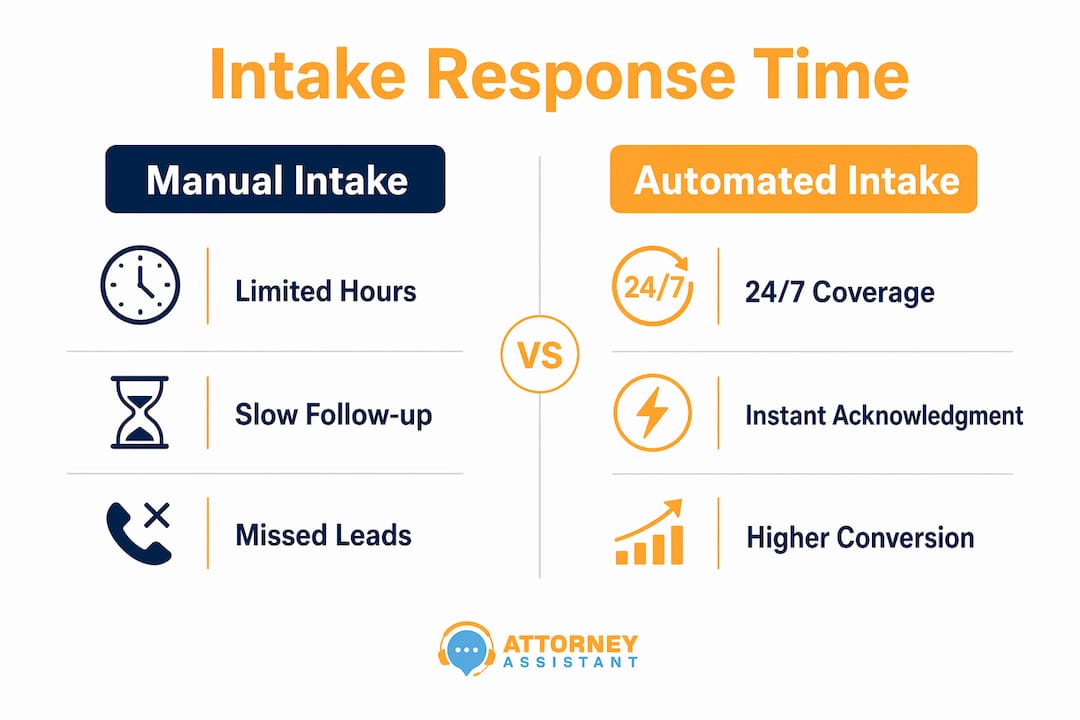
Manual intake vs. automated intake: how response speed compares
The gap between manual and automated intake systems is not a matter of preference. It is a measurable difference in how many leads your firm captures and converts.
| Feature | Manual intake | Automated or AI-assisted intake |
|---|---|---|
| Hours of coverage | Business hours only | 24 hours a day, 7 days a week |
| Average first response | 2–24 hours | Under 1 minute |
| After-hours lead capture | Rarely | Consistently |
| Lead qualification speed | Dependent on staff availability | Immediate, rule-based routing |
| Consistency across inquiries | Variable | Standardized |
| Conversion impact | High drop-off during delays | Higher contact and qualification rates |
Manual intake is not inherently bad. It is simply limited by human availability. A skilled intake specialist who answers calls promptly and follows a structured script will outperform a poorly configured automated system. The problem is that manual intake cannot cover every hour, every channel, and every volume spike simultaneously.
Automated and AI-assisted intake systems capture leads around the clock and qualify prospects before a human ever picks up the phone. That means your intake specialist starts each conversation with context, not from zero. The result is faster qualification, fewer dropped leads, and higher conversion rates across the board.
Operational maturity in legal intake means combining both. Automated systems handle the first response and data capture. Trained staff handle the relationship and close. Neither replaces the other. Together, they eliminate the gaps that cost firms cases.
How to improve intake response time: strategies that work
Improving intake response time is an operational project, not a technology purchase. The firms that see lasting improvement treat it as a process change supported by tools, not the other way around.
The most effective strategies follow a clear sequence:
-
Define SLAs for every channel. Phone calls, web forms, emails, and chat inquiries each need a written response time standard. A phone call should be answered live or returned within five minutes. A web form submission should trigger an automated acknowledgment immediately and a human follow-up within the hour.
-
Audit your intake process empirically. Self-reported response times are almost always optimistic. Run after-hours tests, review call logs, and measure actual response times against your SLAs. The gap between what staff believe happens and what actually happens is usually significant.
-
Implement a unified lead tracking system. Every inquiry, regardless of channel, should enter a single system that timestamps receipt and tracks follow-up. This eliminates the invisible leakage that happens when leads live in separate inboxes, voicemail systems, or spreadsheets.
-
Train intake staff on speed and tone. Speed without professionalism loses clients at the first conversation. Intake staff need scripts that are fast to deliver and warm in tone. A prospect who feels rushed or processed will not sign.
-
Use consistent acknowledgment responses. An automated reply that confirms receipt, sets expectations for callback timing, and includes a direct contact option reduces prospect anxiety immediately. It also buys your team time to respond properly without losing the lead.
-
Review intake communication strategies regularly. Intake is not a set-and-forget system. Quarterly reviews of response time data, conversion rates by channel, and staff performance keep the process sharp.
Intake response time reflects the overall health of firm operations, not just one administrative metric. Firms that treat it as a key performance indicator alongside revenue and case volume tend to catch operational failures earlier and fix them before they compound.
Key Takeaways
Fast intake response time is the most direct lever law firms have for converting existing leads into signed clients without increasing marketing spend.
| Point | Details |
|---|---|
| Speed defines conversion | 70% of prospects choose the first firm to respond, making response time a primary competitive factor. |
| Delays are invisible losses | Slow responses rarely generate complaints; prospects simply disappear and appear as cold leads in your pipeline. |
| After-hours coverage is critical | Around 40% of leads arrive outside business hours, requiring automated systems to capture them reliably. |
| SLAs prevent structural failure | Written response time standards for every channel eliminate the guesswork that causes delays. |
| Automation and staff work together | Automated intake handles first response and data capture; trained staff close the relationship. |
The metric most firms are not watching closely enough
Law firm administrators spend significant time reviewing cost-per-lead, ad performance, and case volume. Intake response time rarely appears on the same dashboard. That is the gap where revenue disappears.
I have seen firms invest heavily in SEO and paid advertising, then lose a third of those leads because no one answered the phone after 5 p.m. The marketing team reports strong lead volume. The intake team reports normal operations. Nobody connects the dots because the lost leads never complained. They just hired someone else.
The cultural shift required here is real. Intake speed has to be treated as a firm performance metric, not an administrative detail. That means leadership has to ask for the data, set the standards, and hold the process accountable. When partners start asking “what was our average response time this week?” the behavior of the entire intake function changes.
The firms I respect most in this space run their intake like a sales operation. They track response time by channel, by hour of day, and by staff member. They test their own systems regularly. They know exactly where leads are dropping and why. That level of operational clarity does not require a massive budget. It requires the decision to treat intake as a revenue function rather than a reception task.
The connection between fast intake and firm revenue is not theoretical. It is measurable, and the measurement starts with knowing your current response time across every channel your prospects use to reach you.
— Nicole
How Attorney Assistant helps firms respond faster and sign more clients
Attorney Assistant works with law firms that are losing cases not because of weak marketing, but because of gaps in their intake process.
Attorney Assistant handles intake, follow-up, and administrative workflows so firms respond faster and convert more of the leads they already have. The intake solutions include 24/7 coverage, AI-assisted lead capture, and structured follow-up that keeps prospects engaged until a signed retainer is in hand. Firms that work with Attorney Assistant stop misreading operational failures as marketing problems. If your firm is ready to close the gap between leads received and cases signed, book a call with the Attorney Assistant team.
FAQ
Why does intake response time affect conversion rates?
Prospects searching for legal help are in an urgent moment. 70% choose the first firm to respond, so delays hand your leads directly to competitors.
What is a good intake response time for a law firm?
The target is an acknowledgment within five minutes of any inquiry. A qualified human follow-up should occur within one hour during business hours and within minutes for after-hours inquiries handled by automated systems.
How do after-hours leads affect firm revenue?
Around 40% of leads arrive after business hours. Firms without 24/7 intake coverage lose those leads entirely, since prospects do not wait until the next business day to find legal help.
How can a firm identify its intake response gaps?
Run a secret shopper audit by submitting inquiries through every channel at different times, including evenings and weekends. Empirical testing consistently reveals delays that internal reporting misses.
Does automation replace intake staff?
Automated systems handle first response and data capture around the clock. Trained intake staff handle qualification and relationship building. The two functions work together, and neither replaces the other.
Recommended
Related Articles
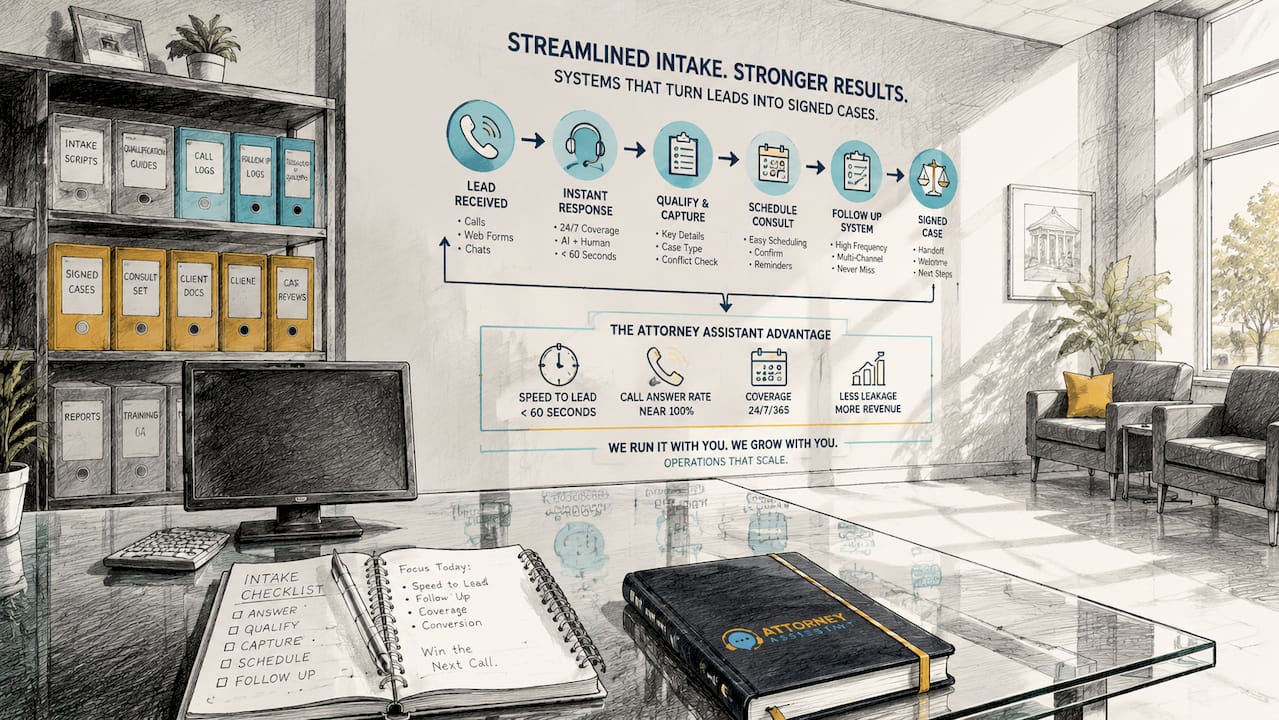
Why Intake Speed Matters for Law Firm Revenue
Discover why intake speed matters for law firm revenue. Boost your conversion rates and stop losing potential clients due to slow responses.

Law Firm Intake Response Time Improvement Guide
Boost your case conversions with our intake response time improvement guide. Learn strategies to enhance client communication and reduce delays!

Medical Record Review for Attorneys: A Step-by-Step Guide
Medical record review for attorneys, step by step: request records, build a verified chronology, audit summaries, and know when to delegate the work.