Why Intake Speed Matters for Law Firm Revenue
TL;DR:
- Responding within five minutes significantly increases a law firm’s lead conversion rate and reduces lost prospects.
- Implementing rapid, warm, and automated intake processes improves client engagement and revenue without additional staff.
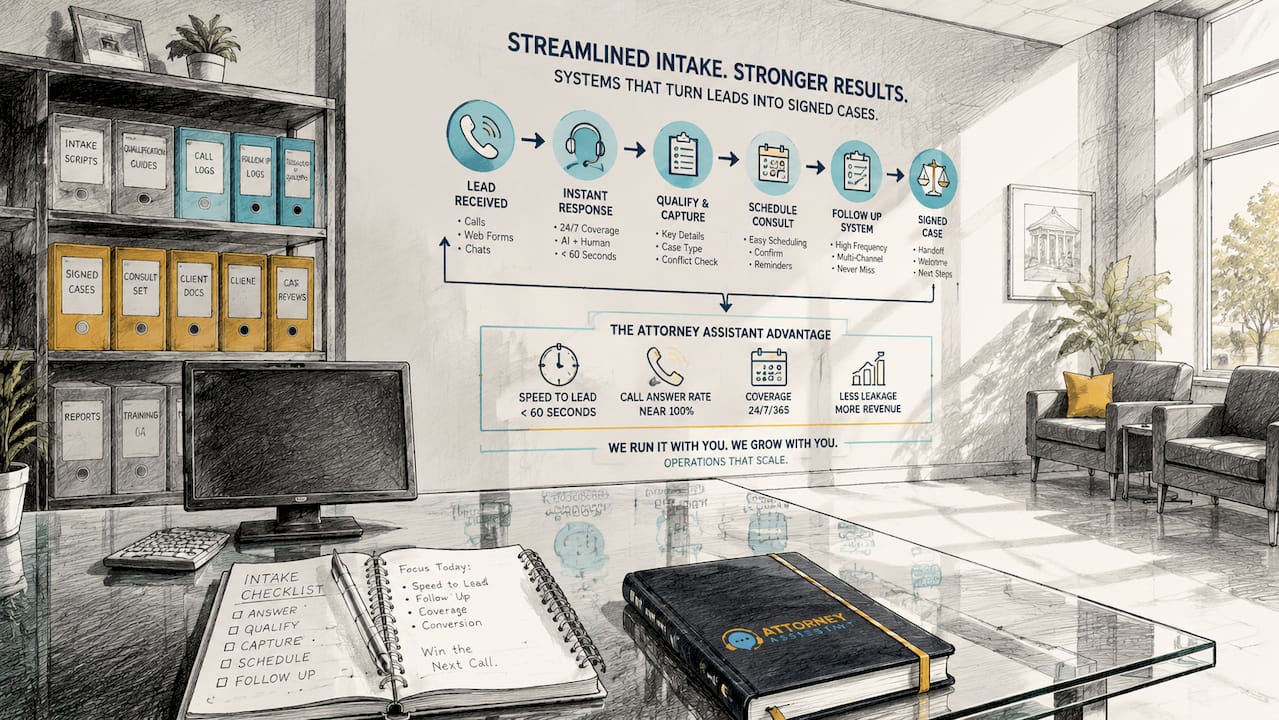
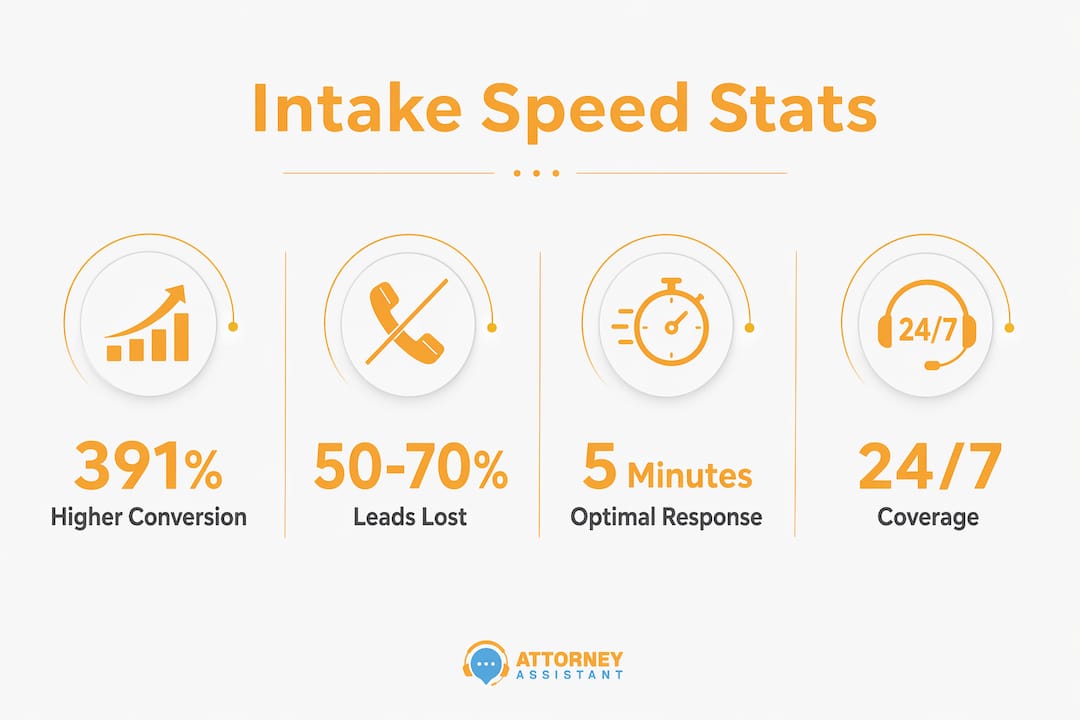
Intake speed is defined as the time between a prospective client’s first inquiry and the firm’s first meaningful response. It is the single most important variable in whether a law firm converts a lead or loses it. Responding within 60 seconds can increase lead conversion rates by 391% compared to industry average response times of 42–47 hours. That gap is not a minor inefficiency. It is the difference between a signed case and a prospect who called the next firm on the list. Attorney Assistant works with firms that already have enough leads. The problem is that slow intake is bleeding revenue before anyone notices.
Why intake speed matters more than lead volume
Most law firms diagnose their revenue problem as a lead shortage. The real problem is lead loss after contact. 50–70% of potential clients are lost due to slow follow-up and after-hours unavailability. That is not a marketing failure. It is an operational one.
The data on speed-to-lead is unambiguous. Firms that engage a prospect within five minutes are ten times more likely to convert than firms that wait an hour. Conversion rates do not decline gradually with delay. They fall off a cliff within the first few minutes of inaction.
After-hours availability compounds the problem. 40% of injury-related legal leads arrive outside business hours. Of those, 80% are lost when the firm relies on voicemail. A prospect who calls at 9 p.m. after an accident is not going to wait until 9 a.m. to hear back. They will call the next firm within minutes.
The table below shows how response time directly affects conversion outcomes.
| Response time | Conversion likelihood | Lead loss risk |
|---|---|---|
| Within 60 seconds | Up to 391% higher than average | Very low |
| Within 5 minutes | 10x more likely than 1-hour delay | Low |
| 1 hour or more | Baseline conversion rate | High |
| After hours, voicemail only | 80% of leads lost | Very high |
| No response to web forms | Zero conversion | Total loss |
26% of law firms never respond to web form submissions at all. That is not a slow response. That is a complete failure to compete for cases the firm already paid to attract.
Speed without warmth still loses the client
Responding fast is necessary. It is not sufficient. A quick answer that feels scripted, rushed, or indifferent does not convert a prospect. It confirms their fear that the firm does not care about their situation.
A meaningful intake response is a two-way interaction. The prospect needs to feel heard, not processed. Speed without warmth is noise. A firm that picks up in 30 seconds but reads from a cold script loses the client just as surely as one that calls back the next day. The intake moment is also the first impression of how the firm will treat the client throughout the case.
The distinction matters operationally. A quick automated acknowledgment, such as a text or email confirming receipt of an inquiry, buys time and signals responsiveness. It is not a substitute for a real follow-up call. The automated message handles the speed requirement. The human follow-up handles the empathy requirement. Both are necessary, and neither replaces the other.
Pro Tip: Design your intake scripts around the client’s situation, not the firm’s process. Open with “I understand you’re dealing with [situation]” before asking any qualifying questions. Clients who feel acknowledged in the first 30 seconds are far more likely to stay on the call and move forward.
Firms that track qualified lead conversion rate rather than vanity metrics like average call wait time see a clearer picture of where they are losing clients. Speed gets the prospect on the phone. Empathy keeps them there.
How intake process design enables fast, effective engagement
The intake process itself creates friction that slows response before a human ever gets involved. 81% of users abandon online intake forms that are too long or tedious. The average static form converts at just 1.7%. That means 98 out of every 100 people who start a form never finish it.

The fix is not a better form. It is a shorter initial capture step. Ask only what is needed to route the lead correctly. Collect the rest during the follow-up call. Every additional field in the initial form is a point where the prospect can leave.
Triage design is the next layer. First-come, first-served intake queues treat a personal injury case with a statute of limitations deadline the same as a general inquiry. Automated triage systems that route urgent cases immediately and handle routine inquiries separately reduce both delays and errors. Codified urgency criteria, meaning a written set of rules that define what counts as a high-priority lead, remove the guesswork from routing decisions.
Operational best practices for collapsing lead response time:
- Shorten the initial capture step. Collect name, contact number, and case type only. Route immediately.
- Set up automated acknowledgment. Send a text or email within seconds of any inquiry, 24 hours a day, 7 days a week.
- Define urgency tiers in writing. Specify which case types trigger immediate human routing versus automated follow-up.
- Use conversational AI for after-hours intake. A system that qualifies leads in real time and routes hot cases immediately prevents the 80% voicemail loss rate.
- Assign ownership to every lead. A lead with no assigned owner gets no follow-up. Name the person responsible at the moment of capture.
Conversational AI intake that operates around the clock, follows up on incomplete answers, and routes priority leads instantly addresses the after-hours gap that static forms and voicemail cannot. It does not replace the human follow-up call. It makes sure the human gets the right information before they dial.
Practical steps to improve intake speed and maximize conversion
Improving intake speed starts with measuring the right numbers. The three KPIs that matter most are win rate, response speed, and lead loss rate. Firms that focus on these three metrics and combine them with coaching and automation see conversion improvements of up to 18% within weeks. Tracking only these numbers removes noise and makes team coaching far more effective.
The table below shows the difference between a traditional intake process and an optimized one.
| Factor | Traditional intake | Optimized intake |
|---|---|---|
| Initial response time | Hours to days | Under 60 seconds (automated) |
| After-hours coverage | Voicemail | Conversational AI, 24/7 |
| Lead routing | First-come, first-served | Automated triage by urgency |
| Form length | Full intake form upfront | Name, phone, case type only |
| KPIs tracked | Call volume, wait time | Win rate, response speed, lead loss rate |
| Human follow-up | Next business day | Within minutes of inquiry |
Firms that reduce intake response times by 50% and track the right KPIs see measurable conversion improvements within 60 days. That timeline is short enough to validate the investment before the next quarter closes.
Training matters as much as technology. Intake staff who know how to open a call with empathy, qualify quickly, and move a prospect toward a signed engagement without pressure convert at higher rates than staff who follow a rigid script. Pair the process improvements with regular coaching sessions built around real call recordings. The data shows what is working. The coaching changes what is not.
For a deeper look at intake optimization methods and how to apply them in 2026, the operational frameworks are well-established. The gap between firms that convert and firms that lose leads is almost always a process gap, not a talent gap. Fix the process first.
Key Takeaways
Intake speed is the primary driver of lead conversion in law firms, and firms that respond within five minutes convert at dramatically higher rates than those that wait even one hour.
| Point | Details |
|---|---|
| Speed drives conversion | Responding within 60 seconds can increase conversion rates by 391% over average response times. |
| After-hours coverage is critical | 40% of legal leads arrive after hours; 80% are lost when firms rely on voicemail. |
| Empathy must accompany speed | A fast but cold response loses clients; meaningful follow-up requires two-way interaction. |
| Reduce form friction first | 81% of prospects abandon long intake forms; shorten initial capture to name, phone, and case type. |
| Track the right KPIs | Win rate, response speed, and lead loss rate predict intake performance better than call volume alone. |
The intake problem most firms refuse to look at directly
I have worked with enough law firms to recognize the pattern. The managing partner believes the firm needs more marketing spend. The intake coordinator is overwhelmed. And somewhere between the web form submission and the follow-up call, a qualified prospect signed with a competitor.
The uncomfortable truth is that most firms already have enough leads to grow. They are just not capturing them. A firm spending thousands of dollars a month on pay-per-click advertising while 26% of web inquiries go unanswered is not a marketing problem. It is a math problem.
What I find most firms resist is the idea that intake is a revenue function. It gets treated as administrative work. It gets staffed accordingly, trained minimally, and measured on the wrong numbers. Call volume and average wait time feel like performance data. They are not. Qualified lead conversion rate is the number that tells you whether intake is doing its job.
The firms that fix this do two things consistently. They build a process that responds fast and routes correctly every time. Then they train their people to handle that first conversation with genuine care. Neither piece works without the other. Speed without empathy is noise. Empathy without speed is a missed opportunity. Get both right, and the revenue impact shows up within weeks, not quarters.
— Nicole
How Attorney Assistant helps firms respond faster and sign more cases
Attorney Assistant handles the intake, follow-up, and routing work that most firms leave to chance. The result is faster first contact, fewer lost leads, and a measurable improvement in signed cases without adding headcount.
Firms working with Attorney Assistant get 24/7 lead capture, intelligent routing that prioritizes urgent cases, and human follow-up that converts prospects rather than just acknowledging them. The intake and reception service is built specifically for law firms that are losing revenue at the intake stage. If you want to see where your firm is leaking cases and what it would take to fix it, book a call with the Attorney Assistant team. The conversation is direct and the assessment is practical.
FAQ
Why does intake speed matter so much for law firms?
Intake speed determines whether a prospect signs with your firm or the next one they call. Firms responding within five minutes are ten times more likely to convert than those waiting an hour.
What is a good intake response time for a law firm?
Responding within 60 seconds produces the highest conversion rates. Even a brief automated acknowledgment sent immediately, followed by a human call within minutes, outperforms a delayed personal response.
How much revenue do slow intake processes cost law firms?
50–70% of potential clients are lost due to slow follow-up and after-hours unavailability. For most firms, that represents a significant share of leads they already paid to generate.
What KPIs should law firms track for intake performance?
Win rate, response speed, and lead loss rate are the three metrics that most accurately reflect intake health. Tracking these three consistently, rather than call volume or wait time, drives faster improvement.
How can a law firm improve intake speed without hiring more staff?
Automated acknowledgment systems, conversational AI for after-hours coverage, and smart routing rules reduce response time without requiring additional headcount. Pairing these tools with lead conversion strategies and focused staff coaching produces the fastest results.
Recommended
Related Articles

Why Intake Response Time Matters for Law Firms
Discover why intake response time matters for law firms. Fast replies boost client conversion and secure more signed cases. Learn how now!

Case Management Notes: A Law Firm's How-To Guide
Learn how to write case management notes that hold up, with a defensible structure, privilege safeguards, handoff tips, and a smarter way to staff the work.

Medical Records Coordinator: What the Role Actually Does
A medical records coordinator manages records retrieval, summaries, billing, and liens for law firms. Learn duties, KPIs, and when to outsource vs hire.