Why Signed Cases Matter for Law Firm Revenue

TL;DR:
- A signed case is a client with a fully executed retainer agreement, the most important revenue metric for law firms. Proper management of signing processes ensures enforceability, attribution, and higher conversion rates, preventing lost revenue and legal issues.
A signed case is a retained client with a fully executed retainer agreement, and it is the single most important metric a law firm tracks. Every other number, leads generated, calls answered, consultations completed, feeds into this one outcome. Signed case conversion is the point where a prospect becomes a client, where revenue becomes real, and where marketing spend either justifies itself or disappears. Firms that treat signed cases as a byproduct of good lawyering, rather than as a managed operational process, consistently leave revenue on the table. Understanding why signed cases matter starts with recognizing that the signature is not a formality. It is a legal and financial event.
Why signed cases matter for law firm revenue
A signed case is defined as a client relationship formalized through a fully executed retainer or engagement agreement. The agreement creates a legally binding contract that establishes the scope of representation, fee structure, and client consent. Without it, a firm has a conversation, not a client.
The business significance runs deeper than legal formality. Signed case attribution traces every executed agreement back to the original ad source, allowing firms to calculate the true cost per acquisition for each marketing channel. That data tells you which campaigns generate revenue, not just calls. A firm spending $10,000 per month on Google Ads without tracking signed case attribution is flying blind.
Signed cases also anchor client retention. A client who has signed a retainer is committed. They have acknowledged the terms, agreed to the process, and accepted the relationship. That commitment reduces early dropout and improves case completion rates. Firms that skip or rush the signing process often see higher client churn in the first 30 days.
The importance of signed cases extends to firm valuation and compliance. Lenders, buyers, and auditors reviewing a firm’s book of business look at signed retainer volume as a proxy for revenue reliability. A firm with 200 signed cases on active retainer is a fundamentally different asset than one with 200 open consultations.
Pro Tip: Track signed cases by marketing source from day one. Even a simple spreadsheet linking each retainer to its lead source will reveal which channels actually drive revenue versus which ones just drive calls.
Legal validity and client commitment
Electronic signatures must include consent records and clear intent acknowledgments to be legally binding under the ESIGN Act and the Uniform Electronic Transactions Act (UETA). That means the signing process itself carries legal weight, not just the document. A signature without a documented consent record is a liability, not an asset.
Signed cases also prove client intent. In any future dispute over fees, scope, or representation, the signed agreement is the first document a court examines. Firms that rely on verbal agreements or unsigned engagement letters have no defense.
How do electronic and ink signatures compare for signed cases?
Physical ink signatures provide a tangible record but lack the audit infrastructure that courts increasingly expect. A wet signature on paper proves a mark was made. It does not prove who made it, when, or whether the document was altered afterward.
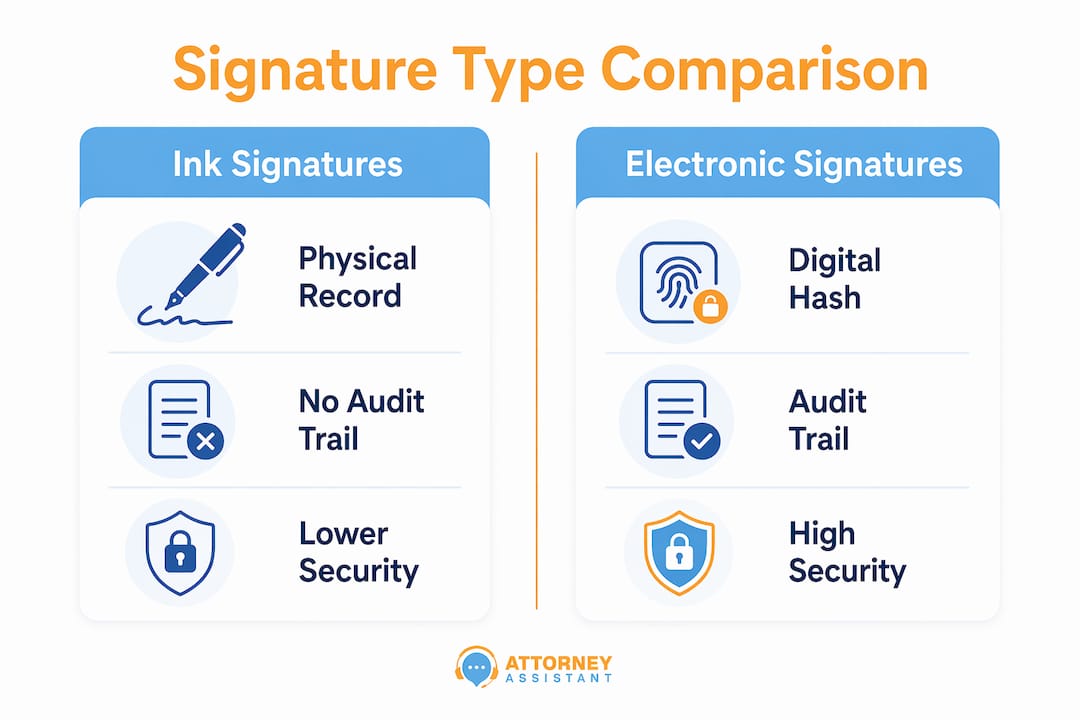
Digital signatures embed a cryptographic hash and timestamp that proves document integrity and signer identity. That combination satisfies the evidentiary standards courts apply when signature validity is challenged. For law firms, this distinction matters every time a client disputes a fee or a third party questions the scope of representation.
Static images of signatures without audit trails are increasingly considered high-risk and legally insufficient. A scanned signature pasted into a PDF looks like a signature but provides no proof of who placed it there or when. That gap is exactly what opposing counsel exploits.
The table below compares the three main signature methods across the criteria that matter most to law firms.
| Signature type | Security level | Audit trail | Court defensibility | Ease of use |
|---|---|---|---|---|
| Wet ink signature | Low | None | Moderate | High |
| Static image/scanned | Very low | None | Low | High |
| Electronic (ESIGN/UETA compliant) | High | Full log | High | High |
| Digital (cryptographic) | Very high | Cryptographic seal | Very high | Moderate |
Pro Tip: For high-value cases or complex fee arrangements, require multi-factor authentication during the signing process. Platforms like DocuSign and Adobe Acrobat Sign support SMS verification and portal login confirmation, which creates proof of signer identity that holds up in court.
What operational practices improve signed case conversion?
Signed case conversion is the process of moving a qualified lead from initial contact to a fully executed retainer. Most firms lose cases not because they lack legal talent, but because their intake process has gaps that let warm leads go cold.
The following practices directly increase signed case volume and quality.
- Use an audit-trail-enabled eSignature platform. Every retainer agreement should be executed through a platform that logs signer identity, timestamp, IP address, and consent acknowledgment. This protects the firm and creates a defensible record.
- Verify signer identity at the appropriate risk level. Risk-based signing practices focus identity verification on high-value agreements. A standard consultation follow-up may need only email confirmation. A contingency fee agreement should require stronger authentication.
- Track signed case attribution back to the original lead source. Connect your intake CRM to your marketing data so every signed retainer is linked to the campaign, ad, or referral that generated the lead. This is the only way to calculate true marketing ROI.
- Train intake staff on document review and signature compliance. Staff who send agreements should know what a complete, valid signing event looks like. Missing fields, unsigned exhibits, and undated agreements are common errors that create disputes later.
- Close follow-up gaps with structured workflows. Operational inefficiencies around signed cases directly harm firm profitability and marketing effectiveness. A lead who receives a retainer agreement but never gets a follow-up call will sign with the next firm that calls them back.
Speed matters more than most firms realize. A prospect who requests a consultation is evaluating multiple firms simultaneously. The firm that sends a retainer agreement within hours and follows up within 24 hours wins the case. The firm that sends it three days later often does not.
A structured client follow-up workflow removes the dependency on individual staff memory and creates consistent, repeatable conversion behavior across the entire intake team.

What are the risks of invalid or improperly executed signed cases?
The consequences of a defective signed case range from lost fees to full case denial. These are not theoretical risks.
Starting July 10, 2026, USCIS will deny immigration filings with invalid signatures rather than simply rejecting and returning them. That distinction is significant. A rejection allows refiling. A denial requires a full new application, additional fees, and potential delays that harm the client and the firm’s reputation. One signature error can cost thousands of dollars and months of work.
The risks extend beyond immigration practice.
- Disputed signer identity. If a client later claims they did not sign an agreement, a firm with no audit trail has no defense. The proof of actual signer identity via secure authentication methods is the only reliable counter to that claim.
- Broken chain of custody. Missing signatures on documents break the chain of custody, allowing opposing counsel to challenge admissibility and undermine the firm’s position.
- Unenforceable fee agreements. A retainer without a valid, documented signature is not enforceable. Firms that cannot collect fees on completed work absorb that loss directly.
- Client churn from poor process. Clients who experience a disorganized signing process lose confidence in the firm before representation even begins.
A signed document is not necessarily legally defensible without process compliance. Technical invalidation of signatures can cause total case denial, regardless of the underlying legal merit.
Monitoring for these risks requires a simple audit practice. Review a sample of signed retainers monthly. Confirm that each one includes a complete audit trail, a verified signer identity, and a fully executed document with no missing fields.
Key takeaways
Signed cases are the revenue foundation of every law firm, and the quality of the signing process determines whether those agreements are enforceable, attributable, and profitable.
| Point | Details |
|---|---|
| Signed cases drive revenue recognition | A fully executed retainer is the event that converts a lead into billable revenue. |
| Attribution requires signed case data | Linking each retainer to its original lead source reveals true marketing ROI. |
| Audit trails are legally required | Electronic signatures without consent logs and timestamps are increasingly unenforceable. |
| Invalid signatures carry hard costs | USCIS denials from signature errors in 2026 require full refiling and additional fees. |
| Follow-up gaps kill conversion | Leads who receive agreements but no follow-up will sign with a competing firm. |
The operational reality most firms ignore
I have worked with enough law firms to recognize a pattern. Owners invest heavily in marketing, hire intake staff, and then assume the signed case will happen naturally once a good lead comes in. It rarely does.
The gap is almost always operational. A retainer goes out unsigned because no one followed up. A client signs but the document is missing an exhibit. A case gets attributed to the wrong campaign because intake never asked how the client found the firm. These are not legal problems. They are process problems, and they cost real money.
The firms that consistently convert leads into signed cases treat the signing event as a managed workflow, not a hoped-for outcome. They use platforms with audit trails. They train staff on what a complete agreement looks like. They follow up within hours, not days. And they track every signed case back to its source so they know exactly which marketing dollars are working.
The signed case is where legal practice and business operations meet. Treating it as purely administrative is the mistake. Treating it as the most important operational metric in the firm is what separates practices that grow from those that stagnate.
If your firm is generating leads but not converting them at the rate you expect, the problem is almost never the leads. It is the process between first contact and signed retainer. Fix that process, and the revenue follows.
— Nicole
How Attorneyassistant helps firms capture more signed cases
Attorneyassistant was built specifically for the gap between lead and signed retainer. Firms that work with us stop losing cases to slow follow-up, missed calls, and intake workflows that depend on individual staff to remember next steps.
We handle intake, follow-up, and administrative workflows so your team responds faster and converts more leads into signed cases. Every agreement gets tracked. Every lead gets followed up. And every signed case gets attributed to the marketing source that generated it, so you know exactly where your revenue comes from. If you want to see how this works in practice, join one of our live firm webinars or explore our intake and reception services to see where your firm is losing cases today.
FAQ
What is a signed case in a law firm?
A signed case is a client relationship formalized through a fully executed retainer or engagement agreement. It marks the point where a prospect becomes a paying client and revenue becomes legally recognizable.
Why are signed cases the most important metric for law firms?
Signed cases represent actual revenue, not just pipeline activity. They enable marketing attribution, support firm valuation, and create the legally binding foundation for all client work.
What makes a signed case legally defensible?
A defensible signed case requires proof of who signed, documented intent to sign, and a complete audit trail capturing timestamp, device, and signer identity. A signature image alone does not meet this standard.
What is signed case conversion?
Signed case conversion is the process of moving a qualified lead from initial contact to a fully executed retainer agreement. Conversion rate measures how many leads a firm successfully retains as paying clients.
How does poor intake affect signed case volume?
Slow follow-up and disorganized intake workflows are the leading causes of lost signed cases. Leads who do not receive a timely response or a clear path to signing will retain a competing firm instead.
Recommended
Related Articles

Call Flow Customer Service for Law Firms: A Practical Guide
Design a call flow customer service system for your law firm that captures leads, qualifies matters, and signs cases. Practical guide

Fear of Talking on Phone: 7 Practical Confidence Tips
Overcome fear of talking on phone with practical scripts, role-play, exposure exercises, and intake tools built for legal teams.

Appointment Setting Online: A Law Firm Guide
Master appointment setting online for law firms with proven strategies that turn leads into booked consultations and grow your practice.