The most popular advice on writing a demand letter is to grab a template, swap the names, and threaten suit if nobody pays in 30 days. That advice produces letters an adjuster can set aside in one sitting. A template does not know whether this claim needs a demand, which statute starts the clock, or which exhibit proves the number on page one.
Adjusters and opposing counsel do not begin with your adjectives. They start with the claim number, the liability documents, whether the specials add up, and whether the deadline you wrote is the one the statute allows. Miss any of those and a polished letter becomes a credibility problem, which is the opposite of pressure.
What follows is a fill-in structure in the order they read. Confirm the claim requires or benefits from a demand. Then draft each section with its exhibit and its deadline already attached.
Table of Contents
- What a Demand Letter Can and Cannot Do
- Check the Response Deadline Before You Set It
- Build the Evidence Package and Avoid Credibility Failures
- The Parts of a Demand Letter, in Order
- How to Set an Amount You Can Defend
- Confirm the Letter Is Ready Before You Send It
What a Demand Letter Can and Cannot Do
A demand letter can open settlement talks, give formal notice, and document an effort to resolve a dispute before suit. It is not automatically required, and sending one does not make a weak claim stronger. The first decision is whether the claim requires notice, benefits from a demand, or should proceed without one.
Classify the file before drafting
Check the governing statute and the consequences of getting notice wrong:
- Governing statute: Does this claim type require written notice?
- Notice prerequisite: What must the letter say to count?
- Cure period: How long does the other side have to address the problem?
- Interest or fee trigger: Can a late or bad-faith response affect interest, fees, or damages?
- Insurer-notice issue: Does the policy or a time-limited demand statute prescribe the letter's contents?
- Preservation obligation: Does evidence need a written hold before it is lost or altered?
Massachusetts Chapter 93A illustrates why the rules matter. A Legal 500 analysis of Chapter 93A demand practice explains that a 30-day demand is required in most circumstances, with exceptions for counterclaims, cross-claims, and respondents without a Massachusetts place of business or assets. An inadequate response or bad-faith refusal can expose a defendant to double or treble damages. Those requirements are specific to that law. Federal government debt demands also follow their own rules; do not borrow timing or notice language from another type of claim without checking what governs.
A forceful tone cannot repair a defective notice. A letter can weaken a claim if it misses a statutory requirement, states the wrong deadline, or makes an unnecessary admission.
Consider a rear-end collision in a state requiring a specific time-limited demand format. The letter may need policy-limits language, a complete release, lien treatment, and a response period measured from receipt. A generic “respond in 30 days or we sue” demand may fail to start the statutory clock if required terms are missing. The carrier can treat it as ordinary correspondence instead. The useful structure is dictated by the rule, not by the template.
The opening should identify the purpose and the claim without burying the reader in argument: “This letter is a settlement demand from Jane Morales concerning the March 4, 2024 collision, directed to the insurer for the insured driver under claim number 24-1187.” For a Texas dispute, the Bryan Fagan demand letter guide offers practical context on presenting a claim before suit.
A demand can invite negotiation, but it cannot guarantee settlement or substitute for proof. Its value depends on whether the claim is supported, the notice is legally effective, and the requested resolution is clear. Triage first. Draft only after confirming what the letter must accomplish.
Check the Response Deadline Before You Set It
About 30 days is common practice. It is a starting point, not a plug-in. Statutory time-limited demands set different minimums, and some of them also dictate what the letter must say before the clock means anything. A review of how insurers respond to bodily injury demands flags the spread: Georgia, Missouri, and California do not share one number, and the rules can require particular language and supporting material.
| Rule or jurisdiction | Period | Other requirement |
|---|---|---|
| General practice | About 30 days | Use only when no statute sets a different period |
| Georgia time-limited demand | At least 30 days from receipt | Payment date at least 40 days after receipt |
| Missouri time-limited demand | 90 days | Payment at least 10 days after the insurer receives the executed release |
| California demand | 30 or 33 days | Set by transmission method and the statute |
| Massachusetts Chapter 93A demand | 30 days in most circumstances | Exceptions for counterclaims, cross-claims, and respondents without a Massachusetts place of business or assets |
| Federal government debt demand | Ordinarily no more than 30 days after delivery | Must identify the debt basis and review rights |
Read the rows as alternatives, not as a menu you mix. General practice is the fallback when nothing else governs. Georgia's response floor and Missouri's 90 days are minimums for specified time-limited demands, not suggestions you can shorten because the file feels simple. California's 30 or 33 days turns on how you transmit the demand and on what the statute requires, so "thirty days from today" can be the wrong sentence even when the count looks familiar.
The number is the easy part
Time-limited policy-limits demands need more than a settlement figure and a date. Statutory summaries collected in a policy-limits demand overview describe a short list that generic templates skip.
- All claims, including liens: Offer to resolve every claim within the applicable policy limits, liens included.
- A complete release: Offer a full release of the insured, not a partial one buried in a footnote.
- The loss itself: State the date and location, give the claim number when you know it, and identify the known injuries.
- Reasonable proof: Enclose the records that let the carrier evaluate the offer without a second request.
- Payment mechanics: Georgia's summary pairs a payment date at least 40 days after receipt with the response period. Missouri's summary ties payment to at least 10 days after the insurer receives the executed release.
Check required language, supporting material, and the release and lien terms against the applicable statute. Then write the deadline as an exact calendar date, say when the period starts (usually receipt, not the date on your letterhead), and confirm the demand satisfies that statute before you threaten anything for silence.
A missed internal date is a different failure, and it is a common one. Pair the statutory date with whatever court deadline tracking your firm already uses for limitations and hearing dates, so the demand clock does not live only in the drafter's inbox.
Build the Evidence Package and Avoid Credibility Failures
Assemble the package before you draft a word of the letter. An adjuster who cannot tie a sentence to a document will discount the sentence, then the page, then the number. Assembly Software's guide to the personal injury demand treats the letter as an evidence-controlled package, not a persuasive essay, and that is the right standard.
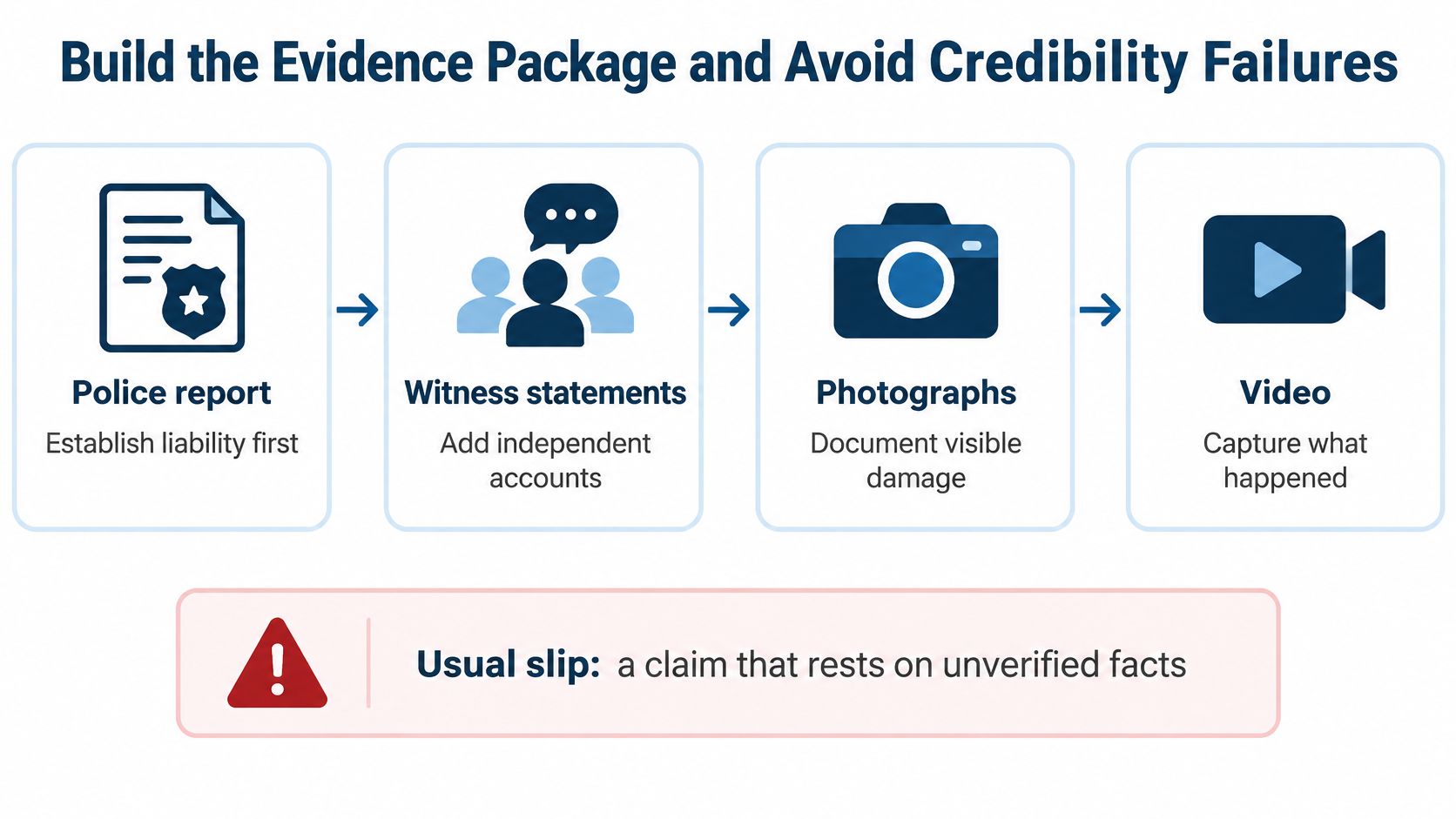
- Establish liability with documents, not the client's retelling. Attach the police or incident report, witness statements, photographs, and video. The usual slip is a claim that rests on the client's version with nothing behind it. If the report conflicts with the intake notes, resolve that on the file before the letter pretends it isn't there.
- Write a short chronology. Date, time, location, and the causal sequence, in that order. Two paragraphs is plenty. A novel invites the adjuster to hunt for the one fact you overstated.
- Build the medical chronology by provider and date of service. Cover diagnosis, treatment, prognosis, and every treatment gap. The usual slip is an unexplained gap, which adjusters read as proof the injury was minor or unrelated. A gap with a reason in the chart is a footnote. A gap with no reason is an argument for the other side.
- Reconcile the specials line by line. Medical bills, wage-loss records, property-damage estimates, and other invoices should add to the same total the letter states. The usual slip is a total that does not match the attachments. Once the arithmetic fails, the adjuster has a reason to discount every other figure, including the ones that were right.
- Add future care or a permanent-injury claim only with an opinion. A treating provider or an expert has to say it. Your suspicion, however reasonable, is not an exhibit.
- Index every exhibit and map each assertion to a number. "See records" is not a map. The usual slip is a copy-paste carried over from another client: the wrong name, the wrong date of loss, a provider this person never saw. One visible error casts doubt on every number in the letter.
Before transmission, audit names, dates, arithmetic, and attachments against the index. A medical record review done before that audit is what makes the chronology and the specials agree with each other.
| Failure | How the adjuster responds | Fix before sending |
|---|---|---|
| Specials that do not reconcile | Discounts every figure in the letter | Tie each line to a bill, wage record, or estimate |
| Copy-paste errors from another client | Questions the whole file | Check names, dates, and providers against the records |
| Unexplained treatment gaps | Treats the injury as minor or unrelated | Explain each gap or attach the records that cover it |
| Future care without an opinion | Rejects the future-damages line | Attach a treating-provider or expert opinion, or remove the claim |
| Exaggerated injuries or losses | Requests the full file and slows the claim | State only what the records show |
| Exhibits that do not match assertions | Cannot verify the claim from the attachments | Map each assertion to a numbered exhibit |
Comparative fault belongs in the same audit. If the report gives your client a share of responsibility and the letter never mentions it, the adjuster assumes you either missed it or hoped they would. Address it, price it, and move on. Exaggeration has the same effect as a math error. It hands the file back for a slower review you did not need to invite.
The Parts of a Demand Letter, in Order
Hand this table to whoever assembles the package. The checklist should exist before drafting starts, in the order an adjuster reads, which is also the order EvenUp's demand-letter guide lays out: identity, incident, treatment, dollars, the ask, and the date.
| Part | What it must state | Exhibit to attach |
|---|---|---|
| Identifiers and purpose | Claimant, insured, claim number, and purpose of the letter | Copy of the claim notice |
| Incident and liability | Date, time, location, and causal sequence of the incident | Police report, photographs, witness statements |
| Injuries and treatment | Diagnoses, treatment, prognosis, and any treatment gaps explained | Medical records and provider chronology |
| Economic damages | Itemized medical bills, wage loss, and property costs | Bills, wage records, property estimates |
| Non-economic harm | How the injury changed daily life, tied to the records | Treating-provider notes |
| Settlement figure | One specific amount with the calculation behind it | Damages calculation sheet |
| Response deadline | Exact calendar date and when the period starts | None |
| Reservation and preservation | Right to supplement and request to preserve evidence | None |
That order lets an adjuster check identity, coverage, liability, causation, and damages without rebuilding the file from a zip folder named "FINAL_v7." A letter that says the client was badly hurt and deserves compensation is not a demand package. It is an invitation to begin an investigation the firm should already have finished.
A header block that matches the first row looks like this.
Claimant: Jane Morales. Insured: Robert Hale. Claim number: 24-1187. Purpose: settlement demand for the March 4, 2024 collision at the Main Street and Oak intersection.
Fill in the rest in the same order
Purpose. "This letter is a settlement demand concerning the incident on [date] at [location]."
Liability. State the facts in a neutral sequence and cite Exhibits 1 to 3. Neutral does not mean timid. It means the police report could have written the paragraph.
Injuries. List diagnoses, providers, and prognosis. Cite the Exhibit 4 chronology. Explain any treatment gap in Exhibit 5, in a sentence, not a speech.
Damages. Summarize the specials, totaling $[amount], reconciled to Exhibits 6 to 8. Tie non-economic harm to the records: what the notes say the person can no longer do, not a catalog of adjectives.
Demand. "To resolve all claims for $[specific figure], payable within [period]."
Deadline. "This offer remains open until [exact calendar date], which is [number] days after receipt."
Reservation. State the right to supplement if treatment continues, and request preservation of the listed evidence: vehicle data, premises video, maintenance logs, or whatever this file has.
Closing. Signature block, then an enclosure list keyed to the same exhibit numbers. If Exhibit 6 in the letter is Exhibit 6 in the stack, the adjuster can work. If it isn't, they won't.
How to Set an Amount You Can Defend
A defensible demand starts with a figure the records support. Use the Kentucky Bar Association resource on writing a demand for general guidance on ordering the letter, then set the amount from the file rather than from a fixed multiplier.
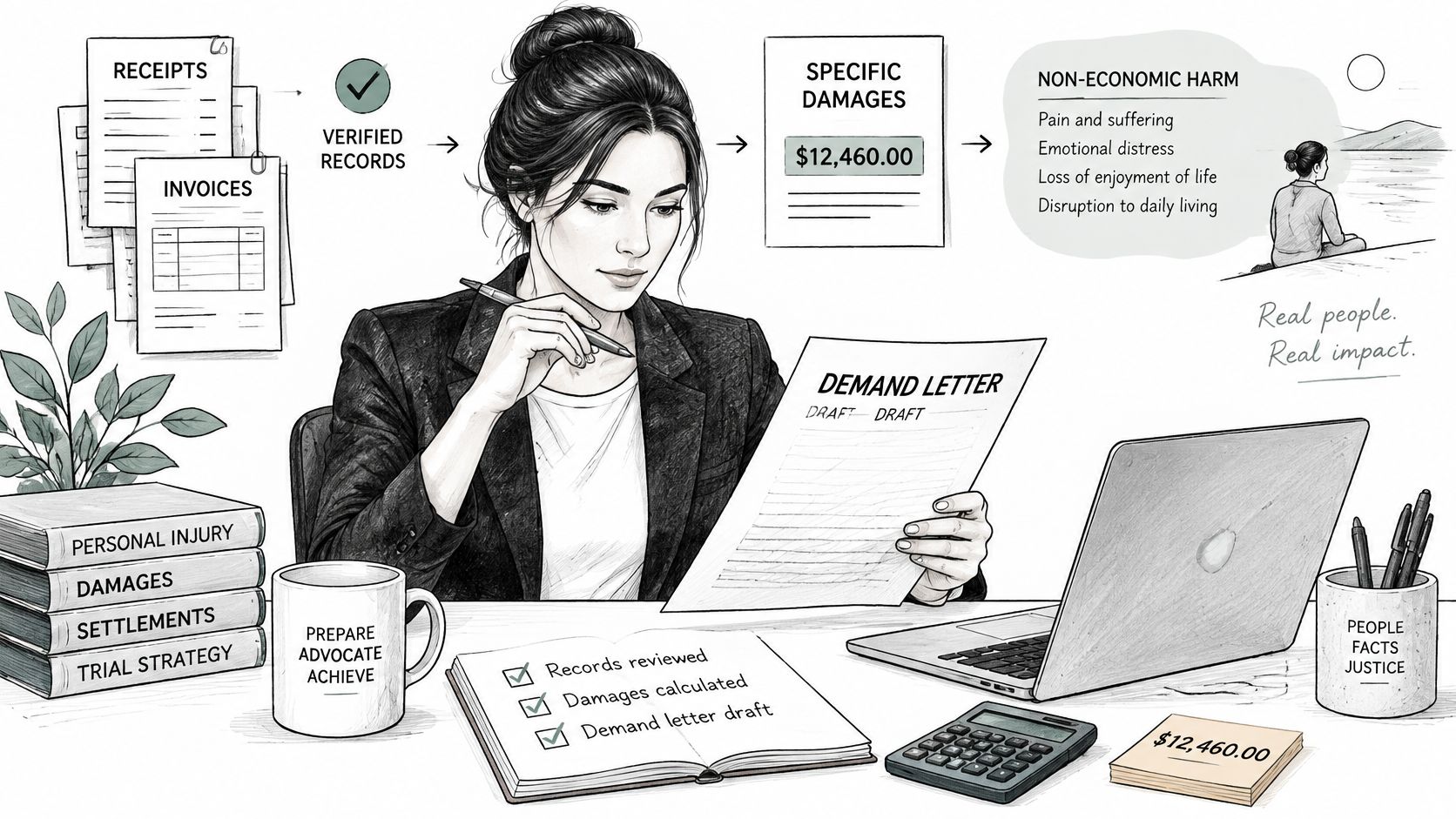
Start with economic damages supported by records: medical bills, wage loss, property damage, and out-of-pocket costs. Show how the figures add up. Describe non-economic harm separately, tying it to documented effects on the claimant's life rather than a string of adjectives. Then assess liability and comparative-fault risks. If the evidence leaves room for dispute, account for that weakness in the demand instead of ignoring it.
Build reasonable bargaining room into the opening figure, but keep it within what the evidence can support. An inflated number can make the demand harder to justify to the adjuster or to take to a supervisor. If treatment or damages remain unsettled, say that the claim may be supplemented. Set the response deadline after the calculation is complete.
Track your own demand results
Settlement percentages quoted as general benchmarks do not provide a reliable basis for setting a demand. Track your firm's own files instead, and compare like claim types rather than treating auto, premises, and commercial claims as one group.
- Delivery-to-response rate: Count delivered demands that receive a response.
- Response time: Track the days from confirmed receipt to the first substantive reply.
- Offer-to-demand ratio: Compare the first offer with the figure demanded.
- Settlement rate by claim type: Separate auto, premises, and commercial matters.
- Days from complete package to resolution: Start the count when the package is complete.
- Share of demands that needed supplementing: Review whether the initial demand went out before the supporting materials were ready.
Read these measures together. A prompt response with a low initial offer may point to a demand figure that is difficult to support. Delays and frequent supplements may indicate that medical records, wage proof, or lien information was incomplete when the package went out. Include medical lien information in the calculation: outstanding lien figures can change the damages picture and the amount being demanded.
Confirm the Letter Is Ready Before You Send It
Run this list on the letter in front of you, not on the idea of the letter. Most "we already checked it" failures are a skipped line, not a mystery of advocacy.
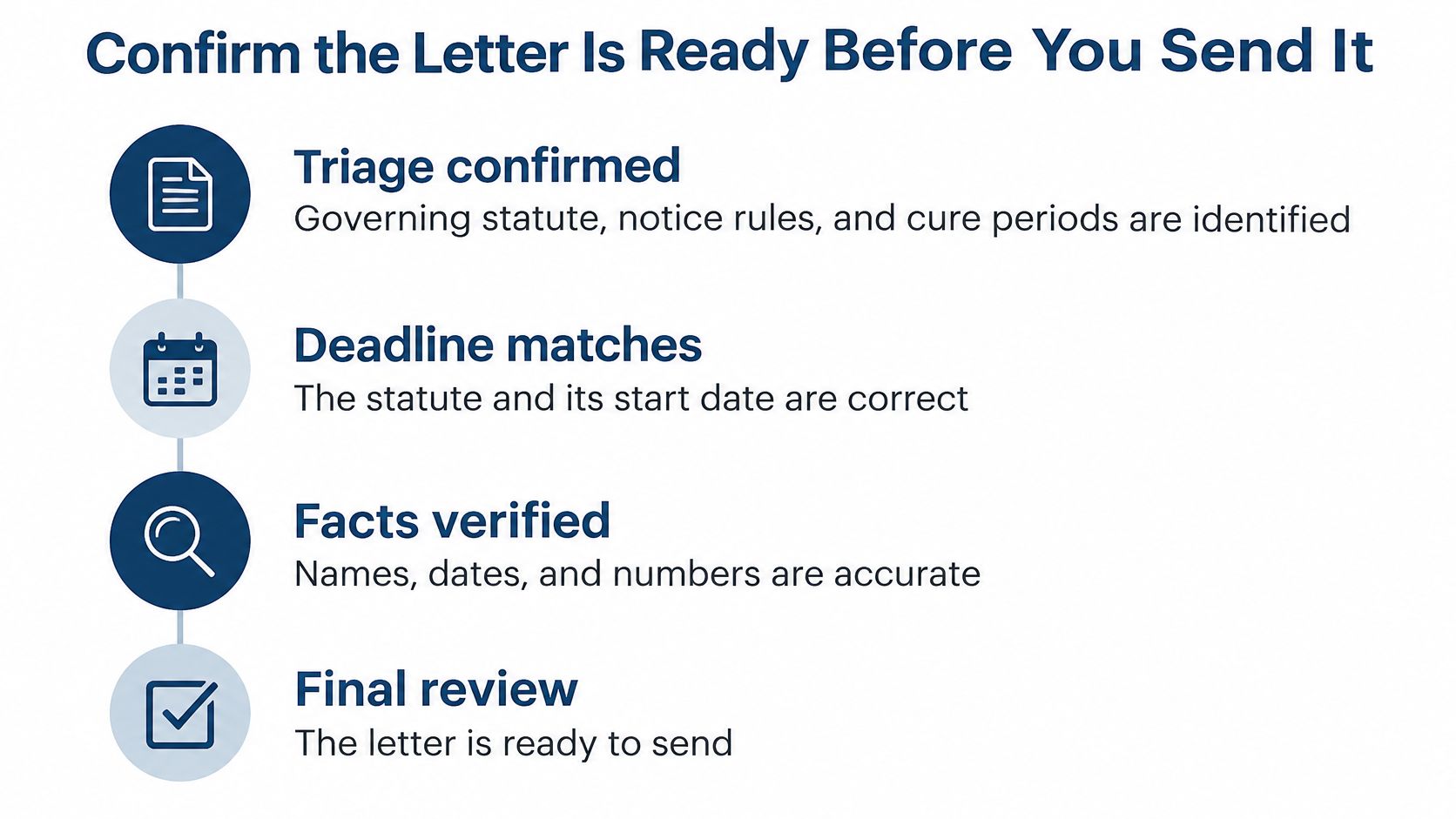
- Triage is done. The governing statute, the notice rules, and any cure period for this claim are identified, and someone can say which row of the deadline table applies.
- The deadline matches that statute. It is an exact calendar date, and the letter says when the period starts.
- The amount ties to verified records. The calculation sheet is in the file and in the enclosure list, and it matches the specials table to the dollar.
- Every assertion maps to a numbered exhibit. If you cannot name the exhibit, cut the sentence.
- Parties, claim number, and dates match the records. Read the header against the police report and the first medical bill, not against the prior draft.
- Preservation language is in the letter. Name the evidence. A generic "please preserve all relevant materials" is what people write when they have not looked at the file.
- Counsel has checked the jurisdiction-specific points. This is general information about how a package gets read. It is not legal advice, and it is not a substitute for the statute that governs this claim.
The part nobody owns
A correct letter still dies in a queue. Records sit with one provider, the chronology waits on a staff member who is also covering the phones, and the demand goes out late or thin because nobody's job was "finish the package." That is an operations problem wearing a legal costume.
We diagnose the specific operational failures that cost a firm money, then build a co-managed fix around them. A free intake audit is available for firms that want that look. Fill out the form, and a team member reaches out. You can also run the seven lines above with no outside help and still get the full value of the list.
The action for this week is smaller than a new system. Pull the next demand in the queue and run the checklist against that one file before it goes out.
Demand packages stall in the same place a lot of firm work stalls: records, follow-up, and a checklist that lives in someone's head. Attorney Assistant builds dedicated case-support capacity and 24/7 live intake so that work does not sit on the lawyers who should be deciding the claim. If you want to see where your own files slow down, visit Attorney Assistant.
Related Articles

Demand Letter for Personal Injury: How to Draft One
Learn how to write a demand letter for personal injury that actually moves negotiations forward, with structure, sample language, and settlement timing tips.

Lawyer Billable Hours Average Benchmarks for 2026
Lawyer billable hours average near 1,600 a year in median benchmarks, but firm size changes the target. Here is how to read the numbers.

Legal Staff Solutions: Models, Costs and How to Choose
Compare in-house, outsourced and co-managed legal staff solutions, with real cost drivers, pros and cons, and a way to choose the right model.